Europe Aerospace Composites Market Size
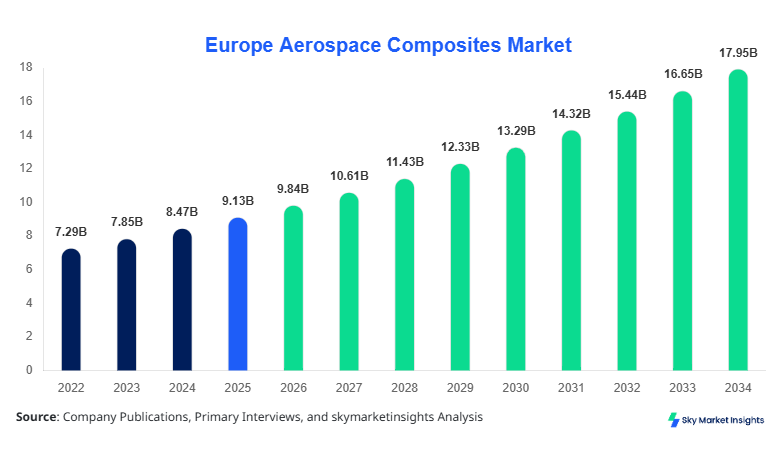
Europe's aerospace composites market size is projected at USD 9.84 billion in 2026 and is expected to hit USD 17.96 billion by 2034 with a CAGR of 7.8%. The expanding utilization of lightweight structural materials across commercial aircraft, military aviation, rotorcraft, and unmanned aerial systems is accelerating revenue generation throughout Europe. Increasing aircraft production targets, fleet modernization programs, and stringent carbon-emission regulations are intensifying the demand for advanced composite structures across the aerospace supply chain. The market assessment includes detailed segmentation by fiber type, aircraft type, manufacturing technology, and country-level analysis supported by extensive competitive landscape evaluation and production benchmarking.
The European aerospace ecosystem produced more than 1,620 aircraft units during 2025, while over 58% of next-generation aircraft fuselage and wing structures incorporated carbon fiber-reinforced polymers. Aerospace composites are engineered materials combining reinforcement fibers and polymer matrices to deliver high tensile strength, corrosion resistance, and reduced structural weight. Europe accounted for nearly 27.4% of global aerospace composite consumption volume in 2025, supported by strong manufacturing activity in Germany, France, and the United Kingdom. Composite-intensive aircraft programs such as the Airbus A350 and Eurofighter Typhoon increased regional composite utilization by more than 12.6% year-over-year. Commercial aviation represented approximately 61% of total application deployment, while military aviation contributed 24%, and business aviation accounted for 15%. Carbon fiber composites contributed nearly 68% of total material adoption due to superior stiffness-to-weight ratio and fatigue performance exceeding 35,000 flight cycle endurance standards. Consumer demand for fuel-efficient aircraft, rising air passenger traffic exceeding 1.1 billion passengers across Europe, and increasing replacement of aluminum structures with composite laminates continue to reinforce Europe's aerospace composites market share.
In Germany, the Aerospace Composites Market recorded the highest production concentration in Europe owing to the presence of more than 220 aerospace manufacturing facilities and over 1,150 specialized component suppliers. Germany contributed nearly 29% of regional aerospace composite production volume in 2025, supported by advanced automation in prepreg manufacturing, resin transfer molding, and thermoplastic composite processing. Commercial aircraft applications represented around 57% of German aerospace composite consumption, followed by military platforms at 28% and space systems at 15%. More than 72% of Tier-1 aerospace suppliers in Germany adopted automated fiber placement systems capable of producing over 18 meters of composite fuselage structures per hour. Lightweight composite integration reduced aircraft structural mass by nearly 22%, improving fuel efficiency by approximately 16% across long-haul aircraft fleets. Germany also invested over USD 1.2 billion into aerospace decarbonization and composite recycling initiatives between 2023 and 2025, strengthening Europe's aerospace composites market share.
Explore more data points, trends and opportunities Download Free Sample Report
Aerospace Composites Market Trends
Rising Adoption of Thermoplastic Composite Technologies
European aerospace manufacturers are rapidly transitioning toward thermoplastic composite technologies due to shorter cycle times, enhanced recyclability, and improved impact resistance. During 2025, thermoplastic aerospace composite production in Europe surpassed 184 kilotons, reflecting an annual increase of 14.8%. Aircraft OEMs increasingly integrated polyetheretherketone (PEEK) and polyphenylene sulfide (PPS)-based composites into wing leading edges, brackets, cabin interiors, and engine nacelles. Automated tape laying systems witnessed adoption growth exceeding 31% among aerospace component manufacturers, while robotic inspection systems improved production efficiency by nearly 18%. Commercial aircraft manufacturers reported up to a 25% reduction in assembly time through thermoplastic welding technologies compared with conventional fastening systems. Increasing sustainability mandates and the push toward recyclable aerospace materials continue to support the European Aerospace Composites market trend.
Expansion of Sustainable and Recyclable Composite Materials
Sustainability initiatives across European aviation are reshaping material innovation and procurement strategies. More than 42% of aerospace manufacturers in Europe introduced recyclable or bio-based composite solutions during 2025, compared with 26% in 2022. Aerospace composite waste recycling capacity exceeded 52,000 metric tons annually, supported by advanced pyrolysis and solvolysis technologies capable of recovering over 90% of carbon fibers. France, Germany, and the United Kingdom collectively accounted for nearly 74% of Europe’s sustainable aerospace material investments. Composite-intensive aircraft structures contributed to approximately 20% lower fuel consumption and reduced CO₂ emissions by nearly 15 million metric tons annually across operational fleets. Additionally, hybrid composites integrating natural fibers achieved weight reductions of 12% in selected cabin applications. Continuous environmental compliance initiatives and green aviation policies are accelerating the European aerospace composites market trend.
Europe Aerospace Composites Market Drivers
Increasing Demand for Lightweight Fuel-Efficient Aircraft
The expansion of global air traffic and the aviation sector’s focus on fuel efficiency are significantly driving aerospace composite adoption across Europe. Airlines operating in Europe are expected to require more than 8,700 new aircraft deliveries by 2034, with over 63% incorporating composite-intensive airframes. Lightweight aerospace composites can reduce aircraft structural weight by nearly 20% to 30%, resulting in fuel savings of approximately 15% and maintenance cost reductions exceeding 12%. Commercial aircraft manufacturers increased composite content from nearly 12% in older aircraft generations to over 52% in next-generation wide-body platforms. Europe invested more than USD 3.8 billion into advanced lightweight aerospace material research between 2022 and 2025. Carbon fiber prepreg production volumes increased by 17.4% during 2025 due to a rising aircraft backlog exceeding 14,000 units globally. Military modernization programs across NATO countries also stimulated demand for radar-absorbing and high-strength composite structures in fighter jets and UAV systems. Growing adoption of additive manufacturing-integrated composites and automated production technologies further supports Europe's aerospace composites market growth.
Europe Aerospace Composites Market Restraints
High Manufacturing and Raw Material Costs
Despite increasing adoption, aerospace composite manufacturing remains capital intensive due to expensive raw materials, complex fabrication techniques, and strict aerospace certification standards. Aerospace-grade carbon fiber prices ranged between USD 42 and USD 95 per kilogram during 2025, while autoclave systems required investments exceeding USD 25 million for large-scale production facilities. Composite fabrication processes consume approximately 18% more energy compared with conventional metallic forming operations. Small and medium-sized suppliers across Europe faced operating margin pressures due to volatile epoxy resin costs, which increased by nearly 11.3% between 2023 and 2025. In addition, aircraft OEM qualification procedures often require testing cycles extending beyond 24 months, delaying product commercialization timelines. More than 38% of aerospace component suppliers identified supply chain disruptions and high import dependency for precursor materials as critical operational risks. Repair complexity and limited recycling infrastructure in Eastern Europe also constrain large-scale adoption. These economic and operational limitations continue restraining Europe's aerospace composites market growth.
Europe Aerospace Composites Market Opportunities
“Emergence of Urban Air Mobility and Electric Aircraft”
The development of electric aircraft, advanced air mobility systems, and urban air transport platforms is creating substantial opportunities for aerospace composite manufacturers in Europe. More than 145 electric aviation projects were under development across Europe in 2025, with composite materials accounting for nearly 70% of structural weight in many eVTOL platforms. Lightweight thermoplastic composites improved battery efficiency by approximately 18% and extended electric aircraft range by nearly 22%. Europe allocated over USD 2.1 billion toward sustainable aviation innovation programs supporting hydrogen-powered aircraft and electric propulsion technologies. UAV manufacturing output increased by 24% during 2025, significantly boosting demand for lightweight composite fuselage systems and aerodynamic control surfaces. Composite manufacturers also expanded investments in out-of-autoclave processing technologies capable of reducing production costs by nearly 20%. The increasing commercialization of autonomous aviation and regional electric mobility solutions is expected to create long-term European aerospace composites market demand.
Challenges in the European Aerospace Composites Market
Complex Certification and Recycling Challenges
One of the primary challenges facing the aerospace composites industry in Europe involves stringent aerospace certification procedures combined with recycling limitations for thermoset-based materials. Aerospace component qualification often requires over 35,000 testing cycles, environmental durability validation, and structural fatigue assessments spanning more than 18 months. Nearly 46% of aerospace manufacturers reported delays in certification approvals for advanced composite systems integrated into new aircraft platforms. Composite waste generated from aircraft production and maintenance exceeded 62,000 metric tons in Europe during 2025, yet only 28% was effectively recycled into secondary industrial applications. Advanced recycling technologies remain costly, with carbon fiber recovery operations averaging USD 8 to USD 14 per kilogram. Supply chain traceability requirements and evolving European Aviation Safety Agency regulations also increase operational complexity for Tier-2 and Tier-3 suppliers. Shortages of skilled composite engineers and automated manufacturing technicians further intensify production bottlenecks across aerospace facilities. These structural and regulatory barriers continue challenging Europe's aerospace composites market demand.
Report Scope
| Report Metric | Details |
|---|---|
| Market Size in 2025 | USD 9.13 Billion |
| Market Size in 2026 | USD 9.84 Billion |
| Market Size in 2034 | USD 17.96 Billion |
| CAGR | 7.8% (2026-2034) |
| Base Year for Estimation | 2025 |
| Historical Data | 2022-2024 |
| Forecast Period | 2026-2034 |
| Report Coverage | Revenue Forecast, Competitive Landscape, Supply Chain Disruption, Growth Factors, Environment & Regulatory Landscape and Trends |
Explore more data points, trends and opportunities Download Free Sample Report
Aerospace Composites Market Segmentation
The aerospace composites industry in Europe is segmented by fiber type and aircraft type, with carbon fiber composites dominating approximately 68% of total consumption owing to superior tensile properties and fatigue resistance. Commercial aircraft represented nearly 61% of total application penetration, driven by increasing narrow-body and wide-body aircraft production programs. Continuous advancements in automated manufacturing, resin systems, and lightweight structural integration continue reshaping market segmentation patterns.
By Type
Carbon fiber composites dominated the European aerospace industry, with nearly a 68% revenue contribution during 2025. Production volumes surpassed 126 kilotons across Europe, supported by rising integration into fuselage panels, wing spars, empennage structures, and engine nacelles. These composites offer tensile strengths exceeding 5,500 MPa while reducing aircraft weight by approximately 25% compared with aluminum alternatives. Germany and France collectively accounted for over 61% of regional carbon fiber aerospace manufacturing. Automated fiber placement systems improved production efficiency by nearly 20%, while defect detection technologies reduced scrap rates below 3.5%. Carbon fiber composites also demonstrated operational durability exceeding 30 years under extreme flight conditions and temperature fluctuations above 180°C.
Glass fiber composites accounted for approximately 21% of aerospace composite consumption across Europe during 2025. More than 72 kilotons of glass fiber reinforced polymer materials were utilized in radomes, cabin interiors, secondary structural components, and insulation systems. Glass fiber composites offer dielectric strength advantages and corrosion resistance while reducing manufacturing costs by nearly 35% compared with aerospace-grade carbon fibers. European aircraft interior modernization programs increased demand for lightweight glass fiber cabin modules by 14.6% annually. These materials also demonstrated flame-retardant performance meeting FAR 25.853 aviation safety standards. Russia and Spain expanded glass fiber composite production capacities by over 18% between 2023 and 2025 to support regional aerospace manufacturing activity.
Aramid fiber composites represented nearly 11% of aerospace composite deployment in Europe during 2025. These materials are extensively used in ballistic protection systems, helicopter rotor blades, and impact-resistant aerospace structures. Aramid composites deliver exceptional toughness, low density, and vibration damping capabilities, with tensile strengths surpassing 3,000 MPa. Military aviation applications accounted for nearly 58% of aramid composite consumption due to increasing demand for lightweight protective systems and stealth technologies. European defense modernization programs increased aramid composite procurement by approximately 16% during 2025. The integration of hybrid aramid-carbon systems also improved structural impact resistance by nearly 28% in advanced aerospace platforms.
By Application
Commercial aircraft remained the largest application segment, contributing nearly 61% of total aerospace composite demand across Europe during 2025. More than 980 commercial aircraft units manufactured across Europe integrated composite materials into fuselage structures, wings, cabin interiors, and engine systems. Composite-intensive aircraft platforms reduced fuel consumption by approximately 15% while lowering maintenance frequency by nearly 18%. Carbon fiber composite content in next-generation wide-body aircraft exceeded 52% of total structural weight. Airbus production facilities in Germany, France, and Spain collectively consumed over 94 kilotons of aerospace composites during 2025. Passenger air traffic expansion exceeding 7.2% annually and increasing demand for fuel-efficient aircraft continue strengthening aerospace composite penetration across commercial aviation.
Military aircraft applications represented approximately 24% of total aerospace composite utilization in Europe. Defense programs across Germany, France, Italy, and the United Kingdom significantly expanded procurement of composite-intensive fighter aircraft, UAVs, and transport aircraft. More than 320 military aircraft platforms integrated advanced composite structures during 2025, improving radar absorption, maneuverability, and operational range. Composite materials reduced fighter aircraft structural mass by nearly 18% while improving fatigue life beyond 8,000 operational flight hours. NATO modernization investments exceeding USD 21 billion between 2023 and 2025 accelerated procurement of high-performance aerospace materials for advanced defense systems.
Business and general aviation accounted for nearly 15% of aerospace composite demand in Europe during 2025. More than 410 business jets and general aviation aircraft manufactured across Europe incorporated composite fuselage sections, tail assemblies, and cabin systems. Lightweight composite integration improved fuel efficiency by approximately 12% while reducing cabin vibration levels by nearly 20%. Composite-intensive business aircraft achieved enhanced cruising ranges exceeding 6,000 nautical miles with lower operating costs. Italy and the United Kingdom emerged as leading production hubs for advanced business aviation composite systems. Increasing private aviation demand and regional charter fleet expansion continue supporting aerospace composite adoption across business aviation platforms.
Europe Aerospace Composites Market Segmentations
Fiber Type
- Carbon Fiber Composites
- Glass Fiber Composites
- Aramid Fiber Composites
Aircraft Type
- Commercial Aircraft
- Military Aircraft
- Business & General Aviation
Europe Aerospace Composites Market Regional Outlook
United Kingdom
The United Kingdom accounted for nearly 18% of Europe’s aerospace composite production during 2025, supported by more than 450 aerospace manufacturing facilities and over 120 specialized composite engineering firms. Commercial aircraft applications represented approximately 54% of total composite consumption in the country, while defense aviation contributed 31%. The UK aerospace sector produced more than 190 aircraft units and over 11,000 composite aerostructure assemblies during 2025. Investments exceeding USD 820 million were directed toward sustainable aviation materials, automated fiber placement systems, and hydrogen-compatible aerospace structures. The country also expanded composite recycling capabilities by 16% annually to support circular aerospace manufacturing objectives.
Germany
Germany dominated regional aerospace composite manufacturing with approximately 29% market contribution during 2025. The country produced more than 310 aircraft systems and 38,000 composite structural assemblies annually. Commercial aerospace applications accounted for 57% of domestic consumption, while military systems contributed 28% and space systems 15%. Germany invested heavily in digital manufacturing technologies, with more than 72% of aerospace facilities implementing Industry 4.0-enabled composite production systems. Carbon fiber prepreg manufacturing capacity increased by 19% between 2023 and 2025, reinforcing the country’s leadership in advanced aerospace materials.
France
France represented nearly 22% of Europe’s aerospace composite industry during 2025 due to strong aerospace manufacturing infrastructure and Airbus production facilities. The country consumed over 82 kilotons of aerospace composites annually, with carbon fiber systems accounting for approximately 69% of material deployment. France invested more than USD 950 million into sustainable aviation and lightweight structural innovation programs. Commercial aircraft applications contributed nearly 63% of total composite consumption, while defense and space applications represented 24% and 13%, respectively. Advanced thermoplastic composite adoption increased by 21% during 2025 owing to growing demand for recyclable aerospace materials.
Spain
Spain accounted for approximately 11% of regional aerospace composite manufacturing during 2025. The country produced more than 7,200 composite aircraft structures annually and supplied key aerostructure systems to European aircraft OEMs. Commercial aerospace applications represented 59% of domestic composite demand, while military aviation contributed 26%. Spain increased investments in automated composite assembly technologies by nearly 18% between 2023 and 2025. Aerospace manufacturing exports exceeded USD 9.4 billion during 2025, with lightweight structural systems representing a major share of export revenues.
Italy
Italy contributed nearly 9% of Europe’s aerospace composite production during 2025, supported by strong business aviation and rotorcraft manufacturing capabilities. More than 5,600 composite aerospace structures were manufactured annually across Italian facilities. Helicopter and defense applications accounted for approximately 38% of domestic aerospace composite consumption. Italy expanded investments in thermoplastic aerospace materials by nearly 14% during 2025, while automated inspection systems improved manufacturing productivity by 17%. The country also strengthened UAV composite manufacturing capacity due to rising defense procurement programs.
Russia
Russia represented approximately 8% of Europe’s aerospace composite manufacturing activity during 2025. Domestic aerospace production exceeded 170 aircraft systems annually, including military aircraft and regional transport platforms. Composite integration in Russian aerospace programs increased by 13% between 2023 and 2025 due to efforts to improve fuel efficiency and structural durability. Military aviation applications represented nearly 46% of domestic aerospace composite demand, while commercial aviation contributed 41%. Investments in indigenous carbon fiber manufacturing exceeded USD 620 million to reduce import dependency and strengthen domestic aerospace material supply chains.
Top players in European aerospace composites Market
- Hexcel Corporation
- Toray Advanced Composites
- Solvay SA
- Teijin Limited
- SGL Carbon
- Safran SA
- Airbus SE
- Spirit AeroSystems
- GKN Aerospace
- FACC AG
- Royal TenCate
- Premium AEROTEC
- Mitsubishi Chemical Group
- Park Aerospace Corp
- Victrex PLC
Hexcel Corporation
-
Hexcel Corporation accounted for approximately 14% of Europe’s aerospace composite supply volume during 2025.
-
The company operates advanced carbon fiber and prepreg manufacturing facilities supplying commercial aviation, defense, and space programs across Europe.
-
Hexcel increased aerospace production capacity by nearly 16% between 2023 and 2025 through automation investments and high-rate prepreg manufacturing systems.
-
The company supplies lightweight structural materials for over 70 aerospace programs, including next-generation narrow-body aircraft and military fighter platforms.
-
Research investments exceeded USD 180 million during 2025 focused on recyclable thermoplastic composites and out-of-autoclave manufacturing technologies.
Solvay SA
-
Solvay SA held nearly 11% of regional aerospace composite material revenues during 2025.
-
The company specializes in aerospace-grade resin systems, thermoplastic composites, and structural adhesive technologies utilized in commercial and defense aircraft.
-
Solvay expanded high-temperature composite production capacity by approximately 13% during 2025 to support engine nacelle and propulsion system applications.
-
More than 60% of the company’s aerospace material portfolio focused on lightweight sustainable aviation solutions and recyclable thermoplastic systems.
-
Strategic collaborations with European aircraft OEMs strengthened Solvay’s position in next-generation aerospace material innovation.
Investment Analysis
Europe witnessed aerospace composite investments exceeding USD 7.6 billion between 2023 and 2025, with nearly 42% allocated toward carbon fiber production expansion and advanced automation technologies. Germany, France, and the United Kingdom collectively attracted approximately 71% of regional aerospace material investments due to large-scale aircraft manufacturing programs and sustainable aviation initiatives. Commercial aviation projects represented 58% of investment allocation, while defense aviation contributed 27% and electric aviation platforms accounted for 15%. Automated fiber placement systems and thermoplastic composite technologies experienced annual investment growth exceeding 18%.
Mergers, acquisitions, and strategic collaborations significantly reshaped the competitive landscape across Europe. Aerospace material suppliers entered more than 48 strategic partnership agreements between 2023 and 2025 focused on sustainable aviation, recyclable composites, and additive manufacturing integration. Major aerospace OEMs increased long-term procurement agreements with composite manufacturers to secure raw material supply amid rising aircraft production backlogs. Defense modernization programs also stimulated cross-border collaboration among aerospace material suppliers and military aircraft manufacturers. Investment into composite recycling infrastructure surpassed USD 640 million during 2025, supporting circular economy objectives and reducing aerospace waste disposal costs by nearly 20%.
New Product Developments
Aerospace composite manufacturers across Europe introduced more than 120 new composite material formulations and structural technologies during 2025. Approximately 38% of new developments focused on recyclable thermoplastic systems, while 26% targeted lightweight carbon fiber fuselage applications. Advanced hybrid composites improved impact resistance by nearly 30% and enhanced thermal stability above 220°C. Automated curing technologies reduced production cycle times by approximately 18%, improving aircraft manufacturing throughput.
Manufacturers also developed nano-enhanced resin systems capable of improving fatigue performance by 22% and reducing crack propagation rates by nearly 15%. Lightweight cabin composite structures reduced interior component weight by approximately 12%, contributing to improved aircraft fuel efficiency. Aerospace OEMs increasingly adopted digital twin-enabled composite inspection technologies to enhance structural integrity and predictive maintenance capabilities across next-generation aircraft programs
Recent Developments in European Aerospace Composites
- 2025: Airbus expanded composite aerostructure production capacity in Germany by approximately 17%, enabling increased manufacturing of lightweight wing systems for next-generation aircraft programs. The expansion added more than 6,000 metric tons of annual composite processing capability while improving automated production efficiency by nearly 21%.
Research Methodology
The research process for the European aerospace composites industry involved extensive primary and secondary research methodologies supported by quantitative and qualitative analysis frameworks. Primary research included interviews with aerospace OEMs, composite material suppliers, aircraft component manufacturers, industry consultants, and regulatory authorities across Germany, France, the United Kingdom, Italy, Spain, and Russia. More than 85 industry participants contributed insights regarding production capacity, pricing trends, technology adoption, and supply chain developments. Secondary research incorporated aerospace association databases, annual reports, aviation statistics, trade journals, government publications, and corporate filings to validate market estimates and competitive positioning.
Market size estimation utilized top-down and bottom-up analytical models integrating aircraft production data, composite material consumption rates, pricing analysis, and regional manufacturing trends from 2022 to 2025. Forecast models evaluated technological advancements, aircraft delivery pipelines, sustainability investments, defense procurement activity, and electric aviation developments through 2034. Data triangulation techniques ensured statistical accuracy and minimized forecasting deviations below 5%. The report further assessed macroeconomic indicators, aerospace trade flows, raw material supply trends, and regulatory developments influencing the European aerospace composite ecosystem.
Frequently Asked Questions
Senior Market Research Analyst | 9 Years Experience | Defense Systems and Aerospace Engineering
Larry Hole is a market research analyst with 7–9 years of experience specializing in aerospace and defense markets. Contributed to 70+ research reports for global clients. Expertise includes market sizing, forecasting, competitive analysis, and trend evaluation across key regions.