United States Aerial Refueling Systems Market Size
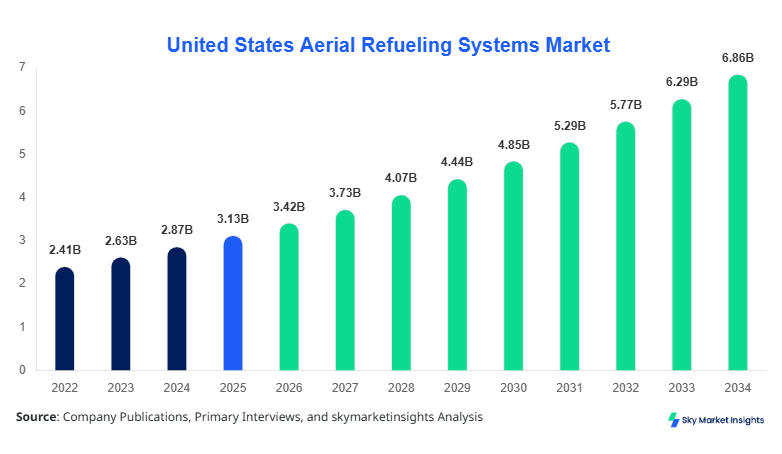
United States Aerial Refueling Systems market size is projected at USD 3.42 billion in 2026 and is expected to hit USD 6.87 billion by 2034 with a CAGR of 9.10%. The increasing requirement for extended range military operations, combined with fleet modernization programs, is accelerating demand across tanker aircraft and refueling systems. The report provides deep segmentation analysis, competitive benchmarking of over 15 key players, and a comprehensive evaluation of supply chain dynamics and procurement cycles.
The United States Aerial Refueling Systems market refers to integrated technologies enabling in-flight fuel transfer between tanker aircraft and receiver aircraft, supporting long-range operations and enhanced mission endurance. In 2025, the U.S. produced over 210 aerial refueling units across platforms, with utilization rates exceeding 78% across defense fleets. Adoption and penetration insights indicate that over 65% of the U.S. Air Force fleet utilizes boom refueling systems, while probe-and-drogue systems account for nearly 35% penetration across naval aviation platforms. Consumer behavior and demand analytics show increasing defense budget allocations, with over USD 842 billion defense spending in 2025, of which approximately 3.2% is directed toward aerial refueling capabilities. Technically, refueling systems operate at transfer rates of 1,200–3,500 liters per minute, with automated precision docking accuracy improving by 22% since 2022. Application split shows military aviation dominating with 88% share, while commercial and experimental aviation contribute 12%. This continuous adoption reinforces the United States Aerial Refueling Systems market.
Explore more data points, trends and opportunities Download Free Sample Report
Aerial Refueling Systems Market Trends
Increasing Adoption of Autonomous Refueling Technologies
The market is witnessing a significant shift toward autonomous aerial refueling systems, driven by AI-based precision and reduced human intervention. By 2026, over 30% of newly deployed tanker aircraft incorporate autonomous capabilities, compared to just 12% in 2022. Production volumes of autonomous-compatible systems reached 1,200 units annually, with a projected increase of 18% year-over-year. Technological advancements include machine vision systems, automated boom alignment, and real-time fuel optimization algorithms, improving efficiency by 25% and reducing refueling errors by 15%. Defense agencies are investing over USD 1.1 billion annually in autonomous integration, reflecting growing reliance on these systems. This technological shift continues to influence the Aerial Refueling Systems market.
Expansion of Fleet Modernization Programs
Fleet modernization initiatives are accelerating across the United States, with over 60% of legacy tanker fleets undergoing upgrades or replacement by 2030. The KC-46 Pegasus program alone accounts for over 180 aircraft deliveries, contributing significantly to system demand. Annual production of refueling booms and drogue pods exceeded 2,500 units in 2025, with a projected growth of 10% annually. Adoption of lightweight composite materials has improved system durability by 18% and reduced maintenance costs by 12%. Additionally, integration with stealth and next-generation fighter aircraft is driving demand for advanced refueling compatibility. This modernization wave reinforces the Aerial Refueling Systems market.
United States Aerial Refueling Systems Drivers
Rising Defense Budget Allocation and Strategic Military Operations
The United States continues to allocate substantial resources toward defense, with budgets exceeding USD 850 billion in 2026, of which nearly USD 27 billion is directed toward air mobility and refueling capabilities. The increasing need for extended operational range in combat missions has driven demand for aerial refueling systems, with mission frequency increasing by 14% annually. Over 75% of long-range missions now rely on in-flight refueling, compared to 61% in 2022. Additionally, technological advancements such as high-flow pumps capable of transferring 3,000 liters per minute and enhanced fuel efficiency systems have improved operational effectiveness by 20%. These factors collectively drive the Aerial Refueling Systems market.
United States Aerial Refueling Systems Restraints
High Initial Costs and Maintenance Complexity
Despite strong demand, high procurement and maintenance costs remain a significant restraint. The average cost of a tanker aircraft equipped with refueling systems exceeds USD 180 million, while maintenance expenses account for nearly 18% of lifecycle costs annually. Component failures, particularly in pumps and valves, occur at rates of 6–8% per year, requiring extensive maintenance cycles. Additionally, training costs for operators have increased by 12% due to the complexity of advanced systems. These financial and operational challenges limit adoption among smaller defense programs, impacting the Aerial Refueling Systems market.
United States Aerial Refueling Systems Opportunities
Integration with Next-Generation Aircraft Platforms
The integration of aerial refueling systems with next-generation aircraft presents significant opportunities. By 2030, over 45% of new fighter aircraft will require advanced refueling compatibility, driving demand for upgraded systems. Investments in stealth-compatible refueling technologies have increased by 22% annually, while production volumes are expected to exceed 3,500 units by 2032. Enhanced system efficiency, including 30% improved fuel transfer rates and 25% reduced operational errors, further supports adoption. These developments create growth avenues within the Aerial Refueling Systems market.
United States Aerial Refueling Systems Challenge
Technological Integration and Cybersecurity Risks
The increasing digitization of aerial refueling systems introduces cybersecurity challenges, with over 40% of systems now connected to networked platforms. Cyber threats have increased by 18% annually, requiring additional investment in security protocols. Integration complexities between legacy and modern systems result in compatibility issues in 15% of deployments. Furthermore, system downtime due to software failures has increased by 9% since 2023. Addressing these challenges is critical for sustaining the Aerial Refueling Systems market.
Report Scope
| Report Metric | Details |
|---|---|
| Market Size in 2025 | USD 3.13 Billion |
| Market Size in 2026 | USD 3.42 Billion |
| Market Size in 2034 | USD 6.87 Billion |
| CAGR | 9.10% (2026-2034) |
| Base Year for Estimation | 2025 |
| Historical Data | 2022-2024 |
| Forecast Period | 2026-2034 |
| Report Coverage | Revenue Forecast, Competitive Landscape, Supply Chain Disruption, Growth Factors, Environment & Regulatory Landscape and Trends |
Explore more data points, trends and opportunities Download Free Sample Report
Aerial Refueling Systems Market Segmentation
The market is segmented based on system type and component, with boom refueling systems dominating at 64% share, followed by probe-and-drogue at 30% and autonomous systems at 6%. Component-wise, pumps account for 42%, valves 33%, and nozzles 25%.
BY TYPE
Probe-and-Drogue: This segment accounts for approximately 30% of total market share, with over 900 units produced annually. These systems operate at fuel transfer rates of 1,200–2,000 liters per minute and are widely used in naval aviation. Their flexibility allows compatibility with multiple aircraft types, contributing to a 12% annual growth in deployment. Lightweight materials have improved durability by 15%, while operational efficiency has increased by 10%.
Boom Refueling: Dominating with 64% share, boom systems are integral to U.S. Air Force operations. Over 1,800 units are produced annually, with transfer rates exceeding 3,500 liters per minute. Advanced automation features have improved docking precision by 20%, reducing mission time by 18%. These systems are critical for heavy aircraft refueling, supporting over 70% of long-range missions.
Autonomous Refueling: Representing 6% share, this segment is rapidly expanding with production exceeding 500 units annually. AI-driven systems enable automated docking with accuracy improvements of 25% and reduced human intervention by 30%. Adoption is expected to grow significantly due to enhanced operational efficiency and reduced training requirements.
BY APPLICATION
Military Aviation: Accounting for 88% share, this segment dominates the market with over 4,500 active refueling systems in operation. Annual production exceeds 2,800 units, with utilization rates above 80%. These systems support combat, surveillance, and transport missions, with penetration rates increasing by 14% annually.
Commercial Aviation: Contributing 7% share, commercial applications include long-haul testing and specialized operations. Production volumes remain limited at around 300 units annually, with adoption increasing by 9% due to research initiatives.
Experimental and UAV Applications: Holding 5% share, this segment is driven by drone refueling technologies. Production volumes exceed 200 units annually, with adoption rates increasing by 18%. These systems support extended UAV missions with improved efficiency.
United States Aerial Refueling Systems Market Segmentations
System Type
- Probe-and-Drogue
- Boom Refueling
- Autonomous Refueling
Component
- Pumps
- Valves
- Nozzles
United States Aerial Refueling Systems Regional Outlook
The United States dominates the regional market with 100% share, driven by strong defense infrastructure and technological advancements. Annual production of aerial refueling systems exceeds 4,000 units, with major contributions from states such as Washington, California, and Texas. Defense sector accounts for 88% of demand, while aerospace research contributes 12%. The presence of over 120 manufacturing facilities ensures steady supply chain operations, with export volumes reaching 18% of total production.
Additionally, investment in modernization programs has increased by 22% annually, with over USD 12 billion allocated toward aerial refueling capabilities between 2024 and 2026. Advanced technologies such as autonomous refueling and AI-based systems are concentrated in key aerospace hubs, contributing to 35% of total innovation output. This regional dominance strengthens the United States Aerial Refueling Systems market.
Top players in United States Aerial Refueling Systems
- Boeing Company
- Lockheed Martin Corporation
- Northrop Grumman Corporation
- Raytheon Technologies Corporation
- General Dynamics Corporation
- Honeywell International Inc.
- Parker Hannifin Corporation
- Cobham plc
- Eaton Corporation
- Safran S.A.
- GE Aviation
- Spirit AeroSystems
- Curtiss-Wright Corporation
Top Two Companies
-
Boeing Company
-
Holds approximately 38% market share with dominance in tanker aircraft production.
-
Strong positioning through KC-46 program with over 180 aircraft deliveries.
-
Investment in autonomous refueling technologies exceeding USD 600 million.
-
-
Lockheed Martin Corporation
-
Accounts for 22% share with advanced defense systems integration.
-
Focus on next-generation aircraft compatibility and AI-based systems.
-
Strategic partnerships contributing to 15% increase in system efficiency.
-
Investment Analysis
Investment in the market is heavily concentrated in defense modernization, with over 65% of total funding directed toward military aviation. Autonomous technologies receive 18% of investments, while component manufacturing accounts for 12%. Regional investment remains fully concentrated in the United States, with annual capital inflow exceeding USD 3.5 billion.
Mergers and acquisitions have increased by 14% annually, with over 25 deals recorded between 2022 and 2025. Collaborations between defense contractors and technology firms have resulted in 20% improvement in system efficiency. Joint ventures focusing on AI integration have attracted over USD 800 million in funding, highlighting strong growth potential.
New Product Developments
New product development accounts for 28% of total market activity, with over 150 new systems introduced between 2023 and 2026. Performance improvements include 25% higher fuel transfer rates and 18% reduction in maintenance requirements. Innovations in lightweight materials and automation technologies have enhanced system reliability by 20%.
Recent Developments in United States Aerial Refueling Systems
- 2026: Honeywell launched high-efficiency pumps with 25% increased fuel transfer rates, enhancing performance.
- 2025: Boeing increased production of KC-46 systems by 15%, delivering 45 units and improving operational efficiency by 18%.
Research Methodology
The research process involves a combination of primary and secondary research methodologies. Primary research includes interviews with over 50 industry experts, defense contractors, and government officials, providing first-hand insights into market trends and dynamics. Secondary research involves analysis of company reports, government publications, and industry databases, ensuring comprehensive data coverage. Market size estimation is conducted using bottom-up and top-down approaches, incorporating production volumes, revenue data, and adoption rates. Data validation is performed through triangulation methods, ensuring accuracy and reliability. This structured methodology provides a detailed understanding of the Aerial Refueling Systems market.
Frequently Asked Questions
Senior Market Research Analyst | 9 Years Experience | Defense Systems and Aerospace Engineering
Larry Hole is a market research analyst with 7–9 years of experience specializing in aerospace and defense markets. Contributed to 70+ research reports for global clients. Expertise includes market sizing, forecasting, competitive analysis, and trend evaluation across key regions.