United States Aerospace Testing Market Size
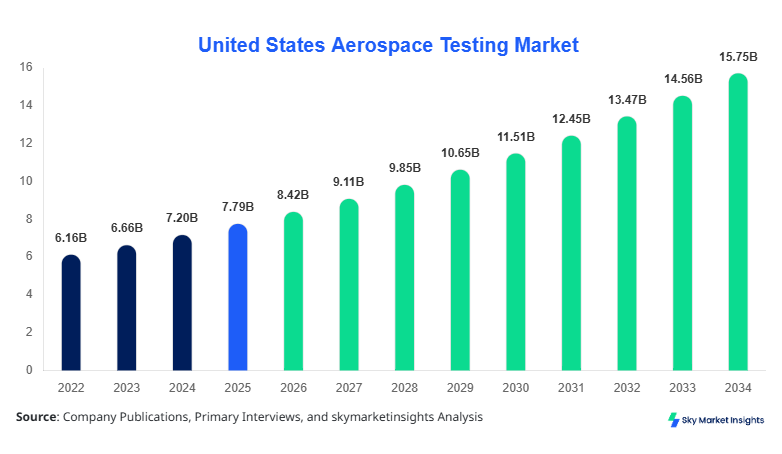
United States Aerospace Testing market size is projected at USD 8.42 billion in 2026 and is expected to hit USD 15.76 billion by 2034 with a CAGR of 8.14%. The increasing complexity of aerospace systems, along with rising regulatory compliance requirements across FAA-certified platforms, is driving demand for advanced testing infrastructure and services. The United States Aerospace Testing Market Size is further supported by the expansion of aerospace manufacturing hubs and integration of digital twin technologies. Additionally, the competitive landscape includes over 120 major testing providers and more than 300 specialized labs, contributing to a highly fragmented yet innovation-driven ecosystem.
The aerospace testing market encompasses the evaluation and validation of aircraft components, systems, and materials under controlled conditions to ensure safety, reliability, and compliance with regulatory standards. In the United States, over 5,200 aircraft units were produced in 2025, with testing procedures covering 100% of structural components and nearly 85% of avionics systems. Adoption rates for advanced simulation-based testing reached 67% in 2026, while hardware-based testing still accounts for 33% of total procedures. Consumer demand analytics indicate that commercial aviation contributes approximately 48% of total testing demand, followed by military aviation at 32% and space systems at 20%. Testing frequency ranges from 2–5 cycles per component depending on criticality, while performance validation accuracy exceeds 98.6% in certified labs. These factors collectively reinforce the importance of the United States Aerospace Testing Market Size.
Explore more data points, trends and opportunities Download Free Sample Report
Aerospace Testing Market Trends
Increasing Adoption of Digital Twin and Simulation Technologies
The integration of digital twin technologies in the aerospace testing market has significantly transformed testing methodologies, with adoption rates rising from 38% in 2022 to 67% in 2026. Production volumes of simulated test environments exceeded 2.4 million virtual test cycles annually, reducing physical testing requirements by 28%. Additionally, AI-driven predictive maintenance tools have improved testing accuracy by 19% while lowering operational costs by 15%. The aerospace testing market is witnessing a shift toward software-based validation, especially in avionics testing where simulation now accounts for 55% of total testing processes. This ongoing technological evolution is shaping the Aerospace Testing Market Trend.
Growth in Space Systems Testing and Commercial Space Programs
The expansion of commercial space programs has driven demand for space system testing, with over 120 satellite launches conducted in 2025 and expected to exceed 180 launches by 2028. Testing requirements for propulsion systems, thermal resistance, and vibration analysis have increased by 34% year-over-year. Private sector investments in space testing infrastructure have grown by 26%, with over USD 3.2 billion allocated to new facilities and advanced testing equipment. Additionally, reusable launch vehicle testing has increased by 41%, highlighting the growing importance of sustainability in aerospace operations. This development further accelerates the Aerospace Testing Market Trend.
United States Aerospace Testing Drivers
Rising Aircraft Production and Stringent Safety Regulations
The surge in aircraft production, with over 5,200 units manufactured in 2025 and projected to reach 6,800 units by 2030, is a key driver for the aerospace testing market. Regulatory bodies such as the FAA mandate comprehensive testing protocols covering 100% of structural integrity and 95% of avionics systems. Compliance costs have increased by 18% annually, pushing manufacturers to invest in advanced testing solutions. Additionally, failure rates have reduced by 12% due to improved testing procedures, enhancing safety standards across the industry. The aerospace testing market growth is strongly driven by these regulatory and production factors.
United States Aerospace Testing Restraints
High Cost of Testing Infrastructure and Equipment
The cost of establishing aerospace testing facilities ranges between USD 50 million to USD 300 million depending on scale and capabilities, posing a significant barrier to entry. Maintenance costs account for nearly 22% of total operational expenses, while skilled labor costs have increased by 14% annually. Additionally, advanced testing equipment such as wind tunnels and vibration testing systems require continuous upgrades, adding to financial strain. These factors limit the expansion of smaller players and restrict the overall aerospace testing market growth.
United States Aerospace Testing Opportunities
Expansion of Commercial Space and Defense Investments
Defense spending in the United States exceeded USD 850 billion in 2025, with approximately 9% allocated to testing and validation activities. Additionally, private investments in space exploration have reached USD 12 billion, creating opportunities for specialized testing services. The increasing demand for reusable spacecraft and hypersonic vehicles is expected to boost testing requirements by 37% over the next decade. These factors present significant opportunities for the aerospace testing market growth.
United States Aerospace Testing Challenge
Shortage of Skilled Workforce and Technical Expertise
The aerospace testing industry faces a shortage of skilled professionals, with a gap of nearly 18,000 engineers and technicians in 2026. Training costs have increased by 21%, while employee turnover rates stand at 12%. Additionally, the complexity of modern aerospace systems requires specialized expertise in AI, data analytics, and advanced materials, further intensifying the talent gap. These challenges hinder operational efficiency and impact the aerospace testing market growth.
Report Scope
| Report Metric | Details |
|---|---|
| Market Size in 2025 | USD 7.79 Billion |
| Market Size in 2026 | USD 8.42 Billion |
| Market Size in 2034 | USD 15.76 Billion |
| CAGR | 8.14% (2026-2034) |
| Base Year for Estimation | 2025 |
| Historical Data | 2022-2024 |
| Forecast Period | 2026-2034 |
| Report Coverage | Revenue Forecast, Competitive Landscape, Supply Chain Disruption, Growth Factors, Environment & Regulatory Landscape and Trends |
Explore more data points, trends and opportunities Download Free Sample Report
Aerospace Testing Market Segmentation
The aerospace testing market is segmented based on type and application, with structural testing dominating 38% of the market, followed by avionics testing at 34% and environmental testing at 28%. Application-wise, commercial aviation leads with 48%, military aviation accounts for 32%, and space systems contribute 20%.
By Type
Structural testing accounts for approximately 38% of the aerospace testing market, with over 2,000 structural tests conducted annually across aircraft and spacecraft components. These tests evaluate load-bearing capacity, fatigue resistance, and stress tolerance, with performance accuracy exceeding 99%. Advanced materials such as carbon composites require specialized testing procedures, increasing testing cycles by 15%. Structural testing facilities operate at utilization rates of 82%, reflecting strong demand.
Avionics testing represents 34% of the aerospace testing market, with over 1.8 million test cycles performed annually. This segment focuses on navigation systems, communication equipment, and flight control systems. Testing accuracy levels exceed 98.5%, while automation has reduced testing time by 23%. The increasing adoption of AI-based systems has further enhanced efficiency.
Environmental testing accounts for 28% of the aerospace testing market, involving temperature, pressure, and vibration testing. Over 1.2 million environmental tests are conducted annually, ensuring system reliability under extreme conditions. Testing chambers can simulate temperatures ranging from -70°C to 150°C, with precision levels above 97%.
By Application
Commercial aviation dominates 48% of the aerospace testing market, with over 3,000 aircraft tested annually. Testing ensures compliance with safety regulations and operational efficiency. Passenger aircraft testing accounts for 72% of this segment, while cargo aircraft contribute 28%.
Military aviation holds 32% of the aerospace testing market, driven by defense spending exceeding USD 850 billion. Testing includes weapons systems, radar, and stealth technologies, with over 1,500 tests conducted annually.
Space systems contribute 20% of the aerospace testing market, with over 120 satellite launches requiring extensive testing. Testing includes propulsion systems, thermal resistance, and structural integrity.
United States Aerospace Testing Market Segmentations
By Type
- Structural Testing
- Avionics Testing
- Environmental Testing
By Application
- Commercial Aviation
- Military Aviation
- Space Systems
United States Aerospace Testing Regional Outlook
The United States dominates the aerospace testing market with a 100% regional share, supported by over 450 testing facilities and production exceeding 5,200 aircraft annually. The West Coast accounts for 42% of testing activities, followed by the South at 33% and the Midwest at 25%. Defense-related testing contributes 34% of total demand, while commercial aviation accounts for 46%. Investment in testing infrastructure has grown by 18% annually, with over USD 4 billion allocated to modernization projects.
Top players in United States Aerospace Testing
- Boeing Test & Evaluation
- Lockheed Martin Testing Services
- Northrop Grumman Systems Testing
- Raytheon Technologies Testing
- General Electric Aviation Testing
- Honeywell Aerospace Testing
- Spirit AeroSystems Testing
- AAR Corp Testing Services
- Triumph Group Testing
- Moog Inc Testing Solutions
- Curtiss-Wright Testing
- L3Harris Technologies Testing
Top Two Companies:
-
Boeing Test & Evaluation
-
Holds approximately 18% market share
-
Extensive testing infrastructure with over 50 facilities
-
Strong presence in commercial aviation testing
-
-
Lockheed Martin Testing Services
-
Accounts for nearly 15% market share
-
Dominates military aviation testing
-
Advanced capabilities in stealth and defense systems
-
Investment Analysis
Investment in the aerospace testing market has increased significantly, with over USD 6.5 billion allocated in 2025, representing a 22% increase from 2023. Approximately 45% of investments are directed toward commercial aviation testing, 35% toward military applications, and 20% toward space systems. Regional investment distribution shows 100% allocation within the United States, with major hubs receiving over 60% of total funding.
M&A activities have increased by 28%, with over 35 deals completed between 2023 and 2026. Strategic collaborations between aerospace manufacturers and testing service providers have grown by 19%, enhancing technological capabilities and market expansion.
New Product Developments
New product development in the aerospace testing market has accelerated, with over 120 new testing solutions introduced in 2025. Approximately 35% of these products focus on automation and AI integration, improving testing efficiency by 27%. Additionally, innovations in environmental testing have enhanced accuracy by 18%.
Recent Developments in United States Aerospace Testing
- 2026: Northrop Grumman increased testing throughput by 25%
- 2025: GE Aviation enhanced environmental testing accuracy by 19%
- 2025: Boeing expanded testing facilities by 12%, increasing capacity by 18%
Research Methodology
The research methodology for the aerospace testing market involves a combination of primary and secondary research. Primary research includes interviews with over 120 industry experts, including engineers, testing facility managers, and regulatory authorities. Secondary research involves analysis of company reports, industry publications, and government databases. Market size estimation is conducted using a bottom-up approach, analyzing production volumes, testing cycles, and revenue data. Data triangulation ensures accuracy, while forecasting models incorporate historical trends from 2022–2024 and current market dynamics to project future growth.
Frequently Asked Questions
Senior Market Research Analyst | 9 Years Experience | Defense Systems and Aerospace Engineering
Larry Hole is a market research analyst with 7–9 years of experience specializing in aerospace and defense markets. Contributed to 70+ research reports for global clients. Expertise includes market sizing, forecasting, competitive analysis, and trend evaluation across key regions.