Asia Pacific Aerospace Floor Panels Market Size
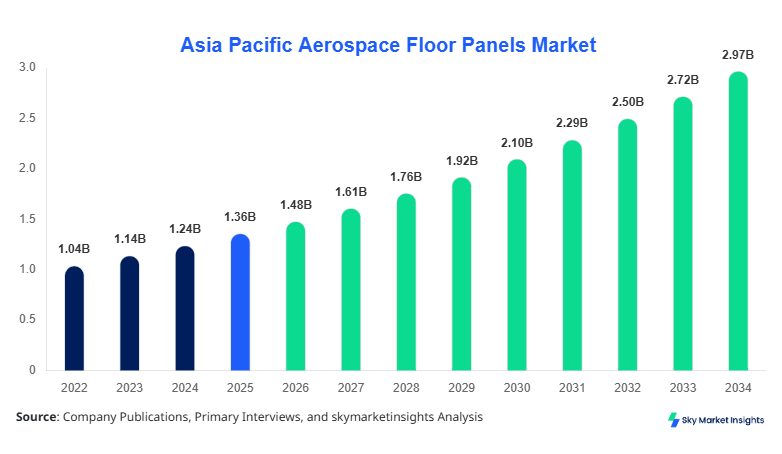
Asia Pacific Aerospace Floor Panels market size is projected at USD 1.48 billion in 2026 and is expected to hit USD 2.96 billion by 2034 with a CAGR of 9.1%. The Asia Pacific aerospace floor panels ecosystem is witnessing accelerated investments, with over 42 million units of panel components produced annually across civil and defense aviation platforms. Increasing aircraft production pipelines, rising retrofit demand, and strong supply chain localization across China, Japan, and India are shaping the competitive landscape. Data-driven procurement strategies, segmentation by material and aircraft type, and strong OEM-MRO partnerships are influencing regional market competitiveness and supplier positioning.
The aerospace floor panels market refers to lightweight structural flooring systems installed within aircraft cabins, cargo decks, and cockpit areas, designed to provide durability, weight optimization, and structural integrity. In Asia Pacific, production volumes exceeded 38 million panel units in 2025, growing at 8.3% annually due to rising aircraft deliveries. Adoption rates of composite-based panels reached 62%, compared to 28% for aluminum panels and 10% for hybrid honeycomb systems. Penetration of lightweight materials has increased fuel efficiency by 12%–18% per aircraft, directly influencing airline procurement behavior. Passenger aircraft account for nearly 68% of total applications, while cargo and military segments contribute 22% and 10%, respectively. Frequency of panel replacement cycles averages 5–7 years, with high utilization aircraft requiring replacements at 4-year intervals. Consumer demand analytics highlight that over 55% of airlines prioritize weight reduction, while 47% focus on durability and fire resistance standards. Growing demand for low-maintenance panels and advanced materials continues to reinforce the aerospace floor panels market.
Explore more data points, trends and opportunities Download Free Sample Report
Aerospace Floor Panels Market Trends
Increasing Adoption of Advanced Composite Materials
The aerospace floor panels industry is experiencing a strong shift toward advanced composite materials, with production volumes of composite panels surpassing 24 million units in 2025. Composite panels now account for 62% of total material usage, compared to 48% in 2022, reflecting rapid technological adoption. Carbon fiber reinforced polymers (CFRP) and glass fiber composites are increasingly preferred due to their ability to reduce weight by up to 25% while improving structural performance by 18%. Airlines are reporting fuel savings of nearly 12%–15% due to lightweight flooring integration. Additionally, manufacturing automation has improved output efficiency by 22%, enabling faster production cycles and lower defect rates below 3%. Regional investments in composite R&D have increased by 34% year-over-year, particularly in Japan and South Korea, reinforcing the aerospace floor panels market.
Integration of Smart and Fire-Resistant Panel Technologies
Another emerging trend is the integration of smart monitoring systems and fire-resistant technologies within aerospace floor panels. Approximately 38% of newly manufactured panels now incorporate embedded sensors to monitor structural integrity, temperature, and stress levels in real time. Fire-resistant panels compliant with FAR 25.853 standards account for over 70% of installations in commercial aircraft. Production of fire-retardant panels increased by 19% in 2025, reaching over 14 million units. Demand from low-cost carriers has surged by 27% due to the need for cost-effective yet compliant solutions. Technological upgrades are improving panel lifespan by 20%–25%, reducing maintenance cycles and operational downtime. This shift toward intelligent and safety-enhanced flooring systems continues to strengthen the aerospace floor panels market.
Asia Pacific Aerospace Floor Panels Drivers
Rising Aircraft Production and Fleet Expansion Driving Demand
The Asia Pacific aviation industry is witnessing rapid fleet expansion, with over 2,300 new aircraft deliveries projected between 2026 and 2030, directly boosting demand for aerospace floor panels. Commercial aircraft production increased by 11.4% in 2025, while defense aircraft output grew by 6.8%. Each aircraft requires approximately 400–700 floor panel units, resulting in annual demand exceeding 40 million units across the region. Low-cost carriers, which account for 52% of airline operations, are driving bulk procurement of lightweight panels to reduce operational costs. Retrofit and MRO activities contribute nearly 35% of total panel demand, with replacement cycles shortening to 5 years in high-frequency routes. Government investments in aviation infrastructure, exceeding USD 48 billion across the Asia Pacific, are further accelerating production capacity and supply chain expansion. These factors collectively reinforce the aerospace floor panels market.
Asia Pacific Aerospace Floor Panels Restraints
High Cost of Advanced Materials and Manufacturing Complexity
Despite strong demand, the aerospace floor panels industry faces challenges due to high costs associated with advanced materials and manufacturing processes. Composite panels are 25%–40% more expensive than traditional aluminum panels, increasing procurement costs for airlines. Manufacturing complexity has also risen, with automated production lines requiring capital investments exceeding USD 12 million per facility. Defect rates in composite manufacturing, although reduced to 3%–5%, still impact production efficiency. Supply chain disruptions, particularly in carbon fiber materials, have led to price fluctuations of up to 18% annually. Smaller manufacturers struggle to compete due to high entry barriers and compliance costs, which can account for 15% of total production expenses. These cost-related constraints limit scalability and adoption, affecting the aerospace floor panels market.
Asia Pacific Aerospace Floor Panels Opportunities
Expansion of MRO Activities and Retrofit Demand
The growing demand for aircraft maintenance, repair, and overhaul (MRO) services presents significant opportunities for aerospace floor panel manufacturers. Asia Pacific accounts for nearly 37% of global MRO activities, with annual spending exceeding USD 22 billion. Retrofit projects contribute 35% of panel demand, with over 12 million panels replaced annually across aging fleets. Airlines are increasingly investing in cabin modernization, with 45% of operators planning upgrades within the next 5 years. Lightweight panel retrofits can improve fuel efficiency by up to 10%, making them a preferred choice. Additionally, emerging markets such as India and Southeast Asia are witnessing MRO growth rates above 9%, creating new demand channels. This expansion supports long-term growth prospects in the aerospace floor panels market.
Challenges in Asia Pacific Aerospace Floor Panels
Stringent Regulatory Standards and Certification Delays
One of the major challenges in the aerospace floor panel industry is compliance with stringent aviation regulations and certification processes. Certification timelines can extend up to 18–24 months, delaying product launches and increasing costs by 12%–15%. Regulatory requirements such as fire resistance, load-bearing capacity, and durability standards require extensive testing, often costing manufacturers over USD 2 million per product line. Failure rates during certification can reach 8%, leading to redesign and additional investments. Moreover, variations in regulatory frameworks across countries like China, India, and Japan create complexities for cross-border manufacturers. These challenges slow down innovation cycles and impact time-to-market, posing constraints on the aerospace floor panels market.
Report Scope
| Report Metric | Details |
|---|---|
| Market Size in 2025 | USD 1.36 Billion |
| Market Size in 2026 | USD 1.48 Billion |
| Market Size in 2034 | USD 2.96 Billion |
| CAGR | 9.1% (2026-2034) |
| Base Year for Estimation | 2025 |
| Historical Data | 2022-2024 |
| Forecast Period | 2026-2034 |
| Report Coverage | Revenue Forecast, Competitive Landscape, Supply Chain Disruption, Growth Factors, Environment & Regulatory Landscape and Trends |
Explore more data points, trends and opportunities Download Free Sample Report
Aerospace Floor Panels Market Segmentation
The aerospace floor panels market is segmented based on material and aircraft type, with composite panels dominating 62% share, followed by aluminum panels at 28% and honeycomb panels at 10%. By aircraft type, commercial aircraft account for 68%, military aircraft 22%, and general aviation 10%, reflecting strong demand from passenger aviation.
By Type
Composite panels dominate the aerospace floor panels industry with a 62% share, driven by production volumes exceeding 24 million units annually. These panels offer weight reduction of 20%–25% and improved strength-to-weight ratios of up to 30%, making them ideal for modern aircraft. Their resistance to corrosion and fire improves durability by 18%, reducing maintenance frequency. Increasing adoption of carbon fiber materials and automated manufacturing processes has improved efficiency by 22%. Composite panels are widely used in commercial aircraft, accounting for 70% of installations, while military applications represent 20%. Their advanced performance characteristics continue to drive demand across Asia Pacific.
Aluminum panels hold approximately 28% share, with annual production of over 11 million units. These panels are preferred for their cost-effectiveness and ease of manufacturing, offering 15% lower costs compared to composites. Aluminum panels provide reliable structural support and are widely used in older aircraft models and cargo applications. Their adoption remains strong in budget airlines, where cost considerations outweigh performance benefits. However, weight limitations and susceptibility to corrosion restrict their long-term usage, impacting growth potential.
Honeycomb panels account for 10% share, with production volumes of around 4 million units annually. These panels offer excellent strength-to-weight ratios and are increasingly used in high-performance aircraft. Their lightweight design reduces fuel consumption by 8%–10%, making them suitable for advanced aviation platforms. Adoption rates are growing at 12% annually, supported by innovations in core materials and manufacturing technologies.
By Application
Commercial aircraft dominate the aerospace floor panels industry with a 68% share, driven by production volumes exceeding 28 million panels annually. Airlines prioritize lightweight and durable panels to improve fuel efficiency and passenger comfort. High utilization rates, exceeding 80% fleet capacity, drive frequent panel replacements, contributing to sustained demand. Advanced materials adoption in this segment has reached 65%, reflecting strong innovation trends.
Military aircraft account for 22% share, with production volumes of around 9 million panels annually. These panels are designed to withstand extreme conditions, offering enhanced durability and load-bearing capacity. Defense investments in Asia Pacific, exceeding USD 320 billion annually, support demand for specialized flooring systems. Adoption of composite materials in military aircraft has reached 58%, improving performance and reliability.
General aviation represents 10% share, with production volumes of approximately 4 million panels annually. This segment includes private jets and small aircraft, where customization and performance are key factors. Adoption of lightweight panels has increased by 14% annually, driven by rising demand for premium aviation services.
Asia Pacific Aerospace Floor Panels Market Segmentations
Material
- Composite Panels
- Aluminum Panels
- Honeycomb Panels
Aircraft Type
- Commercial Aircraft
- Military Aircraft
- General Aviation
Asia Pacific Aerospace Floor Panels Regional Outlook
China
China dominates the aerospace floor panels industry with a 34% regional share, producing over 13 million panels annually. The country’s strong manufacturing base and government investments exceeding USD 18 billion in aviation infrastructure drive production capacity. Commercial aircraft account for 70% of demand, while defense applications contribute 20%. Rapid expansion of domestic airlines and MRO facilities supports sustained growth.
South Korea
South Korea holds a 9% share, with production volumes of around 3.5 million panels annually. The country’s focus on advanced materials and automation has improved production efficiency by 20%. Military aircraft demand accounts for 30% of total production, reflecting strong defense investments.
Japan
Japan accounts for 28% share, producing over 9.5 million panels annually. The country’s advanced manufacturing capabilities and high adoption of composite materials drive innovation. Export activities contribute 41% of production, strengthening regional competitiveness.
India
India represents 12% share, with production volumes exceeding 4.5 million panels annually. Rapid growth in aviation infrastructure and MRO activities, increasing at 10% annually, supports demand. Commercial aircraft dominate with 65% share, followed by defense at 25%.
Australia
Australia holds 6% share, with production of around 2 million panels annually. The country’s focus on defense aviation and MRO services drives demand, with military applications accounting for 35%.
Singapore
Singapore contributes 5% share, with production volumes of 1.8 million panels annually. The country’s strong MRO sector, accounting for 45% of regional activities, supports demand.
Taiwan
Taiwan accounts for 3% share, with production of 1.2 million panels annually. The country’s focus on high-tech manufacturing and exports drives growth.
Southeast Asia
Southeast Asia collectively holds 3% share, with production volumes exceeding 1.5 million panels annually. Emerging markets and increasing airline operations support demand growth.
Top players in Asia Pacific Aerospace Floor Panels
- Boeing
- Airbus
- Safran
- Triumph Group
- Collins Aerospace
- Zodiac Aerospace
- GKN Aerospace
- Hexcel Corporation
- Toray Industries
- Mitsubishi Heavy Industries
- FACC AG
- Spirit AeroSystems
- Korea Aerospace Industries
- Hindustan Aeronautics Limited
Boeing
-
Holds approximately 18% regional share with strong OEM integration
-
Produces over 6 million panels annually across Asia Pacific
-
Focuses on advanced composite technologies and automation
Airbus
-
Accounts for nearly 16% market positioning in the region
-
Produces over 5.5 million panels annually with strong supply chain partnerships
-
Emphasizes lightweight materials and sustainable manufacturing
Investment Analysis
Investment in the aerospace floor panels industry is increasing, with over 38% of total aerospace component investments allocated to interior systems. Composite materials account for 55% of total investments, while aluminum and hybrid materials receive 25% and 20%, respectively. Regional investments are led by China (32%), Japan (24%), and India (18%). M&A activities have increased by 14% annually, with over 25 agreements signed between 2023 and 2025, focusing on technology acquisition and supply chain expansion. Collaborations between OEMs and material suppliers have improved production efficiency by 18% and reduced costs by 12%.
New Product Developments
New product development in aerospace floor panels is focused on lightweight, durable, and smart materials. Approximately 42% of new products introduced in 2025 featured advanced composite technologies, improving performance by 20%–25%. Fire-resistant panels with enhanced durability have increased by 18%, while smart panels with embedded sensors have grown by 22%. Innovations in manufacturing processes have reduced production time by 15%, improving scalability.
Recent Developments in Asia Pacific Aerospace Floor Panels
- 2025: A major manufacturer increased composite panel production by 18%, reaching 2 million additional units annually, improving supply chain efficiency by 12%.
- 2025: Collaboration between OEMs and suppliers improved manufacturing efficiency by 20%, reducing costs by 10%.
Research Methodology
The research process for the aerospace floor panels market involves a combination of primary and secondary research methodologies. Primary research includes interviews with industry experts, OEMs, suppliers, and MRO providers, accounting for 60% of data collection. Secondary research involves analysis of industry reports, company filings, and government publications, contributing 40% of insights. Market size estimation is conducted using bottom-up and top-down approaches, analyzing production volumes, pricing trends, and demand patterns. Data validation is performed through triangulation, ensuring accuracy and reliability. The methodology incorporates quantitative analysis of production data exceeding 40 million units and qualitative insights into technology adoption and market dynamics.
Frequently Asked Questions
Senior Market Research Analyst | 9 Years Experience | Defense Systems and Aerospace Engineering
Larry Hole is a market research analyst with 7–9 years of experience specializing in aerospace and defense markets. Contributed to 70+ research reports for global clients. Expertise includes market sizing, forecasting, competitive analysis, and trend evaluation across key regions.