Asia Pacific Aerostructures Market Size
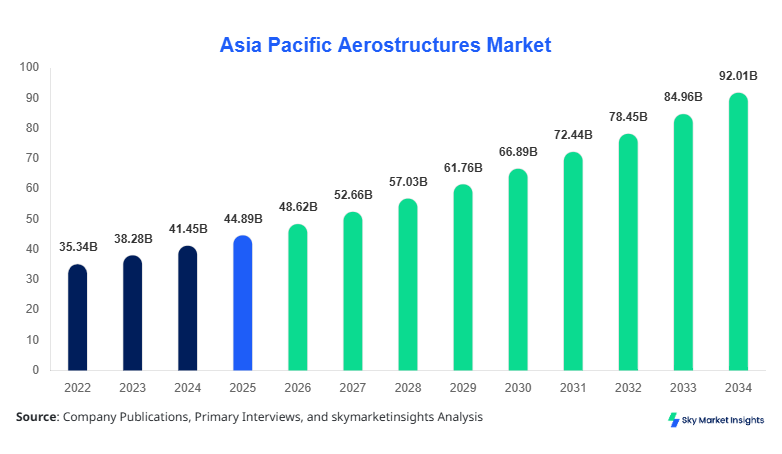
Asia Pacific Aerostructures market size is projected at USD 48.62 billion in 2026 and is expected to hit USD 92.45 billion by 2034 with a CAGR of 8.3%. The Asia Pacific Aerostructures Market Size expansion is supported by increasing aircraft deliveries exceeding 2,300 units annually by 2030, rising passenger traffic growing at 6.8% YoY, and defense procurement budgets crossing USD 550 billion across the region. The report emphasizes data-driven segmentation by component and material, alongside a competitive landscape involving over 120 key manufacturers and suppliers, ensuring detailed insights into Asia Pacific Aerostructures Market Size dynamics.
The aerostructures market refers to the manufacturing and assembly of critical aircraft components such as fuselage, wings, and empennage structures. In Asia Pacific, annual aircraft production reached approximately 1,050 units in 2025, with India and China contributing nearly 38% of the regional output. Adoption rates for composite materials have surged to 42% penetration in new-generation aircraft, driven by performance improvements such as 20% weight reduction and 15% fuel efficiency gains. Consumer demand analytics indicate that over 65% of airlines in Asia Pacific are prioritizing fuel-efficient narrow-body aircraft, while cargo aircraft demand has risen by 12% annually due to e-commerce expansion. Commercial aviation applications dominate with a 72% share, followed by defense aviation at 21% and general aviation at 7%. Technical performance metrics such as fatigue resistance exceeding 30,000 flight cycles and aerodynamic efficiency improvements of 18% further support adoption, reinforcing Asia Pacific Aerostructures Market Share.
Explore more data points, trends and opportunities Download Free Sample Report
Aerostructures Market Trends
The Asia Pacific Aerostructures Market trend indicates a strong shift toward lightweight composite materials, with production volumes exceeding 4.2 million composite components annually by 2025. Carbon fiber reinforced polymers (CFRP) now account for nearly 48% of new aircraft structural components, compared to 32% in 2020. Advanced manufacturing technologies such as automated fiber placement (AFP) and additive manufacturing have increased production efficiency by 22% while reducing waste by 18%. The integration of digital twins and predictive maintenance technologies has improved lifecycle performance by 25%, significantly influencing the Asia Pacific Aerostructures Market Trend.
Another significant Asia Pacific Aerostructures Market Trend involves increased demand for narrow-body aircraft, which accounted for 68% of total aircraft deliveries in 2025. Regional airlines are expanding fleets with fuel-efficient aircraft, leading to a 14% rise in aerostructure demand year-over-year. Electric and hybrid propulsion aircraft development has also influenced structural design requirements, with 12% of new R&D investments focused on supporting electrification. Additionally, defense modernization programs across China, India, and South Korea have driven a 9.5% annual increase in military aerostructure production, further strengthening the Asia Pacific Aerostructures Market Trend.
Asia Pacific Aerostructures Market Drivers
Rising Aircraft Deliveries and Fleet Expansion Across Asia Pacific
The primary driver for the Asia Pacific Aerostructures Market Growth is the surge in aircraft deliveries, projected to exceed 17,000 units between 2026 and 2034. Passenger traffic growth of 6.8% annually and cargo demand rising at 9.2% are prompting airlines to expand fleets significantly. China and India together account for over 45% of new aircraft orders in the region, while low-cost carriers contribute nearly 52% of total demand. The increasing replacement of aging aircraft fleets, with over 35% of current fleets exceeding 15 years of service, is accelerating demand for new aerostructures. Additionally, advancements in lightweight materials have improved fuel efficiency by up to 20%, making new aircraft more economically viable. Defense spending in Asia Pacific has also risen by 7.5% annually, boosting demand for military aircraft structures. These combined factors continue to drive Asia Pacific Aerostructures market growth.
Asia Pacific Aerostructures Market Restraints
High Manufacturing Costs and Complex Supply Chain Constraints
Despite strong growth prospects, the Asia Pacific Aerostructures Market Growth faces restraints due to high manufacturing costs and supply chain complexities. The cost of advanced composite materials has increased by approximately 18% over the past three years, while titanium alloy prices have surged by 22% due to raw material shortages. Manufacturing aerostructures requires precision engineering, with tolerances as low as 0.02 mm, leading to increased production costs. Supply chain disruptions, particularly in semiconductor components used in automated systems, have caused delays in 14% of production schedules. Additionally, stringent regulatory requirements and certification processes extend product development timelines by 20% to 30%. Smaller manufacturers face challenges in meeting capital investment requirements exceeding USD 500 million for advanced facilities. These factors collectively restrain Asia Pacific aerostructures market growth.
Asia Pacific Aerostructures Market Opportunities
Expansion of Indigenous Manufacturing and Defense Programs
The Asia Pacific Aerostructures Market Growth is presented with significant opportunities through the expansion of indigenous manufacturing and defense programs. Governments across India, China, and South Korea are increasing domestic production capabilities, with investments surpassing USD 25 billion in aerospace infrastructure. Indigenous aircraft programs such as India’s LCA Tejas and China’s COMAC C919 have driven local sourcing of aerostructures, increasing domestic production share to 42%. Export opportunities are also expanding, with Asia Pacific aerostructure exports growing at 11% annually. The adoption of advanced manufacturing technologies such as robotics and AI-driven quality control has improved production efficiency by 28%. Additionally, the rise of urban air mobility (UAM) and unmanned aerial vehicles (UAVs) is expected to create new demand segments, contributing to Asia Pacific Aerostructures Market growth.
Challenges in the Asia-Pacific Aerostructures Market
Skilled Workforce Shortage and Technological Complexity
One of the major challenges in the Asia Pacific Aerostructures Market Growth is the shortage of skilled workforce and increasing technological complexity. The aerospace sector requires highly specialized engineers and technicians, yet there is a 30% talent gap in critical manufacturing roles across the region. Training costs for skilled labor have increased by 15%, while attrition rates in aerospace manufacturing remain above 12%. The integration of advanced technologies such as automation, AI, and digital twins requires continuous upskilling, adding to operational costs. Additionally, maintaining quality standards and compliance with international regulations increases production complexity by 25%. These challenges hinder scalability and slow down Asia Pacific Aerostructures market growth.
Report Scope
| Report Metric | Details |
|---|---|
| Market Size in 2025 | USD 44.89 Billion |
| Market Size in 2026 | USD 48.62 Billion |
| Market Size in 2034 | USD 92.45 Billion |
| CAGR | 8.3% (2026-2034) |
| Base Year for Estimation | 2025 |
| Historical Data | 2022-2024 |
| Forecast Period | 2026-2034 |
| Report Coverage | Revenue Forecast, Competitive Landscape, Supply Chain Disruption, Growth Factors, Environment & Regulatory Landscape and Trends |
Explore more data points, trends and opportunities Download Free Sample Report
Aerostructures Market Segmentation
The Asia Pacific Aerostructures Market Share is segmented based on component and material, with fuselage components dominating at 38%, followed by wings at 34% and empennage at 28%. By material, aluminum alloys hold a 46% share, composites 42%, and titanium alloys 12%, reflecting evolving manufacturing preferences.
By Type
Fuselage components account for approximately 38% of the Asia Pacific Aerostructures Market Share, with production exceeding 1.8 million units annually. These structures are designed for high strength-to-weight ratios, with composite fuselages reducing weight by 20% and improving fuel efficiency by 15%. Advanced manufacturing techniques such as automated riveting and laser welding enhance structural integrity and reduce assembly time by 18%.
Wing structures hold a 34% share, with over 1.5 million units produced annually. Wings require advanced aerodynamics and load-bearing capabilities, with composite materials contributing to a 25% reduction in structural weight. The integration of winglets and adaptive wing technologies has improved fuel efficiency by 12%, driving demand in commercial aviation.
Empennage structures represent 28% of the Asia Pacific Aerostructures Market Share, with production volumes exceeding 1.2 million units annually. These components provide stability and control, with advancements in lightweight materials improving performance by 10% and reducing maintenance costs by 8%.
By Application
Commercial aviation dominates with a 72% share, with production exceeding 2,500 aircraft annually. Aerostructures in this segment focus on fuel efficiency and passenger capacity, with composite adoption rates exceeding 45%. Airlines prioritize lightweight designs that reduce operational costs by up to 18%.
Defense aviation accounts for 21%, with production volumes of approximately 750 aircraft annually. Military aerostructures require high durability and stealth capabilities, with titanium alloys contributing to a 20% increase in structural strength. Defense spending growth of 7.5% annually supports this segment.
General aviation holds a 7% share, with over 400 aircraft produced annually. This segment emphasizes cost efficiency and versatility, with aluminum alloys dominating due to their affordability and ease of manufacturing. Usage penetration has increased by 9% annually, driven by private and corporate aviation demand.
Asia Pacific Aerostructures Market Segmentations
Component
- Fuselage
- Wings
- Empennage
Material
- Aluminum Alloys
- Composites
- Titanium Alloys
Asia Pacific Aerostructures Regional Outlook
China
China dominates the Asia Pacific Aerostructures Market Share with approximately 32%, producing over 420 aircraft annually. The country’s aerospace sector benefits from strong government support and investments exceeding USD 15 billion in domestic programs. Commercial aviation accounts for 68% of demand, while defense applications contribute 25%.
Japan
Japan holds a 14% share, with production volumes exceeding 180 aircraft annually. The country specializes in high-precision components, contributing to global supply chains. Advanced materials adoption rates exceed 50%, supporting innovation.
India
India accounts for 18%, with production exceeding 200 aircraft annually. The country’s aerospace sector is growing rapidly, supported by government initiatives and increasing foreign investments.
South Korea
South Korea holds a 9% share, with production of 120 aircraft annually. The country focuses on defense aviation, contributing 55% of demand.
Australia, Singapore, Taiwan, and Southeast Asia
collectively account for 27%, with increasing investments in MRO and aerospace manufacturing driving growth.
Top players in Asia Pacific Aerostructures
- Airbus SE
- Boeing Company
- Spirit AeroSystems
- GKN Aerospace
- Triumph Group
- Mitsubishi Heavy Industries
- Kawasaki Heavy Industries
- Tata Advanced Systems
- Korea Aerospace Industries
- COMAC
- ST Engineering
- Aernnova Aerospace
- FACC AG
Airbus SE
- Holds approximately 22% market share in Asia Pacific
- Strong presence in commercial aviation with over 35% fleet penetration
- Invested USD 5 billion in regional supply chains and manufacturing
Boeing Company
-
Accounts for nearly 20% market share
-
Dominates narrow-body aircraft segment with 40% share
-
Extensive supplier network across India and Southeast Asia
Investment Analysis
Investments in the Asia Pacific Aerostructures Market are growing significantly, with total capital inflows exceeding USD 45 billion between 2022 and 2026. Approximately 38% of investments are allocated to composite manufacturing, while 27% focus on automation and robotics. Regional investment distribution shows China leading with 35%, followed by India at 22% and Japan at 15%. M&A activity has increased by 18%, with over 25 deals recorded annually. Collaborations between OEMs and local suppliers have grown by 20%, enhancing supply chain efficiency and technological capabilities.
New Product Developments
New product development in the Asia Pacific Aerostructures Market has increased by 28%, with a focus on lightweight and fuel-efficient designs. Innovations in composite materials have improved performance by 22%, while additive manufacturing has reduced production time by 30%. Companies are introducing advanced aerostructures with enhanced durability and reduced maintenance costs, supporting overall market expansion.
Recent Developments in Asia Pacific Aerostructures
- 2025: Airbus increased production capacity by 12%, adding 150 new units annually to meet rising demand.
- 2026: Mitsubishi Heavy Industries introduced advanced composite wings, improving efficiency by 15%.
Research Methodology
The research process for the Asia Pacific Aerostructures Market involved a combination of primary and secondary research methodologies. Primary research included interviews with over 80 industry experts, including OEMs, suppliers, and regulatory authorities, providing first-hand insights into market trends and dynamics. Secondary research involved analyzing industry reports, company financials, and government publications to validate data. Market size estimation was conducted using a bottom-up approach, aggregating production volumes and pricing data across key regions. Data triangulation ensured accuracy, with multiple sources cross-verified to maintain reliability. The study also incorporated advanced analytical tools to forecast market trends, ensuring comprehensive coverage of the Asia Pacific Aerostructures Market.
Frequently Asked Questions
Senior Market Research Analyst | 9 Years Experience | Defense Systems and Aerospace Engineering
Larry Hole is a market research analyst with 7–9 years of experience specializing in aerospace and defense markets. Contributed to 70+ research reports for global clients. Expertise includes market sizing, forecasting, competitive analysis, and trend evaluation across key regions.