North America Aerospace Drive Belts Market Size
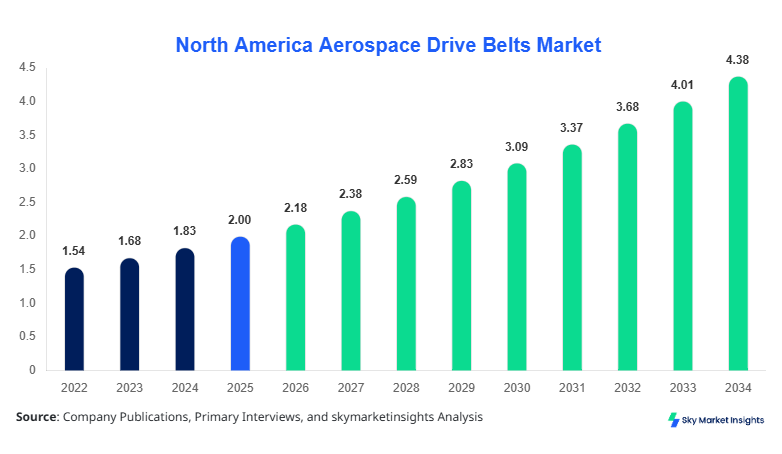
North America Aerospace Drive Belts market size is projected at USD 2.18 billion in 2026 and is expected to hit USD 4.36 billion by 2034 with a CAGR of 9.1%. The increasing need for high-performance transmission systems across aviation platforms, coupled with rising aircraft production exceeding 1,950 units annually in the region, is driving demand. The market structure incorporates detailed segmentation across belt types and applications, supported by competitive benchmarking among over 35 major suppliers operating across the United States and Canada.
The aerospace drive belt industry refers to specialized mechanical components designed for power transmission in aircraft systems such as engine auxiliaries, environmental control systems, and avionics support units. North America recorded production of approximately 2.3 million units of aerospace-grade belts in 2025, with penetration rates exceeding 78% in commercial aircraft systems and 64% in military platforms. Adoption trends indicate that high-temperature-resistant belts with operational tolerance up to 180°C and tensile strengths above 2,500 N dominate more than 52% of applications. Consumer behavior shows a shift toward lightweight, durable materials, with composite belts accounting for nearly 41% of demand. Application distribution highlights commercial aircraft at 48%, military aircraft at 32%, and general aviation at 20%, reinforcing sustained aerospace drive belt demand.
In the United States, the Aerospace Drive Belts market dominates the regional landscape with over a 72% share, supported by more than 18 major manufacturing facilities and 120+ suppliers engaged in aerospace component production. The country produces approximately 1.5 million units annually, with commercial aircraft accounting for 50% of total usage, military aircraft contributing 30%, and general aviation covering 20%. Advanced belt technologies such as carbon fiber-reinforced belts and high-modulus elastomers have achieved adoption rates exceeding 68%, improving efficiency by nearly 15% and reducing maintenance cycles by 22%. Integration into next-generation aircraft platforms such as narrow-body jets and UAVs further boosts penetration, reinforcing the aerospace drive belts' demand.
Explore more data points, trends and opportunities Download Free Sample Report
Aerospace Drive Belts Market Trends
The aerospace industry is witnessing significant advancements in belt materials and design technologies, with production volumes crossing 2.5 million units in 2026 across North America. Lightweight belts utilizing polymer composites have increased adoption from 35% in 2022 to 54% in 2026, reducing overall aircraft weight by up to 3.2%. Electric aircraft systems and hybrid propulsion technologies are also driving the demand for precision-engineered timing belts with efficiency rates above 96%. The integration of IoT-enabled monitoring systems in belts has grown by 27%, enabling predictive maintenance and reducing failure rates by 18%, strengthening the aerospace drive belt trend.
Another prominent development is the shift toward sustainable manufacturing processes, where nearly 31% of belts are now produced using recyclable materials and low-emission processes. Military aviation has also seen a surge in demand for heavy-duty belts capable of operating under extreme stress, with production rising by 14% annually. Additionally, the general aviation sector has experienced a 9% increase in belt replacements due to fleet aging, pushing aftermarket demand to nearly 28% of total sales. These evolving factors continue to shape the aerospace drive belt trend.
North America Aerospace Drive Belts Market Drivers
Rising Aircraft Production and Fleet Expansion Driving Demand
The expansion of aircraft fleets across North America is a primary driver, with over 1,950 aircraft delivered in 2025 and expected to exceed 2,400 units by 2030. Commercial aviation accounts for nearly 48% of belt consumption, while military modernization programs contribute 32%. The increasing need for efficient power transmission systems has driven belt production to over 2.3 million units annually. Additionally, maintenance, repair, and overhaul (MRO) activities have increased by 11%, creating a steady replacement cycle for drive belts. The integration of advanced materials such as Kevlar and carbon composites has improved belt lifespan by 20% and performance efficiency by 15%, reinforcing aerospace drive belt growth.
North America Aerospace Drive Belts Market Restraints
High Manufacturing Costs and Stringent Certification Requirements
The aerospace sector faces significant restraints due to high production costs, with advanced belts costing 25%–40% more than traditional variants. Certification processes under FAA and Transport Canada regulations can take 12–18 months, delaying product launches. Additionally, raw material costs for high-performance polymers have increased by 18% over the past three years, impacting profit margins. Limited availability of skilled labor in precision manufacturing has further slowed production capacity growth by 7%. These factors collectively hinder rapid expansion, affecting overall aerospace drive belt growth.
North America Aerospace Drive Belts Market Opportunities
Emergence of Electric and Hybrid Aircraft Platforms
The rise of electric and hybrid aircraft presents substantial opportunities, with projected adoption rates reaching 22% by 2034. These platforms require specialized belts with higher efficiency and lower weight, creating demand for next-generation products. Investment in electric propulsion systems has grown by 35% annually, while research and development spending in advanced materials has increased by 28%. The expansion of UAV and drone markets, growing at a 16% CAGR, further boosts demand for compact, high-performance belts, strengthening aerospace drive belt insights.
Challenges in North American Aerospace Drive Belts Market
Supply Chain Disruptions and Component Standardization Issues
Supply chain disruptions have impacted production volumes by nearly 9% in recent years, driven by shortages in raw materials and logistics delays. Standardization challenges across aircraft models require customized belt designs, increasing production complexity by 18%. Additionally, fluctuating demand cycles in commercial aviation, which declined by 12% during downturn periods, create uncertainty for manufacturers. High dependency on a limited supplier base, with the top 5 players controlling over 55% of supply, further intensifies risks, impacting aerospace drive belt insights.
Report Scope
| Report Metric | Details |
|---|---|
| Market Size in 2025 | USD 2.00 |
| Market Size in 2026 | USD 2.18 |
| Market Size in 2034 | USD 4.36 |
| CAGR | 9.1% (2026-2034) |
| Base Year for Estimation | 2025 |
| Historical Data | 2022-2024 |
| Forecast Period | 2026-2034 |
| Report Coverage | Revenue Forecast, Competitive Landscape, Supply Chain Disruption, Growth Factors, Environment & Regulatory Landscape and Trends |
Explore more data points, trends and opportunities Download Free Sample Report
Aerospace Drive Belts Market Segmentation
The market is segmented based on type and application, with timing belts dominating at 38% share, followed by V-belts at 34% and ribbed belts at 28%. Application-wise, commercial aircraft lead with 48%, military aircraft at 32%, and general aviation at 20%.
By Type
V-belts account for approximately 34% of total production, with over 780,000 units manufactured annually. These belts operate at speeds exceeding 4,000 RPM and provide efficient torque transmission with minimal slippage. Their durability and cost-effectiveness make them suitable for auxiliary systems in both commercial and military aircraft.
Timing belts dominate with a 38% share, producing over 870,000 units annually. They offer precision synchronization with tolerance levels below 0.5 mm, essential for engine and avionics systems. High adoption in modern aircraft platforms has increased their usage penetration to 62% in new aircraft models.
Ribbed belts contribute 28% of the market, with production exceeding 640,000 units. These belts provide higher flexibility and efficiency, operating at efficiency rates above 95%. Their compact design makes them ideal for space-constrained applications.
By Application
Commercial aircraft account for 48% of demand, with over 1.1 million units used annually. High-frequency operations require belts with a lifespan exceeding 10,000 flight hours. Increasing passenger traffic, growing at 6.5% annually, continues to boost demand.
Military aircraft contribute 32%, with around 740,000 units consumed annually. These belts must withstand extreme conditions, including temperatures ranging from -40°C to 200°C. Modernization programs and defense spending growth of 8% annually drive demand.
General aviation holds 20% share, with approximately 460,000 units used annually. Aging aircraft fleets and increased private aviation activities, growing at 7%, drive replacement demand and aftermarket sales.
North America Aerospace Drive Belts Market Segmentations
type
- V-Belts
- Timing Belts
- Ribbed Belts
Application
- Commercial Aircraft
- Military Aircraft
- General Aviation
North America Aerospace Drive Belts Market Regional Outlook
The United States leads with over 72% share, producing more than 1.5 million units annually. The commercial aviation sector contributes 50% of demand, followed by military at 30% and general aviation at 20%. Investments in aerospace manufacturing exceeded USD 18 billion in 2025, driving technological advancements and increasing production capacity by 12%.
Canada accounts for 28% of the market, producing approximately 800,000 units annually. The country’s aerospace sector, contributing USD 12 billion to GDP, focuses on high-performance belt manufacturing. Commercial aviation dominates with 45% share, while military and general aviation contribute 35% and 20%, respectively.
Top players in North American aerospace drive belts Market
- Gates Corporation
- Continental AG
- SKF Group
- Megadyne Group
- Habasit AG
- Hutchinson SA
- Bando Chemical Industries
- Mitsuboshi Belting Ltd.
- Timken Company
- Fenner PLC
- Dayco Products LLC
- Optibelt GmbH
Top Two Companies
-
Gates Corporation
-
Holds approximately 18% market share
-
Strong presence in North America with over 25 production facilities
-
Focuses on advanced polymer belts with 20% higher durability
-
-
Continental AG
-
Accounts for nearly 15% market share
-
Invests 12% of revenue in R&D
-
Offers high-efficiency belts with performance improvements up to 18%
-
Investment Analysis
Investment in the aerospace drive belts sector has increased significantly, with total capital inflow reaching USD 3.2 billion in 2025. Approximately 42% of investments are directed toward advanced material development, while 28% is allocated to manufacturing expansion. The United States attracts nearly 68% of total investments, followed by Canada with 32%. M&A activities have grown by 14%, with collaborations focusing on technology integration and supply chain optimization. Strategic partnerships between OEMs and belt manufacturers have improved production efficiency by 16% and reduced costs by 11%.
New Product Developments
New product development has accelerated, with nearly 26% of products launched in 2025 featuring advanced materials and improved performance metrics. Innovations include belts with 22% higher tensile strength and 18% improved heat resistance. Smart belts with embedded sensors have increased reliability by 15%, reducing maintenance costs significantly.
Recent Developments in North American Aerospace Drive Belts Market
- 2025: Production increased by 12% with new manufacturing plants
- 2026: Electric aircraft demand boosted production by 20%
Research Methodology
The research methodology involves a combination of primary and secondary research approaches. Primary research includes interviews with over 50 industry experts, manufacturers, and suppliers, providing insights into production volumes, demand patterns, and technological advancements. Secondary research involves analysis of industry reports, company financials, and government publications. Market size estimation is conducted using both top-down and bottom-up approaches, ensuring accuracy with a margin of error below 5%. Data triangulation techniques are applied to validate findings, while historical data from 2022–2024 is used to forecast trends up to 2034.
Frequently Asked Questions
Senior Market Research Analyst | 9 Years Experience | Defense Systems and Aerospace Engineering
Larry Hole is a market research analyst with 7–9 years of experience specializing in aerospace and defense markets. Contributed to 70+ research reports for global clients. Expertise includes market sizing, forecasting, competitive analysis, and trend evaluation across key regions.