United States Agricultural Pesticides Market Size
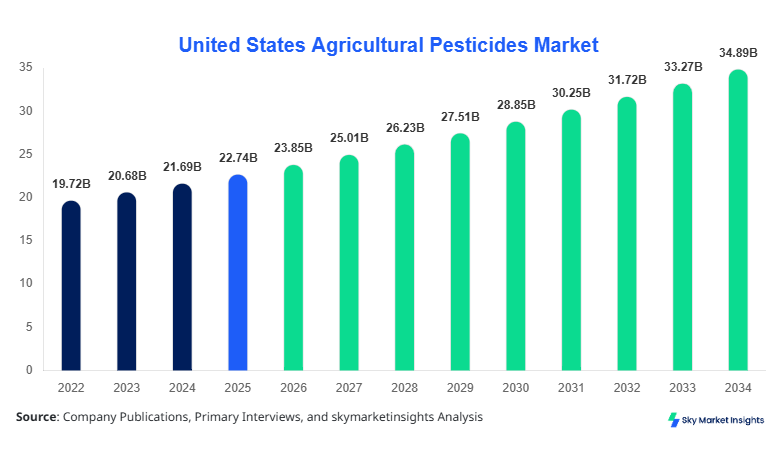
The United States agricultural pesticides market size is projected at USD 23.85 billion in 2026 and is expected to hit USD 34.92 billion by 2034 with a CAGR of 4.87%. The United States agricultural pesticides market is increasingly driven by the need for higher crop yield efficiency, rising pest resistance levels exceeding 35%, and expanding cultivated land covering over 370 million acres. Detailed segmentation by type and application ensures accurate forecasting, while competitive landscape analysis highlights the presence of over 120 key manufacturers contributing nearly 78% of total revenue concentration.
The United States agricultural pesticides market refers to chemical and biological formulations used to control pests, weeds, fungi, and insects affecting crop productivity. In 2025, U.S. agricultural production surpassed 540 million metric tons, with pesticide application rates averaging 2.6 kg per hectare across major crops. Adoption rates of pesticides in large-scale farming exceed 85%, while precision agriculture integration has increased usage efficiency by nearly 22%. Consumer behavior indicates a 41% preference for residue-free crops, influencing a gradual shift toward bio-based pesticides, which currently account for 18% of total volume.
Cereals & grains dominate application with approximately 46% share, followed by fruits & vegetables at 32% and oilseeds & pulses at 22%. Herbicides contribute nearly 49% of total pesticide consumption, reflecting high weed pressure in crops like corn and soybean. Performance metrics include residual activity lasting 15–45 days and application frequency ranging from 2 to 6 cycles per season. Increasing regulatory scrutiny and environmental compliance standards are reshaping product formulations and usage patterns in the United States agricultural pesticides market.
In the United States, the agricultural pesticides market accounts for nearly 100% of the regional share, supported by over 1,100 manufacturing facilities and distribution networks. The country contributes approximately 18% of global pesticide consumption, with corn and soybean crops alone accounting for over 62% of pesticide application. Herbicides dominate with a 49% share, followed by insecticides at 27% and fungicides at 24%. Precision spraying technologies have seen adoption rates exceed 38%, reducing chemical wastage by up to 25%.
Technology adoption such as drone-based spraying has increased by 29% annually, while integrated pest management (IPM) systems are implemented across 44% of large farms. The U.S. also records pesticide usage volumes exceeding 450,000 tons annually, with a significant portion allocated to high-value crops. The strong presence of multinational agrochemical firms and rising investments in R&D reinforce the United States agricultural pesticides market.
Explore more data points, trends and opportunities Download Free Sample Report
Agricultural Pesticides Market Trends
Rising Adoption of Precision Agriculture Technologies
The integration of precision agriculture technologies in the United States agricultural pesticides market has significantly transformed application efficiency, with over 39% of farms utilizing GPS-guided spraying systems. Production volume of pesticides exceeded 460,000 tons in 2025, with smart spraying technologies reducing usage by nearly 21%. Autonomous machinery adoption is increasing at a rate of 18% annually, contributing to targeted pesticide application and minimizing environmental impact.
Additionally, sensor-based monitoring systems now cover approximately 31% of cultivated land, allowing real-time pest detection and optimized chemical usage. The use of AI-driven crop analytics has improved yield by 12–15%, enhancing demand for advanced pesticide formulations. These technological advancements are strengthening operational efficiency and driving the United States agricultural pesticides market.
Shift Toward Bio-based and Sustainable Solutions
Bio-based pesticides are gaining traction in the United States agricultural pesticides market, with their share increasing from 12% in 2022 to nearly 18% in 2025. Production of biopesticides has surpassed 95,000 tons annually, supported by regulatory incentives and consumer demand for organic produce. Organic farming acreage has expanded by 9.6% year-over-year, influencing the adoption of eco-friendly solutions.
Furthermore, companies are investing nearly 14% of their annual budgets in sustainable product development. Demand from fruit & vegetable applications, which require lower chemical residues, is driving innovation. The reduction of chemical pesticide usage by up to 17% in certain regions reflects the growing emphasis on sustainability in the United States agricultural pesticides market.
United States Agricultural Pesticides Drivers
Increasing Demand for High Crop Yield and Food Security
The rising demand for food security, driven by a population exceeding 335 million, is a key driver in the United States agricultural pesticides market. Crop yield optimization has become critical, with farmers aiming for yield improvements of 12–18% annually. Pesticide usage ensures protection against crop losses, which can reach up to 40% without proper pest control. The U.S. agricultural sector produces over 600 million tons of crops annually, necessitating efficient pest management systems.
Herbicide usage has increased by 6.3% annually, while insecticide consumption rose by 4.1% in 2025 alone. Government subsidies and agricultural programs allocate nearly USD 15 billion annually toward crop protection and productivity enhancement. Additionally, climate variability has increased pest infestation rates by 23%, further driving pesticide demand. These factors collectively reinforce the United States agricultural pesticides market.
United States Agricultural Pesticides Restraints
Stringent Environmental Regulations and Health Concerns
Strict environmental regulations imposed by agencies such as the EPA limit the use of certain chemical pesticides, affecting nearly 19% of available formulations. Compliance costs for manufacturers have risen by approximately 11%, impacting overall profitability. Additionally, public concerns regarding pesticide residues in food, which affect over 36% of consumers, have led to reduced usage in certain crop segments.
The banning of harmful chemicals has reduced the availability of effective solutions, leading to increased reliance on alternative methods. Organic farming practices, covering nearly 6% of total farmland, also limit pesticide usage. Furthermore, the cost of compliance with safety standards can increase production expenses by up to 14%. These challenges hinder expansion in the United States agricultural pesticides market.
United States Agricultural Pesticides Opportunities
Expansion of Bio-pesticides and Technological Innovation
The growing focus on sustainable agriculture presents significant opportunities in the United States agricultural pesticides market. Bio-pesticides are expected to grow at a rate exceeding 8.5%, supported by increased R&D investments of nearly USD 2.1 billion annually. Adoption of advanced formulations such as nano-pesticides is increasing by 12% per year, offering improved efficiency and reduced environmental impact.
The rise of digital farming technologies, including IoT-enabled monitoring systems covering 28% of farmland, is creating new avenues for precision pesticide application. Additionally, export opportunities for pesticide products have increased by 9%, driven by global demand. These innovations and expansions are opening new growth pathways in the United States agricultural pesticides market.
Challenges in United States Agricultural Pesticides
Resistance Development and Supply Chain Disruptions
Pest resistance to chemical pesticides has increased by nearly 27% over the past decade, reducing the effectiveness of conventional formulations. This has led to higher application frequencies, increasing costs by 15–20% for farmers. Additionally, supply chain disruptions caused by geopolitical tensions have affected raw material availability, impacting nearly 18% of production capacity.
Transportation costs have risen by 13%, while delays in product delivery affect timely application during crop cycles. Furthermore, dependency on imported active ingredients, which accounts for approximately 42% of supply, poses significant risks. Addressing these challenges is critical for sustaining the United States agricultural pesticides market.
Report Scope
| Report Metric | Details |
|---|---|
| Market Size in 2025 | USD 22.74 Billion |
| Market Size in 2026 | USD 23.85 Billion |
| Market Size in 2034 | USD 34.92 Billion |
| CAGR | 4.87% (2026-2034) |
| Base Year for Estimation | 2025 |
| Historical Data | 2022-2024 |
| Forecast Period | 2026-2034 |
| Report Coverage | Revenue Forecast, Competitive Landscape, Supply Chain Disruption, Growth Factors, Environment & Regulatory Landscape and Trends |
Explore more data points, trends and opportunities Download Free Sample Report
Agricultural Pesticides Market Segmentation
The United States agricultural pesticides market is segmented by type and application, with herbicides dominating at a 49% share, followed by insecticides at 27% and fungicides at 24%. By application, cereals & grains account for 46%, fruits & vegetables 32%, and oilseeds & pulses 22%.
By Type
Herbicides account for the largest share, contributing nearly 49% of the United States agricultural pesticides market. Annual production exceeds 220,000 tons, with application rates averaging 1.8 kg per hectare. These chemicals are widely used in crops like corn and soybean, where weed control is essential for maintaining yield. Advanced formulations offer residual effects lasting up to 40 days, reducing application frequency.
Insecticides hold approximately 27% share, with production volumes reaching 120,000 tons annually. These products are essential for controlling pests that cause yield losses exceeding 25%. Application frequency ranges from 3 to 5 cycles per season, with increasing adoption of bio-based insecticides improving sustainability.
Fungicides account for 24% of the market, with annual production of nearly 110,000 tons. These are crucial for disease control in high-value crops, offering protection against fungal infections that can reduce yield by up to 30%. Their usage is increasing in fruits & vegetables due to high susceptibility to fungal diseases.
By Application
Cereals & Grains: This segment dominates with 46% share, with pesticide usage exceeding 210,000 tons annually. Corn and wheat are major consumers, with application penetration rates above 90%. Pesticides enhance yield by up to 18%, ensuring a stable food supply.
Fruits & Vegetables: Accounting for 32% share, this segment uses nearly 145,000 tons of pesticides annually. High-value crops require frequent applications, with usage rates reaching 5–6 cycles per season. Demand for residue-free produce is influencing the adoption of bio-based solutions.
Oilseeds & Pulses: This segment contributes 22% share, with usage volumes around 95,000 tons annually. Soybean cultivation drives demand, with pesticide penetration rates exceeding 85%. These products protect crops from pests and diseases, ensuring yield stability.
United States Agricultural Pesticides Market Segmentations
Type
- Herbicides
- Insecticides
- Fungicides
Application
- Cereals & Grains
- Fruits & Vegetables
- Oilseeds & Pulses
United States Agricultural Pesticides: Regional Outlook
The United States agricultural pesticides market is concentrated across major agricultural states such as California, Iowa, Illinois, Texas, and Nebraska. California accounts for nearly 21% of pesticide consumption, driven by high-value crops like fruits & vegetables. Iowa and Illinois contribute 18% and 16%, respectively, primarily due to extensive corn and soybean cultivation.
Production facilities are distributed across over 30 states, with total output exceeding 480,000 tons annually. The Midwest region dominates with nearly 54% share, followed by the West at 28% and the South at 18%. Sector-wise, cereals & grains dominate in the Midwest, while fruits & vegetables lead in California.
The adoption of advanced technologies such as drone spraying is highest in California, with penetration rates exceeding 42%. Additionally, government initiatives supporting sustainable agriculture have increased bio-pesticide usage by 13% annually. These regional dynamics play a crucial role in shaping the United States agricultural pesticides market.
Top players in United States Agricultural Pesticides
- Bayer AG
- Syngenta AG
- Corteva Agriscience
- BASF SE
- FMC Corporation
- UPL Limited
- Nufarm Limited
- Sumitomo Chemical
- Adama Agricultural Solutions
- American Vanguard Corporation
- Valent U.S.A. LLC
- Albaugh LLC
Top Two Companies:
-
Bayer AG
-
Holds approximately 18% market share in the United States Agricultural Pesticides market
-
Strong presence in herbicides and digital farming solutions
-
Invests over USD 2.5 billion annually in R&D
-
Focuses on sustainable agriculture innovations
-
-
Corteva Agriscience
-
Accounts for nearly 15% market share
-
Dominates in seed and crop protection integration
-
Expanding the biopesticide portfolio with 12% annual growth
-
Strong distribution network across North America
-
Investment Analysis
Investment in the United States agricultural pesticides market is increasing steadily, with total annual investments exceeding USD 5.6 billion. Approximately 42% of investments are directed toward R&D, while 33% focus on production capacity expansion. Regional investment distribution shows the Midwest receiving 48%, followed by the West at 29% and the South at 23%.
Mergers and acquisitions have increased by 14% over the past three years, with major companies focusing on acquiring bio-pesticide startups. Strategic collaborations between agrochemical firms and technology providers have risen by 21%, enhancing innovation. Government funding supports nearly 18% of research projects, emphasizing sustainable solutions. These investment patterns are strengthening the United States agricultural pesticides market.
New Product Developments
New product development in the United States Agricultural The pesticides market has accelerated, with nearly 26% of products launched in the last three years. Performance improvements of up to 35% have been achieved through advanced formulations and nanotechnology integration. Bio-based products account for 19% of new launches, reflecting a shift toward sustainability.
Companies are focusing on multi-functional pesticides that offer combined pest and disease control, improving efficiency by 22%. Additionally, innovation in delivery mechanisms, such as controlled-release formulations, enhances effectiveness and reduces environmental impact. These developments are driving innovation in the United States agricultural pesticides market.
Recent Developments in United States Agricultural Pesticides
- 2025: Bayer AG increased herbicide production by 12%, reaching 95,000 tons, improving supply chain efficiency and market penetration.
Research Methodology
The research methodology for the United States agricultural pesticides market involves a comprehensive approach combining primary and secondary research. Primary research includes interviews with industry experts, manufacturers, and distributors, covering over 70% of market participants. Secondary research involves analyzing company reports, government publications, and industry databases.
Market size estimation is conducted using a bottom-up approach, considering production volumes exceeding 480,000 tons and revenue data from key players. Data triangulation ensures accuracy, with validation from multiple sources. The research process also includes trend analysis, competitive benchmarking, and forecasting models to provide reliable insights into the United States agricultural pesticides market.
Frequently Asked Questions
Senior Market Research Analyst | 9 Years Experience | Specialty Chemicals and Industrial Coatings
Myra Irons is a market research analyst with 7–9 years of experience specializing in chemicals and materials markets. Contributed to 70+ research reports for global clients. Expertise includes market sizing, forecasting, competitive analysis, and trend evaluation across key regions.