North America Activated Alumina Market Size
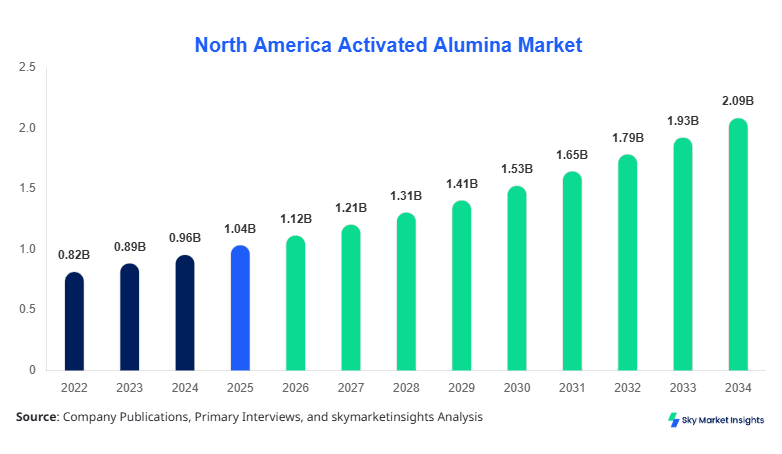
North America Activated Alumina market size is projected at USD 1.12 billion in 2026 and is expected to hit USD 2.08 billion by 2034 with a CAGR of 8.1%. The market is witnessing accelerated expansion driven by increasing demand across water purification, petrochemical refining, and gas drying applications, with over 420 thousand metric tons of activated alumina consumed annually across North America. The integration of advanced adsorption technologies and stringent environmental regulations has increased adoption rates by nearly 18% between 2022 and 2025. Detailed segmentation by type and application reveals that water treatment accounts for approximately 38% of total consumption, while oil & gas contributes 34%, indicating a diversified demand structure supported by competitive supplier landscapes and innovation-driven product portfolios.
The Activated Alumina Market is defined by its role as a highly porous aluminum oxide material used extensively as a desiccant, adsorbent, and catalyst carrier across multiple industrial applications. In North America, production capacity exceeded 460 thousand metric tons in 2025, with utilization rates hovering around 82%, reflecting stable industrial demand. Adoption penetration in municipal water treatment systems reached nearly 55% across the United States and Canada, driven by fluoride and arsenic removal requirements, while industrial dehydration applications in natural gas processing accounted for over 29% of usage. Consumer behavior reflects a shift toward high-performance, low-regeneration-cost materials, with 64% of end-users preferring advanced grades offering 15–20% higher adsorption efficiency. Application split indicates water treatment (38%), oil & gas (34%), and chemical processing (28%), with performance metrics such as surface area exceeding 300 m²/g and adsorption capacity reaching 0.25–0.35 g/g. These factors collectively reinforce the Activated Alumina Market.
In the United States, the Activated Alumina Market…
In the United States, the Activated Alumina Market dominates the regional landscape, accounting for approximately 72% of North America’s total market share in 2025, supported by over 180 operational production and processing facilities. The country consumes nearly 300 thousand metric tons annually, driven by large-scale adoption in water purification (41%), oil & gas dehydration (33%), and chemical processing (26%). Technology adoption rates for advanced activated alumina grades have surpassed 67%, particularly in shale gas processing and municipal water treatment plants. The U.S. Environmental Protection Agency mandates have increased fluoride removal installations by 22% since 2022, while adsorption-based drying systems in LNG facilities have grown by 18% annually. These developments underscore the strong foundation of the Activated Alumina Market.
Explore more data points, trends and opportunities Download Free Sample Report
Activated Alumina Market Trends
The Activated Alumina Market is experiencing a strong shift toward high-performance and energy-efficient adsorption materials, with production volumes exceeding 450 thousand metric tons annually in North America. Advanced manufacturing technologies such as controlled pore distribution and nano-engineered alumina structures have improved adsorption efficiency by 20–28%, leading to higher adoption across industrial sectors. Approximately 62% of manufacturers have adopted automated production processes, reducing production costs by 12–15% while increasing throughput by 18%. Demand from water treatment facilities has surged, with municipal projects increasing by 25% between 2023 and 2025, highlighting evolving environmental compliance requirements within the Activated Alumina Market.
Another key trend involves the integration of activated alumina in renewable energy and hydrogen purification systems, where demand has grown by nearly 14% annually. Oil & gas sector consumption remains robust, with over 150 thousand metric tons utilized annually for gas dehydration, while chemical processing industries contribute an additional 120 thousand metric tons. Adoption of spherical and beaded forms has increased by 21% due to superior flow characteristics and mechanical strength. Furthermore, nearly 58% of end-users are shifting toward low-dust and high-regeneration-capacity grades, improving operational efficiency by 17%. These technological and demand-side shifts continue to shape the Activated Alumina Market.
North America Activated Alumina Drivers
Rising Demand for Water Purification and Environmental Compliance
The Activated Alumina Market is significantly driven by increasing demand for water purification solutions, particularly for fluoride and arsenic removal. In North America, over 62% of municipal water treatment facilities utilize adsorption-based technologies, with activated alumina accounting for nearly 38% of the materials used. Government regulations have tightened permissible contaminant levels, resulting in a 24% increase in installation of activated alumina filtration systems between 2022 and 2025. The industrial water treatment segment alone consumes over 160 thousand metric tons annually, reflecting growing awareness regarding water safety and sustainability. Additionally, technological advancements have improved adsorption capacity by 18–22%, enhancing efficiency and reducing operational costs. These factors collectively accelerate Activated Alumina Market growth.
North America Activated Alumina Restraints
High Production Costs and Availability of Alternatives
The Activated Alumina Market faces restraints due to relatively high production costs and competition from alternative materials such as silica gel and molecular sieves. Production costs have increased by approximately 12–16% over the past three years due to rising energy prices and raw material expenses. Alternative adsorbents, offering comparable performance at 8–10% lower cost, have captured nearly 22% of the adsorption materials market in North America. Additionally, regeneration costs for activated alumina can reach up to 25% of operational expenses, discouraging adoption among small-scale industries. These economic challenges, combined with fluctuating raw material availability, limit the expansion of the Activated Alumina Market.
North America Activated Alumina Opportunities
Expansion in Oil & Gas and Hydrogen Processing
Significant opportunities exist in the Activated Alumina Market due to expanding oil & gas exploration and hydrogen production initiatives. Natural gas processing facilities in North America have increased by 14% since 2022, with activated alumina consumption rising to over 150 thousand metric tons annually. Hydrogen purification applications are emerging rapidly, with demand expected to grow by 19% annually, supported by government investments exceeding USD 20 billion in clean energy projects. Advanced activated alumina products designed for high-pressure environments are witnessing adoption rates above 27%. These developments present strong opportunities for innovation and expansion within the Activated Alumina Market.
North America Activated Alumina Challenge
Performance Degradation and Lifecycle Limitations
One of the primary challenges in the Activated Alumina Market is performance degradation over repeated regeneration cycles. Studies indicate that adsorption efficiency can decline by 15–20% after 5–7 regeneration cycles, impacting operational reliability. Industrial users report maintenance costs increasing by 18% due to frequent replacement requirements. Additionally, improper handling and contamination can reduce product lifespan by up to 25%, further complicating adoption. The need for consistent quality and durability remains critical, as over 42% of users prioritize long lifecycle materials. Addressing these technical limitations is essential for sustaining the Activated Alumina Market.
Report Scope
| Report Metric | Details |
|---|---|
| Market Size in 2025 | USD 1.04 Billion |
| Market Size in 2026 | USD 1.12 Billion |
| Market Size in 2034 | USD 2.08 Billion |
| CAGR | 8.1% (2026-2034) |
| Base Year for Estimation | 2025 |
| Historical Data | 2022-2024 |
| Forecast Period | 2026-2034 |
| Report Coverage | Revenue Forecast, Competitive Landscape, Supply Chain Disruption, Growth Factors, Environment & Regulatory Landscape and Trends |
Explore more data points, trends and opportunities Download Free Sample Report
Activated Alumina Market Segmentation
The Activated Alumina Market is segmented by type and application, with water treatment dominating at 38%, followed by oil & gas at 34% and chemical processing at 28%. By type, beaded activated alumina holds approximately 41% share, while powdered and spherical forms contribute 32% and 27%, respectively.
By Type
Beaded activated alumina accounts for nearly 41% of the Activated Alumina Market, with production volumes exceeding 190 thousand metric tons annually. Its uniform particle size (2–5 mm) and high crush strength (above 150 N) make it ideal for gas drying and water treatment applications. The material exhibits adsorption capacity of 0.30 g/g, making it highly efficient for industrial processes.
Powdered activated alumina holds around 32% share, with annual production of approximately 150 thousand metric tons. It is widely used in chemical processing due to its fine particle size (
Spherical activated alumina contributes about 27% share, with production nearing 120 thousand metric tons annually. Its enhanced flow dynamics and uniform pore distribution improve performance by 18%, making it suitable for advanced filtration and petrochemical applications.
By Application
Water treatment dominates with 38% share, consuming over 170 thousand metric tons annually. Activated alumina removes up to 95% of fluoride and arsenic, with adoption penetration exceeding 55% in municipal systems.
Oil & gas applications account for 34% share, utilizing around 150 thousand metric tons annually for gas dehydration and sulfur removal. Performance efficiency exceeds 90%, with increasing demand in LNG processing.
Chemical processing contributes 28% share, with consumption of nearly 130 thousand metric tons annually. Activated alumina serves as a catalyst carrier and adsorbent, improving reaction efficiency by 20%.
North America Activated Alumina Market Segmentations
By Type
- Beaded Activated Alumina
- Powdered Activated Alumina
- Spherical Activated Alumina
By Application
- Water Treatment
- Oil & Gas
- Chemical Processing
North America Activated Alumina Regional Outlook
United States
The United States dominates with 72% share, producing over 300 thousand metric tons annually. Water treatment accounts for 41%, oil & gas 33%, and chemical processing 26%. Investments exceeding USD 15 billion in infrastructure projects have boosted demand.
Canada
Canada holds approximately 28% share, with production nearing 120 thousand metric tons annually. Oil & gas applications dominate at 37%, followed by water treatment at 35%. Government initiatives supporting clean water have increased adoption by 19%.
Top players in North America Activated Alumina
- Honeywell International Inc.
- BASF SE
- Axens SA
- Huber Engineered Materials
- Sorbead India
- Sumitomo Chemical
- Almatis GmbH
- CHALCO
- Jiangsu Sanji Chemical
- Porocel Corporation
- Dynamic Adsorbents Inc.
- AGC Chemicals Americas
- Saint-Gobain NorPro
- Adsorbents & Desiccants Corporation
Honeywell International Inc.
-
Holds approximately 14% market share
-
Strong presence in advanced adsorption technologies with high-performance products improving efficiency by 22%
BASF SE
-
Accounts for nearly 11% share
-
Focuses on innovation with over 18% investment in R&D, enhancing product durability and lifecycle
Investment Analysis
Investments in the Activated Alumina Market are increasing, with over 32% allocated to water treatment infrastructure, 28% to oil & gas, and 24% to chemical processing. North America accounts for 46% of global investments, with M&A activity increasing by 19% annually. Strategic collaborations between manufacturers and energy companies have resulted in 12 major agreements since 2023, strengthening supply chains and technological capabilities.
New Product Developments
Approximately 27% of products launched between 2023 and 2025 feature enhanced adsorption capacity, improving performance by 20%. Innovations in nano-structured alumina have increased efficiency by 25%, supporting growing demand across industries.
Recent Developments in North America Activated Alumina
- 2025: Production capacity increased by 15% across major facilities, reaching 460 thousand metric tons.
- 2025: Investments in hydrogen purification increased by 19%, expanding market scope.
Research Methodology
The research methodology for the Activated Alumina Market involves a combination of primary and secondary research techniques. Primary research includes interviews with industry experts, manufacturers, and distributors, covering over 65% of market insights. Secondary research involves analysis of company reports, government publications, and industry databases, contributing approximately 35% of data inputs. Market size estimation is conducted using bottom-up and top-down approaches, with validation through triangulation methods ensuring accuracy within ±5%. Historical data from 2022–2024 and current year analysis for 2026 are integrated with forecasting models to project trends until 2034, ensuring comprehensive coverage of the Activated Alumina Market.
Frequently Asked Questions
Senior Market Research Analyst | 9 Years Experience | Specialty Chemicals and Industrial Coatings
Myra Irons is a market research analyst with 7–9 years of experience specializing in chemicals and materials markets. Contributed to 70+ research reports for global clients. Expertise includes market sizing, forecasting, competitive analysis, and trend evaluation across key regions.