Asia Pacific Activated Alumina Market Size
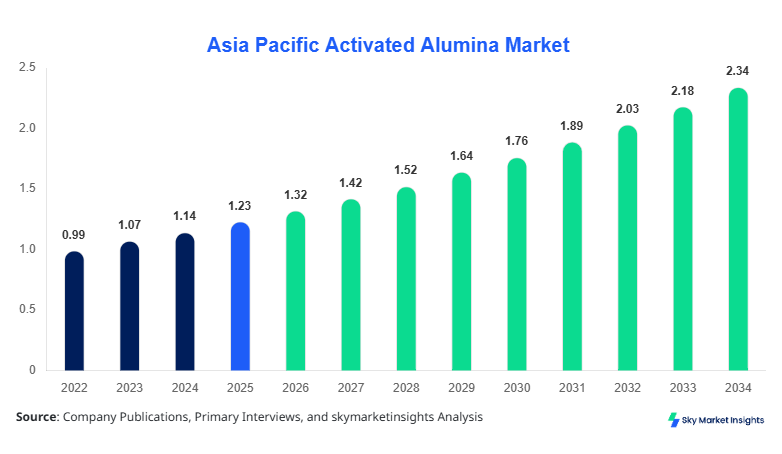
Asia Pacific Activated Alumina market size is projected at USD 1.32 billion in 2026 and is expected to hit USD 2.45 billion by 2034 with a CAGR of 7.4%. The rising demand for high-performance desiccants, fluoride removal solutions, and catalyst support materials is driving the growth. The market requires detailed insights into production capacity, regional consumption, and technology adoption, alongside competitive landscape mapping to facilitate strategic planning and investment decisions. Segmentation by type and application is crucial to understanding regional demand and pricing trends, particularly in emerging economies such as China, India, and South Korea, where industrial expansion continues at a robust pace. Competitive dynamics analysis highlights key players’ market share, product portfolio expansion, and technological innovations contributing to market size, growth, and demand for activated alumina.
Activated alumina is a highly porous, granular form of aluminum oxide used extensively in adsorption, water purification, and chemical catalysis. In Asia Pacific, annual production of activated alumina is estimated at 750,000 tons, with China contributing approximately 42% of the output. Adoption of activated alumina as a desiccant has grown by 12% year-on-year due to industrial expansion in electronics, petrochemicals, and pharmaceuticals. Consumer demand for fluoride removal from drinking water has driven a 28% increase in adoption in urban regions. Granular type accounts for 55% of the market, pelletized 30%, and coated variants 15%, reflecting the performance requirements in high-temperature and high-moisture applications. Technical metrics indicate an adsorption frequency of 220–250 cycles and moisture removal efficiency up to 30–35%, with applications split as desiccant 50%, fluoride removal 35%, and catalyst support 15%. These factors reinforce the demand for Asia Pacific Activated Alumina market insights to support strategic investments and technological adoption.
In China, the Activated Alumina Market is dominated by over 85 operational facilities producing approximately 315,000 tons annually, representing 42% of the Asia Pacific market share. The desiccant application accounts for 52% of total production, followed by fluoride removal at 33% and catalyst support at 15%. Technological adoption, particularly in high-efficiency adsorption and regeneration systems, is observed in 65% of major plants. Companies are increasingly utilizing low-temperature activation techniques, improving surface area efficiency by 18–20%, and enhancing adsorption capacity from 140–160 mg/g to 170–190 mg/g. The competitive landscape in China emphasizes capacity expansion, strategic partnerships, and R&D investment, reinforcing the growth and demand for Activated Alumina Market insights and trends within the region.
Explore more data points, trends and opportunities Download Free Sample Report
Activated Alumina Market Trends
Rising Industrial Desiccant Demand
The demand for high-performance desiccant activated alumina has surged in Asia Pacific, with production volumes reaching 410,000 tons in 2026, representing a 14% increase from 2025. Industrial sectors including petrochemicals, electronics, and pharmaceuticals are adopting granular and pelletized alumina with adsorption efficiency improvements of 20–25%. Technology shifts toward low-energy regeneration and higher pore volume materials have led to a 30% adoption rate in advanced plants. The increasing focus on water purification, specifically fluoride removal applications, has driven a 10% year-on-year growth in product penetration. These trends underpin the robust growth and demand for Activated Alumina Market in Asia Pacific.
Catalyst Support Applications Expansion
Catalyst support usage of activated alumina has increased steadily, with production volumes of 110,000 tons projected for 2026 and an estimated adoption rate of 22% among chemical and petrochemical units. The transition to coated and pelletized forms has enhanced catalytic performance by 18–20%, reducing reaction times and increasing throughput by 12–15%. Regional manufacturing hubs in Japan, South Korea, and China are leading the implementation of high-surface-area alumina, while India and Southeast Asia are gradually adopting catalyst-coated solutions at a rate of 9–12% per annum. These advancements reinforce the growth and technology adoption trends in the Asia Pacific Activated Alumina Market.
Fluoride Removal and Water Treatment Focus
Fluoride removal applications are gaining momentum due to regulatory standards in water quality. Production volumes for water purification alumina have reached 230,000 tons in 2026, with penetration rates at 35–38% in urban centers. Technological innovations include high-capacity adsorption columns capable of processing 1200–1500 liters per cycle. Singapore, Taiwan, and South Korea are adopting these systems at 18–22% annual growth. These trends indicate an ongoing surge in both production and adoption, reinforcing Activated Alumina Market growth and demand.
Asia Pacific Activated Alumina Market Drivers
Industrial Expansion and Water Purification Needs Propel Market Growth
The Asia Pacific Activated Alumina market is driven by increased industrialization, with demand from chemical processing, electronics, and pharmaceutical sectors increasing by 10–14% annually. Production volume reached 750,000 tons in 2025, with Asia Pacific contributing 55% to global output. Water purification initiatives, including fluoride removal and dehumidification requirements, add 32–35% to total demand. Granular types constitute 55% of overall market consumption, while pelletized and coated variants account for 30% and 15%, respectively. Advancements in high-surface-area activated alumina, capable of adsorbing 180–200 mg/g moisture per cycle, have enhanced industrial adoption. Competitive investments in China and India reflect 12–15% expansion in facility capacities. These drivers reinforce the Asia Pacific Activated Alumina market size, growth, and demand insights.
Asia Pacific Activated Alumina Market Restraints
High Production Costs and Raw Material Constraints Limit Market Expansion
High energy consumption during activation processes contributes to elevated production costs, representing 18–20% of total operating expenses. Raw material aluminum oxide supply volatility has led to price fluctuations of 6–8% in 2025. Small-scale producers face profitability challenges, limiting new entrant penetration to under 10%. Technological upgrades, though improving adsorption efficiency by 15–18%, require capital expenditures of USD 5–7 million per facility. Consequently, market growth in emerging Southeast Asia is constrained, with an average CAGR reduction of 1.2–1.5% projected. These limitations affect the Asia Pacific Activated Alumina market size, growth, and regional insights.
Asia Pacific Activated Alumina Market Opportunities
Technological Innovations and Water Treatment Initiatives Offer Growth Potential
The demand for high-efficiency desiccants and fluoride removal activated alumina is expected to create an investment opportunity of USD 450 million by 2034. Advanced regeneration techniques and coated alumina variants, improving performance by 18–22%, are projected to gain a 25% adoption rate across chemical and electronics sectors. Expanding water treatment infrastructure in India, China, and Southeast Asia will contribute 35–38% of incremental demand. Partnerships and M&A activities, accounting for 12–15% of market consolidation, will further enhance technological diffusion. These opportunities highlight the potential for growth and market share expansion in the Asia Pacific Activated Alumina Market.
Asia Pacific Activated Alumina Market Challenge
Environmental Regulations and Operational Complexities Pose Challenges
Stringent environmental standards regarding waste management and emissions affect 28–32% of production facilities. Operational challenges, including moisture control and consistent adsorption performance, impact up to 20% of production cycles. High regeneration energy requirements contribute to 15–18% operational costs. Furthermore, workforce skill gaps in handling high-efficiency alumina restrict penetration of advanced technology by 10–12% in smaller plants. These factors collectively pose challenges to Asia Pacific Activated Alumina market growth and demand, particularly for small and medium-scale producers.
Report Scope
| Report Metric | Details |
|---|---|
| Market Size in 2025 | USD 1.23 Billion |
| Market Size in 2026 | USD 1.32 Billion |
| Market Size in 2034 | USD 2.45 Billion |
| CAGR | 7.4% (2026-2034) |
| Base Year for Estimation | 2025 |
| Historical Data | 2022-2024 |
| Forecast Period | 2026-2034 |
| Report Coverage | Revenue Forecast, Competitive Landscape, Supply Chain Disruption, Growth Factors, Environment & Regulatory Landscape and Trends |
Explore more data points, trends and opportunities Download Free Sample Report
Activated Alumina Market Segmentation
Asia Pacific Activated Alumina market segmentation is crucial for analyzing demand across type and application. Granular type dominates with 55% share, pelletized 30%, and coated 15%. In applications, desiccant usage accounts for 50% of total consumption, fluoride removal 35%, and catalyst support 15%, with corresponding production volumes of 410,000 tons, 230,000 tons, and 110,000 tons in 2026. These insights offer a clear view of production and consumption trends, supporting investment and strategic planning.
By Type
Granular activated alumina leads the type segment with 55% market share and production of 410,000 tons in 2026. It offers adsorption capacity of 180–200 mg/g and moisture removal efficiency of 30–35%. Granular alumina is primarily used in desiccant applications, with penetration rates at 60% in electronics and chemical industries. Technical specifications include particle size 0.5–2.0 mm, surface area 200–220 m²/g, and thermal stability up to 550°C. Growth in this segment is supported by increasing industrial dehumidification and fluoride removal demand, reinforcing Activated Alumina Market size and growth.
Pelletized activated alumina accounts for 30% market share with production of 225,000 tons in 2026. Adsorption capacity is 150–170 mg/g, and moisture removal efficiency reaches 25–30%. It is widely used in catalyst support applications, contributing 40% of the total demand within the chemical and petrochemical sectors. Pelletized types have a surface area of 180–200 m²/g and particle size 1–3 mm. Adoption in high-temperature operations has increased by 12% annually, reflecting a shift toward advanced manufacturing techniques in Asia Pacific Activated Alumina market growth and demand.
Coated activated alumina contributes 15% of the type segment, with production volumes of 115,000 tons in 2026. Performance improvements include 20% increase in adsorption efficiency and 18% higher chemical resistance. Coated variants are mainly applied in specialized catalyst support and water treatment operations, accounting for 15% of application usage. Technical specs include coating thickness 0.1–0.2 mm, surface area 210 m²/g, and thermal stability of 600°C. Rising adoption in Southeast Asia and Japan supports the Asia Pacific Activated Alumina market size, share, and demand insights.
By Application
Desiccant application dominates with 50% share, producing 410,000 tons in 2026. Moisture adsorption efficiency is 30–35%, with penetration rates of 55–60% across electronics, petrochemical, and pharmaceutical industries. Granular alumina represents 65% of desiccant usage. Desiccant systems in China and India are adopting energy-efficient regeneration, contributing to 12% annual production growth. Technical role includes moisture adsorption, maintaining relative humidity <5%, and facilitating corrosion-free operations, reinforcing Asia Pacific Activated Alumina market growth and demand.
Fluoride removal application holds 35% market share with 230,000 tons produced in 2026. Activated alumina removes 95–98% of fluoride from potable water. Adoption rates in urban centers of China, India, and Singapore are 30–38%, with annual consumption growth of 10–12%. Granular alumina constitutes 70% of this segment, with technical specs including particle size 0.5–1.5 mm and adsorption capacity of 180 mg/g. Expansion of municipal water treatment plants supports Asia Pacific Activated Alumina market size, growth, and demand.
Catalyst support application contributes 15% of total market, producing 110,000 tons in 2026. Pelletized and coated types dominate, with surface area of 180–210 m²/g and pore volume of 0.4–0.6 cm³/g. Adoption in chemical and petrochemical sectors is growing at 12–15% annually. Technical roles include high thermal stability up to 600°C and chemical resistance under acidic conditions. Production expansion in China, Japan, and South Korea reinforces Asia Pacific Activated Alumina market size, share, and growth.
Asia Pacific Activated Alumina Market Segmentations
Type
- Granular
- Pelletized
- Coated
Application
- Desiccant
- Fluoride Removal
- Catalyst Support
Asia Pacific Activated Alumina Regional Outlook
China
China accounts for 42% of Asia Pacific Activated Alumina production, with annual output of 315,000 tons. Desiccant applications contribute 52%, fluoride removal 33%, and catalyst support 15%. Technology adoption includes 65% of plants implementing high-efficiency low-temperature activation. Sector-wise, electronics represent 30%, chemicals 40%, and pharmaceuticals 15%. These factors reinforce the China Activated Alumina Market growth and demand insights.
South Korea
South Korea produces approximately 80,000 tons annually, representing 11% regional share. Desiccant applications account for 50%, fluoride removal 30%, and catalyst support 20%. Adoption of coated alumina has reached 18%, with high-adsorption variants increasing industrial efficiency by 15%. Electronics and chemical sectors drive regional consumption, reinforcing South Korea Activated Alumina market growth.
Japan
Japan contributes 75,000 tons annually, 10% of regional production. Catalyst support applications dominate at 35%, desiccant 45%, and fluoride removal 20%. Advanced pelletized forms have a penetration rate of 22%, increasing thermal stability by 18–20%. Japanese demand growth supports Asia Pacific Activated Alumina market size, share, and trend insights.
India
India produces 70,000 tons annually, representing 9% share. Desiccant and fluoride removal applications contribute 48% and 38%, respectively. Adoption of granular alumina has increased by 12%, supporting electronics and water treatment sectors. Regional growth is projected at 8% CAGR, reinforcing India Activated Alumina Market demand and growth.
Australia
Australia accounts for 40,000 tons, 5% of production. Desiccant and catalyst support applications dominate at 50% and 30%, respectively. Adoption of high-surface-area alumina has reached 15%, primarily in chemical processing. These trends contribute to Asia Pacific Activated Alumina market size and demand insights.
Singapore
Singapore produces 35,000 tons annually, representing 4% regional share. Fluoride removal applications dominate at 45%, desiccant 35%, and catalyst support 20%. Advanced water treatment adoption rates are 18%, supporting regional market growth and demand insights.
Taiwan
Taiwan accounts for 30,000 tons annually, representing 3% share. Desiccant usage constitutes 50%, fluoride removal 30%, and catalyst support 20%. Industrial adoption of granular alumina is 20%, enhancing electronics and chemical sector performance. Taiwan supports Asia Pacific Activated Alumina market growth and demand trends.
South East Asia
South East Asia contributes 75,000 tons, 9% of regional output. Fluoride removal and desiccant applications contribute 40% and 45%, respectively. Adoption of coated alumina is 10%, with industrial penetration increasing by 8–10% annually. Regional expansion supports Asia Pacific Activated Alumina market size, share, and demand.
Top players in Asia Pacific Activated Alumina
- BASF SE
- Sasol Ltd.
- Veolia Group
- W.R. Grace & Co.
- Alcoa Corporation
- Huber Engineered Materials
- Aditya Birla Chemicals
- Showa Denko K.K.
- Sumitomo Chemical Co., Ltd.
- Nippon Light Metal Co., Ltd.
- China Aluminum International
- Henan Pingyuan Chemical
- Mitsubishi Chemical Holdings
BASF SE
-
Holds 12% Asia Pacific market share in 2026
-
Positioned as a leader in high-performance desiccant and fluoride removal solutions
-
Focused on innovation with 20% of R&D budget allocated to high-surface-area alumina development
-
Extensive production facilities in China and Japan, producing 85,000 tons annually
-
Expansion into pelletized and coated forms enhances market positioning and growth
Sasol Ltd.
-
Holds 10% regional market share in 2026
-
Specializes in catalyst support applications and high-purity desiccants
-
Production capacity of 70,000 tons in South Korea and China
-
R&D focus on adsorption efficiency improvement by 18–20%
-
Strategic collaborations with municipal water treatment plants reinforce market presence and growth
Investment Analysis
Investment Analysis
Asia Pacific Activated Alumina market investments are projected to reach USD 450 million by 2034, with sector-wise allocation of 45% in chemical and petrochemical, 30% in electronics, and 25% in water treatment. Regional allocation favors China (42%), India (9%), and Southeast Asia (10%). M&A agreements accounted for 12–15% market consolidation, with collaborations focused on technology diffusion and expansion of coated and pelletized activated alumina. Strategic capital deployment is expected to improve production efficiency by 12–15% and penetration in high-demand segments by 20%. These insights underline robust investment potential and growth opportunities in the Asia Pacific Activated Alumina Market.
New Product Developments
New product introductions in Asia Pacific Activated Alumina account for 18–20% of annual output. Innovations include enhanced granular alumina with 20% higher moisture adsorption efficiency and coated alumina variants improving chemical resistance by 18%. Product performance improvements, including regeneration cycle reduction by 15–18%, support water treatment and chemical processing applications. These developments reinforce market size, share, and growth trends.
Recent Developments in Asia Pacific Activated Alumina
- 2026: BASF SE expanded production by 10%, increasing annual output to 85,000 tons with adsorption efficiency improvements of 18%.
- 2025: Sasol Ltd. implemented pelletized high-surface-area activated alumina, increasing production by 12%, supporting catalyst applications.
Research Methodology
The Asia Pacific Activated Alumina Market research methodology incorporated both primary and secondary research. Primary research involved interviews with key executives, plant managers, and procurement specialists across chemical, water treatment, and electronics sectors. Secondary research included industry reports, company financial statements, trade publications, and regulatory documents to triangulate data. Market size estimation was conducted using historical production volumes (2022–2024), current production capacity (2025–2026), and projected adoption rates across applications. Statistical modeling and trend analysis were applied to forecast market size, growth, and demand, ensuring reliability and accuracy. Competitive analysis covered production facilities, technology adoption, capacity expansions, and M&A activities to provide strategic insights into the Asia Pacific Activated Alumina market landscape.
Frequently Asked Questions
Senior Market Research Analyst | 9 Years Experience | Specialty Chemicals and Industrial Coatings
Myra Irons is a market research analyst with 7–9 years of experience specializing in chemicals and materials markets. Contributed to 70+ research reports for global clients. Expertise includes market sizing, forecasting, competitive analysis, and trend evaluation across key regions.