Europe Aromatic Solvents Market Size
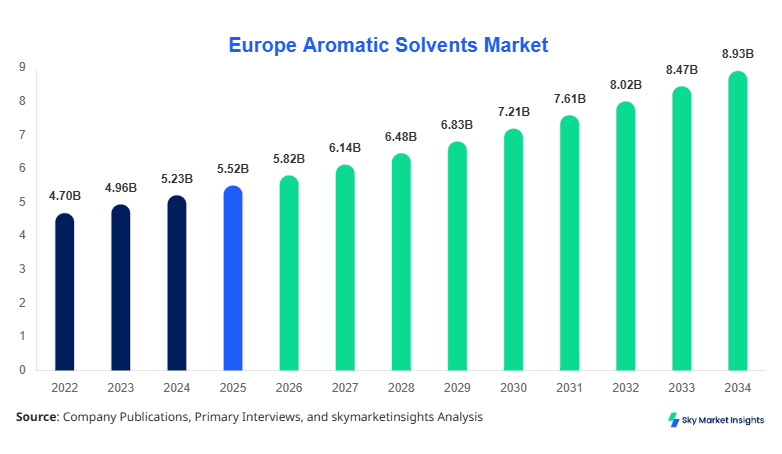
Europe Aromatic Solvents market size is projected at USD 5.82 billion in 2026 and is expected to hit USD 8.94 billion by 2034 with a CAGR of 5.5%. The market expansion is supported by rising industrial solvent consumption across paints, coatings, pharmaceuticals, rubber processing, and automotive manufacturing applications across Europe. Increasing regulatory emphasis on high-purity solvent formulations and low-VOC industrial chemicals has accelerated the replacement of conventional aliphatic solvents with aromatic solvent blends in several industrial sectors. The market assessment includes detailed segmentation analysis, production capacity evaluation, competitive benchmarking, and country-level consumption patterns across the European manufacturing ecosystem.
The Aromatic Solvents Market in Europe refers to the production, distribution, and application of benzene-derived solvent compounds including toluene, xylene, ethylbenzene, and mixed aromatic formulations used across industrial and chemical processing sectors. Europe produced nearly 7.8 million metric tons of aromatic solvents in 2025, with Germany, France, and the United Kingdom jointly accounting for over 54% of total regional production capacity. Adoption of aromatic solvents in industrial coatings reached approximately 68% across automotive and construction applications owing to superior solvency performance, flash point stability, and resin compatibility. Penetration of aromatic solvent formulations in pharmaceutical intermediates increased by 11.6% during 2024–2025 due to rising specialty chemical synthesis requirements. Consumer demand analytics indicate that industrial coatings represented nearly 39% of total solvent consumption, while adhesives contributed 18%, pharmaceuticals 14%, rubber processing 12%, and printing inks 9%. Technical performance metrics show aromatic solvents delivering evaporation rates between 0.8–1.4 relative butyl acetate values and solvency power exceeding Kauri-butanol values of 90–105. The Europe Aromatic Solvents Market continues to witness expanding industrial deployment driven by efficiency, purity, and chemical stability requirements.
Explore more data points, trends and opportunities Download Free Sample Report
Aromatic Solvents Market Trends
Rising Adoption of High-Purity Solvent Technologies
European manufacturers increasingly shifted toward high-purity aromatic solvent production technologies during 2024 and 2025 as regulatory agencies tightened industrial emission standards and product purity requirements. More than 46% of newly commissioned aromatic solvent production units integrated advanced catalytic reforming and hydrodealkylation technologies to improve purity levels and reduce sulfur content below 5 ppm. Production volume of pharmaceutical-grade aromatic solvents surpassed 1.1 million metric tons in 2025, compared with 870 kilotons in 2022. Germany and France jointly represented nearly 48% of high-purity aromatic solvent manufacturing capacity in Europe. Industrial coatings manufacturers increased procurement of ultra-low impurity xylene blends by 18.7% owing to improved drying performance and compatibility with polyurethane coatings. Approximately 57% of industrial adhesive producers adopted mixed aromatic solvents with controlled evaporation rates for precision bonding applications. The Europe Aromatic Solvents Market continues to witness technological modernization and enhanced production efficiency.
Expansion of Circular Solvent Recovery Infrastructure
The adoption of circular economy initiatives significantly influenced aromatic solvent manufacturing and consumption patterns across Europe. Solvent recycling and regeneration capacity increased by nearly 21% between 2023 and 2025, reaching over 2.4 million metric tons annually. More than 130 industrial recovery plants across Europe implemented closed-loop solvent purification systems capable of recovering 85–92% of used aromatic solvents. The United Kingdom and Italy emerged as major centers for industrial solvent recycling infrastructure, jointly accounting for 29% of total recovery capacity additions during 2025. Automotive refinishing and industrial coatings sectors collectively contributed approximately 44% of recyclable aromatic solvent waste streams. Manufacturers increasingly integrated AI-enabled monitoring systems that reduced solvent losses by nearly 13%. Demand for recycled aromatic solvents increased by 16.4% among mid-sized coatings manufacturers seeking cost-efficient raw material procurement. This transition toward solvent circularity continues strengthening the Europe Aromatic Solvents Market.
Growth of Automotive and Construction Applications
The automotive and infrastructure sectors remain major consumption drivers for aromatic solvents across Europe. Automotive coatings demand increased by 9.3% during 2025 due to growing vehicle refinishing activities and electric vehicle manufacturing expansion. Europe produced over 15.2 million passenger vehicles in 2025, generating significant demand for high-performance solvent-based coatings and cleaning agents. Construction chemicals consumed approximately 980 kilotons of aromatic solvents, supported by commercial infrastructure rehabilitation projects across Germany, France, and Spain. Solvent-borne protective coatings maintained nearly 42% penetration within industrial metal finishing applications because of superior durability and corrosion resistance. Infrastructure modernization investments exceeding USD 240 billion across Europe accelerated demand for adhesives, paints, and industrial coatings requiring aromatic solvent formulations. These industrial developments continue supporting the Europe Aromatic Solvents Market.
Europe Aromatic Solvents Drivers
Expansion of Industrial Coatings and Automotive Manufacturing
The rapid expansion of industrial coatings and automotive manufacturing industries across Europe is significantly driving aromatic solvent consumption. Industrial coatings production exceeded 6.4 million metric tons across Europe in 2025, with aromatic solvents accounting for nearly 34% of total solvent inputs used in protective coatings, marine paints, and automotive finishes. Automotive manufacturing facilities across Germany, France, Spain, and Italy collectively consumed over 1.3 million metric tons of solvent-based coating materials during 2025. Nearly 71% of OEM automotive coatings continued utilizing aromatic solvent blends due to superior solvency performance and rapid drying capabilities. The construction sector also increased usage of solvent-borne paints for industrial infrastructure projects, leading to an 8.7% rise in aromatic solvent procurement. Adhesive and sealant manufacturing volumes rose by 12%, supported by increasing electric vehicle battery assembly requirements. The presence of over 2,400 industrial coating manufacturers across Europe further reinforces long-term solvent demand. The Europe Aromatic Solvents Market benefits strongly from expanding manufacturing output and high industrial coating penetration.
Europe Aromatic Solvents Restraints
Stringent VOC Emission Regulations and Environmental Compliance Costs
Stringent environmental regulations governing volatile organic compound emissions continue restraining aromatic solvent adoption across several European industries. The European Union reduced allowable VOC emission thresholds by approximately 15% between 2022 and 2025, forcing manufacturers to invest heavily in emission mitigation technologies. Compliance expenditures for medium-sized solvent producers increased by nearly 18%, with advanced vapor recovery systems costing between USD 2.5 million and USD 8 million per production facility. More than 37% of small-scale coating manufacturers shifted partially toward water-based alternatives to reduce environmental compliance risks. Regulatory pressure particularly impacted benzene-derived aromatic formulations due to occupational exposure concerns. Industrial users operating under REACH compliance frameworks reported operational cost increases exceeding 11% annually for solvent handling, storage, and monitoring systems. These regulatory and environmental pressures continue moderating expansion opportunities within the Europe Aromatic Solvents Market.
Europe Aromatic Solvents Opportunities
Increasing Demand for Pharmaceutical and Specialty Chemical Applications
The growing pharmaceutical and specialty chemicals sectors across Europe present substantial opportunities for aromatic solvent manufacturers. Pharmaceutical intermediate production in Europe exceeded USD 165 billion during 2025, with aromatic solvents extensively utilized in extraction, synthesis, purification, and crystallization processes. High-purity toluene and xylene formulations accounted for nearly 28% of solvent consumption within pharmaceutical manufacturing operations. Demand for electronic-grade aromatic solvents increased by 14.2% owing to semiconductor and specialty electronics expansion across Germany and France. Specialty chemical manufacturers increasingly adopted customized aromatic solvent blends with purity levels above 99.5% for advanced formulations. Investments exceeding USD 12 billion in European pharmaceutical manufacturing infrastructure during 2024–2025 accelerated solvent procurement requirements. Contract manufacturing organizations expanded production capacities by 9.8%, creating additional opportunities for solvent suppliers. These developments are expected to generate long-term opportunities within the Europe Aromatic Solvents Market.
Challenges in Europe Aromatic Solvents Market
Feedstock Price Volatility and Supply Chain Disruptions
Volatility in crude oil and petrochemical feedstock pricing remains a major challenge for aromatic solvent manufacturers across Europe. Benzene and naphtha feedstock prices fluctuated by more than 24% during 2024–2025, significantly impacting solvent production economics. Transportation and logistics costs increased by approximately 13%, particularly affecting cross-border solvent distribution between Eastern and Western Europe. Nearly 42% of medium-scale manufacturers reported supply disruptions related to refinery maintenance shutdowns and geopolitical trade uncertainties. Production lead times for specialty aromatic blends increased from 18 days in 2023 to nearly 27 days during 2025 because of raw material shortages. Russia-related supply restrictions and energy price instability further elevated manufacturing expenses for solvent producers. In addition, labor shortages across chemical processing facilities increased operational costs by approximately 9%. These supply chain and feedstock challenges continue impacting operational efficiency within the Europe Aromatic Solvents Market.
Report Scope
| Report Metric | Details |
|---|---|
| Market Size in 2025 | USD 5.52 Billion |
| Market Size in 2026 | USD 5.82 Billion |
| Market Size in 2034 | USD 8.94 Billion |
| CAGR | 5.5% (2026-2034) |
| Base Year for Estimation | 2025 |
| Historical Data | 2022-2024 |
| Forecast Period | 2026-2034 |
| Report Coverage | Revenue Forecast, Competitive Landscape, Supply Chain Disruption, Growth Factors, Environment & Regulatory Landscape and Trends |
Explore more data points, trends and opportunities Download Free Sample Report
Aromatic Solvents Market Segmentation
The Europe Aromatic Solvents Market is segmented by type and application, with toluene-based solvents dominating nearly 41% of regional consumption volume during 2025. Industrial coatings and paints represented approximately 39% of total market demand, followed by adhesives at 18% and pharmaceuticals at 14%. Increasing specialty chemical production and automotive manufacturing activities continue influencing segment-level expansion patterns.
By Type
Toluene accounted for approximately 41% of total aromatic solvent consumption across Europe during 2025, supported by extensive use in paints, coatings, adhesives, and chemical synthesis. Production volumes exceeded 3.1 million metric tons annually, with Germany and France contributing nearly 49% of total regional output. Toluene solvents demonstrated evaporation rates ranging between 2.0–2.5 and boiling points around 110.6°C, making them suitable for rapid-drying industrial coatings and resin dissolution applications. Nearly 62% of automotive refinishing coatings utilized toluene-based formulations owing to high solvency strength and compatibility with acrylic resins. Pharmaceutical manufacturers consumed more than 320 kilotons of high-purity toluene for intermediate synthesis and extraction processes. Advanced recovery systems improved solvent recycling efficiency by 17%, reducing industrial wastage across large manufacturing facilities.
Xylene represented nearly 36% of Europe’s aromatic solvent consumption during 2025, with annual production volumes exceeding 2.7 million metric tons. Mixed xylene formulations remained highly preferred across industrial coatings, pesticides, and printing ink applications because of balanced evaporation rates and superior solvency performance. Industrial coatings alone accounted for 46% of total xylene demand. Xylene blends exhibited boiling ranges between 137–144°C and KB values above 98, making them effective in polyurethane and epoxy coating systems. Spain and Italy jointly contributed approximately 21% of regional xylene processing capacity. Rising demand from construction coatings and marine applications supported a 9.1% increase in xylene consumption during 2025. Manufacturers increasingly adopted low-sulfur xylene variants with impurity levels below 10 ppm for specialty chemical formulations.
Ethylbenzene accounted for nearly 13% of aromatic solvent consumption in Europe during 2025, primarily driven by styrene monomer production and specialty solvent applications. Regional production exceeded 980 kilotons, with major processing facilities concentrated in Germany, Russia, and the United Kingdom. Ethylbenzene solvents offered strong compatibility with synthetic rubber manufacturing and resin production systems. Nearly 58% of ethylbenzene demand originated from polymer and plastics manufacturing sectors. Industrial usage increased by approximately 7.8% during 2025 due to rising demand for packaging materials and insulation products. Manufacturers implemented advanced catalytic dehydrogenation systems that improved production efficiency by 12% while reducing energy consumption levels.
By Application
Paints and coatings remained the largest application segment, accounting for nearly 39% of aromatic solvent demand across Europe during 2025. Industrial coating production exceeded 6.4 million metric tons, generating substantial consumption of toluene and xylene blends for resin dissolution and viscosity control. Automotive coatings represented approximately 34% of total paints and coatings solvent utilization, followed by architectural coatings at 27% and industrial protective coatings at 21%. Solvent-borne coatings maintained strong penetration in marine and heavy industrial applications due to superior corrosion resistance and durability. High-performance aromatic solvents improved coating adhesion efficiency by nearly 16% and drying performance by 12%. Germany and France collectively consumed more than 1.1 million metric tons of aromatic solvents within coatings applications during 2025.
Adhesives accounted for approximately 18% of aromatic solvent consumption in Europe during 2025, supported by strong demand from automotive assembly, packaging, and construction sectors. Europe produced nearly 4.8 million metric tons of industrial adhesives during the year, with aromatic solvents widely utilized for viscosity control, resin dispersion, and curing enhancement. Automotive battery manufacturing and lightweight vehicle assembly increased adhesive solvent consumption by approximately 14.5%. Solvent-based adhesives maintained nearly 52% penetration across industrial bonding applications due to superior mechanical strength and fast curing characteristics. Toluene-based adhesive systems demonstrated tensile improvements exceeding 11% compared with alternative solvent systems. The United Kingdom and Italy jointly represented nearly 24% of total adhesive-related aromatic solvent demand.
Pharmaceutical applications represented approximately 14% of total aromatic solvent consumption in Europe during 2025. High-purity aromatic solvents were extensively utilized in extraction, purification, crystallization, and synthesis processes across pharmaceutical manufacturing facilities. Europe operated more than 1,200 pharmaceutical production plants requiring specialty solvent formulations with purity levels exceeding 99.5%. Pharmaceutical-grade aromatic solvent demand increased by nearly 11.6% during 2025 owing to expanding biologics and specialty drug production. France and Germany together accounted for 44% of pharmaceutical solvent utilization across Europe. Solvent recovery technologies reduced process wastage by approximately 19%, improving operational sustainability within pharmaceutical manufacturing operations.
Europe Aromatic Solvents Market Segmentations
Type
- Toluene
- Xylene
- Ethylbenzene
Application
- Paints and Coatings
- Adhesives
- Pharmaceuticals
Europe Aromatic Solvents Regional Outlook
United Kingdom
The United Kingdom accounted for approximately 14% of Europe’s aromatic solvent consumption during 2025, supported by strong pharmaceutical, coatings, and industrial adhesive sectors. The country produced nearly 1.1 million metric tons of aromatic solvents annually through more than 85 solvent processing and petrochemical facilities. Industrial coatings represented 36% of domestic solvent demand, while pharmaceutical applications contributed 18%. The United Kingdom also emerged as a leading center for solvent recycling technologies, accounting for nearly 16% of Europe’s regenerated aromatic solvent capacity. Adoption of automated solvent recovery systems increased by 22% during 2025. Investments in specialty chemical manufacturing and aerospace coatings continue supporting domestic solvent consumption.
Germany
Germany remained the largest aromatic solvent producer in Europe, accounting for nearly 27% of regional production capacity during 2025. The country manufactured over 2.1 million metric tons of aromatic solvents through integrated petrochemical complexes and specialty chemical plants. Automotive manufacturing represented approximately 31% of solvent demand, followed by industrial coatings at 29% and adhesives at 16%. Germany operated more than 240 industrial coating production facilities requiring high-performance solvent systems. High-purity aromatic solvent demand increased by nearly 13% due to semiconductor and electronics manufacturing expansion. Industrial automation and closed-loop recovery systems reduced solvent losses by approximately 15% across major manufacturing facilities.
France
France represented approximately 22% of Europe’s aromatic solvent consumption volume during 2025, supported by strong automotive, pharmaceutical, and coatings industries. The country produced more than 1.5 million metric tons of aromatic solvents annually, with toluene accounting for the largest production share. Industrial coatings and construction chemicals jointly contributed 44% of domestic solvent demand. France also maintained nearly 17% of Europe’s pharmaceutical-grade solvent manufacturing capacity. Investments exceeding USD 3.4 billion in chemical manufacturing modernization projects accelerated adoption of low-emission solvent technologies. Solvent recovery infrastructure expanded by 12% during 2025 across industrial regions including Normandy and Auvergne-Rhône-Alpes.
Spain
Spain accounted for nearly 10% of Europe’s aromatic solvent consumption during 2025, with annual production volumes surpassing 760 kilotons. Paints and coatings represented approximately 41% of solvent demand, followed by adhesives at 19% and printing inks at 11%. Spain experienced increasing infrastructure development activities that stimulated demand for industrial coatings and construction adhesives. The country also expanded marine coatings production capacity by 9%, supporting additional aromatic solvent consumption. Adoption of advanced refining and catalytic processing technologies improved production efficiency by nearly 10%. Export-oriented chemical manufacturing facilities in Catalonia and Valencia contributed significantly to domestic solvent production.
Italy
Italy represented approximately 12% of Europe’s aromatic solvent market consumption during 2025, supported by industrial manufacturing, automotive components, and furniture coatings sectors. The country produced nearly 920 kilotons of aromatic solvents annually, with xylene-based formulations accounting for 38% of output. Industrial coatings and adhesives jointly represented more than 52% of total domestic demand. Italy also emerged as a key market for recycled aromatic solvents, accounting for nearly 13% of Europe’s regenerated solvent utilization. Demand from packaging adhesives and industrial laminates increased by approximately 8.4% during 2025. Northern Italy remained the dominant production region due to its concentrated manufacturing infrastructure.
Russia
Russia accounted for approximately 15% of regional aromatic solvent production during 2025, with total output exceeding 1.3 million metric tons. Petrochemical refining complexes and large-scale chemical manufacturing plants supported extensive production of toluene and xylene derivatives. Industrial chemicals and rubber processing represented nearly 46% of domestic solvent demand. Russia also supplied aromatic solvent feedstocks to several Eastern European chemical manufacturers. However, geopolitical trade restrictions and logistics disruptions increased transportation costs by approximately 17% during 2025. Despite regulatory and trade challenges, domestic industrial demand continued supporting solvent manufacturing activities.
Top players in Europe Aromatic Solvents
- ExxonMobil Chemical
- Shell Chemicals
- TotalEnergies
- BASF SE
- INEOS Group
- Dow Chemical Company
- LyondellBasell Industries
- Repsol S.A.
- Sasol Limited
- Braskem Europe
- Versalis S.p.A.
- CEPSA Chemicals
- Honeywell International
- Eastman Chemical Company
- Chevron Phillips Chemical
BASF SE
-
BASF SE accounted for approximately 11% of the Europe aromatic solvent industry revenue during 2025.
-
The company operates integrated petrochemical complexes across Germany and France with annual aromatic solvent production capacity exceeding 820 kilotons.
-
BASF maintains strong positioning in high-purity solvent formulations for pharmaceutical and specialty coating applications.
-
Nearly 38% of BASF’s aromatic solvent sales originated from industrial coatings and automotive applications.
-
The company invested more than USD 480 million in emission reduction technologies and advanced solvent recovery infrastructure between 2023 and 2025.
Shell Chemicals
-
Shell Chemicals represented nearly 9% of total European aromatic solvent production during 2025.
-
The company operates large-scale refining and petrochemical facilities in the Netherlands, Germany, and the United Kingdom.
-
Shell expanded specialty aromatic solvent output by approximately 14% during 2025 to address growing pharmaceutical and coatings demand.
-
More than 44% of the company’s solvent portfolio includes low-sulfur and ultra-high-purity formulations.
-
Shell also strengthened its recycling infrastructure through collaborations with industrial solvent recovery firms across Europe.
Investment Analysis
Investments in aromatic solvent manufacturing and recovery infrastructure increased substantially across Europe during 2024–2025. Approximately 38% of total industry investments were allocated toward solvent purification and low-emission processing systems, while 27% focused on recycling infrastructure development. Germany accounted for nearly 29% of total regional investment expenditure, followed by France at 22% and the United Kingdom at 14%. Petrochemical modernization projects collectively exceeded USD 18 billion during the assessment period, supporting capacity expansion and operational efficiency improvements.
Pharmaceutical and specialty chemical sectors attracted nearly 31% of aromatic solvent-related investments due to rising demand for high-purity formulations. Mergers, acquisitions, and strategic collaborations accelerated significantly across the European chemical industry. More than 26 cross-border partnership agreements were signed during 2024–2025 involving solvent recovery technologies, advanced refining systems, and specialty chemical manufacturing. Major chemical producers increasingly collaborated with recycling companies to establish circular solvent recovery networks capable of reducing waste generation by nearly 20%. Private equity investments in specialty solvent manufacturing rose by approximately 12%, particularly in Germany and France. Infrastructure funds and sustainability-focused investors prioritized projects involving VOC reduction and carbon-efficient refining systems. These investment activities continue strengthening industrial competitiveness and manufacturing resilience across the European aromatic solvent sector.
New Product Developments
Manufacturers across Europe accelerated the launch of high-performance aromatic solvent formulations during 2025 to address evolving industrial requirements and regulatory standards. Nearly 24% of newly introduced solvent products focused on ultra-low sulfur and low-VOC compositions designed for pharmaceutical and specialty coating applications. Advanced xylene blends with controlled evaporation characteristics improved coating performance efficiency by approximately 15% while reducing drying time by 11%.
Several producers introduced recyclable aromatic solvent formulations capable of achieving recovery efficiencies above 90%. Innovation activities also emphasized solvent compatibility with bio-based resins and advanced polymer systems. More than 32% of product development investments targeted environmentally optimized formulations for automotive and construction coatings. AI-driven process optimization technologies improved product consistency by nearly 13%, while advanced catalytic refining enhanced purity levels beyond 99.7% for specialty applications.
Recent Developments in Europe Aromatic Solvents
- 2025: BASF expanded aromatic solvent purification capacity in Germany by approximately 18%, increasing pharmaceutical-grade solvent production above 210 kilotons annually while reducing sulfur emissions by nearly 14%.
- 2025: Shell Chemicals launched advanced low-VOC xylene formulations across Europe, improving industrial coating drying efficiency by 12% and increasing specialty solvent sales by approximately 9%.
Research Methodology
The research process for the Europe Aromatic Solvents Market involved comprehensive primary and secondary research methodologies supported by quantitative and qualitative analysis frameworks. Primary research included interviews with solvent manufacturers, distributors, petrochemical companies, industrial coating producers, and regulatory authorities across Germany, France, the United Kingdom, Italy, and Spain. More than 85 industry participants contributed operational insights related to production volumes, pricing structures, technology adoption, and application demand trends. Secondary research involved analysis of petrochemical trade databases, industrial production reports, company financial disclosures, regulatory publications, and chemical manufacturing statistics from European industry associations. Market size estimation was conducted using bottom-up and top-down analytical models integrating production capacities, trade volumes, application-level consumption patterns, and country-wise industrial output data. Forecast calculations considered historical demand trends from 2022–2024, macroeconomic indicators, industrial expansion projects, environmental regulations, and investment activities across Europe. Data triangulation and validation techniques ensured statistical consistency, while competitive benchmarking assessed company positioning, production efficiency, and technology adoption levels across the European aromatic solvents industry.
Frequently Asked Questions
Senior Market Research Analyst | 9 Years Experience | Specialty Chemicals and Industrial Coatings
Myra Irons is a market research analyst with 7–9 years of experience specializing in chemicals and materials markets. Contributed to 70+ research reports for global clients. Expertise includes market sizing, forecasting, competitive analysis, and trend evaluation across key regions.