Europe Alpha Methylstyrene (AMS) Market Size
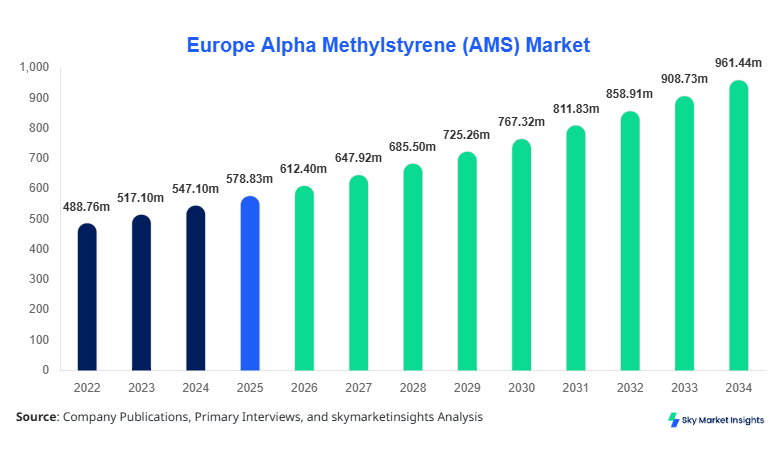
Europe Alpha Methylstyrene (AMS) market size is projected at USD 612.4 million in 2026 and is expected to hit USD 958.7 million by 2034 with a CAGR of 5.8%. The Europe Alpha Methylstyrene (AMS) industry is witnessing increasing utilization across ABS resin manufacturing, adhesives, and specialty polymer production owing to rising industrial output and higher demand from automotive and electronics sectors. The market evaluation includes detailed production analysis, consumption patterns, import-export dynamics, competitive benchmarking, and segment-level assessment across major European countries. Expanding investments in high-purity AMS production facilities and technological upgrades in polymer manufacturing are further strengthening the Europe Alpha Methylstyrene (AMS) market.
Alpha methylstyrene (AMS) is an aromatic hydrocarbon intermediate primarily utilized in the manufacturing of acrylonitrile butadiene styrene (ABS) resins, plasticizers, adhesives, waxes, coatings, and synthetic rubber products. Europe produced nearly 428 kilotons of AMS in 2025, with Germany accounting for approximately 31% of regional output, followed by France at 18% and the United Kingdom at 14%. The adoption rate of AMS-based additives in polymer reinforcement applications exceeded 46% in 2025 due to enhanced thermal stability and improved oxidation resistance characteristics. Penetration of AMS in automotive polymer blends reached 39%, while utilization in electronic housing compounds represented nearly 27% of total demand volume across Europe. Consumer behavior analysis indicates that industrial manufacturers are increasingly prioritizing lightweight polymer materials, resulting in a 21% increase in AMS consumption among automotive component producers between 2023 and 2025. The ABS resin application segment contributed nearly 52% of total market revenue, followed by adhesives & coatings at 24% and plasticizers at 16%. Technical performance metrics such as boiling point stability of 165°C, high refractive index, and polymerization efficiency above 93% continue supporting industrial-scale adoption in the Europe Alpha Methylstyrene (AMS) market.
Explore more data points, trends and opportunities Download Free Sample Report
Europe Alpha Methylstyrene (AMS) Market Trends
The European AMS industry is experiencing substantial technological transformation with increasing investment in high-purity AMS processing technologies and sustainable chemical manufacturing practices. Production of high-purity AMS exceeded 246 kilotons in 2025, representing nearly 58% of overall regional output. Manufacturers are adopting advanced catalytic dehydrogenation systems capable of improving yield efficiency by 14% while lowering volatile organic compound emissions by 11%. The electronics and consumer appliance sector increased AMS procurement by 19% between 2024 and 2025 due to rising demand for durable ABS plastic housings and heat-resistant polymer blends. Industrial automation and AI-driven chemical monitoring systems have also gained traction, with adoption rates surpassing 37% among large-scale European chemical facilities. Increasing integration of AMS in engineered plastics and synthetic rubber production continues shaping the Europe Alpha Methylstyrene (AMS) market.
The automotive sector remains a critical demand generator, accounting for approximately 33% of total AMS consumption in Europe during 2025. Electric vehicle production across Germany, France, and the United Kingdom increased by 22%, leading to stronger demand for lightweight polymer composites utilizing AMS-enhanced ABS materials. Additionally, recycling initiatives are influencing market dynamics, with nearly 17% of AMS-derived polymer materials being integrated into recyclable plastic systems. Sustainable packaging manufacturers increased AMS-based resin usage by 13% to improve durability and thermal resistance. Europe imported approximately 61 kilotons of AMS derivatives from Asia-Pacific suppliers to support regional supply-demand balancing. These industrial shifts continue reinforcing the Europe Alpha Methylstyrene (AMS) market.
The adhesives and coatings segment is also observing rapid transformation owing to growing construction and infrastructure activities across Europe. AMS-based coating formulations demonstrated a 16% improvement in adhesion performance and 12% enhancement in weather resistance compared to conventional resin systems. Industrial coating demand in Spain and Italy increased by 9% and 11%, respectively, in 2025. More than 44% of specialty adhesive manufacturers integrated AMS into premium product formulations to enhance chemical resistance and curing performance. Expansion of smart manufacturing facilities and industrial robotics production further contributed to higher AMS utilization in precision coating applications, strengthening the Europe Alpha Methylstyrene (AMS) market.
Europe Alpha Methylstyrene (AMS) Market Drivers
Rising Demand for ABS Resins Across Automotive and Electronics Industries
The rapid expansion of ABS resin utilization in automotive interiors, electronic devices, and industrial equipment is a major factor driving market expansion. Europe produced over 2.8 million tons of ABS polymers during 2025, with approximately 29% containing AMS-derived additives for enhanced thermal and mechanical properties. Automotive lightweighting initiatives increased AMS-based polymer demand by nearly 18% between 2023 and 2025 as manufacturers aimed to reduce vehicle weight by 8%–12%. Germany and France collectively accounted for 46% of regional ABS resin consumption. Electronic appliance production in Europe surpassed 178 million units in 2025, generating substantial demand for heat-resistant polymer compounds containing AMS. Technological advancements in polymer blending improved impact resistance by 14% and heat stability by 17%, making AMS a preferred feedstock in high-performance plastic manufacturing. The increasing requirement for lightweight, durable, and chemically stable polymer materials is expected to continue driving the Europe Alpha Methylstyrene (AMS) market.
Europe Alpha Methylstyrene (AMS) Market Restraints
Volatility in Raw Material Pricing and Environmental Compliance Costs
Fluctuating benzene and cumene feedstock prices remain a major restraint impacting profitability across AMS manufacturing operations. Feedstock price volatility averaged nearly 16% during 2024–2025 due to geopolitical disruptions and fluctuating crude oil prices. European environmental compliance regulations increased production costs by approximately 9% for medium-scale AMS producers due to stricter VOC emission standards and carbon taxation policies. Nearly 28% of smaller chemical manufacturers reported operational margin pressure associated with wastewater treatment investments and emission control infrastructure upgrades. Furthermore, import competition from low-cost Asian suppliers reduced pricing flexibility among European AMS manufacturers. Transportation costs for hazardous chemical materials increased by 12% during 2025, impacting overall supply chain economics. These cost-related challenges may limit operational scalability and short-term profitability within the Europe Alpha Methylstyrene (AMS) market.
Europe Alpha Methylstyrene (AMS) Market Opportunities
Expansion of Sustainable Polymer Manufacturing and Recycling Technologies
The increasing emphasis on circular economy initiatives and recyclable polymers presents significant opportunities for AMS producers across Europe. Nearly 36% of polymer manufacturers initiated investments in recyclable ABS and engineered plastic systems during 2025. Recycled polymer integration in automotive components increased from 11% in 2022 to 19% in 2025, creating demand for AMS-based stabilizers and performance enhancers. European Union sustainability funding for advanced recycling technologies exceeded USD 1.2 billion between 2024 and 2026, supporting innovation in chemical recycling infrastructure. Manufacturers adopting low-emission catalytic AMS technologies reported energy consumption reductions of approximately 15%. In addition, the packaging sector increased demand for durable recyclable polymer coatings by 13% owing to regulatory pressure against single-use plastics. The development of bio-based AMS derivatives and sustainable chemical processing systems is expected to create long-term opportunities for the Europe Alpha Methylstyrene (AMS) market.
Challanges in Europe Alpha Methylstyrene (AMS) Market
Supply Chain Disruptions and Dependence on Petrochemical Feedstocks
The Europe AMS industry faces operational challenges associated with feedstock availability, import dependency, and logistical bottlenecks. Approximately 41% of regional benzene feedstock requirements are sourced through imports, increasing vulnerability to geopolitical trade disruptions. Port congestion and transportation delays during 2024 resulted in average delivery lead-time increases of 14% across major European chemical hubs. Nearly 22% of manufacturers experienced temporary production slowdowns due to insufficient raw material availability and rising energy prices. Electricity costs for petrochemical operations in Europe increased by 19% between 2023 and 2025, negatively impacting manufacturing economics. Smaller AMS processors also encountered financing difficulties for modernization projects, with capital expenditure requirements increasing by nearly 17% due to inflationary pressures. Managing supply continuity and ensuring cost-efficient production remain key challenges influencing the Europe Alpha Methylstyrene (AMS) market.
Report Scope
| Report Metric | Details |
|---|---|
| Market Size in 2025 | USD 578.83 million |
| Market Size in 2026 | USD 612.4 million |
| Market Size in 2034 | USD 958.7 million |
| CAGR | 5.8% (2026-2034) |
| Base Year for Estimation | 2025 |
| Historical Data | 2022-2024 |
| Forecast Period | 2026-2034 |
| Report Coverage | Revenue Forecast, Competitive Landscape, Supply Chain Disruption, Growth Factors, Environment & Regulatory Landscape and Trends |
Explore more data points, trends and opportunities Download Free Sample Report
Europe Alpha Methylstyrene (AMS) Market Segmentation
The Europe AMS industry is segmented by type and application, with high-purity AMS products dominating approximately 58% of total consumption due to rising demand for advanced polymer formulations. ABS resins remained the largest application segment with over 52% market contribution, followed by adhesives & coatings and plasticizers. Increasing industrial specialization and performance requirements continue supporting segment diversification.
By Type
Purity above 99.5% AMS accounted for nearly 58% of total regional demand in 2025 owing to its superior performance in high-grade ABS resin manufacturing and specialty coatings. Production volumes exceeded 246 kilotons supported by investments in advanced catalytic distillation and purification technologies. These grades demonstrated polymerization efficiency above 94% and thermal resistance capabilities exceeding 160°C. Germany and France collectively contributed more than 61% of high-purity AMS production. Automotive manufacturers increasingly utilized high-purity AMS compounds for lightweight polymer components and dashboard systems, generating approximately 39 kilotons of demand during 2025. Electronics applications represented another 26% of this segment owing to enhanced heat resistance and impact strength. Demand for premium AMS purity grades continues increasing among specialty chemical producers and engineered plastics manufacturers across Europe.
The 95%-99.5% purity category represented approximately 29% of market consumption in 2025 and remained widely utilized in adhesives, industrial coatings, and synthetic rubber applications. Annual production volumes reached nearly 124 kilotons across Europe. This grade offers moderate thermal stability and cost advantages for medium-performance polymer systems. Italy and Spain jointly accounted for 22% of regional production within this category. Adhesive manufacturers integrated these grades into construction sealants and industrial bonding products, generating demand growth of approximately 11% between 2023 and 2025. Coating applications represented nearly 31% of segment consumption due to improved surface adhesion and weather resistance properties. Industrial packaging and appliance manufacturers also contributed significantly to utilization rates across this AMS purity category.
Purity below 95% AMS contributed approximately 13% of overall market volume and remained concentrated in low-cost industrial processing applications. Production reached nearly 58 kilotons during 2025. These products are commonly utilized in lower-grade resin formulations, fuel additives, and basic industrial chemical blending operations. Russia accounted for approximately 27% of regional low-purity AMS output due to cost-efficient petrochemical infrastructure. Despite lower performance efficiency compared to premium grades, these products maintain relevance in cost-sensitive industrial applications. Demand from industrial coatings and auxiliary chemical formulations increased by nearly 7% in 2025. However, stricter environmental standards and higher preference for advanced purity grades may gradually limit the long-term expansion potential of this category.
By Application
ABS resins represented the largest application category with more than 52% of regional AMS consumption during 2025. Europe produced over 2.8 million tons of ABS polymers, with AMS additives extensively used to improve thermal stability, gloss retention, and impact resistance. Automotive applications consumed approximately 44% of AMS-enhanced ABS materials owing to increased electric vehicle manufacturing and lightweight component integration. Electronics represented another 29% of segment demand due to rising production of consumer devices, home appliances, and industrial equipment housings. Germany, France, and the United Kingdom together accounted for nearly 63% of AMS utilization within the ABS sector. Manufacturers increasingly adopted high-purity AMS formulations to improve polymer durability and processing efficiency, reinforcing demand across advanced engineering plastic applications.
The adhesives & coatings segment accounted for nearly 24% of overall AMS demand in Europe during 2025. Production of AMS-based industrial coatings exceeded 146 kilotons, supported by rising infrastructure projects and automotive refinishing activities. AMS-enhanced coatings improved chemical resistance by approximately 15% and increased surface durability by 13%. Construction applications represented nearly 34% of segment demand, while industrial machinery coatings contributed 27%. Spain and Italy recorded strong growth in AMS-based coating adoption due to expanding infrastructure modernization projects. Adhesive manufacturers integrated AMS into pressure-sensitive formulations and specialty industrial sealants to improve bonding strength and curing performance. Industrial packaging and consumer appliance sectors also contributed to segment growth across Europe.
Plasticizers represented approximately 16% of AMS application demand in Europe during 2025. Production volumes surpassed 92 kilotons owing to increasing use in flexible polymers, cable insulation, and synthetic rubber formulations. AMS-derived plasticizers improved flexibility and thermal stability by approximately 12% compared to conventional alternatives. The construction industry accounted for nearly 38% of segment consumption due to rising demand for flexible PVC materials and insulation systems. France and Russia jointly contributed over 33% of AMS plasticizer production capacity across Europe. Demand from consumer goods manufacturing and automotive interiors also increased by nearly 10% during 2025. Regulatory shifts toward safer and higher-performance plasticizer formulations continue supporting technological innovation in this segment.
Europe Alpha Methylstyrene (AMS) Market Segmentations
Type
- Purity Above 99.5%
- Purity 95%-99.5%
- Purity Below 95%
Application
- ABS Resins
- Adhesives & Coatings
- Plasticizers
Europe Alpha Methylstyrene (AMS) Regional Market Outlook
United Kingdom
The United Kingdom accounted for approximately 14% of regional AMS revenue during 2025 supported by growing specialty polymer production and industrial adhesive manufacturing. AMS consumption exceeded 61 kilotons, with ABS resins representing nearly 49% of total utilization. The country’s electronics and appliance manufacturing sector generated rising demand for heat-resistant polymer blends, increasing AMS procurement by 11% between 2023 and 2025. More than 17 major chemical facilities are actively involved in AMS-related production and downstream processing activities. Sustainable polymer initiatives and recyclable packaging projects also contributed to higher demand for AMS-based coatings and engineered plastics across the United Kingdom.
Germany
Germany dominated the European market with approximately 34% regional share and production volumes surpassing 132 kilotons during 2025. The country’s automotive and engineering sectors remained the primary demand centers, collectively consuming nearly 58% of AMS output. Germany operates more than 42 advanced chemical processing facilities specializing in high-purity AMS production and polymer blending technologies. Electric vehicle manufacturing expansion increased AMS-derived ABS resin demand by approximately 18% during 2025. Industrial automation, sustainable polymer technologies, and export-oriented chemical manufacturing continue positioning Germany as the leading hub within the European AMS industry.
France
France represented nearly 18% of regional AMS consumption supported by robust chemical manufacturing and packaging industries. Annual production volumes exceeded 77 kilotons in 2025, with adhesives and coatings accounting for approximately 28% of total utilization. France invested more than USD 320 million in sustainable polymer and recycling technologies between 2023 and 2025. Automotive polymer applications contributed nearly 31% of national AMS demand due to increased electric vehicle assembly operations. High-purity AMS adoption among specialty chemical manufacturers exceeded 52%, strengthening advanced material development across the French industrial sector.
Spain
Spain accounted for approximately 10% of the Europe AMS market during 2025 owing to infrastructure development and rising industrial coatings demand. AMS consumption surpassed 44 kilotons, with construction-related coatings and adhesives contributing nearly 36% of overall demand. The country observed a 9% increase in industrial coating production between 2024 and 2025. Spain’s packaging and consumer goods industries also increased procurement of AMS-derived polymer materials to improve durability and recyclability performance. Investments in smart manufacturing technologies and sustainable industrial processing continue supporting AMS market expansion across Spain.
Italy
Italy contributed nearly 11% of regional AMS revenue in 2025 with production volumes reaching approximately 47 kilotons. Adhesives, coatings, and specialty polymer applications collectively represented 54% of domestic demand. Italy’s automotive component sector increased AMS utilization by nearly 12% owing to lightweight material integration initiatives. More than 14 medium-scale chemical facilities actively process AMS for downstream industrial applications. The country also experienced rising demand for AMS-enhanced industrial coatings in infrastructure modernization projects and machinery manufacturing operations.
Russia
Russia accounted for approximately 13% of European AMS production capacity during 2025 primarily due to cost-efficient petrochemical infrastructure and availability of feedstock materials. Annual production exceeded 56 kilotons, with low-purity AMS categories representing nearly 37% of output. Industrial chemical processing and synthetic rubber manufacturing remained key application sectors. Domestic producers expanded capacity utilization rates by approximately 8% during 2025 despite logistical and trade-related challenges. Russia continues maintaining a notable presence within the European AMS supply chain owing to large-scale petrochemical operations and competitive production economics.
Top players in Europe Alpha Methylstyrene (AMS) Market
- INEOS Group
- Rosneft Chemicals
- Mitsui Chemicals Europe
- Solvay SA
- Versalis S.p.A.
- SABIC Europe
- BASF SE
- Arkema SA
- Evonik Industries AG
- Royal Dutch Shell Chemicals
- LyondellBasell Industries
- Repsol Chemicals
- TotalEnergies Petrochemicals
- Dow Europe GmbH
- LG Chem Europe
BASF SE
- BASF SE accounted for approximately 14% of the European AMS industry during 2025.
- The company operates integrated petrochemical and polymer manufacturing facilities across Germany and France.
- BASF expanded high-purity AMS processing capacity by nearly 11% between 2023 and 2025.
- Around 46% of BASF’s AMS-related sales originated from ABS resin applications and engineered plastics.
- The company focuses heavily on sustainable chemical manufacturing, low-emission processing technologies, and recyclable polymer systems to strengthen market positioning across Europe.
INEOS Group
- INEOS Group represented nearly 12% of total regional AMS revenue during 2025.
- The company maintains strong presence in petrochemical feedstock integration and industrial polymer manufacturing.
- INEOS invested approximately USD 180 million in advanced catalytic processing infrastructure during 2024–2025.
- Nearly 38% of the company’s AMS output was supplied to automotive polymer manufacturers across Germany and the United Kingdom.
- Strategic partnerships with specialty resin producers and coating manufacturers continue strengthening INEOS’s competitive position in the European AMS industry.
Investment Analysis
The European AMS industry is experiencing increasing capital allocation toward sustainable polymer technologies, high-purity processing systems, and advanced recycling infrastructure. Nearly 41% of total investments during 2025 were directed toward high-purity AMS production expansion projects. Germany accounted for approximately 34% of total regional chemical investment expenditure, followed by France at 19% and the United Kingdom at 14%. Investments in low-emission catalytic technologies increased by nearly 23% between 2023 and 2025 owing to tightening environmental regulations. Automotive polymer applications attracted approximately 31% of AMS-related industrial investments due to rising demand for lightweight materials and electric vehicle production.
Mergers, acquisitions, and collaborative agreements also accelerated across the European AMS value chain. More than 18 strategic agreements involving specialty polymer producers, petrochemical companies, and recycling technology providers were announced during 2024–2025. BASF SE and multiple automotive polymer suppliers initiated collaborative development projects focused on recyclable ABS systems with AMS-derived stabilizers. INEOS Group expanded supply partnerships with industrial adhesive manufacturers across Western Europe to strengthen downstream market penetration. Approximately USD 620 million was allocated toward chemical recycling projects involving AMS-derived polymer materials across Europe between 2024 and 2026. These collaborative investments continue enhancing regional production efficiency, sustainability performance, and long-term competitiveness.
New Product Developments
Manufacturers across Europe increasingly introduced advanced AMS-based formulations designed for improved thermal stability, recyclability, and processing efficiency. Nearly 27% of new polymer additives introduced during 2025 incorporated AMS-derived compounds for enhanced heat resistance and impact durability. High-performance ABS resin grades utilizing premium AMS achieved approximately 16% higher tensile strength and 13% better oxidation resistance compared to conventional formulations. Electronics and automotive manufacturers actively adopted these advanced materials to improve product lifespan and structural performance.
Specialty coating producers also launched AMS-enhanced industrial coating systems demonstrating 14% higher weather resistance and 11% improved adhesion performance. Around 22% of newly introduced industrial adhesives across Europe during 2025 utilized AMS-derived chemical additives. Companies further focused on developing low-emission AMS processing technologies capable of reducing manufacturing energy consumption by approximately 15%. Product innovation and sustainable formulation development remain key strategic priorities within the European AMS industry.
Recent Developments in Europe Alpha Methylstyrene (AMS) Market
- 2025: BASF SE expanded its Germany-based high-purity AMS production facility by approximately 12%, increasing annual production capacity by nearly 18 kilotons. The project focused on supplying automotive polymer manufacturers and specialty ABS resin producers. The facility also integrated advanced emission reduction systems capable of lowering VOC emissions by 10%, supporting sustainability objectives across the European petrochemical industry.
- 2025: INEOS Group entered a strategic supply agreement with multiple European adhesive manufacturers to increase AMS deliveries for industrial coatings and construction sealants. The agreement supported a projected 14% increase in AMS utilization within industrial adhesive applications across Western Europe. The collaboration also emphasized recyclable polymer development and energy-efficient chemical processing technologies.
Research Methodology
The research methodology for the Europe Alpha Methylstyrene (AMS) industry involved extensive primary and secondary research processes combined with quantitative market modeling and competitive benchmarking analysis. Primary research included interviews with petrochemical manufacturers, polymer producers, distributors, industrial coating companies, and industry experts across Germany, France, the United Kingdom, Italy, Spain, and Russia. More than 65 interviews and surveys were conducted to validate production capacity, consumption patterns, pricing trends, and application-level demand forecasts. Secondary research involved analysis of company annual reports, trade journals, chemical association databases, customs statistics, investor presentations, and industrial publications. Market size estimation was conducted using bottom-up and top-down approaches incorporating production volume analysis, application demand evaluation, and regional trade assessments. Forecasting models considered macroeconomic indicators, automotive production growth, polymer demand trends, infrastructure investments, environmental regulations, and technological adoption rates across Europe. Data triangulation and validation techniques were applied to ensure accuracy, consistency, and reliability of market estimations and competitive positioning analysis.
Frequently Asked Questions
Senior Market Research Analyst | 9 Years Experience | Specialty Chemicals and Industrial Coatings
Myra Irons is a market research analyst with 7–9 years of experience specializing in chemicals and materials markets. Contributed to 70+ research reports for global clients. Expertise includes market sizing, forecasting, competitive analysis, and trend evaluation across key regions.