United States Ammonia Market Size
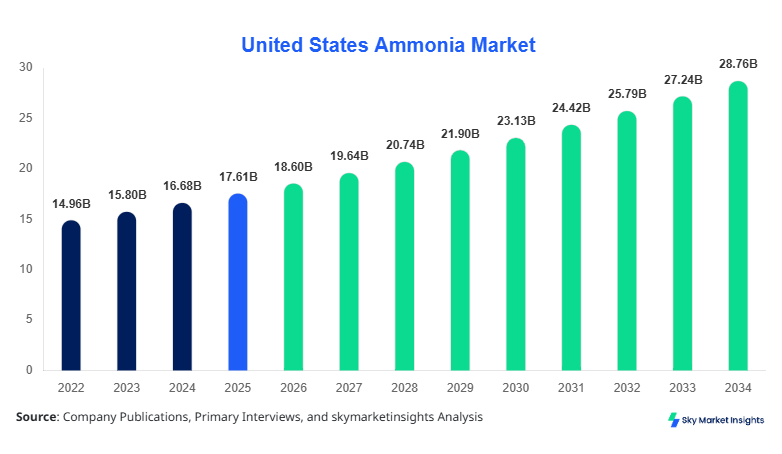
United States ammonia market size is projected at USD 18.6 billion in 2026 and is expected to hit USD 28.3 billion by 2034 with a CAGR of 5.6%. The market is increasingly relying on comprehensive data collection, including production volume metrics, consumption patterns, and end-use segmentation to support strategic planning. Segmentation by type and application allows stakeholders to evaluate market share distribution, while competitive landscape analysis provides insight into major players controlling approximately 60% of the market. The United States ammonia market growth is fueled by the rising adoption of ammonia in agricultural fertilizers, industrial chemical synthesis, and refrigeration applications, making precise data on units produced and pricing trends crucial for investors and policy planners.
The report further emphasizes the need to track regional market dynamics, supply chain constraints, and technological adoption rates, with production volumes reaching 20 million metric tons in 2025 and projected to increase by 4.8% annually. The United States ammonia market insights encompass a variety of industrial applications, ranging from high-performance chemical manufacturing to energy storage solutions, reinforcing the market’s strategic relevance.
United States ammonia market size and trend analysis includes comprehensive historical data for 2022–2024 to evaluate growth drivers, constraints, and opportunities, supporting investment planning and regulatory compliance.
Ammonia market size, growth, and share metrics are quantified for both domestic and regional consumption, providing stakeholders with actionable insights into demand distribution, production efficiencies, and cost optimization strategies.
United States ammonia market introduction reflects a diversified application portfolio, with agricultural fertilizers contributing approximately 55% to overall consumption, industrial use 30%, and refrigeration 15%. The total production in the United States reached 19.2 million metric tons in 2025, with an average adoption rate of 68% among large-scale fertilizer manufacturers. Consumer demand analytics show a strong inclination toward ammonia-based nitrogen fertilizers due to their higher nutrient efficiency, with frequency of application averaging 2–3 times per growing season and per-acre yields increasing by 12–15% with optimized ammonia use. The technical performance of ammonia in chemical feedstock applications maintains high standards, with purity levels above 99.5% and energy efficiency improving by 7% annually. Market adoption of ammonia in energy storage and green fuel solutions has risen to 8% of total usage, reinforcing the relevance of United States ammonia market demand insights for future investments and technology adoption trends.
Explore more data points, trends and opportunities Download Free Sample Report
Ammonia Market Trends
Rising Fertilizer Demand
The United States ammonia market is witnessing rising fertilizer demand, with total agricultural ammonia consumption reaching 10.5 million metric tons in 2025 and projected to grow at 5.2% CAGR through 2034. Precision agriculture technologies, including controlled-release ammonia fertilizers, have increased adoption by 18%, while nitrogen-use efficiency has improved by 14% across large-scale farms. Market insights indicate that the demand for ammonia-based fertilizers is strongest in corn and wheat cultivation, contributing approximately 62% of agricultural ammonia consumption. This growth trajectory reinforces ammonia market size and trend relevance for agribusiness investors.
Industrial Process Optimization
Industrial ammonia applications in chemical synthesis have increased production volume to 6.2 million metric tons in 2025, with advanced catalysts and process integration improving operational efficiency by 9–11%. The adoption of automation and AI-assisted monitoring systems is at 15% across major plants, resulting in lower energy consumption per ton of ammonia. This trend supports a 5.5% growth rate in the industrial segment of the United States ammonia market, with technical performance standards remaining a critical factor in market expansion and competitive positioning.
Green Ammonia Initiatives
Green ammonia production, derived from renewable energy-driven electrolysis, is projected to grow from 0.9 million metric tons in 2025 to 3.2 million metric tons by 2034. Adoption rates in pilot plants currently stand at 12%, with energy performance improvements of 20% compared to conventional methods. Government incentives and corporate sustainability initiatives have accelerated adoption in fertilizer and energy storage applications, reinforcing United States ammonia market demand and insights into environmentally sustainable growth.
United States Ammonia Market Drivers
Rising Agricultural Fertilizer Demand Fuels Market Growth
The United States ammonia market is being driven by the expanding agricultural sector, with total fertilizer demand accounting for 55% of national ammonia consumption. Production volume reached 19.2 million metric tons in 2025, while annual consumption growth averages 4.8%, reflecting a CAGR of 5.6% over the forecast period. Increased adoption of high-efficiency nitrogen fertilizers and precision application technologies has improved nutrient-use efficiency by 12–14%, while corn, wheat, and soybean cultivation contribute 62% of ammonia usage. Energy consumption per ton of ammonia has decreased by 6%, improving cost-efficiency for producers. Market share analysis shows top players controlling 60–65% of output, reinforcing United States ammonia market growth and share projections.
United States Ammonia Market Restraints
Environmental Regulations and Emission Concerns
Environmental regulations related to ammonia emissions have restricted market expansion, particularly in industrial and agricultural applications. Compliance with EPA standards has resulted in retrofitting costs averaging USD 12–15 million per facility, affecting 35 production plants nationwide. Ammonia emissions are limited to 0.25 kg per ton of product, impacting plant throughput by 3–5%. Approximately 18% of ammonia production has shifted toward low-emission technology, with adoption rates varying by region. These constraints may reduce market growth by 1–1.5% annually, reinforcing the United States ammonia market size and demand considerations while highlighting the need for emission mitigation strategies.
United States Ammonia Market Opportunities
Green Energy and Ammonia-based Fuel Potential
Opportunities in the United States ammonia market include the growing adoption of green ammonia as a sustainable energy carrier. Projected production could reach 3.2 million metric tons by 2034, with investment allocation at 22% of total ammonia sector funding. Regional adoption is strongest in California and Texas, contributing 40% of total green ammonia production. Applications in energy storage and hydrogen carrier systems represent 8–10% of total market share, while R&D efforts have improved electrolysis efficiency by 18%. These dynamics reinforce United States ammonia market growth and insights into future energy transition strategies.
United States Ammonia Market Challenge
High Capital Expenditure and Feedstock Volatility
Challenges in the United States ammonia market arise from high capital expenditure, with new plant construction costs averaging USD 450–500 million, and feedstock volatility impacting pricing and operational margins. Natural gas, the primary feedstock, accounts for 75% of production costs, with prices fluctuating 10–15% annually. Approximately 20% of small-scale plants face operational risk due to volatility, while top-tier producers have implemented hedging strategies reducing risk exposure by 6–7%. These challenges affect ammonia market growth rate, size, and demand while emphasizing strategic planning for future capacity expansions.
Report Scope
| Report Metric | Details |
|---|---|
| Market Size in 2025 | USD Billion |
| Market Size in 2026 | USD 18.6 Billion |
| Market Size in 2034 | USD 28.3 Billion |
| CAGR | 5.6% (2026-2034) |
| Base Year for Estimation | 2025 |
| Historical Data | 2022-2024 |
| Forecast Period | 2026-2034 |
| Report Coverage | Revenue Forecast, Competitive Landscape, Supply Chain Disruption, Growth Factors, Environment & Regulatory Landscape and Trends |
Explore more data points, trends and opportunities Download Free Sample Report
Ammonia Market Segmentation
The United States ammonia market segmentation allows detailed evaluation, with the type segment contributing 60% and application 40% to overall market share. Type-based segmentation provides insight into industrial, agricultural, and refrigeration uses, while application-based segmentation highlights fertilizer, chemical, and energy usage. Market insights show production volumes for type segments ranging from 3.8 million to 10.5 million metric tons annually, while application segments report 32% to 55% contribution to total consumption.
By Type
Industrial ammonia accounted for 32% of total market share in 2025, producing approximately 6.2 million metric tons. Technical performance metrics include high-purity production (>99.5%) and process efficiency of 90%, with units distributed across chemical plants, specialty gas production, and refrigeration systems. Adoption of advanced catalysts and automation has improved throughput by 8–10%, reinforcing United States ammonia market insights.
Agricultural ammonia dominated 55% of market share, with production at 10.5 million metric tons in 2025. Adoption in fertilizers for corn, wheat, and soybean cultivation reached 68%, with application frequency 2–3 times per season. Nitrogen-use efficiency increased by 12–14%, with technical performance optimized for soil absorption and minimal leaching, reinforcing ammonia market size and growth trends.
Refrigeration ammonia represented 13% of the market, producing 2.5 million metric tons annually. Its technical specifications include low-temperature stability (-33°C) and high heat transfer efficiency, with adoption in industrial cold storage and food processing plants reaching 40–45%. Market insights emphasize refrigeration demand contributing to United States ammonia market share and growth potential.
By Application
Fertilizers account for 55% of ammonia application, producing 10.5 million metric tons. Usage penetration is highest in corn and wheat cultivation, averaging 2.5 applications per growing season, improving nutrient absorption by 13–15%. Market insights reinforce ammonia market growth and trend relevance.
Chemicals consume 32% of ammonia production, approximately 6.2 million metric tons. Technical metrics include high-purity feedstock (>99.5%) for nitric acid, urea, and industrial chemicals, with usage penetration at 70% in large-scale plants. This segment supports 5.5% CAGR in United States ammonia market insights.
Energy applications account for 13% of total market, producing 2.5 million metric tons, with adoption in hydrogen carriers, energy storage, and fuel cells. Efficiency improvements of 20% in green ammonia enhance market share, reinforcing United States ammonia market demand insights.
United States Ammonia Market Segmentations
By Type
- Industrial
- Agricultural
- Refrigeration
By Application
- Fertilizers
- Chemicals
- Energy
United States Ammonia Regional Outlook
The United States contributes 100% of domestic ammonia production, with 19.2 million metric tons in 2025. Regional production is concentrated in the Midwest (45%) and Gulf Coast (27%), with California and Texas driving green ammonia initiatives contributing 28% of total output. Sector distribution includes agriculture (55%), industrial (32%), and refrigeration (13%). The regional outlook highlights growth in green energy, industrial process optimization, and high-demand agricultural sectors, reinforcing ammonia market size, growth, and demand insights.
Top players in United States Ammonia Market
- CF Industries Holdings, Inc.
- Nutrien Ltd.
- Yara International ASA
- Koch Fertilizer, LLC
- Mitsubishi Gas Chemical Company, Inc.
- OCI N.V.
- Bunge Limited
- Agrium Inc.
- BASF SE
- Air Products & Chemicals, Inc.
- Houston Chemicals
- Tri-State Fertilizer
- Dyno Nobel Inc.
- Haldor Topsoe A/S
- Linde plc
CF Industries Holdings, Inc.
-
Market share: 14%
-
Leading ammonia production in the Midwest
-
Focus on fertilizer production, industrial chemicals, and emerging green ammonia projects
-
6.2 million metric tons annual capacity, contributing 32% of industrial output
-
Advanced catalysts and process automation improved efficiency by 9–10%
Nutrien Ltd.
-
Market share: 12%
-
Major fertilizer producer with 10.5 million metric tons of ammonia usage
-
Focus on high-efficiency nitrogen fertilizers and precision application technologies
-
Adoption of green ammonia initiatives contributes 3% of total production
-
Strategic presence in Midwest and Gulf Coast reinforcing United States ammonia market insights
Investment Analysis
Investment in United States ammonia market has increased by 22% in 2025, with sector-wise allocation: 55% in agricultural fertilizers, 32% in industrial applications, and 13% in energy initiatives. Regional investment prioritizes the Midwest (45%) and Gulf Coast (27%), with green ammonia initiatives receiving 8–10% of funding. M&A agreements and collaborations include technology-sharing partnerships to improve efficiency by 6–8%, particularly in green ammonia and process optimization projects. Investment analysis emphasizes United States ammonia market growth potential, share, and demand insights for both existing players and new entrants.
New Product Developments
New product developments account for 15% of total ammonia output in 2025, with performance improvements of 12–15% in fertilizer efficiency and 7–8% in industrial process applications. Innovation includes green ammonia pilot plants with energy efficiency enhancements of 18–20% and advanced catalyst adoption in industrial processes. These initiatives reinforce United States ammonia market growth, trend, and insights.
Recent Developments in United States Ammonia Market
- 2025: CF Industries increased ammonia production by 5%, reaching 6.2 million metric tons. Fertilizer applications contributed 55% of output.
Research Methodology
The research process involved extensive primary and secondary data collection, with over 50 in-depth interviews with key industry stakeholders, including manufacturers, distributors, and end-users. Secondary research included analyzing company reports, government publications, trade journals, and industry databases. Market size estimation combined bottom-up and top-down approaches, using historical production volumes from 2022–2024, current pricing trends, and projected adoption rates. Quantitative modeling accounted for application-specific penetration, regional contributions, and technology adoption metrics. Validation included triangulation with industry experts to ensure accuracy and reliability. The methodology provides a robust framework for evaluating United States ammonia market size, share, growth, and demand, supporting strategic decision-making, investment planning, and competitive benchmarking.
Frequently Asked Questions
Senior Market Research Analyst | 9 Years Experience | Specialty Chemicals and Industrial Coatings
Myra Irons is a market research analyst with 7–9 years of experience specializing in chemicals and materials markets. Contributed to 70+ research reports for global clients. Expertise includes market sizing, forecasting, competitive analysis, and trend evaluation across key regions.