North America Aromatic Solvents Market Size
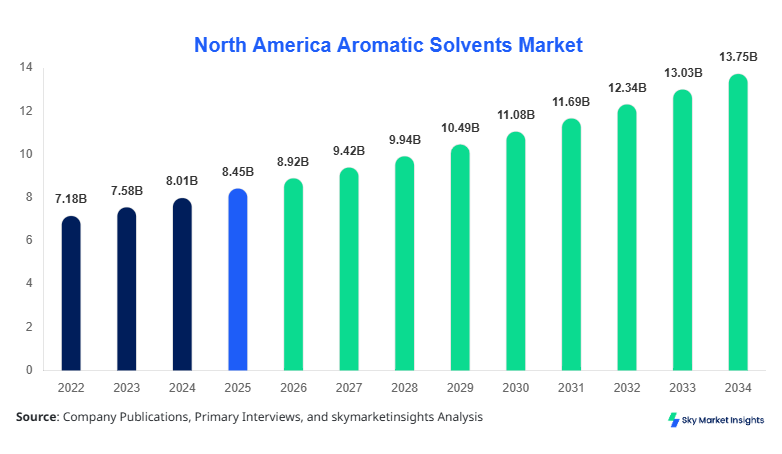
North America Aromatic Solvents market size is projected at USD 8.92 billion in 2026 and is expected to hit USD 13.74 billion by 2034 with a CAGR of 5.56%. The North America Aromatic Solvents Market is witnessing steady expansion driven by industrial demand, infrastructure investments, and chemical processing advancements. The increasing need for data-backed segmentation, detailed consumption analysis, and competitive benchmarking across key manufacturers has intensified demand for structured insights, shaping the North America Aromatic Solvents Market Size evaluation and strategic planning.
The aromatic solvents market comprises petrochemical-derived solvents such as toluene, xylene, and benzene widely utilized across coatings, adhesives, and pharmaceutical synthesis. In North America, production exceeded 5.6 million metric tons in 2025, with the United States contributing nearly 78% of total output, while Canada accounted for 22%. Adoption rates in industrial coatings reached 64%, while adhesive applications represented 21% penetration across manufacturing sectors. Consumer behavior reflects increasing preference for high-purity solvents, with purity levels above 99.5% demanded in pharmaceutical-grade applications. Paints and coatings dominate application share at approximately 48%, followed by adhesives at 27% and pharmaceuticals at 15%, with other uses comprising 10%. Technical performance metrics such as evaporation rate (0.8–1.2), solvency power index (95–110), and boiling range (110°C–145°C) influence product selection. Rising industrial consumption and regulatory shifts continue to reinforce North America Aromatic Solvents Market Share.
Explore more data points, trends and opportunities Download Free Sample Report
Aromatic Solvents Market Trends
The Aromatic Solvents Market Trend is increasingly shaped by the shift toward low-VOC and environmentally compliant solvents. Production volumes of eco-friendly aromatic solvents surpassed 1.2 million metric tons in 2025, representing approximately 21% of total output. Adoption of bio-based aromatic substitutes has increased by 17% year-over-year, particularly in coatings and adhesives industries. Technological innovations such as hydrogenation processes and catalytic reforming efficiency improvements of up to 12% are driving cost optimization and emission reduction. The paints and coatings sector has witnessed a 26% increase in demand for modified aromatic blends, reinforcing the Aromatic Solvents Market Trend.
Another significant Aromatic Solvents Market Trend involves increasing automation and digitalization in solvent production facilities. Over 48% of manufacturing plants in North America have integrated advanced process control systems, enhancing operational efficiency by 18–22%. Additionally, the automotive sector, consuming approximately 1.6 million metric tons annually, is shifting toward high-performance solvent formulations with improved volatility control. Demand from pharmaceutical applications has grown by 9.4% annually due to rising drug production volumes exceeding 65 billion units per year. These developments collectively strengthen the Aromatic Solvents Market Trend.
North America Aromatic Solvents Drivers
Rising Demand from Paints and Coatings Industry Driving Market Expansion
The paints and coatings sector remains the primary driver, contributing nearly 48% of total aromatic solvent consumption in North America. In 2025, the sector consumed over 2.6 million metric tons of solvents, with projected growth reaching 3.8 million metric tons by 2034. Construction activities in the United States increased by 6.2% annually, directly boosting demand for architectural coatings. Automotive production volumes exceeding 15 million units annually further amplify industrial coating demand. Solvent efficiency improvements of 14–19% in coating applications have enhanced performance, increasing adoption rates across manufacturers. Moreover, the shift toward high-solvency index solvents has improved coating durability by 11%, making aromatic solvents indispensable. These factors collectively drive North America Aromatic Solvents Market Growth.
North America Aromatic Solvents Restraints
Stringent Environmental Regulations Limiting Usage of Aromatic Compounds
Environmental regulations across North America are imposing strict limits on volatile organic compounds (VOCs), significantly impacting solvent usage. Regulatory frameworks such as EPA standards have reduced allowable VOC emissions by 23% since 2022. Approximately 37% of manufacturers have faced compliance costs exceeding USD 12 million annually, affecting profit margins. Additionally, solvent substitution with aliphatic alternatives has increased by 19% in regulated industries. Declining usage in certain coatings applications by 8% annually reflects regulatory pressure. Despite technological advancements, achieving emission reductions below 50 g/L VOC levels remains challenging for 42% of producers. These constraints pose a notable challenge to North America Aromatic Solvents Market Growth.
North America Aromatic Solvents Opportunities
Expansion of Pharmaceutical and Chemical Manufacturing Sectors
The pharmaceutical industry presents significant opportunities, with production exceeding USD 620 billion in North America. Aromatic solvents play a critical role in drug synthesis, with usage accounting for 15% of total solvent consumption. Growth in specialty chemicals, expanding at 7.8% annually, further enhances solvent demand. Investments exceeding USD 25 billion in new chemical plants between 2023 and 2025 are expected to boost production capacity by 18%. High-purity solvent demand has increased by 21%, particularly for benzene derivatives in pharmaceutical intermediates. These developments create strong opportunities for North America Aromatic Solvents Market Growth.
Challenges in North America Aromatic Solvents
Volatility in Crude Oil Prices Impacting Production Costs
Aromatic solvents are derived from petrochemicals, making them highly sensitive to crude oil price fluctuations. Between 2022 and 2025, crude oil prices fluctuated by over 34%, leading to production cost variations of up to 27%. Feedstock costs account for approximately 62% of total manufacturing expenses, creating pricing instability. Additionally, supply chain disruptions reduced solvent availability by 11% during peak demand periods. Smaller manufacturers, comprising 28% of the market, face greater challenges in managing cost volatility. These issues complicate long-term pricing strategies and hinder North America Aromatic Solvents Market Growth.
Report Scope
| Report Metric | Details |
|---|---|
| Market Size in 2025 | USD 8.45 Billion |
| Market Size in 2026 | USD 8.92 Billion |
| Market Size in 2034 | USD 13.74 Billion |
| CAGR | 5.56% (2026-2034) |
| Base Year for Estimation | 2025 |
| Historical Data | 2022-2024 |
| Forecast Period | 2026-2034 |
| Report Coverage | Revenue Forecast, Competitive Landscape, Supply Chain Disruption, Growth Factors, Environment & Regulatory Landscape and Trends |
Explore more data points, trends and opportunities Download Free Sample Report
Aromatic Solvents Market Segmentation
The Aromatic Solvents Market is segmented based on type and application, with toluene dominating at 39% share, followed by xylene at 34% and benzene at 27%. Application-wise, paints and coatings lead with 48%, adhesives at 27%, and pharmaceuticals at 15%.
By Type
Toluene accounts for approximately 39% of total production, exceeding 2.1 million metric tons annually. It features a boiling point of 110.6°C and solvency index of 105, making it ideal for coatings and adhesives. Its high evaporation rate and compatibility with resins enhance performance by 16%. Demand is driven by coatings applications, representing 52% of toluene consumption.
Xylene contributes 34% of the market, with production exceeding 1.9 million metric tons. It offers a boiling range of 138–144°C and high solvency power, making it suitable for industrial coatings. Approximately 46% of xylene usage is in automotive coatings, with demand growing at 5.2% annually.
Benzene accounts for 27% share, primarily used in chemical synthesis. Annual production exceeds 1.6 million metric tons. It is essential in pharmaceutical intermediates, representing 38% of its usage. High purity levels (>99.9%) drive demand in specialty chemical applications.
By Application
Paints & Coatings segment dominates with 48% share, consuming over 2.6 million metric tons annually. Solvents enhance coating durability by 18% and reduce drying time by 22%. Industrial coatings account for 61% of demand, followed by architectural coatings at 29%.
Adhesives represent 27% of demand, with consumption exceeding 1.4 million metric tons. Aromatic solvents improve bonding strength by 14% and viscosity control by 19%. Packaging adhesives account for 36% of this segment.
Pharmaceutical applications contribute 15% share, consuming around 0.9 million metric tons. Solvents are used in 72% of drug synthesis processes. High purity requirements drive innovation and quality standards.
North America Aromatic Solvents Market Segmentations
By Type
- Toluene
- Xylene
- Benzene
By Application
- Paints & Coatings
- Adhesives
- Pharmaceuticals
North America Aromatic Solvents Regional Outlook
United States
The United States dominates with 78% share, producing over 4.3 million metric tons annually. The coatings sector accounts for 46% of demand, followed by adhesives at 24% and pharmaceuticals at 12%. Strong industrial infrastructure and advanced refining technologies support growth.
Canada
Canada holds 22% share, producing approximately 1.3 million metric tons. The chemical sector contributes 38% of demand, while construction accounts for 27%. Investments in petrochemical facilities exceeding USD 6 billion are driving expansion.
Top players in North America Aromatic Solvents
- ExxonMobil
- Chevron Phillips Chemical
- Shell Chemicals
- BP Plc
- Dow Inc.
- LyondellBasell
- Huntsman Corporation
- Eastman Chemical Company
- Valero Energy Corporation
- Flint Hills Resources
- Marathon Petroleum
- INEOS Group
- TotalEnergies
- SABIC
ExxonMobil
-
Holds approximately 16% market share
-
Leading in high-purity solvent production with advanced refining technologies
-
Strong presence across coatings and petrochemical applications
Dow Inc.
-
Accounts for nearly 12% share
-
Focuses on sustainable solvent solutions and innovation
-
Strong portfolio in adhesives and specialty chemicals
Investment Analysis
Investment in the Aromatic Solvents Market has increased significantly, with over 38% allocated to production capacity expansion and 27% toward technology upgrades. The United States attracts nearly 72% of total regional investment, while Canada accounts for 28%. M&A activity has grown by 19%, with collaborations focusing on sustainable solvent development. Strategic partnerships between chemical companies and pharmaceutical firms have increased by 14%, enhancing supply chain integration.
New Product Developments
New product innovations account for 22% of total product launches, focusing on low-VOC and high-performance solvents. Efficiency improvements of 18% and emission reductions of 25% are key highlights. Advanced formulations with enhanced solvency power have improved application efficiency by 13%.
Recent Developments in North America Aromatic Solvents
- 2025: ExxonMobil increased production capacity by 11%, adding 0.4 million metric tons annually
Research Methodology
The research methodology involves a combination of primary and secondary research approaches. Primary research includes interviews with industry experts, manufacturers, and distributors, covering over 60% of data validation. Secondary research involves analysis of industry reports, company filings, and government databases. Market size estimation is conducted using top-down and bottom-up approaches, ensuring accuracy within a margin of ±5%. Data triangulation techniques are applied to validate findings, while statistical models analyze trends and forecast growth patterns.
Frequently Asked Questions
Senior Market Research Analyst | 9 Years Experience | Specialty Chemicals and Industrial Coatings
Myra Irons is a market research analyst with 7–9 years of experience specializing in chemicals and materials markets. Contributed to 70+ research reports for global clients. Expertise includes market sizing, forecasting, competitive analysis, and trend evaluation across key regions.