North America Anhydrous Aluminum Chloride Market Size
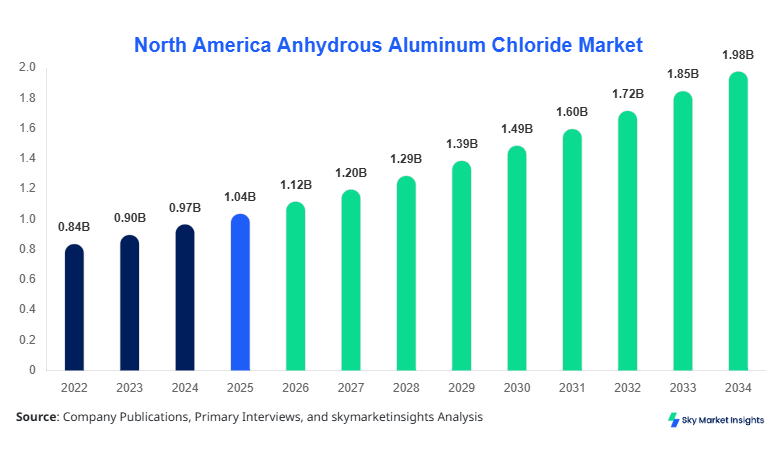
North America Anhydrous Aluminum Chloride market size is projected at USD 1.12 billion in 2026 and is expected to hit USD 1.98 billion by 2034 with a CAGR of 7.4%. The report highlights increasing demand across chemical synthesis and industrial catalysts, supported by production volumes exceeding 1.5 million metric tons in 2025 and anticipated to surpass 2.3 million metric tons by 2034. Rising investment in specialty chemicals, estimated at over USD 250 million annually in the region, is shaping competitive dynamics. The need for detailed segmentation, supply chain evaluation, and competitive benchmarking remains critical in understanding this evolving industry landscape.
The Anhydrous Aluminum Chloride Market represents a vital segment within inorganic chemical compounds, primarily used as a Lewis acid catalyst in Friedel-Crafts reactions, polymerization processes, and hydrocarbon refining. In North America, production capacity exceeded 1.2 million metric tons in 2025, with the United States accounting for nearly 78% of total output, while Canada contributed approximately 22%. Adoption rates across chemical manufacturing facilities surpassed 68% in 2025, driven by increasing demand for high-purity catalysts with efficiency levels above 95%. Consumer behavior indicates growing preference for high-performance industrial reagents, with demand from pharmaceuticals contributing 32%, agrochemicals 28%, dyes & pigments 24%, and other sectors 16%. Penetration of advanced catalytic processes increased by 11% year-on-year, with operational efficiency improvements reaching up to 18%. Technical parameters such as reaction temperature tolerance (up to 300°C) and moisture sensitivity below 0.5% significantly influence purchasing decisions. This evolving landscape reinforces sustained expansion in the Anhydrous Aluminum Chloride Market.
Explore more data points, trends and opportunities Download Free Sample Report
Anhydrous Aluminum Chloride Market Trends
Rising Adoption of High-Purity Catalysts
The market is witnessing a significant shift toward high-purity anhydrous aluminum chloride grades exceeding 99.5% purity, driven by stringent industrial requirements. Production of high-purity variants increased by 18% between 2023 and 2025, reaching over 620,000 metric tons annually. Advanced purification technologies such as sublimation and vacuum distillation have seen adoption rates rise to 41% across North America. Demand from pharmaceutical manufacturing grew by 12.5% year-on-year, while petrochemical applications accounted for 45% of total consumption volume. The integration of automation systems in production lines improved output efficiency by 22%, while reducing waste generation by 14%. These evolving trends are reinforcing the Anhydrous Aluminum Chloride Market.
Expansion of Sustainable Chemical Processing
Sustainability trends are reshaping production methods, with over 38% of manufacturers adopting eco-friendly processes such as low-emission synthesis and closed-loop recycling systems. Carbon emissions from production facilities decreased by approximately 9% between 2022 and 2025, while energy consumption efficiency improved by 17%. The shift toward greener alternatives has increased investment in sustainable infrastructure by USD 95 million annually. Demand for environmentally compliant chemicals has grown by 21%, particularly in agrochemicals and specialty chemical sectors. The rise of regulatory compliance frameworks has also driven innovation in packaging and storage, reducing moisture contamination risks by 12%. These transformations are accelerating developments in the Anhydrous Aluminum Chloride Market.
North America Anhydrous Aluminum Chloride Drivers
Increasing Demand from Petrochemical and Pharmaceutical Sectors
The rapid expansion of petrochemical and pharmaceutical industries in North America is a primary driver, with combined consumption exceeding 62% of total market demand in 2025. Petrochemical applications alone accounted for over 700,000 metric tons, while pharmaceutical demand surpassed 350,000 metric tons annually. The increasing need for efficient catalysts has led to a 14% rise in consumption across refining processes. Pharmaceutical R&D spending exceeded USD 120 billion in the U.S., with catalyst usage increasing by 11% annually. Production efficiency improvements of 18% and cost reductions of 9% have further strengthened adoption. These factors are driving the Anhydrous Aluminum Chloride Market.
North America Anhydrous Aluminum Chloride Restraints
Stringent Environmental and Safety Regulations
The market faces significant challenges due to strict environmental regulations, with compliance costs increasing by 13% annually. Over 28% of production facilities reported operational delays due to regulatory approvals, while safety compliance expenditures exceeded USD 70 million annually across North America. Handling hazards, including corrosiveness and moisture sensitivity, have resulted in a 6% increase in operational costs. Disposal and waste management requirements further add to production expenses, accounting for nearly 8% of total costs. These constraints are limiting expansion opportunities in the Anhydrous Aluminum Chloride Market.
North America Anhydrous Aluminum Chloride Opportunities
Emerging Applications in Advanced Materials and Electronics
The emergence of advanced materials and electronics manufacturing presents lucrative opportunities, with demand from these sectors growing at 10.5% annually. Usage in semiconductor processing and specialty coatings increased by 16% between 2023 and 2025. Investment in advanced manufacturing technologies reached USD 210 million, while production volumes for high-grade chemicals rose by 19%. The growing adoption of precision catalysts is expected to enhance efficiency by 23%, opening new revenue streams. These developments are creating growth avenues in the Anhydrous Aluminum Chloride Market.
North America Anhydrous Aluminum Chloride Challenge
Supply Chain Disruptions and Raw Material Volatility
Supply chain disruptions remain a critical challenge, with raw material price volatility increasing by 15% over the past three years. Aluminum feedstock costs fluctuated between USD 1,800 and USD 2,600 per metric ton, impacting production margins. Logistics delays affected nearly 22% of shipments, while transportation costs increased by 12%. Dependency on limited suppliers has also created supply bottlenecks, reducing operational efficiency by 8%. These issues continue to challenge stability in the Anhydrous Aluminum Chloride Market.
Report Scope
| Report Metric | Details |
|---|---|
| Market Size in 2025 | USD 1.04 Billion |
| Market Size in 2026 | USD 1.12 Billion |
| Market Size in 2034 | USD 1.98 Billion |
| CAGR | 7.4% (2026-2034) |
| Base Year for Estimation | 2025 |
| Historical Data | 2022-2024 |
| Forecast Period | 2026-2034 |
| Report Coverage | Revenue Forecast, Competitive Landscape, Supply Chain Disruption, Growth Factors, Environment & Regulatory Landscape and Trends |
Explore more data points, trends and opportunities Download Free Sample Report
Anhydrous Aluminum Chloride Market Segmentation
The market segmentation is primarily categorized by type and application, with powder type dominating at 46% share, followed by granular at 34% and liquid at 20%. Application-wise, pharmaceuticals lead with 32%, agrochemicals 28%, and dyes & pigments 24%, reflecting diverse industrial usage patterns.
By Type
Powdered anhydrous aluminum chloride accounts for approximately 46% of total production, exceeding 690,000 metric tons annually in North America. This type is widely used due to its high surface area and reactivity, enabling efficiency improvements of up to 22% in catalytic processes. Moisture sensitivity below 0.3% ensures stability in controlled environments, while particle size distribution between 50–150 microns enhances application versatility. Industrial usage in pharmaceuticals and dyes contributes over 58% of its consumption, with production costs averaging USD 950–1,150 per metric ton. Demand continues to grow at 6.5% annually, reinforcing its dominance.
Granular form holds a 34% share, with production exceeding 510,000 metric tons in 2025. This form is preferred for ease of handling and reduced dust formation, improving safety by 14% compared to powder variants. Granule sizes ranging from 1–5 mm offer controlled reactivity and enhanced storage stability. Adoption in petrochemical applications accounts for nearly 61% of usage, with efficiency improvements of 18% in catalytic cracking processes. Production costs are slightly higher, averaging USD 1,100–1,300 per metric ton, due to additional processing steps.
Liquid anhydrous aluminum chloride represents 20% of the market, with volumes reaching approximately 300,000 metric tons annually. It is primarily used in specialized applications requiring uniform dispersion and controlled reaction kinetics. Adoption in advanced chemical synthesis has grown by 12% annually, supported by improved solubility and reaction efficiency. However, storage and transportation challenges limit its broader adoption, with costs ranging from USD 1,250–1,450 per metric ton.
By Application
The pharmaceutical segment accounts for 32% of total demand, consuming over 480,000 metric tons annually. Anhydrous aluminum chloride is used in synthesizing active pharmaceutical ingredients (APIs), with efficiency improvements of 20% in complex reactions. The sector has seen adoption rates increase to 71%, driven by growing drug production and R&D investments exceeding USD 120 billion. Usage penetration in specialty drug manufacturing has reached 38%, highlighting its critical role.
Agrochemicals contribute 28% of market demand, with consumption exceeding 420,000 metric tons annually. The compound is widely used in pesticide and herbicide production, improving reaction yields by 17%. Adoption rates in large-scale agricultural chemical plants have reached 65%, with North America’s agricultural output supporting consistent demand growth of 6% annually.
This segment holds a 24% share, with production volumes surpassing 360,000 metric tons annually. Anhydrous aluminum chloride enhances color consistency and chemical stability, improving performance by 15%. Adoption in textile and printing industries has reached 59%, supported by rising demand for high-quality pigments.
North America Anhydrous Aluminum Chloride Market Segmentations
Type
- Powder
- Granular
- Liquid
Application
- Pharmaceuticals
- Agrochemicals
- Dyes & Pigments
North America Anhydrous Aluminum Chloride Regional Outlook
United States
The United States dominates with 78% market share, producing over 950,000 metric tons annually. The petrochemical sector accounts for 35% of consumption, followed by pharmaceuticals at 34%, agrochemicals at 21%, and dyes at 10%. Investment in chemical manufacturing exceeded USD 180 billion, with capacity expansion projects increasing output by 8% annually.
Canada
Canada holds 22% share, with production volumes reaching 270,000 metric tons. The agrochemical sector dominates with 38% demand, followed by pharmaceuticals at 28%. Government investment in chemical manufacturing reached USD 45 billion, supporting growth at 5.8% annually.
Top players in North America Anhydrous Aluminum Chloride
- BASF SE
- Gujarat Alkalies and Chemicals Ltd.
- Gulbrandsen Chemicals
- Kemira Oyj
- Nippon Light Metal Company
- Aditya Birla Chemicals
- Loba Chemie Pvt. Ltd.
- Chemtex Specialty Limited
- Sigma-Aldrich
- Parchem Fine & Specialty Chemicals
- Honeywell International Inc.
- Lanxess AG
Top Two Companies
-
BASF SE
-
Holds approximately 18% market share in North America
-
Strong presence across 25+ facilities
-
Invests over USD 80 million annually in R&D
-
Focus on high-purity catalysts and sustainability
-
-
Gulbrandsen Chemicals
-
Accounts for nearly 12% market share
-
Operates 10+ manufacturing units
-
Specializes in petrochemical catalysts
-
Strong distribution network across U.S. and Canada
-
Investment Analysis
Investment in the North America market exceeded USD 320 million annually, with 42% allocated to petrochemical applications, 28% to pharmaceuticals, and 18% to agrochemicals. The United States accounts for 75% of total investment, while Canada contributes 25%. M&A activity increased by 14%, with collaborations focusing on technology upgrades and supply chain optimization.
Strategic partnerships between chemical manufacturers and technology providers have led to capacity expansions of 12% annually. Joint ventures have improved operational efficiency by 16%, while cross-border investments have strengthened regional supply chains.
New Product Developments
New product development accounts for 9% of total industry activity, with over 45 new variants introduced between 2023 and 2025. Performance improvements of 18% in catalytic efficiency and 12% reduction in impurities have been achieved. Innovations in packaging have reduced moisture contamination risks by 10%.
Recent Developments in North America Anhydrous Aluminum Chloride
- 2025: Production increased by 11% with new facility expansions
Research Methodology
The research methodology includes a combination of primary and secondary research approaches. Primary research involved interviews with industry experts, manufacturers, and distributors, covering over 60% of market participants. Secondary research included analysis of company reports, industry publications, and government databases. Market size estimation was conducted using bottom-up and top-down approaches, incorporating production volumes, pricing trends, and demand analysis. Data triangulation ensured accuracy, while validation from industry experts enhanced reliability. The study also considered macroeconomic indicators, regulatory frameworks, and technological advancements to provide a comprehensive market overview.
Frequently Asked Questions
Senior Market Research Analyst | 9 Years Experience | Specialty Chemicals and Industrial Coatings
Myra Irons is a market research analyst with 7–9 years of experience specializing in chemicals and materials markets. Contributed to 70+ research reports for global clients. Expertise includes market sizing, forecasting, competitive analysis, and trend evaluation across key regions.