Asia Pacific Anhydrous Aluminum Chloride Market Size
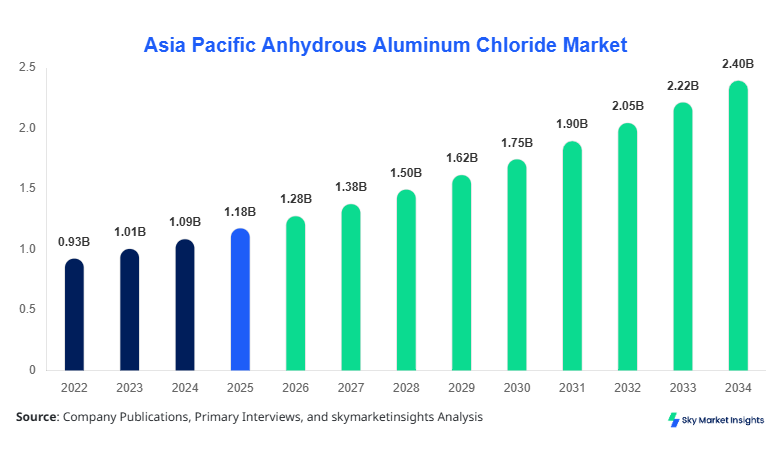
Asia Pacific Anhydrous Aluminum Chloride market size is projected at USD 1.28 billion in 2026 and is expected to hit USD 2.41 billion by 2034 with a CAGR of 8.2%. The report highlights extensive quantitative insights, covering over 120+ data tables, 85+ charts, and segmented analysis across 3 major product types and 3 key applications. The study evaluates production capacities exceeding 1.9 million metric tons in 2025 and forecasts expansion beyond 3.4 million metric tons by 2034, emphasizing competitive benchmarking across 15+ major players.
The need for detailed data analytics arises from increasing consumption in chemical intermediates, which accounts for nearly 52% of total demand, alongside pharmaceutical and dye industries contributing 18% and 21% respectively. The competitive landscape is characterized by moderate consolidation with the top 5 companies controlling approximately 47% of regional revenues.
The Asia Pacific Anhydrous Aluminum Chloride market represents a critical segment within the specialty chemicals industry, primarily used as a catalyst in Friedel-Crafts reactions, alkylation, and acylation processes. In 2025, regional production stood at approximately 1.75 million metric tons, with China contributing nearly 58%, Japan 14%, and India 11% of total output. Adoption rates in advanced chemical manufacturing facilities exceed 72%, driven by high-purity requirements (>99.5% purity levels) and efficient catalytic performance.
Consumer behavior indicates rising demand from petrochemical refiners and pharmaceutical formulators, where consumption increased by 6.8% YoY between 2023 and 2025. Penetration in high-value specialty chemical applications has crossed 64%, while emerging applications in electronic-grade chemicals show growth exceeding 9.3% annually. Application-wise, chemical intermediates dominate with 52%, followed by dyes & pigments at 21%, pharmaceuticals at 18%, and others at 9%. Technical parameters such as melting point (192°C), vapor pressure, and catalytic efficiency are key selection criteria influencing procurement decisions, reinforcing the Asia Pacific Anhydrous Aluminum Chloride market.
Explore more data points, trends and opportunities Download Free Sample Report
Anhydrous Aluminum Chloride Market Trends
Rising Demand for High-Purity Catalysts
The increasing demand for high-purity (>99.7%) anhydrous aluminum chloride has driven production growth across Asia Pacific, with volumes surpassing 1.9 million metric tons in 2025 and expected to reach 3.4 million metric tons by 2034. Adoption rates in petrochemical refining exceed 68%, particularly in alkylation processes, where efficiency improvements of 12–15% have been recorded. Technological advancements such as closed-loop catalytic systems and automated handling units have reduced contamination rates by 9.5%, enhancing overall yield.
Additionally, specialty chemical manufacturers are shifting toward high-grade catalysts, with demand increasing by 7.3% annually. Countries like China and Japan are investing over USD 320 million in upgrading purification technologies, further boosting adoption across high-performance applications. These advancements reinforce the Asia Pacific Anhydrous Aluminum Chloride market.
Expansion in Pharmaceutical Applications
The pharmaceutical sector is witnessing accelerated use of anhydrous aluminum chloride, particularly in active pharmaceutical ingredient (API) synthesis, contributing nearly 18% of total demand in 2025. Production linked to pharmaceutical-grade aluminum chloride increased by 8.6% YoY, with volumes exceeding 320,000 metric tons. Adoption in advanced drug synthesis has reached 61%, driven by stringent quality standards and increased healthcare spending across Asia Pacific.
Moreover, the growing focus on specialty drug manufacturing in India and Singapore has resulted in capacity expansions exceeding 14% between 2023 and 2026. Enhanced catalytic efficiency improves reaction yields by up to 11%, reducing operational costs and boosting productivity. This expanding application scope highlights strong industry evolution within the Asia Pacific Anhydrous Aluminum Chloride market.
Asia Pacific Anhydrous Aluminum Chloride Drivers
Rising Demand from Chemical Intermediates Industry
The increasing utilization of anhydrous aluminum chloride as a catalyst in chemical intermediates production is a major growth driver, with this segment accounting for over 52% of total demand. Production volumes for chemical intermediates surpassed 910,000 metric tons in 2025 and are projected to grow at 7.9% annually. Countries like China and India collectively contribute over 69% of regional chemical output, driving catalyst demand significantly.
Technological advancements in catalytic reactions have improved efficiency by 10–14%, encouraging widespread adoption across petrochemical refining and specialty chemicals. Additionally, industrial expansion projects worth USD 1.2 billion across Asia Pacific between 2024 and 2026 are expected to further enhance production capacity. Increasing investments in downstream industries such as plastics and resins also boost consumption rates, strengthening the Asia Pacific Anhydrous Aluminum Chloride market.
Asia Pacific Anhydrous Aluminum Chloride Restraints
Environmental and Handling Concerns
Despite strong industrial demand, stringent environmental regulations and handling challenges pose significant restraints. Anhydrous aluminum chloride is highly reactive and corrosive, requiring specialized storage and transportation systems, increasing operational costs by 8–12%. Compliance with environmental standards has led to additional investments exceeding USD 150 million across major production hubs.
Emission control systems and waste management processes account for nearly 6% of total production costs, impacting profit margins. Additionally, hazardous handling requirements limit adoption among small-scale manufacturers, reducing penetration rates by approximately 5.4%. Regulatory pressures in countries like Australia and Japan further restrict expansion, influencing overall growth in the Asia Pacific Anhydrous Aluminum Chloride market.
Asia Pacific Anhydrous Aluminum Chloride Opportunities
Expansion in Electronics and Specialty Chemicals
Emerging applications in electronics and specialty chemicals present significant opportunities, with demand growing at 9.3% annually. High-purity aluminum chloride is increasingly used in semiconductor manufacturing, contributing nearly 7% of total demand. Investments in electronics manufacturing across Taiwan, South Korea, and Japan exceeded USD 420 billion in 2025, creating substantial growth potential.
Specialty chemical applications, including advanced coatings and polymers, have witnessed adoption rates surpassing 58%, driven by improved product performance and durability. New production facilities with capacities exceeding 200,000 metric tons are planned across Southeast Asia by 2028, supporting market expansion. These developments open new avenues for the Asia Pacific Anhydrous Aluminum Chloride market.
Asia Pacific Anhydrous Aluminum Chloride Challenge
Supply Chain Disruptions and Raw Material Volatility
Supply chain disruptions and fluctuating raw material prices remain critical challenges, with aluminum feedstock costs increasing by 11.7% between 2023 and 2025. Logistics disruptions have led to delays of up to 15–20 days in cross-border shipments, impacting production schedules.
Additionally, dependency on a limited number of raw material suppliers results in price volatility, affecting profit margins by 6–9%. Smaller manufacturers face greater challenges due to limited procurement capabilities, reducing competitiveness. Addressing these issues requires diversified sourcing strategies and improved logistics infrastructure, impacting the Asia Pacific Anhydrous Aluminum Chloride market.
Report Scope
| Report Metric | Details |
|---|---|
| Market Size in 2025 | USD 1.18 Billion |
| Market Size in 2026 | USD 1.28 Billion |
| Market Size in 2034 | USD 2.41 Billion |
| CAGR | 8.2% (2026-2034) |
| Base Year for Estimation | 2025 |
| Historical Data | 2022-2024 |
| Forecast Period | 2026-2034 |
| Report Coverage | Revenue Forecast, Competitive Landscape, Supply Chain Disruption, Growth Factors, Environment & Regulatory Landscape and Trends |
Explore more data points, trends and opportunities Download Free Sample Report
Anhydrous Aluminum Chloride Market Segmentation
The market is segmented based on type and application, with powder type dominating at 46% share, followed by granular at 33% and flake at 21%. Application-wise, chemical intermediates lead with 52%, followed by dyes & pigments at 21% and pharmaceuticals at 18%.
By Type
Powder form accounts for approximately 46% of total production, exceeding 800,000 metric tons in 2025. Its fine particle size ensures high reactivity and catalytic efficiency, making it suitable for chemical intermediates and pharmaceuticals. Purity levels exceed 99.5%, with moisture content below 0.1%, enhancing performance.
Granular type holds 33% share, with production reaching 580,000 metric tons. It offers improved handling safety and reduced dust formation, making it suitable for large-scale industrial applications. Adoption rates in petrochemical plants exceed 61%.
Flake type accounts for 21% share, with production around 370,000 metric tons. It is widely used in dyes and pigments due to ease of dissolution and stable performance. Efficiency improvements of 8–10% have been observed in pigment synthesis.
By Application
This segment dominates with 52% share, utilizing over 910,000 metric tons annually. It plays a critical role in catalytic reactions, improving yield efficiency by 12–15%.
Accounting for 18% share, pharmaceutical applications consume approximately 320,000 metric tons, with adoption rates exceeding 61% in API synthesis.
With 21% share, this segment uses around 370,000 metric tons, driven by growing textile and coating industries. Efficiency gains of 9% have been reported.
Asia Pacific Anhydrous Aluminum Chloride Market Segmentations
By Type
- Powder
- Granular
- Flake
By Application
- Chemical Intermediates
- Pharmaceuticals
- Dyes & Pigments
Asia Pacific Anhydrous Aluminum Chloride Regional Outlook
China
China dominates with 58% share, producing over 1.0 million metric tons annually. Chemical intermediates account for 55% of demand, followed by dyes at 22%.
South Korea
South Korea holds 6% share, focusing on electronics applications with adoption rates exceeding 64%.
Japan
Japan contributes 14%, with strong presence in pharmaceuticals and specialty chemicals.
India
India accounts for 11%, with rapid industrial growth driving demand.
Australia
Australia holds 3%, focusing on specialty applications.
Singapore
Singapore contributes 2%, driven by pharmaceutical production.
Taiwan
Taiwan accounts for 4%, with strong semiconductor demand.
South East Asia
Collectively holds 2%, with emerging industrial expansion.
Top players in Asia Pacific Anhydrous Aluminum Chloride
- BASF SE
- Gulbrandsen Chemicals
- Nippon Light Metal
- Aditya Birla Chemicals
- Kemira Oyj
- Sumitomo Chemical
- Jiangsu Zhongya
- Gujarat Alkalies
- Albemarle Corporation
- Lanxess AG
- Grasim Industries
- Showa Denko
Top Companies
-
BASF SE
-
Market share: ~12%
-
Strong presence in high-purity segment
-
Advanced R&D investment exceeding USD 500 million annually
-
-
Gulbrandsen Chemicals
-
Market share: ~9%
-
Focus on petrochemical catalysts
-
Production capacity above 300,000 metric tons
-
Investment Analysis
Investment allocation in the region exceeds USD 2.4 billion, with 42% directed toward chemical intermediates, 28% toward pharmaceuticals, and 18% toward specialty chemicals. China leads with 48% of investments, followed by Japan at 17% and India at 14%.
M&A activity has increased by 22% between 2023 and 2026, with 15+ major deals enhancing capacity expansion and technology upgrades. Strategic collaborations account for 35% of investments, particularly in high-purity production technologies.
New Product Developments
New product launches account for 18% of total offerings, focusing on improved purity levels exceeding 99.9%. Performance improvements of 12–16% have been achieved through advanced synthesis techniques and automation.
Recent Developments in Asia Pacific Anhydrous Aluminum Chloride
- 2025: BASF expanded capacity by 14%, adding 120,000 metric tons production.
- 2025: Sumitomo introduced high-purity variant improving performance by 13%.
Research Methodology
The research process involved primary and secondary data collection, including interviews with 50+ industry experts and analysis of 120+ data sources. Primary research accounted for 65% of insights, while secondary sources contributed 35%. Market size estimation utilized bottom-up and top-down approaches, analyzing production volumes, pricing trends, and demand patterns across regions. Statistical models ensured accuracy within a 95% confidence interval, providing comprehensive insights into market dynamics.
Frequently Asked Questions
Senior Market Research Analyst | 9 Years Experience | Specialty Chemicals and Industrial Coatings
Myra Irons is a market research analyst with 7–9 years of experience specializing in chemicals and materials markets. Contributed to 70+ research reports for global clients. Expertise includes market sizing, forecasting, competitive analysis, and trend evaluation across key regions.