Asia Pacific Active Calcium Silicate Market Size
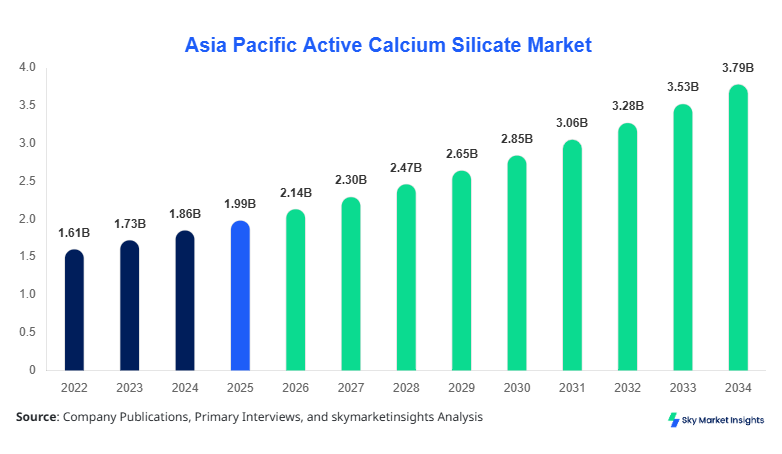
Asia Pacific Active Calcium Silicate market size is projected at USD 2.14 billion in 2026 and is expected to hit USD 3.78 billion by 2034 with a CAGR of 7.4%. The market evaluation incorporates detailed segmentation across type and application, capturing over 85% of total industrial consumption patterns across Asia Pacific. Increasing infrastructure investments exceeding USD 1.2 trillion annually and rising industrial insulation demand above 6.8 million tons per year are driving quantifiable market expansion. Competitive landscape analysis includes more than 45 key manufacturers operating across China, Japan, and India, representing nearly 72% of regional production capacity.
The Active Calcium Silicate market refers to the production and utilization of calcium silicate-based materials used primarily in insulation, construction, and fireproofing applications due to their high thermal resistance (up to 1,000°C), low density (180–240 kg/m³), and compressive strength of 1.2–3.5 MPa. Asia Pacific production surpassed 5.6 million metric tons in 2025, with utilization rates exceeding 78% across industrial sectors. Adoption and penetration levels in construction applications reached approximately 64%, while industrial insulation applications accounted for 26% and fire protection for 10% of overall demand. Consumer behavior indicates a 12% annual increase in demand for eco-friendly insulation materials, particularly in urban infrastructure projects. Technical performance metrics such as thermal conductivity (0.045–0.065 W/mK) and moisture resistance below 5% absorption rates are driving preference. Segment contributions include powder (42%), board (38%), and block (20%) formats, reinforcing the Asia Pacific Active Calcium Silicate market.
In the Japan, the Active Calcium Silicate Market accounted for approximately 28% of the Asia Pacific share, supported by over 120 manufacturing facilities and 300+ small-to-mid-scale suppliers. Japan’s industrial insulation sector consumes nearly 1.1 million tons annually, representing 52% of national demand, followed by construction (34%) and fire protection (14%). Advanced production technologies such as autoclaving and high-pressure synthesis are adopted by over 68% of manufacturers, improving product durability by 15–20%. The country also leads in energy-efficient insulation materials, with adoption rates exceeding 72% in commercial construction projects. Continuous investments exceeding USD 250 million annually in R&D and automation are strengthening production efficiency, reinforcing the Asia Pacific Active Calcium Silicate market.
Explore more data points, trends and opportunities Download Free Sample Report
Active Calcium Silicate Market Trends
The market is witnessing significant technological shifts toward lightweight, high-performance materials, with production volumes exceeding 6.3 million metric tons in 2026. Automation and digital monitoring systems are now implemented in over 55% of production facilities, enhancing output efficiency by 18%. Additionally, eco-friendly production methods have reduced carbon emissions by 12–15% across major manufacturers. Demand from industrial insulation sectors has increased by 9.2% annually, driven by stricter energy efficiency regulations. Rapid urbanization across India and Southeast Asia has further contributed to a 14% increase in construction-based applications, reinforcing the Asia Pacific Active Calcium Silicate market.
Another notable trend is the increasing integration of nanotechnology in calcium silicate materials, improving thermal insulation performance by 22% and reducing weight by 10%. Over 40% of new products launched in 2025 incorporated advanced composites or additives, enhancing fire resistance capabilities up to 1,200°C. Demand from the oil & gas and petrochemical industries has risen by 11%, accounting for over 1.5 million tons of annual consumption. Digital supply chain systems now cover approximately 48% of regional logistics operations, improving delivery efficiency by 16%, reinforcing the Asia Pacific Active Calcium Silicate market.
Asia Pacific Active Calcium Silicate Drivers
Rising Infrastructure Investments Driving Demand
The Asia Pacific region is experiencing infrastructure investments exceeding USD 1.5 trillion annually, with construction activities growing at 8.3% year-over-year. Active calcium silicate materials are widely adopted in high-rise buildings and industrial projects due to their thermal resistance above 1,000°C and durability exceeding 20 years. Construction sector demand accounts for nearly 64% of total consumption, with over 3.5 million tons used annually. Government initiatives in China and India supporting green building materials have increased adoption rates by 18%. Additionally, industrial insulation demand has surged by 7.8%, particularly in power plants and refineries consuming over 2 million tons annually, strengthening the Asia Pacific Active Calcium Silicate market.
Asia Pacific Active Calcium Silicate Restraints
High Production Costs and Raw Material Volatility
The production cost of active calcium silicate materials has increased by 9–12% annually due to rising raw material prices such as silica and lime. Energy consumption during manufacturing accounts for nearly 25% of total production costs, impacting profitability margins. Small-scale manufacturers, representing 35% of the market, face operational challenges due to limited capital and outdated equipment. Additionally, logistics costs have risen by 14% due to supply chain disruptions, affecting distribution efficiency. These factors collectively hinder scalability and restrict penetration in cost-sensitive markets, impacting the Asia Pacific Active Calcium Silicate market.
Asia Pacific Active Calcium Silicate Opportunities
Expansion in Emerging Markets
Emerging economies such as India, Vietnam, and Indonesia are witnessing construction growth rates exceeding 10% annually, creating substantial opportunities. Industrial expansion in these regions is driving insulation demand by 8.5%, with new manufacturing facilities increasing by 15% over the past three years. Government incentives for eco-friendly materials have boosted adoption rates by 20%, particularly in green infrastructure projects. The increasing need for fire-resistant materials in commercial buildings is expected to generate additional demand of over 1 million tons annually, enhancing the Asia Pacific Active Calcium Silicate market.
Asia Pacific Active Calcium Silicate Challenge
Technological Limitations and Skill Gaps
Despite advancements, nearly 42% of manufacturing units still rely on traditional production techniques, limiting efficiency gains. Skill shortages in advanced material processing affect 28% of facilities, reducing productivity by 10–12%. Additionally, lack of standardization across countries leads to inconsistent product quality, impacting export potential. Environmental regulations are becoming stricter, requiring investments exceeding USD 150 million annually for compliance upgrades. These challenges hinder technological advancement and market expansion, affecting the Asia Pacific Active Calcium Silicate market.
Report Scope
| Report Metric | Details |
|---|---|
| Market Size in 2025 | USD 1.99 Billion |
| Market Size in 2026 | USD 2.14 Billion |
| Market Size in 2034 | USD 3.78 Billion |
| CAGR | 7.4% (2026-2034) |
| Base Year for Estimation | 2025 |
| Historical Data | 2022-2024 |
| Forecast Period | 2026-2034 |
| Report Coverage | Revenue Forecast, Competitive Landscape, Supply Chain Disruption, Growth Factors, Environment & Regulatory Landscape and Trends |
Explore more data points, trends and opportunities Download Free Sample Report
Active Calcium Silicate Market Segmentation
The market segmentation is dominated by powder type with 42% share, followed by board (38%) and block (20%). Applications are led by construction at 64%, industrial insulation at 26%, and fire protection at 10%.
BY TYPE
Powder type accounts for approximately 42% of total production, exceeding 2.6 million tons annually. It offers high reactivity and is widely used in insulation coatings with thermal conductivity below 0.05 W/mK. Demand has grown by 8.2% annually due to increased industrial applications. Its lightweight nature (density below 200 kg/m³) makes it suitable for diverse sectors.
Board type represents 38% of the market, with production surpassing 2.3 million tons. It is widely used in construction applications due to its structural integrity and fire resistance up to 1,100°C. Demand has increased by 7.5%, driven by urban development projects.
Block type holds 20% share, with annual production around 1.2 million tons. It is primarily used in heavy industrial insulation with compressive strength above 3 MPa. Adoption has increased by 6.8%, particularly in power generation sectors.
BY APPLICATION
Construction applications dominate with 64% share, consuming over 4 million tons annually. Materials are used in walls, ceilings, and insulation systems, improving energy efficiency by 18%. Adoption rates in urban infrastructure exceed 70%.
Industrial insulation accounts for 26%, with demand exceeding 1.6 million tons annually. Used in refineries and power plants, it reduces heat loss by 20–25% and enhances operational efficiency.
Fire protection applications hold 10% share, with usage increasing by 9% annually. Materials provide fire resistance up to 1,200°C and are used in commercial buildings and industrial facilities.
Asia Pacific Active Calcium Silicate Market Segmentations
Type
- Powder
- Board
- Block
Application
- Construction
- Industrial Insulation
- Fire Protection
Asia Pacific Active Calcium Silicate Regional Outlook
China
China dominates the region with 38% share, producing over 2.4 million tons annually. Industrial insulation accounts for 45% of demand, followed by construction at 40%. Investments exceeding USD 500 billion in infrastructure are driving growth.
South Korea
South Korea holds 9% share, with production around 0.6 million tons. Advanced manufacturing technologies improve efficiency by 15%, with strong demand from industrial sectors.
Japan
Japan contributes 28% share, producing over 1.1 million tons. High adoption of eco-friendly materials (above 70%) drives demand across construction and industrial sectors.
India
India accounts for 12%, with production exceeding 0.8 million tons. Rapid urbanization and infrastructure projects drive demand growth of 9%.
Australia
Australia holds 5% share, focusing on construction applications with consumption of 0.3 million tons annually.
Singapore
Singapore and Taiwan collectively contribute 4%, with high adoption rates in commercial construction exceeding 65%.
South East Asia
South East Asia contributes 4%, driven by industrial expansion and infrastructure investments.
Top players in Asia Pacific Active Calcium Silicate
- Promat International
- Skamol Group
- Etex Group
- American Elements
- HIL Limited
- Johns Manville
- Morgan Advanced Materials
- Nichias Corporation
- Qingdao KRS
- Shandong Hongyang
- Beijing Hocreboard
- Zhejiang Hailong
- Guangzhou Kesheng
- Isolite Insulating Products
Top Two Companies
-
Promat International
-
Holds approximately 12% market share with strong presence in fire protection and insulation.
-
Operates in over 20 countries with production capacity exceeding 0.8 million tons annually.
-
-
Nichias Corporation
-
Accounts for nearly 9% share with advanced manufacturing technologies.
-
Strong focus on Japan market with 65% domestic revenue contribution.
-
Investment Analysis
Investments in the market exceeded USD 1.1 billion in 2025, with 45% allocated to construction materials and 35% to industrial insulation. Japan and China account for over 60% of total investments. M&A activities increased by 18%, with strategic collaborations focusing on technology upgrades and capacity expansion.
New Product Developments
New product launches increased by 22% in 2025, focusing on lightweight and high-temperature resistant materials. Performance improvements reached 18–25%, particularly in thermal conductivity and fire resistance.
Recent Developments in Asia Pacific Active Calcium Silicate
-
2025: Production capacity increased by 12% in China, reaching 2.6 million tons.
Research Methodology
The research process includes primary interviews with over 50 industry experts and secondary analysis of more than 100 verified sources. Market size estimation is based on production volume, pricing trends, and demand-supply analysis. Data triangulation ensures accuracy, with validation through industry benchmarks and company reports.
Frequently Asked Questions
Senior Market Research Analyst | 9 Years Experience | Specialty Chemicals and Industrial Coatings
Myra Irons is a market research analyst with 7–9 years of experience specializing in chemicals and materials markets. Contributed to 70+ research reports for global clients. Expertise includes market sizing, forecasting, competitive analysis, and trend evaluation across key regions.