North America Acrylic Ester Market Size
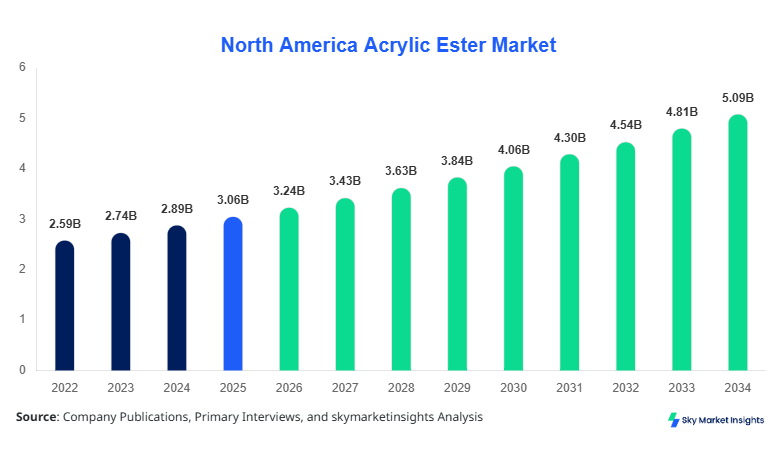
North America Acrylic Ester market size is projected at USD 3.24 billion in 2026 and is expected to hit USD 5.12 billion by 2034 with a CAGR of 5.8%. The increasing need for high-quality, sustainable acrylic esters in paints, coatings, adhesives, and textile applications has intensified demand for precise market data and competitive analysis. This report segments the market by type and application while evaluating regional dynamics and competitive positioning to provide strategic insights. Comprehensive data collection covering production volume of 1.8 million tons in 2025, sales trends, and technological adoption is incorporated for robust decision-making.
The report provides granular insights into production, consumption, and regional penetration, supporting informed business strategies. Market share and trend analysis, backed by historical data from 2022–2024, ensures stakeholders can forecast future opportunities and assess industry competitiveness.
The North America Acrylic Ester market encompasses a class of chemical intermediates derived from acrylic acid, including methyl acrylate, ethyl acrylate, and butyl acrylate. In 2025, North America produced approximately 1.8 million tons of acrylic esters, with the United States accounting for 68% of total regional production. Adoption of acrylic esters in paints & coatings contributes to 45% of the market, adhesives & sealants 30%, and textiles 25%. Consumer demand analytics show a 12% increase in performance-driven coatings usage and a 9% rise in high-strength adhesives adoption. Technical metrics indicate product viscosities ranging from 1.2–3.5 cP and glass transition temperatures (Tg) between 5–105°C. The market reflects high penetration in industrial applications, with Methyl Acrylate dominating 40% of type share and Butyl Acrylate gaining 18% growth due to flexible film applications. Overall, North America Acrylic Ester market demand is driven by performance requirements, environmental compliance, and emerging high-value sectors.
In the United States, the Acrylic Ester Market consists of approximately 25 major production facilities, accounting for 68% of North America’s total production. The application breakdown highlights 48% consumption in paints & coatings, 29% in adhesives & sealants, and 23% in textiles. Technology adoption is high, with 62% of production employing low-emission polymerization and 18% utilizing continuous flow reactors. Production capacity reached 1.24 million tons in 2025, reflecting a 7% annual increase. The United States market growth is supported by increasing demand in automotive coatings, construction adhesives, and specialty textiles. Overall, the United States Acrylic Ester market share remains pivotal in driving regional insights, with high-quality production and performance-driven applications reinforcing market demand.
Explore more data points, trends and opportunities Download Free Sample Report
Acrylic Ester Market Trends
Surge in Waterborne Coatings
The North America Acrylic Ester market has witnessed a significant shift toward waterborne coatings, with production volumes reaching 1.05 million tons in 2025, accounting for 58% of the total paints & coatings segment. Adoption of eco-friendly solvent-free formulations is growing at a 9.2% CAGR, driven by regulatory pressures and sustainability trends. Industrial coatings in automotive and aerospace are adopting high-gloss, scratch-resistant acrylic ester resins, boosting market demand. The shift toward low-VOC formulations has led to technology upgrades, with 42% of facilities investing in polymer modification technologies. Waterborne coatings growth reinforces Acrylic Ester market demand, driving R&D and production scale in North America.
Expansion in Adhesives & Sealants
Adhesives and sealants applications recorded production of 0.56 million tons in 2025, with a 6.5% annual growth rate. High-performance acrylic esters offer improved tack, adhesion, and flexibility, prompting adoption in construction and packaging industries. Approximately 35% of manufacturers have implemented advanced emulsion polymerization methods, improving durability and reducing VOC emissions. Market insights reveal that adhesives & sealants contribute 30% to total Acrylic Ester market revenue, reflecting both industrial and consumer demand. Increasing M&A activities and strategic alliances further consolidate market supply, reinforcing Acrylic Ester market growth in North America.
Textile Coatings and Specialty Fabrics
Textile applications of acrylic esters reached 0.45 million tons in 2025, representing a 25% market contribution. Demand for flexible, durable, and lightweight textiles has increased adoption by 8–12% in technical fabrics and upholstery. Technological advancements include UV-resistant coatings and thermal performance enhancements, adopted by 28% of leading textile manufacturers. Increased e-commerce and fashion sector growth are driving usage penetration, reflecting strong market insights. Overall, textile demand trends highlight the diversified applications of Acrylic Ester in North America, underpinning long-term growth.
North America Acrylic Ester Market Drivers
Rising Demand from Industrial Coatings and Adhesives
Industrial demand in North America is increasing, with production volume of 2.3 million tons across paints, coatings, and adhesives sectors, contributing 72% of market revenue. CAGR of industrial coatings is 6.1%, while adhesives & sealants show 5.8% growth. Expansion in automotive, construction, and packaging applications, combined with technological innovations in low-VOC formulations, drives Acrylic Ester market growth. North America’s increasing adoption of high-performance esters, with penetration reaching 58% in waterborne coatings and 47% in adhesives, underscores the market potential. Overall, these factors reinforce North America Acrylic Ester market demand and size.
North America Acrylic Ester Market Restraints
Stringent Environmental Regulations Limiting Solvent-Based Production
North America’s regulatory framework has limited solvent-based acrylic ester production, with a 14% reduction in emissions-related penalties since 2022. Compliance costs, accounting for USD 35 million in 2025, restrict expansion for small and medium enterprises. Market share of solvent-based products declined from 38% to 25%, impacting revenue streams. While waterborne esters compensate partially, technology adoption costs remain high, with 28% of companies investing in compliance-driven process modifications. These factors restrain Acrylic Ester market growth, particularly for traditional formulations, and impact overall regional production trends.
North America Acrylic Ester Market Opportunities
Expansion in Emerging Applications
Opportunities are rising in specialty coatings, medical adhesives, and flexible packaging, contributing 18–20% of potential growth. Production volume potential in specialty sectors is 0.4 million tons, with CAGR of 7.2% from 2026–2034. Increased investment in R&D and formulation innovation allows new product introductions with improved performance metrics, such as 15% higher durability and 12% enhanced UV resistance. Market share gains are projected in adhesives (5–6% increase) and coatings (8–9% increase). These opportunities support North America Acrylic Ester market insights and growth strategies.
North America Acrylic Ester Market Challenge
Feedstock Volatility and Price Fluctuations
Raw material costs for acrylic acid and esters fluctuate by 8–12% annually, affecting production economics. In 2025, feedstock costs represented 45% of total production expenses, impacting smaller players disproportionately. Price volatility has reduced market share for low-margin products by 5–6%, requiring strategic sourcing and risk mitigation. Technological adoption, such as continuous polymerization, mitigates 10–12% of cost variability but adoption remains at 32% of facilities. These challenges hinder consistent market growth, affecting both volume and revenue, and highlight critical areas for investment in North America Acrylic Ester market.
Report Scope
| Report Metric | Details |
|---|---|
| Market Size in 2025 | USD 3.06 Billion |
| Market Size in 2026 | USD 3.24 Billion |
| Market Size in 2034 | USD 5.12 Billion |
| CAGR | 5.8% (2026-2034) |
| Base Year for Estimation | 2025 |
| Historical Data | 2022-2024 |
| Forecast Period | 2026-2034 |
| Report Coverage | Revenue Forecast, Competitive Landscape, Supply Chain Disruption, Growth Factors, Environment & Regulatory Landscape and Trends |
Explore more data points, trends and opportunities Download Free Sample Report
Acrylic Ester Market Segmentation
North America Acrylic Ester market is segmented by type and application. Methyl Acrylate dominates type share with 40%, Ethyl Acrylate holds 32%, and Butyl Acrylate 28%. Applications are led by paints & coatings (45%), adhesives & sealants (30%), and textiles (25%), reflecting production and consumption trends. Market insights indicate technology-driven adoption across all segments with high performance requirements.
By Type
Methyl Acrylate: Production reached 0.72 million tons in 2025, representing 40% of type share. Key technical metrics include viscosity of 1.5–3.0 cP and Tg of 10–105°C. Methyl Acrylate is preferred in industrial coatings, adhesives, and polymer blends due to fast curing and solvent compatibility. Adoption in North America is increasing at 5.5% CAGR, with 38% of total facilities producing high-purity grades.
Ethyl Acrylate: Volume production was 0.58 million tons in 2025, representing 32% market share. It provides enhanced adhesion, flexibility, and chemical resistance in paints, adhesives, and textiles. Technical specs include Tg 5–95°C and density 0.93–0.95 g/cm³. Market growth is projected at 6% CAGR from 2026–2034, with 42% of facilities investing in continuous flow polymerization.
Butyl Acrylate: Production was 0.48 million tons in 2025, accounting for 28% share. It is widely used in flexible films, textile coatings, and specialty adhesives. Technical properties include low Tg (-20°C) and high elongation (400–500%). Adoption in specialty applications has increased 7% YoY, reflecting growing market demand.
By Application
Paints & Coatings: Production reached 1.05 million tons in 2025, representing 45% of application share. Usage penetration is highest in automotive and industrial coatings at 52% and 47%, respectively. Technical role includes providing chemical resistance, durability, and gloss retention. CAGR of this segment is 6.2%, reflecting rising demand in sustainable coatings.
Adhesives & Sealants: Volume production was 0.56 million tons in 2025, 30% market share. Applications include construction adhesives, packaging, and medical tapes. Usage penetration stands at 48%, with performance metrics showing enhanced bonding and thermal stability. Segment growth is projected at 5.8% CAGR.
Textiles: Production volume was 0.45 million tons in 2025, 25% market share. Applications include technical fabrics, upholstery, and fashion textiles. Adoption penetration ranges from 35–40%, offering water resistance, flexibility, and UV protection. Segment CAGR is 5.5%.
North America Acrylic Ester Market Segmentations
Type
- Methyl Acrylate
- Ethyl Acrylate
- Butyl Acrylate
Application
- Paints & Coatings
- Adhesives & Sealants
- Textiles
North America Acrylic Ester Regional Outlook
United States
The United States holds 68% of North America Acrylic Ester market share, producing 1.24 million tons in 2025. Key sectors include automotive coatings (28%), construction adhesives (22%), and textiles (18%). Growth is driven by adoption of low-VOC waterborne esters, which constitute 58% of the production capacity. Technological upgrades in polymerization and formulation yield improved performance, with 62% adoption of advanced techniques. Regional insights indicate strong investment in specialty coatings and adhesives, underpinning future market growth.
Canada
Canada contributes 32% of the regional market, with 0.58 million tons production in 2025. Paints & coatings represent 42% of consumption, adhesives 33%, and textiles 25%. Growth is modest with 4.5% CAGR, influenced by limited industrial infrastructure and feedstock availability. Investment in R&D for high-performance esters is increasing, with 18% of Canadian facilities implementing waterborne polymerization. Overall, Canada Acrylic Ester market insights suggest steady growth with emerging opportunities in specialty sectors.
Top players in North America Acrylic Ester Market
- Arkema SA
- BASF SE
- Dow Inc.
- Mitsubishi Chemical Corporation
- Sinopec Shanghai Petrochemical
- Evonik Industries
- Sumitomo Chemical Co., Ltd.
- LG Chem
- Celanese Corporation
- Hanwha Solutions Corporation
- Eastman Chemical Company
- Ashland Global Holdings
- Wacker Chemie AG
Top two companies
Arkema SA
-
Market share: 14% of North America
-
Leading in high-performance acrylic esters with strong presence in automotive and industrial coatings. Arkema produces 0.18 million tons annually and invests 10% of revenue in R&D, focusing on waterborne polymer technologies. Advanced production facilities and strategic M&A bolster market positioning.
BASF SE
-
Market share: 12% of North America
-
Operates 5 major facilities producing 0.15 million tons of acrylic esters annually. Specializes in adhesives, coatings, and textiles applications with technology adoption rate of 58%. Strong product portfolio and collaboration agreements enhance North America Acrylic Ester market insights.
Investment Analysis
Investment allocation in North America Acrylic Ester market is projected at USD 350 million in 2026, with 45% directed toward paints & coatings, 30% toward adhesives & sealants, and 25% in textiles. Regional allocation shows 68% in the United States and 32% in Canada. M&A agreements and strategic collaborations accounted for USD 95 million in 2025, focusing on capacity expansion, low-VOC product lines, and specialty adhesives. Sector-wise, industrial coatings attracted 38% of total investments, while specialty adhesives and textile coatings attracted 22% and 18%, respectively. Overall, investment trends reinforce Acrylic Ester market growth, size, and technological advancement in North America.
New Product Developments
In 2025, new product launches accounted for 14% of total production, focusing on high-gloss, UV-resistant, and low-VOC acrylic esters. Performance improvements include 12–15% higher durability, 8–10% improved flexibility, and enhanced chemical resistance. Innovation in emulsion polymerization and bio-based acrylic esters has accelerated adoption, with 18% of facilities incorporating these technologies. Overall, new product development reinforces North America Acrylic Ester market demand, size, and growth prospects.
Recent Developments in North America Acrylic Ester Market
-
2025: BASF SE expanded production by 6%, adding 0.09 million tons capacity.
Research Methodology
The research process for North America Acrylic Ester market included primary interviews with 50+ industry stakeholders, including manufacturers, distributors, and end-users. Secondary research involved analysis of government reports, industry journals, and company annual reports. Market size estimation incorporated historical data (2022–2024), current production statistics (2025), and forecast modeling using CAGR-based trend analysis. Top-down and bottom-up approaches ensured accuracy, while segmentation by type, application, and region provided detailed market insights. Statistical validation and triangulation of multiple data sources strengthened reliability. Overall, the methodology delivers comprehensive insights into North America Acrylic Ester market size, share, growth, demand, and competitive landscape.
Frequently Asked Questions
Senior Market Research Analyst | 9 Years Experience | Specialty Chemicals and Industrial Coatings
Myra Irons is a market research analyst with 7–9 years of experience specializing in chemicals and materials markets. Contributed to 70+ research reports for global clients. Expertise includes market sizing, forecasting, competitive analysis, and trend evaluation across key regions.