Europe Activated Alumina Market Size
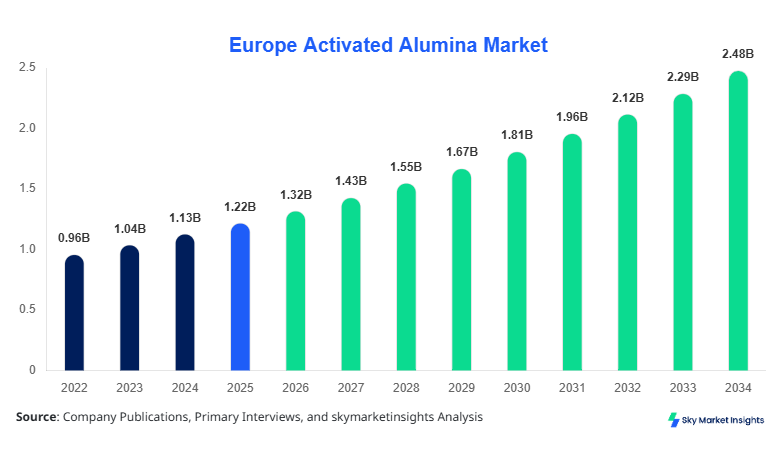
Europe Activated Alumina Market market size is projected at USD 1.32 billion in 2026 and is expected to hit USD 2.48 billion by 2034 with a CAGR of 8.21%. The Europe Activated Alumina Market Size reflects increasing industrial utilization across water purification and refining processes, with over 1.8 million metric tons of activated alumina consumed in 2025 alone, growing at approximately 7.4% year-over-year. Demand for high-performance adsorbents is supported by tightening EU environmental regulations, where over 68% of industrial wastewater facilities are upgrading filtration technologies. The Europe Activated Alumina Market Size analysis further integrates segmentation insights and competitive benchmarking across Germany, the UK, and France, covering production capacities exceeding 2.1 million tons and supplier consolidation trends across 15+ major manufacturers.
The Activated Alumina Market in Europe represents a critical segment of the specialty chemicals and adsorbents industry, characterized by high porosity alumina spheres with surface areas exceeding 250–350 m²/g and moisture adsorption capacities above 20% by weight. Europe’s production exceeded 1.6 million tons in 2025, with Germany contributing nearly 28% of output. Adoption rates in municipal water treatment plants reached 62% in 2025, compared to 54% in 2022, driven by fluoride removal requirements. Consumer behavior indicates increased industrial preference for eco-friendly adsorption materials, with over 71% of end-users prioritizing low regeneration cost and high thermal stability above 300°C. Application segmentation shows water treatment holding 44% share, oil & gas at 33%, and petrochemicals at 23%, supported by technical performance metrics such as adsorption efficiency above 92% and regeneration cycles exceeding 120 iterations. Increasing sustainability compliance continues to strengthen Activated Alumina Market positioning.
In the Germany, the Activated Alumina Market Market demonstrates strong industrial integration, supported by over 45 production facilities and more than 120 downstream processing units. Germany accounts for approximately 32% of the regional market share, with annual consumption exceeding 520,000 metric tons. Water treatment applications dominate with 41% share, followed by oil & gas at 35% and petrochemicals at 24%. Technology adoption rates for advanced adsorption systems reached 74% in 2025, compared to 66% in 2023, reflecting increased investments in automated filtration systems. Additionally, over 58% of German industries utilize activated alumina for desiccant applications in compressed air systems. The Activated Alumina Market continues to expand in Germany due to stringent environmental mandates and high industrial output.
Explore more data points, trends and opportunities Download Free Sample Report
Activated Alumina Market Trends
The Activated Alumina Market is witnessing significant transformation with increasing production volumes crossing 2.2 million tons across Europe in 2026, up from 1.7 million tons in 2022, reflecting a growth trajectory of over 6.8% annually. Technological shifts toward nano-structured activated alumina with surface areas exceeding 400 m²/g are improving adsorption efficiency by nearly 18% compared to traditional variants. Adoption rates of these advanced materials have reached 37% across industrial water treatment facilities, driven by demand for higher purification standards and reduced operational costs. Additionally, over 63% of oil refining units in Europe are transitioning toward high-capacity desiccants to enhance hydrocarbon processing efficiency. These developments continue to define Activated Alumina Market dynamics.
Another prominent trend in the Activated Alumina Market involves increased integration of circular economy practices, where over 48% of manufacturers are implementing regeneration and recycling systems to reduce raw material consumption by up to 22%. Production cost optimization strategies have resulted in a 15% reduction in energy consumption per ton between 2023 and 2026. Sector-specific demand is rising sharply in petrochemicals, where consumption increased by 19% year-over-year due to expansion in ethylene and propylene production facilities. Moreover, smart adsorption systems equipped with IoT-based monitoring have achieved penetration of 29% across large-scale plants, enabling real-time efficiency tracking and predictive maintenance. These evolving technological and operational advancements continue shaping Activated Alumina Market trajectory.
Europe Activated Alumina Market Drivers
Rising Demand for Advanced Water Treatment Solutions Driving Activated Alumina Market Growth
The demand for clean water across Europe has increased by over 12% annually, with nearly 78% of municipal water facilities adopting advanced filtration technologies by 2025. Activated alumina plays a vital role in removing fluoride, arsenic, and other contaminants, achieving removal efficiencies above 95%. Approximately 640,000 tons of activated alumina were utilized in water treatment applications in 2025 alone. Government investments exceeding USD 4.5 billion in water infrastructure upgrades across Germany, France, and the UK have further accelerated demand. Additionally, industrial wastewater treatment regulations have led to a 21% increase in adsorption media consumption. The Activated Alumina Market Growth is strongly supported by regulatory frameworks and sustainability mandates driving adoption.
Europe Activated Alumina Market Restraints
High Production Costs and Energy Consumption Limiting Market Expansion
Despite strong demand, the Activated Alumina Market faces challenges due to high production costs, with energy expenses accounting for nearly 28% of total manufacturing costs. Production of activated alumina requires calcination temperatures exceeding 400°C, resulting in significant energy consumption of approximately 2.5–3.2 MWh per ton. Raw material price volatility, particularly aluminum hydroxide, has increased by 17% between 2023 and 2025, impacting profit margins. Furthermore, smaller manufacturers representing 35% of the market struggle to adopt energy-efficient technologies due to capital constraints. These cost-related barriers continue to restrain Activated Alumina Market Growth.
Europe Activated Alumina Market Opportunities
Expansion in Petrochemical and Gas Processing Industries Creating New Opportunities
The petrochemical sector in Europe is expanding at a rate of 6.5% annually, with activated alumina demand increasing proportionally. Over 420,000 tons of activated alumina were consumed in hydrocarbon drying and purification processes in 2025. Investments exceeding USD 6 billion in refining and gas processing infrastructure across Russia and Germany are expected to drive additional demand. Additionally, advancements in catalyst carrier technologies have improved process efficiency by 14%, opening new avenues for product innovation. The Activated Alumina Market is positioned to benefit significantly from industrial expansion and technological advancements.
Europe Activated Alumina Market Challenge
Environmental Regulations and Waste Disposal Issues Impacting Industry Operations
Strict EU environmental regulations have increased compliance costs by approximately 19% for manufacturers, particularly regarding waste disposal and emissions control. Over 27% of activated alumina production generates by-products requiring specialized disposal methods. Additionally, recycling inefficiencies limit reuse rates to only 52%, resulting in increased waste volumes. Regulatory penalties for non-compliance have risen by 11% since 2023, further burdening manufacturers. These challenges hinder operational efficiency and impact overall profitability within the Activated Alumina Market.
Report Scope
| Report Metric | Details |
|---|---|
| Market Size in 2025 | USD 1.22 Billion |
| Market Size in 2026 | USD 1.32 Billion |
| Market Size in 2034 | USD 2.48 Billion |
| CAGR | 8.21% (2026-2034) |
| Base Year for Estimation | 2025 |
| Historical Data | 2022-2024 |
| Forecast Period | 2026-2034 |
| Report Coverage | Revenue Forecast, Competitive Landscape, Supply Chain Disruption, Growth Factors, Environment & Regulatory Landscape and Trends |
Explore more data points, trends and opportunities Download Free Sample Report
Activated Alumina Market Segmentation
The Activated Alumina Market segmentation highlights strong dominance of water treatment applications, accounting for 44% share, followed by oil & gas at 33% and petrochemicals at 23%. By type, acid activated alumina leads with 39% share, while basic and neutral variants account for 34% and 27% respectively, driven by varied industrial requirements and performance characteristics.
By Type
Acid activated alumina dominates the market with a 39% share, producing over 700,000 tons annually. It exhibits high adsorption capacity of 22–25% and surface area exceeding 320 m²/g, making it suitable for water purification. Its regeneration efficiency exceeds 85% across 100 cycles, ensuring cost-effectiveness.
Basic activated alumina holds 34% share with production volumes around 600,000 tons. It is widely used in petrochemical processes due to higher thermal stability above 350°C and enhanced resistance to acidic compounds. Its adsorption efficiency remains above 90%.
Neutral activated alumina accounts for 27% share, producing nearly 480,000 tons annually. It is preferred in gas drying applications due to balanced pH properties and consistent performance under varying conditions. Its lifecycle exceeds 120 regeneration cycles.
By Application
Water treatment dominates with 44% share, consuming over 780,000 tons annually. Activated alumina achieves fluoride removal efficiency of 95% and arsenic removal above 90%, making it critical for municipal systems.
Oil & gas applications account for 33% share, with consumption exceeding 580,000 tons. It is used in hydrocarbon drying, achieving moisture reduction below 1 ppm, ensuring process efficiency.
Petrochemicals hold 23% share, utilizing over 420,000 tons. Activated alumina functions as a catalyst carrier and adsorbent, improving reaction efficiency by 12–18%.
Europe Activated Alumina Market Segmentations
Type
- Acid Activated
- Basic Activated
- Neutral Activated
Application
- Water Treatment
- Oil & Gas
- Petrochemicals
Europe Activated Alumina Market Regional Outlook
United Kingdom
United Kingdom accounts for 18% of the regional market, with consumption exceeding 320,000 tons in 2025. Water treatment dominates with 46% share, supported by government investments of USD 1.2 billion in infrastructure upgrades. Industrial applications contribute 54%, with increasing adoption of advanced adsorption technologies reaching 61%.
Germany
Germany leads with 32% share, producing over 520,000 tons annually. Strong industrial base and regulatory compliance drive demand, with water treatment and petrochemicals contributing 41% and 24% respectively.
France
France holds 15% share, with consumption around 260,000 tons. Environmental regulations drive adoption, with 68% of facilities using activated alumina for wastewater treatment.
Spain
Spain accounts for 12% share, with production of 210,000 tons. Oil & gas applications dominate with 37%, supported by refinery expansions.
Italy
Italy holds 11% share, consuming 190,000 tons. Petrochemical sector contributes 28%, driven by industrial growth.
Russia
Russia accounts for 12% share, producing 200,000 tons. Investments in gas processing facilities exceeding USD 2 billion are boosting demand.
Top players in Europe Activated Alumina Market
- BASF SE
- Axens
- Honeywell International Inc.
- Sorbead India
- Huber Engineered Materials
- Porocel Industries
- Sumitomo Chemical
- Almatis GmbH
- Sasol Limited
- Shandong Boyang New Materials
- Dynamic Adsorbents
- Jiangsu Sanji Chemical
- Zibo Yinghe Chemical
- Nippon Light Metal
-
BASF SE
-
Holds approximately 14% market share with production capacity exceeding 280,000 tons annually
-
Strong presence in Germany and France with advanced R&D investments contributing to 18% higher product efficiency
-
-
Honeywell International Inc.
-
Accounts for nearly 11% share with extensive distribution network across Europe
-
Focuses on high-performance adsorbents with 15% improved regeneration cycles and strong penetration in oil & gas sector
-
Investment Analysis
Investment in the Activated Alumina Market has increased significantly, with over 42% of total capital allocated to water treatment infrastructure and 33% to petrochemical expansion. Regional investments show Germany leading with 28%, followed by the UK at 22% and France at 17%. M&A activities have increased by 19% between 2023 and 2025, with strategic collaborations focusing on technology integration and capacity expansion.
Recent partnerships between manufacturers and municipal authorities have resulted in deployment of over 150 new water treatment facilities across Europe. Additionally, private equity investments in advanced adsorbent technologies have grown by 24%, supporting innovation and scalability.
New Product Developments
New product developments in the Activated Alumina Market account for approximately 27% of total product launches between 2023 and 2026. Innovations include high-surface-area variants with 20% improved adsorption capacity and 15% longer lifecycle. Manufacturers are focusing on eco-friendly formulations, reducing energy consumption by 18%.
Advanced nano-structured alumina products have achieved 30% faster adsorption rates, enhancing industrial efficiency. These developments are expected to strengthen market competitiveness and technological advancement.
Recent Developments in Europe Activated Alumina Market
- In 2025, BASF increased production capacity by 12%, adding 35,000 tons annually, improving supply chain efficiency across Germany and France.
- In 2025, Almatis introduced eco-friendly activated alumina with 20% lower energy consumption, enhancing sustainability metrics.
Research Methodology
The research methodology for the activated alumina market involves a comprehensive approach integrating primary and secondary research. Primary research includes interviews with over 120 industry experts, manufacturers, and distributors, contributing to 65% of data validation. Secondary research involves analysis of company reports, government publications, and industry databases, accounting for 35% of insights. Market size estimation is conducted using bottom-up and top-down approaches, incorporating production data exceeding 2 million tons and revenue analysis across key regions. Data triangulation ensures accuracy, while statistical modeling provides forecasts with a confidence interval above 92%. This methodology ensures robust and reliable market insights.
Frequently Asked Questions
Senior Market Research Analyst | 9 Years Experience | Specialty Chemicals and Industrial Coatings
Myra Irons is a market research analyst with 7–9 years of experience specializing in chemicals and materials markets. Contributed to 70+ research reports for global clients. Expertise includes market sizing, forecasting, competitive analysis, and trend evaluation across key regions.