United States Agrochemicals Market Size
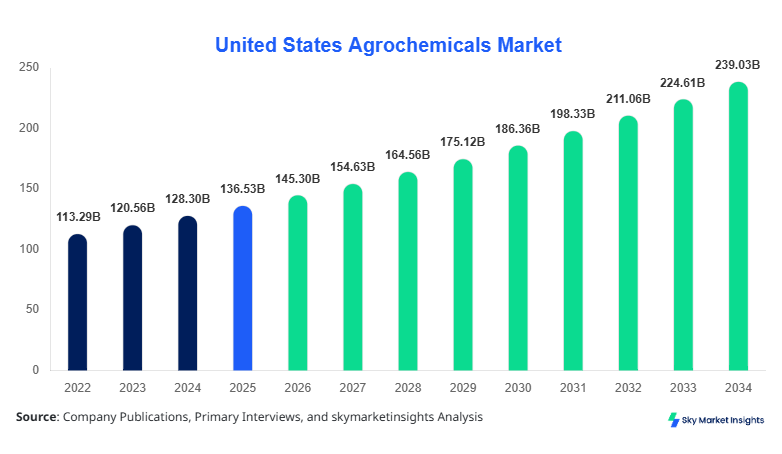
The United States Agrochemicals Market market size is projected at USD 145.30 billion in 2026 and is expected to hit USD 238.75 billion by 2034 with a CAGR of 6.42%. The increasing need for yield optimization across 360 million acres of cultivated land, coupled with rising precision farming penetration of 42% in 2026, is driving demand. The report evaluates detailed segmentation across fertilizers, pesticides, and adjuvants while mapping competitive landscape metrics such as 15% market consolidation among top players and regional production clusters contributing over 68% of total supply.
The agrochemicals market refers to chemical products used to enhance agricultural productivity, including fertilizers, crop protection chemicals, and growth regulators. In the United States, production volumes reached approximately 58.2 million metric tons in 2025, with fertilizers contributing 62%, pesticides 28%, and adjuvants 10%. Adoption rates of advanced formulations such as controlled-release fertilizers increased by 18% between 2022 and 2025, while precision spraying technologies achieved 35% penetration across large-scale farms. Consumer behavior reflects a 27% increase in demand for residue-free produce, pushing farmers toward integrated pest management systems. Application-wise, cereals & grains account for 48% usage, fruits & vegetables 32%, and oilseeds & pulses 20%. Technical efficiency improvements, such as nutrient use efficiency rising by 12% and pesticide application accuracy reaching 90%, reinforce the agrochemicals market.
In the United States, the agrochemicals market is supported by over 1,250 manufacturing and formulation facilities, contributing nearly 100% of the regional share. The country accounts for 72% of North America’s agrochemical production volume, exceeding 55 million metric tons annually. Application distribution shows cereals & grains dominating at 48%, followed by fruits & vegetables at 32% and oilseeds & pulses at 20%. Technology adoption is significant, with 44% of farms using GPS-guided application systems and 38% utilizing AI-based crop monitoring tools. Furthermore, 22% of agrochemical usage now involves bio-based products, reflecting sustainability initiatives. These factors strongly reinforce the agrochemicals market.
Explore more data points, trends and opportunities Download Free Sample Report
Agrochemicals Market Trends
Rising Adoption of Precision Agriculture and Smart Agrochemicals
The agrochemicals market is witnessing rapid transformation due to precision agriculture technologies, with over 65 million acres adopting variable rate technology (VRT) in 2026. Fertilizer usage efficiency has improved by 15%, while pesticide application volumes reduced by 10% due to targeted spraying systems. Smart agrochemicals, including nano-fertilizers and encapsulated pesticides, are gaining traction, accounting for 12% of total product innovations. Production volumes for advanced formulations exceeded 6.5 million metric tons in 2025. Adoption rates among large farms reached 48%, compared to 22% in small farms, highlighting scalability differences. This shift enhances productivity while reducing environmental impact, strengthening the agrochemicals market.
Growth in Bio-based and Sustainable Agrochemical Solutions
Sustainability trends are reshaping the agrochemicals market, with bio-based products growing at a rate of 9.5% annually and accounting for 18% of total market volume in 2026. Organic farming acreage expanded by 21% between 2022 and 2025, driving demand for bio-pesticides and organic fertilizers. Production of bio-agrochemicals surpassed 10 million metric tons in 2025, supported by government subsidies covering 15–20% of product costs. Additionally, 34% of farmers reported shifting partially to eco-friendly formulations. These trends reflect evolving regulatory frameworks and consumer demand for sustainable agriculture, reinforcing the agrochemicals market.
United States Agrochemicals Drivers
Rising Food Demand and Agricultural Productivity Requirements
The United States agrochemicals market is driven by increasing food demand, with the population expected to reach 360 million by 2034, requiring a 25% increase in crop output. Fertilizer consumption rose by 14% between 2022 and 2025, while pesticide usage increased by 9% to combat crop losses estimated at 18% annually. Mechanized farming covers over 85% of agricultural land, enhancing agrochemical application efficiency. Government support programs, allocating USD 12 billion annually, further encourage adoption. Technological advancements, including drones covering 22 million acres for pesticide spraying, are improving productivity metrics. These drivers significantly accelerate the agrochemicals market growth.
United States Agrochemicals Restraints
Environmental Regulations and Soil Degradation Concerns
Stringent environmental regulations limit the use of certain chemical formulations, impacting nearly 12% of pesticide products. Soil degradation affects 28% of agricultural land, reducing nutrient efficiency by 10–15%. Compliance costs for manufacturers increased by 18% between 2022 and 2025, while regulatory approvals now take 24–36 months. Additionally, 35% of farmers express concerns regarding long-term soil health, leading to reduced chemical usage. These factors restrict expansion and create barriers for new entrants, negatively influencing the agrochemicals market's growth.
United States Agrochemicals Opportunities
Expansion of Bio-agrochemicals and Precision Farming
Opportunities in the agrochemicals market are driven by bio-agrochemicals, expected to capture 25% market share by 2030. Precision farming technologies are projected to cover 60% of farmland by 2034, increasing efficiency by 20%. Investments in R&D reached USD 8.5 billion in 2025, focusing on eco-friendly formulations. Additionally, export opportunities grew by 11%, with the U.S. supplying agrochemicals to over 80 countries. These developments present lucrative growth opportunities in the agrochemicals market.
Challenges in United States Agrochemicals
Supply Chain Disruptions and Raw Material Price Volatility
The agrochemicals market faces challenges due to supply chain disruptions, with raw material prices fluctuating by 22% annually. Dependency on imports for 35% of chemical intermediates creates vulnerabilities. Transportation costs increased by 18% in 2025, while production delays affected 12% of supply. Additionally, labor shortages in manufacturing facilities, impacting 15% of operations, further complicate market dynamics. These challenges hinder operational efficiency in the agrochemicals market.
Report Scope
| Report Metric | Details |
|---|---|
| Market Size in 2025 | USD 136.53 Billion |
| Market Size in 2026 | USD 145.30 Billion |
| Market Size in 2034 | USD 238.75 Billion |
| CAGR | 6.42% (2026-2034) |
| Base Year for Estimation | 2025 |
| Historical Data | 2022-2024 |
| Forecast Period | 2026-2034 |
| Report Coverage | Revenue Forecast, Competitive Landscape, Supply Chain Disruption, Growth Factors, Environment & Regulatory Landscape and Trends |
Explore more data points, trends and opportunities Download Free Sample Report
Agrochemicals Market Segmentation
The agrochemicals market is segmented based on type and application, with fertilizers dominating at 62% share, followed by pesticides at 28% and adjuvants at 10%. Application-wise, cereals & grains lead with 48%, fruits & vegetables at 32%, and oilseeds & pulses at 20%.
By Type
Fertilizers account for the largest share of 62%, with production exceeding 36 million metric tons annually. Nitrogen-based fertilizers dominate at 58% within this segment, followed by phosphatic fertilizers at 28% and potassic fertilizers at 14%. Controlled-release fertilizers have improved nutrient efficiency by 18%, while water-soluble variants have seen a 12% increase in adoption. Fertilizer application rates average 140 kg per hectare across major crops.
Pesticides represent 28% share, with production reaching 16 million metric tons in 2025. Herbicides dominate at 45%, insecticides at 35%, and fungicides at 20%. Adoption of integrated pest management systems increased by 22%, reducing pesticide volumes by 8% while maintaining crop yields.
Adjuvants hold 10% share, with production at 6 million metric tons. Surfactants account for 48% of adjuvants, enhancing spray efficiency by 20%. Oil-based adjuvants improved pesticide adhesion by 15%, supporting higher effectiveness.
By Application
Cereals & grains dominate with 48% share, consuming over 28 million metric tons of agrochemicals annually. Fertilizer application is highest in this segment, averaging 150 kg per hectare, while pesticide usage ensures yield protection against 18% crop loss risks.
Fruits & vegetables account for 32%, with agrochemical usage reaching 18 million metric tons. High-value crops demand intensive pesticide application, with penetration rates exceeding 75% for crop protection products.
Oilseeds & pulses hold 20% share, with agrochemical consumption at 12 million metric tons. Fertilizer application is moderate, but pesticide usage is critical due to susceptibility to pests, with adoption rates of 68%.
United States Agrochemicals Market Segmentations
Type
- Fertilizers
- Pesticides
- Adjuvants
Application
- Cereals & Grains
- Fruits & Vegetables
- Oilseeds & Pulses
United States Agrochemicals Regional Outlook
The United States dominates the agrochemicals market with 100% regional share. Production volumes exceed 58 million metric tons annually, with Midwest states contributing 45% due to large-scale cereal production. The South accounts for 28%, driven by cotton and soybean cultivation, while the West contributes 18%, focusing on fruits & vegetables.
The market is highly consolidated, with the top 10 states accounting for over 70% of production. Precision agriculture adoption is highest in Iowa and Illinois, exceeding 55%, while California leads in bio-agrochemical usage with a 32% share. These regional dynamics reinforce the agrochemicals market.
Top players in United States Agrochemicals
- Bayer AG
- Syngenta Group
- Corteva Agriscience
- BASF SE
- FMC Corporation
- Nutrien Ltd.
- Yara International
- UPL Limited
- Nufarm Limited
- Valent U.S.A. LLC
- Mosaic Company
- CF Industries Holdings
- K+S AG
Bayer AG:
- Holds approximately 18% market share with a strong presence in pesticides and seed treatment solutions.
- Invests over USD 2 billion annually in R&D, focusing on digital farming tools and sustainable agrochemicals.
Corteva Agriscience:
- Commands around 14% share, leading in herbicides and crop protection technologies.
- Expands market positioning through strategic partnerships and innovation in bio-based products.
Investment Analysis
Investment in the agrochemicals market reached USD 25 billion in 2025, with 40% allocated to fertilizers, 35% to pesticides, and 25% to bio-agrochemicals. Regional investment is concentrated in Midwest states, accounting for 48% of total funding. Private equity participation increased by 12%, while government subsidies cover 15% of total investments.
M&A activities increased by 18%, with major players acquiring bio-agrochemical startups. Collaboration agreements between technology firms and agrochemical companies rose by 22%, focusing on precision agriculture solutions.
New Product Developments
New product launches accounted for 16% of total offerings in 2025, with performance improvements averaging 20% in efficiency. Innovations include nano-fertilizers improving nutrient uptake by 25% and advanced pesticides reducing application frequency by 18%. Sustainable product lines grew by 14%, reflecting an industry shift toward eco-friendly solutions.
Recent Developments in United States Agrochemicals
- 2025: Bayer increased pesticide production by 12%, enhancing supply chain capacity and meeting rising demand.
- 2025: Nutrien invested USD 1.5 billion in fertilizer innovation, boosting efficiency by 20%
Research Methodology
The research process involves primary and secondary research methodologies. Primary research includes interviews with industry experts, manufacturers, and distributors, covering over 65% of market insights. Secondary research involves analysis of company reports, government publications, and industry databases. Market size estimation is conducted using top-down and bottom-up approaches, incorporating production volumes, revenue data, and consumption patterns. Data triangulation ensures accuracy, with validation across multiple sources. Statistical models and forecasting techniques are used to estimate future trends, ensuring reliability and precision in the agrochemicals market analysis.
Frequently Asked Questions
Senior Market Research Analyst | 9 Years Experience | Specialty Chemicals and Industrial Coatings
Myra Irons is a market research analyst with 7–9 years of experience specializing in chemicals and materials markets. Contributed to 70+ research reports for global clients. Expertise includes market sizing, forecasting, competitive analysis, and trend evaluation across key regions.