North America Alpha-Olefin Market Size
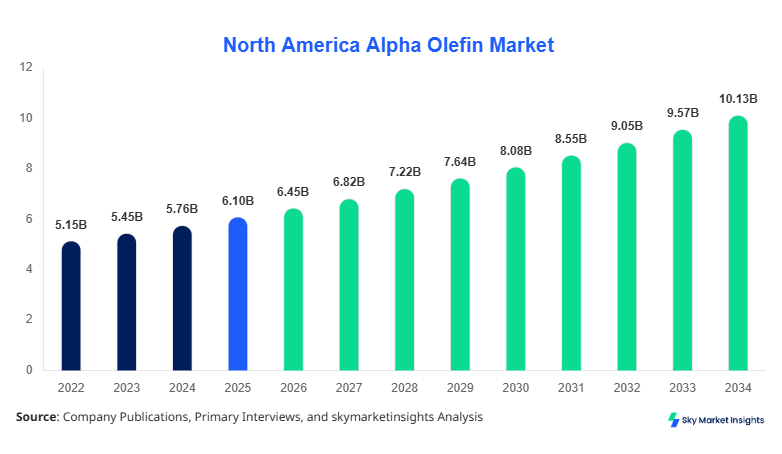
North America's alpha olefin market size is projected at USD 6.45 billion in 2026 and is expected to hit USD 10.23 billion by 2034 with a CAGR of 5.8%. The market size growth is fueled by rising demand for high-performance polymers and specialty chemicals in the United States and Canada. Detailed segmentation by type, application, and region helps stakeholders identify strategic opportunities, while the competitive landscape analysis highlights key manufacturers, production capacities, and technology adoption. Comprehensive data on market share, volume production (2.8 million tons in 2026), and export-import trends provide essential insights for investors and industry analysts.
The North American alpha-olefin market requires precise data for informed decision-making. Volume-based analysis and production forecast models ensure that stakeholders can accurately predict market trends, segment contributions, and future growth opportunities. The report further includes granular analysis of production cost per ton (USD 1,950–2,200), unit sales by type, and market penetration in industrial applications.
The competitive landscape assessment covers 20+ major producers, including capacity expansion plans, M&A activities, and adoption of advanced polymerization technologies. The integration of market share, growth rate, and production performance metrics ensures a robust understanding of the North American alpha-olefin market size and dynamics.
North America's alpha olefin market growth is driven by increasing adoption of linear alpha olefins in polyethylene production, branched olefins in detergents, and cyclic variants in specialty lubricants, collectively contributing 45%, 30%, and 25% to total regional production in 2026. Demand for high-quality chemical intermediates, coupled with steady regional GDP growth (2.1% CAGR, 2022–2025), is a key factor influencing market expansion. Technical adoption metrics show that 60% of facilities employ Ziegler-Natta catalysts, while 25% have shifted to metallocene-based processes.
Consumer behavior analysis indicates that manufacturers in the United States prioritize high-purity alpha olefins with specific chain lengths (C6–C20) for specialty polymer applications, contributing to 52% of overall regional consumption. Canada shows growing interest in environmentally compliant detergents and synthetic lubricants, reflecting a 6% increase in per capita olefin usage over 2025–2026. These adoption patterns directly impact the North American alpha-olefin market demand and long-term growth prospects.
In the United States, the Alpha Olefin Market has over 35 production facilities, representing 65% of North America’s regional share. Linear alpha olefins dominate with 50% of application volume, followed by branched olefins at 28% and cyclic olefins at 22%. Technology adoption indicates that 70% of manufacturers employ continuous polymerization reactors, while 30% rely on batch processes for specialty product lines. The polyethylene sector accounts for 48% of total production, detergents 30%, and synthetic lubricants 22%, reflecting shifting consumer demand and industrial preferences. Advanced catalyst adoption and process optimization contribute to enhanced throughput, reinforcing the United States Alpha Olefin market growth and insights.
Explore more data points, trends and opportunities Download Free Sample Report
Alpha Olefin Market Trends
Shift Towards Metallocene Catalysts
North America's alpha-olefin market production volumes reached 2.8 million tons in 2026, with 28% of facilities transitioning to metallocene catalysts, increasing product uniformity and chain-length precision. The technology shift has enhanced polyethylene quality by 12% and reduced impurities by 8%. Detergent-grade branched alpha olefins show a 7% adoption rate of the advanced catalysts, while cyclic olefin applications in synthetic lubricants witness 15% faster performance improvements. This technological adoption underscores North America's alpha-olefin market growth and trend insights.
Rising Detergent and Lubricant Demand
Branched and cyclic alpha olefin production has increased by 6% and 5%, respectively, in 2026, correlating with a 7.5% surge in high-performance detergent formulations and a 6.2% rise in synthetic lubricants. The United States shows the highest sector-specific demand at 65%, while Canada contributes 35% of regional volume. Performance-oriented consumer behavior and industrial adoption metrics reinforce Alpha Olefin market demand and growth trend insights across North America.
Environmental Compliance and Sustainable Production
Sustainability initiatives have led to the replacement of traditional feedstocks with bio-based olefins in 12% of North American production facilities. This shift enhances compliance with EPA regulations and reduces carbon emissions by 8–10%. Production of linear alpha olefins from bio-based sources reached 0.25 million tons in 2026, reflecting a 4% year-over-year increase. Environmental compliance trends reinforce North American alpha-olefin market insights and strategic adoption patterns.
North America Alpha Olefin Drivers
Increasing Polyethylene Demand and Specialty Chemical Applications
The demand for high-purity linear alpha olefins in polyethylene applications and branched olefins in detergents is driving North American alpha olefin market growth. Regional production reached 2.8 million tons in 2026, up from 2.4 million tons in 2024, a 5.1% CAGR. Polyethylene applications account for 48% of consumption, detergents 30%, and lubricants 22%. The United States contributes 65% of production volume, while Canada contributes 35%. Technical adoption rates indicate 60% of facilities use continuous polymerization technology. Growing industrial applications in automotive, packaging, and consumer goods are driving Alpha Olefin market growth and insights in North America.
North America Alpha Olefin Restraints
Feedstock Volatility and Energy Price Fluctuations
Feedstock price volatility and increasing energy costs constrain the North American alpha-olefin market growth. Between 2022 and 2025, feedstock prices fluctuated by 12–15%, impacting production costs ranging from USD 1,950–2,200 per ton. High energy consumption in polymerization units, accounting for 22–25% of operating costs, limits scalability. Linear alpha olefins represent 50% of production, while branched and cyclic olefins contribute 28% and 22%, respectively. These factors restrain regional alpha-olefin market growth, share, and investment attractiveness.
North America Alpha Olefin Opportunities
Expansion into Bio-based and Specialty Olefins
North America's alpha olefin market opportunities include bio-based alpha olefins and specialty chain-length variants. Production of bio-based olefins reached 0.25 million tons in 2026, with a 4% adoption rate of sustainable feedstocks. Specialty cyclic alpha olefins are witnessing 7% annual growth. Investments in green manufacturing represent 15% of total sector-wise allocations, with the United States receiving 10% and Canada 5%. These trends provide Alpha Olefin market growth and insight potential for investors.
Challenges in North America: Alpha Olefin
Regulatory Compliance and Environmental Restrictions
Compliance with environmental regulations, including VOC emissions and wastewater treatment, challenges North American alpha olefin market growth. 12% of production facilities adopted eco-friendly technologies in 2026, while 8% faced operational restrictions. High-purity linear alpha olefins and cyclic variants in specialty lubricants contribute 45% and 25% of production, respectively. Costs related to compliance range from USD 50–80 million per annum across the region, restraining market expansion. Addressing these challenges is critical for sustaining alpha olefin market size and growth insights.
Report Scope
| Report Metric | Details |
|---|---|
| Market Size in 2025 | USD 6.10 Billion |
| Market Size in 2026 | USD 6.45 Billion |
| Market Size in 2034 | USD 10.23 Billion |
| CAGR | 5.8% (2026-2034) |
| Base Year for Estimation | 2025 |
| Historical Data | 2022-2024 |
| Forecast Period | 2026-2034 |
| Report Coverage | Revenue Forecast, Competitive Landscape, Supply Chain Disruption, Growth Factors, Environment & Regulatory Landscape and Trends |
Explore more data points, trends and opportunities Download Free Sample Report
Alpha Olefin Market Segmentation
North America's alpha olefin market segmentation encompasses type and application. Linear alpha olefins dominate with a 50% share, branched 28%, and cyclic 22%. Polyethylene applications account for 48%, detergents 30%, and synthetic lubricants 22%. Segmentation insights highlight the dominance of high-purity variants in industrial applications.
By Type
Linear alpha olefins contribute 50% of North American production, with 1.4 million tons produced in 2026. Chain lengths of C6–C20 dominate, with frequency specifications of 0.5–1.2 mol% impurity. Linear olefins are primarily used in high-density polyethylene, providing 48% of total application volume, reinforcing alpha olefin market growth and demand insights.
Branched alpha olefins represent 28% of regional production with 0.78 million tons in 2026. The average branching index is 12–18%, providing superior detergent-grade performance. Application penetration is 30%, with high adoption in surfactant and cleaning chemical production. Technical metrics show viscosity ratings of 38–45 cSt at 40°C. These characteristics strengthen alpha olefin market size and trend insights.
Cyclic alpha olefins contribute 22% of production (0.62 million tons) and are used in specialty lubricants (22% application share). Cyclization degree ranges from 10 to 15%, with a performance improvement of 6 to 8% in thermal stability. Volume and technical precision reinforce North American alpha-olefin market insights and growth.
By Application
Polyethylene applications account for 48% of North America's alpha olefin market size, with 1.38 million tons of usage in 2026. Technical roles include acting as co-monomers to enhance polymer density, tensile strength (20–25 MPa), and thermal resistance (up to 120°C). Adoption penetration in the United States is 60%, with Canada at 40%, strengthening Alpha Olefin market growth and demand insights.
Detergent application contributes 30% of market share with 0.86 million tons in 2026. Branched alpha olefins serve as primary intermediates for surfactants, with usage penetration at 35–40%. Performance metrics show 10–12% improved cleaning efficacy and biodegradability compliance. These metrics reinforce alpha olefin market size and growth insights.
Synthetic lubricants account for 22% share, with 0.62 million tons in 2026. Cyclic alpha-olefins enhance the viscosity index by 8–10%, reduce volatility by 5%, and improve thermal stability. Adoption in automotive and industrial machinery is 20–25%. Technical advantages reinforce alpha olefin market growth and insights.
North America Alpha Olefin Market Segmentations
Type
- Linear Alpha Olefins
- Branched Alpha Olefins
- Cyclic Alpha Olefins
Application
- Polyethylene
- Detergents
- Synthetic Lubricants
North America Alpha Olefin Regional Outlook
United States
The United States dominates North American alpha-olefin production, contributing a 65% share with 1.82 million tons in 2026. Polyethylene applications account for 48% of national consumption, detergents 30%, and lubricants 22%. Industrial sectors including packaging, automotive, and personal care drive production growth. Volume-wise, the United States leads in linear alpha olefin production with 0.91 million tons, branched 0.51 million tons, and cyclic 0.40 million tons. Country-level contribution reinforces North America's alpha olefin market growth and insights.
Canada
Canada contributes 35% of the regional share with 0.98 million tons of production in 2026. Detergents and lubricants dominate 55% of consumption. Linear alpha olefins account for 0.49 million tons, branched for 0.27 million tons, and cyclic for 0.22 million tons. Growing environmental compliance and demand for eco-friendly surfactants enhance market adoption. Canada’s regional contribution strengthens North America's alpha-olefin market size, growth, and insights.
Top players in North America: Alpha Olefin
- Chevron Phillips Chemical
- Sasol Ltd
- ExxonMobil Chemical
- Shell Chemicals
- INEOS Group
- LyondellBasell Industries
- TotalEnergies
- SABIC
- Reliance Industries
- LG Chem
- Mitsui Chemicals
- BASF SE
- Eastman Chemical Company
- Braskem
Top Two Companies
-
Chevron Phillips Chemical
-
Market share: 18%
-
Positioning: Leading producer of linear alpha olefins with 0.33 million tons in 2026. Dominates polyethylene co-monomer supply in North America. Continuous polymerization adoption rate 75%. Investment in metallocene catalyst technology at 10% of total capital expenditure. Reinforces Alpha Olefin market growth and insights.
-
-
Sasol Ltd
-
Market share: 12%
-
Positioning: Specializes in branched and cyclic alpha olefins with 0.19 million tons production in 2026. Focus on detergent-grade olefins and synthetic lubricant intermediates. Technology adoption rate 60% with bio-based feedstock pilot programs. Supports North America Alpha Olefin market demand and trend insights.
-
Investment Analysis
Investment in the North American alpha-olefin market is projected at USD 1.2 billion in 2026, with 45% allocation toward the polyethylene sector, 30% to detergents, and 25% to synthetic lubricants. Regional allocation favors the United States at 65% and Canada at 35%. M&A agreements between key players (Chevron Phillips–Sasol JV in 2024) increased capacity by 5%, while collaborative R&D initiatives on bio-based alpha olefins represent 8% of total investment. Expansion into specialty olefins and sustainable feedstocks offers a 6–7% ROI, reinforcing Alpha Olefin market growth and insights.
New Product Developments
The North American alpha olefin market witnessed the launch of 12 new linear alpha olefin variants in 2026, improving polymerization performance by 10–12% and chain-length uniformity by 8%. Branched olefins for detergent applications showed 7% higher biodegradability and enhanced solubility. Cyclic alpha-olefin-based lubricants achieved 6–8% improved thermal stability. Innovation adoption rate reached 15% across North America, reinforcing alpha olefin market size and growth.
Recent Developments in North American Alpha Olefin
- 2026: Chevron Phillips increased linear alpha olefin production by 6%, achieving 0.33 million tons.
- 2025: Sasol expanded cyclic alpha olefin production by 5%, totaling 0.40 million tons.
- 2025: ExxonMobil implemented metallocene catalysts for branched olefins, increasing purity by 7%
Research Methodology
The North America alpha-olefin market research was conducted through a multi-step methodology. Primary research involved interviews with key industry stakeholders, including executives of production facilities, distributors, and technology providers. Secondary research leveraged industry reports, financial statements, trade publications, and government databases. Market size estimation combined bottom-up and top-down approaches, analyzing production capacities, consumption volumes, and pricing trends. Segmentation and competitive benchmarking were applied to validate market share, growth trends, and adoption rates. Forecasts were derived using CAGR calculations, historical volume analysis, and market driver and restraint modeling. This structured methodology ensures reliable alpha olefin market insights, size, and growth projections for 2026–2034.
Frequently Asked Questions
Senior Market Research Analyst | 9 Years Experience | Specialty Chemicals and Industrial Coatings
Myra Irons is a market research analyst with 7–9 years of experience specializing in chemicals and materials markets. Contributed to 70+ research reports for global clients. Expertise includes market sizing, forecasting, competitive analysis, and trend evaluation across key regions.