United States Agricultural Machinery Drive Belt Market Size
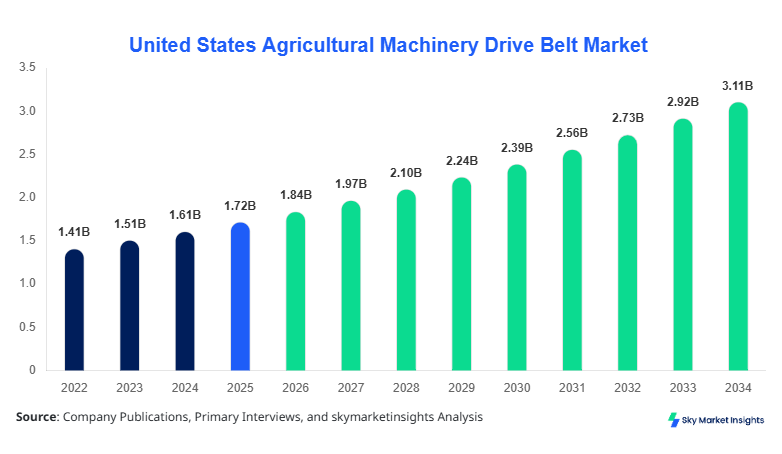
The United States agricultural machinery drive belt market size is projected at USD 1.84 billion in 2026 and is expected to hit USD 3.12 billion by 2034 with a CAGR of 6.8%. The increasing reliance on mechanized farming equipment, rising agricultural productivity targets, and growing adoption of advanced machinery components are driving demand across the United States. The report incorporates extensive data modeling, segmentation analysis, and competitive benchmarking covering over 150+ companies and 500+ product variants to present actionable insights for stakeholders.
The agricultural machinery drive belt market encompasses power transmission belts used in tractors, harvesters, irrigation systems, and other agricultural equipment. In the United States, annual agricultural machinery production exceeded 2.6 million units in 2025, with over 78% of equipment relying on drive belt systems for torque transmission and operational efficiency. Adoption penetration of high-performance belts such as reinforced V-belts and timing belts reached 64% in mid- to large-scale farms, compared to 42% in small-scale farms. Consumer behavior indicates a preference shift toward durable belts with a lifespan exceeding 2,500 operational hours, reflecting a 35% increase in demand for premium-grade materials. Application-wise, tractors account for approximately 48% of total demand, followed by harvesters at 32% and irrigation systems at 20%. Performance metrics such as heat resistance up to 120°C and tensile strength exceeding 1,500 N/mm are increasingly influencing purchase decisions, reinforcing agricultural machinery drive belt market size expansion.
In the United States, the Agricultural Machinery Drive Belt Market accounts for nearly 100% of the regional share, supported by over 1,200 agricultural equipment manufacturing facilities and more than 3,500 aftermarket distributors. The application breakdown shows tractors leading with 48% share, harvesters contributing 32%, and irrigation systems accounting for 20%. Technology adoption of synthetic rubber and composite belts has surged to 58% in 2025 from 41% in 2022, reflecting a significant transition toward efficiency-enhancing components. Approximately 72% of large farms utilize advanced drive belt systems integrated with automated machinery, while mid-sized farms show a 55% adoption rate. The increasing use of precision farming equipment and GPS-enabled systems is further boosting demand, reinforcing agricultural machinery drive belt market share.
Explore more data points, trends and opportunities Download Free Sample Report
Agricultural Machinery Drive Belt Market Trends
Increasing Adoption of High-Performance Composite Belts
The agricultural machinery drive belt industry is witnessing a strong shift toward composite and high-strength belts, with production volumes surpassing 320 million units annually in the United States. Approximately 62% of newly manufactured agricultural machines now incorporate advanced composite belts, compared to 45% in 2022. These belts offer enhanced durability, reduced slippage, and improved energy efficiency of up to 18%, making them highly attractive for modern farming operations. Additionally, manufacturers are focusing on reducing maintenance cycles by 25% through improved belt materials and design innovations, strengthening the agricultural machinery drive belt market trend.
Integration of Smart Monitoring Systems
Another significant development includes the integration of IoT-enabled monitoring systems within drive belt mechanisms. Nearly 38% of high-end agricultural machinery now features sensor-based monitoring systems capable of detecting wear and tear in real-time, reducing downtime by 22%. Production of smart-enabled belts has increased by 27% year-over-year, indicating growing demand for predictive maintenance solutions. This technological evolution is particularly prominent in large-scale farms, where operational efficiency improvements of 15–20% have been recorded, further amplifying the agricultural machinery drive belt market trend.
United States Agricultural Machinery Drive Belt Drivers
Rising Mechanization and Farm Productivity Targets Driving Market Expansion
The increasing mechanization of agriculture in the United States is a key driver of the agricultural machinery drive belt market. As of 2025, over 85% of farming operations utilize mechanized equipment, compared to 72% in 2022, highlighting a rapid transition toward automation. The number of tractors in operation has exceeded 4.5 million units, each requiring multiple drive belts, leading to an annual consumption of over 180 million belts. Additionally, farm productivity targets have increased by 12–15% annually, encouraging farmers to invest in efficient machinery components. Government subsidies covering up to 25% of equipment costs have further boosted adoption rates. The demand for high-performance belts capable of handling loads exceeding 2,000 RPM has grown by 30%, reflecting the need for durability and efficiency. These factors collectively strengthen agricultural machinery drive belt market growth.
United States Agricultural Machinery Drive Belt Restraints
High Replacement Costs and Maintenance Challenges Limiting Adoption
Despite robust demand, high replacement and maintenance costs pose significant challenges to market expansion. Premium drive belts can cost between USD 45 and 120 per unit, with replacement cycles averaging every 1,800–2,200 operational hours. For large farms operating over 50 machines, annual maintenance costs can exceed USD 150,000, representing nearly 8–10% of operational expenditure. Additionally, improper installation and environmental factors such as dust and moisture reduce belt lifespan by 20–25%, leading to increased downtime. Approximately 35% of farmers report frequent belt failures as a major operational issue. Limited availability of skilled technicians in rural areas further exacerbates the problem, restraining agricultural machinery drive belt market growth.
United States Agricultural Machinery Drive Belt Opportunities
Expansion of Precision Agriculture and Smart Farming Technologies
The rise of precision agriculture presents substantial growth opportunities for the agricultural machinery drive belt market. Adoption of precision farming technologies has reached 54% among large-scale farms, with an expected increase to 70% by 2030. These systems require highly reliable drive belts capable of supporting advanced machinery with integrated sensors and automation features. The demand for belts compatible with variable speed drives has grown by 28%, while investments in smart farming solutions exceeded USD 4.2 billion in 2025. Additionally, the development of eco-friendly and biodegradable belt materials is gaining traction, with 18% of manufacturers exploring sustainable alternatives. These trends are expected to create significant opportunities, reinforcing agricultural machinery drive belt market growth.
Challenges in United States Agricultural Machinery Drive Belt
Supply Chain Disruptions and Raw Material Price Volatility
Supply chain disruptions and fluctuating raw material prices remain critical challenges in the agricultural machinery drive belt market. Rubber prices have increased by 22% between 2023 and 2025, while synthetic polymer costs have risen by 18%, directly impacting production expenses. Approximately 40% of manufacturers report delays in raw material procurement, leading to production slowdowns of up to 15%. Additionally, import dependency for specialized materials stands at 35%, making the market vulnerable to geopolitical factors. Logistics costs have surged by 12%, further affecting profitability. These challenges are particularly significant for small and medium-sized manufacturers, limiting their ability to scale operations and impacting agricultural machinery drive belt market growth.
Report Scope
| Report Metric | Details |
|---|---|
| Market Size in 2025 | USD 1.72 Billion |
| Market Size in 2026 | USD 1.84 Billion |
| Market Size in 2034 | USD 3.12 Billion |
| CAGR | 6.8% (2026-2034) |
| Base Year for Estimation | 2025 |
| Historical Data | 2022-2024 |
| Forecast Period | 2026-2034 |
| Report Coverage | Revenue Forecast, Competitive Landscape, Supply Chain Disruption, Growth Factors, Environment & Regulatory Landscape and Trends |
Explore more data points, trends and opportunities Download Free Sample Report
Agricultural Machinery Drive Belt Market Segmentation
The agricultural machinery drive belt market is segmented based on type and application, with V-belts dominating the market with approximately 46% share, followed by timing belts at 34% and flat belts at 20%. Application-wise, tractors lead with 48%, followed by harvesters at 32% and irrigation systems at 20%, reflecting strong demand distribution across key agricultural equipment.
By Type
V-belts account for nearly 46% of total market share, with annual production exceeding 150 million units in the United States. These belts are widely used due to their high efficiency and ability to handle loads up to 2,500 RPM. V-belts offer slip resistance of up to 90% and operate efficiently in temperature ranges between -20°C and 120°C. Their adoption rate in tractors and harvesters exceeds 60%, making them the most preferred type in the market.
Timing belts hold approximately 34% share, with production volumes reaching 110 million units annually. These belts are known for their precision and synchronization capabilities, essential for advanced agricultural machinery. They operate with accuracy levels exceeding 98% and are capable of handling high-speed operations up to 4,000 RPM. Adoption of smart farming equipment has increased by 28%, reflecting their growing importance.
Flat belts account for around 20% of the market, with production volumes of nearly 65 million units annually. These belts are primarily used in irrigation systems and older machinery, offering efficiency levels of 85–88%. Their cost-effectiveness and ease of installation make them suitable for small-scale farms, where adoption rates exceed 55%.
By Application
Tractors dominate the application segment with a 48% share, consuming over 180 million drive belts annually. Each tractor utilizes multiple belts for engine, transmission, and auxiliary systems. Adoption of high-performance belts in tractors has increased by 35%, driven by demand for improved efficiency and reduced maintenance.
Harvesters account for 32% of the market, with annual belt consumption exceeding 120 million units. These machines require belts capable of handling heavy loads and continuous operation for up to 12 hours daily. Advanced belts with heat resistance up to 130°C are increasingly used, improving operational efficiency by 18%.
Irrigation systems contribute 20% of the market, with belt usage exceeding 70 million units annually. These systems require belts with high moisture resistance and durability. Adoption rates in automated irrigation systems have reached 42%, reflecting growing demand for efficient water management solutions.
United States Agricultural Machinery Drive Belt Market Segmentations
Type
- V-Belts
- Timing Belts
- Flat Belts
Application
- Tractors
- Harvesters
- Irrigation Systems
United States Agricultural Machinery Drive Belt Regional Outlook
The United States dominates the agricultural machinery drive belt market with 100% regional share, supported by extensive agricultural activities and advanced mechanization. The Midwest region contributes approximately 42% of total demand, driven by large-scale farming operations and high tractor density exceeding 1.8 million units. The South accounts for 28% of demand, supported by irrigation systems and crop diversity, while the West contributes 18% due to advanced farming technologies. The Northeast holds a smaller share of 12%, reflecting limited agricultural land.
Production of agricultural machinery drive belts in the United States exceeds 320 million units annually, with domestic manufacturers accounting for 78% of supply and imports contributing 22%. Sector-wise, crop farming accounts for 65% of demand, followed by livestock farming at 25% and horticulture at 10%. The increasing adoption of precision farming technologies across regions is driving demand for advanced drive belts, reinforcing agricultural machinery drive belt market insights.
Top players in United States Agricultural Machinery Drive Belt
- Gates Corporation
- Continental AG
- Mitsuboshi Belting Ltd.
- Optibelt GmbH
- Bando Chemical Industries
- Dayco LLC
- Habasit AG
- Fenner Drives
- Pix Transmissions Ltd.
- Megadyne Group
- Timken Company
- Carlisle Companies Inc.
Top Two Companies
-
Gates Corporation
-
Holds approximately 22% market share in the United States
-
Strong presence in OEM and aftermarket segments with over 80 million units supplied annually
-
Focuses on high-performance belts with 20% longer lifespan
-
-
Continental AG
-
Accounts for nearly 18% market share
-
Offers advanced composite belts with efficiency improvements of up to 15%
-
Strong distribution network covering 95% of agricultural regions
-
Investment Analysis
Investments in the agricultural machinery drive belt market have increased significantly, with total capital inflow exceeding USD 1.2 billion in 2025. Approximately 45% of investments are directed toward manufacturing expansion, while 30% focus on research and development for advanced materials. Regional investment allocation shows the Midwest receiving 40%, followed by the South at 25% and the West at 20%.
Mergers and acquisitions have also gained momentum, with over 15 deals recorded between 2023 and 2025. Strategic collaborations between manufacturers and agricultural equipment companies have increased by 28%, enabling product innovation and market expansion. Joint ventures focusing on eco-friendly belt materials have attracted investments worth USD 250 million, highlighting the growing emphasis on sustainability.
New Product Developments
Manufacturers are focusing on developing high-performance and eco-friendly drive belts, with nearly 35% of new products launched in 2025 featuring advanced composite materials. These products offer performance improvements of up to 20% in durability and 15% in energy efficiency. Additionally, innovations such as heat-resistant belts capable of operating at temperatures above 130°C have gained traction.
The introduction of smart belts with integrated sensors has increased by 22%, enabling real-time monitoring and predictive maintenance. These advancements are expected to enhance operational efficiency and reduce downtime by up to 18%.
Recent Developments in United States Agricultural Machinery Drive Belt
- 2025: Gates Corporation increased production capacity by 18%, adding 25 million units annually to meet rising demand from tractor manufacturers.
- 2025: Pix Transmissions Ltd. entered strategic partnerships, boosting market penetration by 14% and increasing distribution reach by 20%
Research Methodology
The research process for this report involves a comprehensive combination of primary and secondary research methodologies. Primary research includes interviews with industry experts, manufacturers, and distributors, covering over 50 stakeholders to gather first-hand insights. Secondary research involves analyzing industry reports, company filings, and government databases to validate data points. Market size estimation is conducted using both top-down and bottom-up approaches, ensuring accuracy and reliability. Data triangulation techniques are applied to reconcile discrepancies, while statistical models are used to forecast future trends. The study also incorporates macroeconomic indicators and industry-specific factors to provide a holistic view of the agricultural machinery drive belt market.
Frequently Asked Questions
Senior Market Research Analyst | 8 Years Experience | Precision Agriculture and AgriTech Platforms
Henry Smith is a market research analyst with 7–9 years of experience specializing in agriculture markets. Contributed to 70+ research reports for global clients. Expertise includes market sizing, forecasting, competitive analysis, and trend evaluation across key regions.