Europe Agriculture Tire Market Size
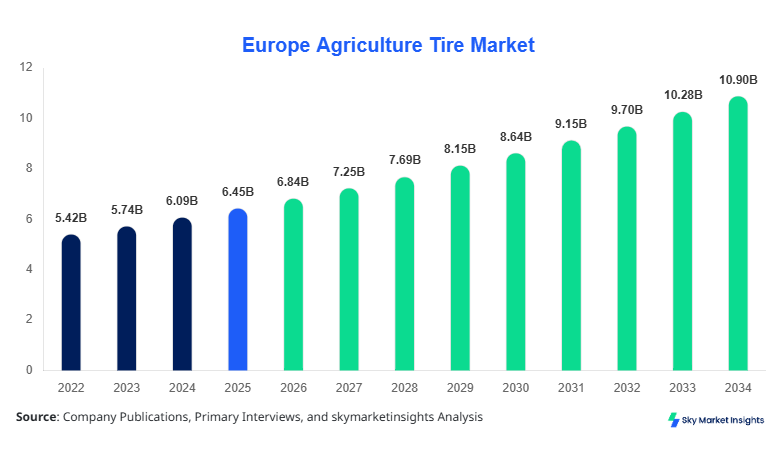
Europe Agriculture Tire market size is projected at USD 6.84 billion in 2026 and is expected to hit USD 10.91 billion by 2034 with a CAGR of 6.0%.
The increasing mechanization of European farming operations, rising adoption of high-horsepower tractors, and rapid replacement cycles for radial agricultural tires are driving revenue generation across the region. The report evaluates production statistics, pricing patterns, supply chain structure, import-export distribution, and the competitive landscape across the United Kingdom, Germany, France, Spain, Italy, and Russia. Market participants are increasingly investing in smart tire technologies, advanced tread compounds, and low-compaction tire systems to improve operational efficiency and fuel optimization across precision farming operations.
The agriculture tire industry comprises tires specifically engineered for agricultural machinery including tractors, combines, harvesters, sprayers, trailers, and loaders operating across arable farming, livestock cultivation, and commercial agriculture applications. Europe recorded agricultural machinery production exceeding 1.42 million units in 2025, with tractor registrations alone surpassing 198,000 units across the region. Radial agricultural tires accounted for nearly 58% of total unit installations due to superior traction performance and reduced soil compaction compared to conventional bias variants. Penetration of IF/VF tire technologies increased to 19% in 2025 from 11% in 2022 owing to the need for low-pressure field operations and improved flotation capabilities.
Consumer purchasing behavior increasingly reflects demand for durability, operational efficiency, and fuel-saving technologies. More than 63% of commercial farming operators in Western Europe now prioritize replacement tires with self-cleaning tread designs and advanced sidewall reinforcement. The average operational lifespan of premium agricultural radial tires reached 5,200–6,100 field hours in 2025 compared with 4,300 hours for standard bias products. Tractors represented approximately 52% of overall application demand, while harvesters contributed 24%, sprayers held 13%, and trailers and loaders accounted for the remaining 11%. Tire widths between 480 mm and 710 mm represented nearly 48% of total sales volume owing to increasing adoption of high-capacity tractors above 150 HP. Growing mechanization and replacement cycles continue to strengthen Europe Agriculture Tire Market expansion.
In the United Kingdom, the Agriculture Tire Market accounted for nearly 21% of the regional revenue share in 2025 due to extensive adoption of advanced mechanized farming equipment across England and Scotland. The country operated more than 95 major agricultural machinery manufacturing and distribution facilities while over 470 tire distribution networks served commercial farms nationwide. Tractor applications represented approximately 54% of tire consumption, harvesters contributed 22%, and sprayers accounted for nearly 14% of installations. Radial tire adoption surpassed 67% across the UK agricultural machinery fleet due to higher fuel efficiency and improved field traction.
The penetration of smart farming technologies and precision agriculture platforms accelerated demand for advanced IF/VF tire systems capable of carrying 20% higher loads at reduced inflation pressure. More than 39% of large-scale UK farms above 500 hectares adopted GPS-enabled autonomous farming equipment in 2025, increasing replacement demand for technologically advanced agricultural tires. The average replacement cycle for high-performance tractor tires in the UK declined from 6.8 years in 2022 to 5.9 years in 2025 owing to intensive cultivation practices and rising field productivity requirements. Increasing farm mechanization continues to reinforce Europe Agriculture Tire Market performance.
Explore more data points, trends and opportunities Download Free Sample Report
Agriculture Tire Market Trends
Rising Adoption of Low-Pressure IF/VF Tire Technologies
The European agricultural sector is witnessing substantial transformation through the adoption of Increased Flexion (IF) and Very High Flexion (VF) tire technologies. IF/VF tire production volume surpassed 5.8 million units across Europe in 2025, representing a 17% increase compared with 2023. These tire systems operate at 30–40% lower pressure while carrying equivalent or higher loads than standard radial variants, significantly reducing soil compaction. Germany, France, and the United Kingdom collectively represented over 61% of total IF/VF tire demand in the region. Agricultural machinery manufacturers increasingly integrate VF-compatible wheel systems into tractors above 180 HP, where penetration rates exceeded 42% in 2025. Additionally, the adoption of central tire inflation systems increased by 24% year-over-year due to rising precision farming applications and automated field monitoring systems. The transition toward sustainable cultivation and reduced field degradation continues shaping Europe Agriculture Tire Market development.
Integration of Smart Monitoring and Sensor-Based Tire Solutions
The integration of sensor-enabled agricultural tires is emerging as a significant technological shift across Europe. More than 1.9 million smart agriculture tires equipped with pressure, temperature, and load-monitoring sensors were deployed across European farms in 2025. Tire manufacturers are investing heavily in embedded telematics systems capable of reducing fuel consumption by 8–12% and improving tire lifespan by nearly 18%. Commercial farms utilizing connected tire management platforms reported productivity improvements exceeding 11% due to minimized equipment downtime and optimized traction control. Spain and Italy demonstrated increasing adoption rates for digitally monitored sprayer and harvester tires due to expanding vineyard and horticulture operations. Furthermore, autonomous tractors and robotic agricultural equipment are accelerating the requirement for highly responsive radial tire systems with advanced tread monitoring capabilities. The emergence of connected agriculture ecosystems continues supporting Europe Agriculture Tire Market transformation.
Expansion of Sustainable and Recycled Rubber Manufacturing
Sustainability initiatives are influencing raw material procurement and tire manufacturing processes throughout Europe. Agricultural tire manufacturers increased recycled rubber utilization by approximately 23% between 2022 and 2025, while bio-based compound adoption exceeded 14% of total material consumption. France and Germany implemented stringent carbon reduction policies that encouraged low-emission tire manufacturing facilities and renewable energy integration across production plants. Several manufacturers reported a 9–13% reduction in production-related carbon emissions through advanced compounding and optimized curing technologies. Demand for eco-efficient tires with low rolling resistance properties increased substantially among commercial farming cooperatives managing over 1,000 hectares of cultivated land. Sustainable production investments continue accelerating Europe Agriculture Tire Market innovation.
Europe Agriculture Tire Drivers
Increasing Farm Mechanization and High-Horsepower Tractor Deployment
The rapid modernization of European agriculture is significantly driving demand for advanced agricultural tires. Europe registered more than 198,000 agricultural tractors in 2025, while machines above 150 HP represented nearly 37% of new installations compared with 29% in 2022. Large-scale farming operations increasingly require radial and IF/VF tire systems capable of supporting heavier machinery loads and wider field operations. Germany and France collectively contributed over 41% of high-horsepower tractor purchases, resulting in strong replacement demand for premium radial tires with enhanced traction efficiency. Tire replacement frequency across intensive farming operations increased by approximately 14% due to extended annual operating hours exceeding 1,600 hours per tractor in commercial farming zones. Additionally, fuel-saving radial tires demonstrated operational efficiency improvements between 7% and 11%, encouraging fleet upgrades among commercial agricultural contractors. Expanding mechanization programs supported by European agricultural subsidies exceeding USD 54 billion annually continue creating favorable conditions for Europe Agriculture Tire Market expansion.
Europe Agriculture Tire Restraints
Volatility in Raw Material Costs and Supply Chain Disruptions
The agricultural tire industry remains highly vulnerable to fluctuations in natural rubber, synthetic rubber, steel cord, and carbon black pricing. Natural rubber prices increased by nearly 18% between 2023 and 2025, while energy-related manufacturing expenses rose by approximately 11% across Europe. Transportation disruptions and geopolitical instability impacted tire imports from Asian manufacturing hubs, increasing logistics costs by nearly 15% in 2025. Small and medium-sized farming operators remain price-sensitive, limiting adoption of premium IF/VF tires priced 28–42% higher than standard bias alternatives. Additionally, raw material shortages reduced production efficiency at several European tire plants, resulting in lead time extensions from 5 weeks to nearly 9 weeks for specialized agricultural tires above 710 mm width. Russia and Eastern European markets experienced additional import restrictions and currency volatility affecting machinery procurement. These economic pressures continue restricting Europe Agriculture Tire Market penetration among cost-sensitive farming segments.
Europe Agriculture Tire Opportunities
Expansion of Precision Agriculture and Autonomous Farming Systems
Precision agriculture technologies are generating substantial growth opportunities for agricultural tire manufacturers across Europe. More than 31% of large-scale European farms integrated GPS-guided equipment and automated field management systems in 2025, compared with 19% in 2022. Autonomous tractors, robotic sprayers, and digitally monitored harvesters require specialized radial tire configurations capable of delivering consistent traction and minimal field compaction. Investments in precision agriculture exceeded USD 7.2 billion across Europe in 2025, with the United Kingdom and Germany accounting for over 46% of total spending. Demand for central tire inflation systems and smart tire telemetry platforms increased by approximately 27% year-over-year due to the need for real-time operational monitoring. Tire manufacturers developing AI-enabled wear monitoring systems and self-adjusting pressure technologies are expected to gain significant market positioning advantages. The digitalization of farming operations continues unlocking substantial Europe Agriculture Tire Market opportunities.
Europe Agriculture Tire Challenge
Limited Replacement Adoption Among Small-Scale Farms
One of the major challenges facing the industry is the relatively slow adoption of premium replacement tires among small-scale farming operators. Nearly 44% of European farms operate on less than 50 hectares of land, where budget constraints limit investment in technologically advanced tire systems. Bias tires still represented approximately 39% of total unit consumption across Eastern Europe in 2025 due to their lower acquisition costs despite reduced operational efficiency. Farmers in Spain, Italy, and Russia reported maintenance expenditure increases of 12–16% related to tire replacement and machinery servicing. Additionally, the shortage of skilled tire maintenance technicians and insufficient awareness regarding pressure optimization technologies hinder widespread adoption of IF/VF tire systems. Fluctuating agricultural commodity prices and uncertain climatic conditions further discourage replacement investments among small-scale producers. These operational limitations continue challenging Europe Agriculture Tire Market adoption rates.
Report Scope
| Report Metric | Details |
|---|---|
| Market Size in 2025 | USD 6.45 Billion |
| Market Size in 2026 | USD 6.84 Billion |
| Market Size in 2034 | USD 10.91 Billion |
| CAGR | 6.0% (2026-2034) |
| Base Year for Estimation | 2025 |
| Historical Data | 2022-2024 |
| Forecast Period | 2026-2034 |
| Report Coverage | Revenue Forecast, Competitive Landscape, Supply Chain Disruption, Growth Factors, Environment & Regulatory Landscape and Trends |
Explore more data points, trends and opportunities Download Free Sample Report
Agriculture Tire Market Segmentation
The market is segmented based on tire type and application, with radial tires dominating approximately 58% of total revenue owing to high durability and superior fuel efficiency. Tractor applications represented nearly 52% of overall demand due to expanding mechanized cultivation activities across Europe.
By Type
Radial tires dominated the European market with approximately 58% share in 2025 due to enhanced traction, lower rolling resistance, and longer operational lifespan. Production volume exceeded 14.2 million units across Europe, with Germany and France contributing nearly 49% of total radial manufacturing capacity. These tires operate with flexible sidewalls and steel-belted tread structures that improve ground contact and reduce soil compaction by approximately 18% compared with conventional bias variants. Radial tire adoption surpassed 70% among tractors above 180 HP due to improved fuel efficiency ranging between 8% and 12%. Average field lifespan reached 5,800 operational hours under intensive cultivation conditions. Premium radial products also demonstrated superior heat dissipation and self-cleaning tread performance during high-moisture operations. Their expanding use in precision agriculture machinery continues strengthening overall market penetration.
Bias tires accounted for nearly 29% of total sales volume across Europe due to affordability and suitability for smaller farming operations. Production exceeded 7.1 million units in 2025, particularly across Eastern Europe and Russia where smaller tractors below 100 HP remain widely utilized. These tires feature crisscross ply construction offering high sidewall rigidity and resistance against punctures during rugged terrain operations. Bias tires typically operate at inflation pressures between 18 psi and 28 psi and remain cost-effective for seasonal agricultural usage. Spain and Italy demonstrated continued demand for bias tires in vineyard cultivation and horticulture applications due to lower replacement costs. Despite reduced traction efficiency and higher soil compaction compared with radial alternatives, bias tires continue serving economically constrained agricultural operators across Europe.
IF/VF tire systems represented approximately 13% of the European agricultural tire industry in 2025, with production surpassing 3.2 million units. These advanced tire technologies allow machinery to carry 20–40% higher loads while operating at significantly lower pressure levels. VF tires reduced soil compaction by nearly 25% compared with standard radial systems, making them increasingly suitable for high-productivity farming environments. Adoption rates among tractors above 250 HP exceeded 34% across the United Kingdom and Germany due to growing precision agriculture implementation. The average selling price of IF/VF tires remained 31% higher than standard radial products, reflecting advanced engineering and specialized materials. Rising integration with central tire inflation systems continues supporting adoption across large-scale farming operations.
By Application
Tractor applications represented the largest demand segment with approximately 52% market share in 2025. More than 17.6 million agricultural tires were installed on tractors operating across Europe, with radial tire penetration exceeding 67% among tractors above 150 HP. These machines require durable tires capable of handling heavy towing loads, prolonged field operations, and variable terrain conditions. Average rear tractor tire diameters ranged from 1.6 meters to 2.3 meters depending on horsepower classification. Precision farming operations increasingly utilize VF tires for tractors equipped with GPS-guided autonomous systems and smart cultivation technologies. Germany and France together accounted for nearly 44% of tractor tire replacement demand due to extensive cereal and grain cultivation activities. Continuous mechanization and fleet modernization are driving strong tire replacement cycles across this segment.
Harvester applications accounted for nearly 24% of total demand in 2025, supported by increasing grain harvesting operations across Europe. More than 8.4 million harvester tires were produced and installed across combines and forage harvesting machinery. Harvesters require low-compaction tire systems capable of carrying extremely heavy loads during peak harvesting seasons. Tire widths exceeding 710 mm represented approximately 39% of harvester installations to improve flotation and reduce crop field damage. France and Russia demonstrated particularly strong demand for high-capacity harvester tires due to extensive wheat and barley cultivation. Technological improvements including reinforced steel belts and advanced tread lug designs improved load-carrying efficiency by nearly 16%. Increasing crop productivity targets continue supporting replacement demand within this application category.
Sprayer applications represented nearly 13% of overall market demand due to rising adoption of precision crop treatment systems. Europe installed over 4.1 million sprayer tires in 2025, particularly within high-value horticulture and vineyard farming operations across Spain and Italy. Narrow-profile radial tires dominated this segment with nearly 61% penetration due to improved row-crop maneuverability and reduced crop damage. Sprayer tires commonly operate at higher inflation pressures between 24 psi and 38 psi to maintain stability during chemical application processes. Autonomous sprayer systems and digitally controlled nutrient application equipment are increasing demand for advanced tread technologies capable of minimizing slippage. Growing precision farming practices continue driving sustained demand across the sprayer application segment.
Europe Agriculture Tire Market Segmentations
Tire Type
- Radial Tires
- Bias Tires
- IF/VF Tires
Application
- Tractors
- Harvesters
- Sprayers
Europe Agriculture Tire Regional Outlook
United Kingdom
The United Kingdom accounted for nearly 21% of regional revenue in 2025 due to high mechanization rates and widespread adoption of premium radial agricultural tires. The country operated more than 470 agricultural tire distribution centers and over 95 manufacturing and assembly facilities related to agricultural machinery. Tractor applications contributed approximately 54% of total tire demand, while harvesters accounted for 22%. Radial tire penetration exceeded 67% among commercial farms larger than 300 hectares. The UK also demonstrated strong adoption of IF/VF technologies, particularly in autonomous cultivation equipment and precision agriculture systems. More than 39% of large-scale farms implemented GPS-guided machinery platforms in 2025, driving demand for advanced tire monitoring systems and central inflation technologies.
Germany
Germany represented approximately 19% of the European market owing to extensive agricultural machinery manufacturing capabilities and advanced farming infrastructure. The country produced more than 36,000 agricultural tractors in 2025 while radial tires accounted for nearly 72% of total installations. Germany maintained one of the highest adoption rates for smart farming technologies, with precision agriculture penetration exceeding 41% among commercial operators. Tire manufacturers invested heavily in sensor-enabled and low-compaction tire technologies supporting high-capacity grain farming operations. The southern and eastern agricultural regions demonstrated strong demand for wide-profile VF tires suitable for heavy machinery above 250 HP. Germany also served as a major export hub for premium agricultural tire systems across Europe.
France
France accounted for nearly 18% of regional demand due to extensive cereal cultivation and large-scale commercial farming activities. The country operated more than 27 million hectares of agricultural land, supporting substantial replacement demand for tractors and combine harvesters. Harvester tire installations exceeded 2.1 million units in 2025, while radial tire penetration reached approximately 64% across commercial farming fleets. Precision spraying and autonomous cultivation systems increasingly influenced adoption of advanced tire technologies. Government support for sustainable farming practices encouraged utilization of low-compaction IF/VF tires capable of minimizing soil degradation. France also experienced strong investment in eco-efficient tire manufacturing technologies using recycled rubber compounds.
Spain
Spain represented nearly 12% of total market revenue in 2025 due to increasing mechanization across vineyard cultivation, horticulture, and fruit farming applications. Narrow-profile sprayer and tractor tires accounted for approximately 29% of total demand due to specialized row-crop farming practices. Radial tire penetration remained around 51%, while bias tire utilization remained comparatively high among small-scale agricultural operators. Southern Spain demonstrated increasing adoption of precision irrigation and automated spraying equipment, boosting demand for technologically advanced agricultural tire systems. The country also witnessed rising imports of IF/VF tires for high-value crop farming and export-oriented agricultural production.
Italy
Italy contributed approximately 11% of the European market, supported by strong agricultural equipment demand across vineyards, olive cultivation, and horticulture operations. More than 3.8 million agricultural tires were sold across Italy in 2025, with sprayer and compact tractor applications representing nearly 34% of total demand. Bias tires retained a notable presence in small-scale farming operations due to lower acquisition costs, although radial tire adoption continued expanding steadily. Northern Italy experienced increasing investment in autonomous farming technologies and digitally managed cultivation systems. Tire manufacturers focused on compact high-traction designs optimized for vineyard maneuverability and reduced crop damage during field operations.
Russia
Russia accounted for nearly 14% of regional agricultural tire demand due to extensive grain cultivation and large agricultural land availability. The country operated one of the largest agricultural machinery fleets in Europe, supporting substantial replacement demand for heavy-duty radial and bias tires. Tractor applications represented approximately 57% of total demand, while harvesters accounted for nearly 27%. Bias tire utilization remained comparatively high at around 46% due to cost-sensitive procurement patterns and rugged terrain requirements. Russia also demonstrated increasing adoption of wide-profile radial tires suitable for large-scale wheat farming operations across southern agricultural regions. Expanding agricultural exports continue supporting long-term machinery modernization and tire replacement demand.
Top players in Europe Agriculture Tire
- Michelin
- Bridgestone Corporation
- Trelleborg AB
- Continental AG
- BKT Tires
- Yokohama Off-Highway Tires
- Mitas Tires
- Apollo Tyres Ltd.
- Titan International
- Nokian Tyres
- Goodyear Tire & Rubber Company
- Pirelli & C. S.p.A.
- Alliance Tire Group
- CEAT Specialty Tires
- Linglong Tire
Michelin
-
Michelin accounted for approximately 16% of the European agricultural tire industry in 2025.
-
The company maintains strong positioning across premium radial and VF tire categories with extensive manufacturing operations in France and Germany.
-
Michelin invested heavily in low-compaction and smart monitoring tire technologies, improving fuel efficiency by nearly 12% for commercial farming operators.
-
Its agricultural tire portfolio serves tractors, combines, and autonomous farming equipment across high-productivity farming regions.
-
The company expanded sustainable rubber sourcing initiatives and increased recycled material integration across manufacturing facilities.
Trelleborg AB
-
Trelleborg held nearly 11% market share in 2025 and maintained strong positioning within precision agriculture tire technologies.
-
The company specialized in IF/VF tire systems and sensor-enabled agricultural tire platforms designed for autonomous cultivation equipment.
-
Trelleborg expanded its European production capacity by approximately 9% between 2023 and 2025 to support rising replacement demand.
-
The company focused heavily on vineyard, horticulture, and high-value crop farming applications across Italy and Spain.
-
Advanced tread compounds and central inflation compatibility strengthened its competitive positioning across premium agricultural machinery fleets.
Investment Analysis
European agricultural tire investments exceeded USD 2.6 billion between 2023 and 2025, with approximately 38% allocated toward smart tire manufacturing technologies and automation systems. Germany, France, and the United Kingdom collectively attracted nearly 61% of regional investments due to strong agricultural machinery manufacturing ecosystems. Investments in recycled rubber processing and sustainable compound development increased by nearly 24% during the period. Tire manufacturers also allocated approximately 29% of capital expenditure toward IF/VF production expansion to support precision agriculture requirements.
Mergers, acquisitions, and collaborative agreements continued reshaping the competitive landscape. Several tire manufacturers partnered with agricultural machinery OEMs to develop integrated smart farming tire systems capable of real-time pressure optimization and load monitoring. Collaborative investment in autonomous farming platforms increased substantially, particularly across Germany and the United Kingdom. Companies also pursued strategic acquisitions of sensor technology firms and rubber compounding specialists to strengthen innovation capabilities. Joint ventures between agricultural machinery manufacturers and tire suppliers expanded product customization and distribution efficiency across Europe.
Furthermore, sustainability-focused investments accelerated across production facilities. More than 31% of newly announced tire manufacturing projects incorporated renewable energy integration and low-emission curing technologies. Investments in digital supply chain management and predictive maintenance systems improved manufacturing productivity by approximately 14%. The increasing transition toward eco-efficient agriculture continues supporting long-term investment opportunities across the region.
New Product Developments
Agricultural tire manufacturers significantly expanded product development activities during 2025, with nearly 27% of new launches focused on IF/VF technologies and smart monitoring systems. Several companies introduced advanced radial tire designs capable of operating at 40% lower pressure while supporting higher load capacities. Improved tread compounds enhanced wear resistance by approximately 18%, while optimized lug geometries improved traction performance by nearly 11% during wet field operations.
Manufacturers also launched sensor-integrated agricultural tires capable of real-time pressure and temperature monitoring. These technologies reduced operational downtime by approximately 9% and improved tire lifespan by 14–17%. Sustainable product development gained momentum as bio-based compounds and recycled rubber materials represented nearly 16% of new agricultural tire formulations introduced across Europe in 2025.
Recent Developments in Europe Agriculture Tire
- 2025: Michelin expanded its VF agricultural tire production facility in France by approximately 14%, increasing annual output capacity beyond 1.2 million units. The investment supported rising demand from precision farming and autonomous tractor applications across Western Europe. The expansion also reduced production lead times by nearly 11%.
- 2025: Trelleborg introduced a new sensor-enabled radial tire series for autonomous tractors capable of improving fuel efficiency by approximately 10% and reducing soil compaction by nearly 21%. The product line targeted large-scale commercial farms operating tractors above 200 HP.
Research Methodology
The research methodology for the Europe agricultural tire industry involved a combination of primary and secondary research processes to ensure data accuracy and analytical consistency. Primary research included interviews with agricultural machinery manufacturers, tire distributors, farming cooperatives, raw material suppliers, and industry experts across the United Kingdom, Germany, France, Spain, Italy, and Russia. More than 120 industry participants contributed operational insights regarding pricing structures, replacement demand, production capacity, and technology adoption trends.
Secondary research involved extensive evaluation of company annual reports, trade publications, customs databases, government agricultural statistics, and industry association records. Market size estimation utilized both top-down and bottom-up analytical approaches incorporating production volumes, installed machinery base, replacement cycles, pricing patterns, and regional consumption trends. Forecast modeling considered macroeconomic indicators, mechanization growth rates, precision agriculture penetration, and technological developments across radial and IF/VF tire categories. Data triangulation techniques and validation procedures were applied throughout the study to ensure reliable forecasting and competitive benchmarking accuracy for the forecast period through 2034.
Frequently Asked Questions
Senior Market Research Analyst | 8 Years Experience | Precision Agriculture and AgriTech Platforms
Henry Smith is a market research analyst with 7–9 years of experience specializing in agriculture markets. Contributed to 70+ research reports for global clients. Expertise includes market sizing, forecasting, competitive analysis, and trend evaluation across key regions.