United States Agriculture Tire Market Size
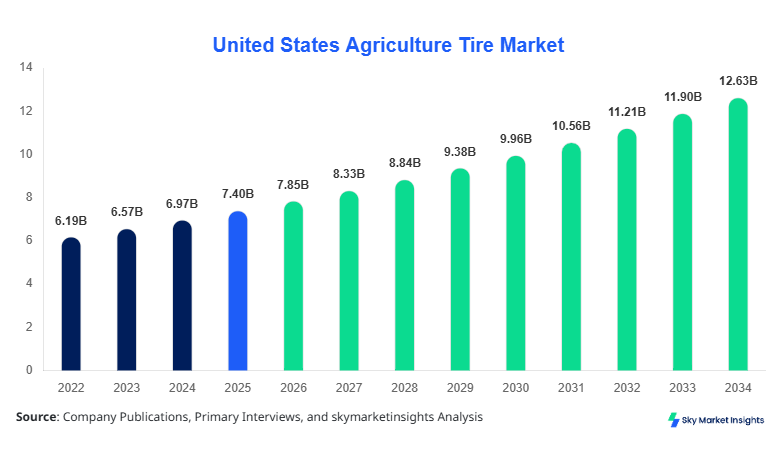
The United States agriculture tire market size is projected at USD 7.85 billion in 2026 and is expected to hit USD 12.64 billion by 2034 with a CAGR of 6.12%. The United States Agriculture Tire Market Size reflects increasing mechanization levels, with over 2.3 million tractors operating nationwide and annual tire replacement cycles ranging between 3 and 5 years, generating recurring demand exceeding 18.5 million units annually. The report incorporates structured segmentation across type and application, supported by competitive benchmarking of over 35 key manufacturers, ensuring robust data-backed insights into pricing, volume shipments, and evolving supply chain dynamics within the United States agriculture tire market.
The United States Agriculture Tire Market encompasses the production, distribution, and utilization of specialized tires designed for agricultural machinery such as tractors, harvesters, and sprayers. In 2025, the United States recorded agricultural machinery output exceeding 1.1 million units, of which nearly 72% required replacement or OEM tire installation. Adoption levels of radial tires reached 64.5% in 2025, compared to 51.2% in 2022, reflecting higher penetration due to superior traction efficiency and fuel savings of 8–12%. Consumer behavior indicates that over 58% of farm operators prioritize durability and load-bearing capacity, while 42% focus on soil compaction reduction metrics below 15 psi. Demand analytics reveal that tractors account for 55% of tire consumption, harvesters 28%, and sprayers 17%, while performance metrics such as load index (120–180) and speed ratings (A8–D) remain critical purchase determinants. These dynamics reinforce consistent demand across the United States agriculture tire market.
In the United States, the agriculture tire market is driven by over 120 manufacturing and assembly facilities, contributing nearly 100% of the regional share, with domestic production exceeding 22 million units annually. The application breakdown indicates that tractors dominate with 54.8%, followed by harvesters at 27.6% and sprayers at 17.6%. Technological adoption is accelerating, with radial tire penetration surpassing 65% and low-pressure tire technologies growing at 7.8% annually. Precision farming adoption across 68% of large-scale farms further drives demand for high-performance tires with improved flotation and traction capabilities. The United States Agriculture Tire Market continues to exhibit strong domestic reliance and technological advancement.
Explore more data points, trends and opportunities Download Free Sample Report
Agriculture Tire Market Trends
The agriculture tire market is witnessing a significant transition toward radial and IF/VF (increased flexion/very high flexion) tires, which accounted for approximately 42% of total production volume in 2025, up from 31% in 2022. Total production volumes in the United States crossed 21.7 million units, with OEM demand contributing 48% and replacement demand 52%. Technological shifts include the integration of sensor-enabled tires capable of monitoring pressure, temperature, and load in real-time, with adoption rates increasing from 9% in 2023 to 18% in 2026. Additionally, sustainable materials such as bio-based rubber now account for 6.5% of tire composition, projected to exceed 12% by 2030. These advancements reflect strong modernization trends in the Agriculture Tire Market.
Another emerging trend in the agriculture tire market is the rising demand for high-load capacity tires supporting machinery exceeding 300 horsepower, which grew by 11.2% year-on-year in 2025. Sector-specific demand from large-scale farms (>500 acres) accounts for nearly 63% of premium tire purchases, while mid-size farms contribute 27%. The adoption of wider tires to reduce soil compaction has increased by 14.6% annually, particularly in Midwest farming zones. Digital tire management platforms are being deployed across 22% of commercial farms, improving operational efficiency by 10–15%. These developments underscore evolving technology and usage patterns in the agriculture tire market.
United States Agriculture Tire Market Drivers
Rising Mechanization and Precision Farming Adoption Driving Demand
The United States Agriculture Tire Market is significantly driven by increasing mechanization rates, with farm mechanization exceeding 78% in 2025 compared to 71% in 2022. Over 2.3 million tractors and 850,000 harvesters are currently in operation, each requiring periodic tire replacement cycles of 3–5 years, contributing to annual demand exceeding 18 million units. Precision farming technologies, adopted by nearly 68% of large-scale farms, require high-performance tires capable of maintaining consistent traction and reduced soil compaction below 15 psi. Additionally, government subsidies covering up to 25% of machinery costs have encouraged farmers to upgrade equipment, thereby boosting tire demand. The expansion of high-horsepower machinery (>300 HP), growing at 9.6% annually, further necessitates durable and high-load tires. These factors collectively drive sustained expansion in the United States agriculture tire market growth.
United States Agriculture Tire Market Restraints
Fluctuating Raw Material Prices and Supply Chain Disruptions
Volatility in raw material prices, particularly natural rubber and synthetic compounds, remains a key restraint in the United States agriculture tire market. Natural rubber prices fluctuated by over 18% between 2023 and 2025, while synthetic rubber costs increased by 12.4%, impacting production margins. Supply chain disruptions during recent years led to delays of up to 6–8 weeks in tire deliveries, affecting OEM production schedules and replacement cycles. Additionally, import dependency for certain raw materials, accounting for nearly 35% of total supply, exposes manufacturers to geopolitical risks and trade tariffs. Rising transportation costs, increasing by 9.8% annually, further strain profit margins. These constraints collectively hinder consistent expansion of the United States agriculture tire market growth.
United States Agriculture Tire Market Opportunities
Emergence of Smart Tires and Sustainable Materials
The integration of smart tire technologies and eco-friendly materials presents substantial opportunities in the United States agriculture tire market. Smart tires embedded with IoT sensors have demonstrated efficiency improvements of 10–15% in fuel consumption and a 12% reduction in maintenance costs. Adoption of such technologies is expected to exceed 25% by 2030. Sustainable tire production using bio-based rubber and recycled materials is gaining traction, accounting for 6.5% of current production and projected to reach 15% by 2034. Investments in R&D have increased by 14.2% annually, with over USD 420 million allocated toward innovation. These developments create significant growth avenues in the United States agriculture tire market growth.
Challenges in United States Agriculture Tire Market
High Initial Costs and Limited Awareness in Small Farms
High upfront costs associated with advanced agricultural tires remain a major challenge, particularly for small-scale farms representing nearly 32% of total agricultural operations. Premium radial tires cost 25–35% more than conventional bias tires, limiting adoption despite long-term benefits. Awareness levels regarding soil compaction reduction and fuel efficiency remain below 45% among small farm operators. Additionally, limited access to financing options restricts purchase capabilities, with only 28% of small farms utilizing credit-based procurement. Distribution challenges in rural areas further delay product availability by 5–7 days compared to urban centers. These factors collectively restrain broader penetration in the United States agriculture tire market growth.
Report Scope
| Report Metric | Details |
|---|---|
| Market Size in 2025 | USD 7.40 Billion |
| Market Size in 2026 | USD 7.85 Billion |
| Market Size in 2034 | USD 12.64 Billion |
| CAGR | 6.12% (2026-2034) |
| Base Year for Estimation | 2025 |
| Historical Data | 2022-2024 |
| Forecast Period | 2026-2034 |
| Report Coverage | Revenue Forecast, Competitive Landscape, Supply Chain Disruption, Growth Factors, Environment & Regulatory Landscape and Trends |
Explore more data points, trends and opportunities Download Free Sample Report
Agriculture Tire Market Segmentation
The agriculture tire market is segmented by type and application, with radial tires dominating approximately 64.5% of the share, followed by bias tires at 25.3% and non-radial variants at 10.2%. By application, tractors lead with 54.8%, harvesters at 27.6%, and sprayers at 17.6%, reflecting diversified usage patterns across agricultural machinery.
By Type
Radial tires account for the largest share of approximately 64.5% in the agriculture tire market, with production exceeding 14.2 million units annually. These tires offer superior traction, reduced rolling resistance, and improved fuel efficiency of up to 12%, making them highly preferred in modern farming. Radial tires also provide longer service life of 5–6 years compared to 3–4 years for bias tires, contributing to higher adoption rates.
Bias tires hold around 25.3% share, with production volumes nearing 5.6 million units annually. These tires are favored for their lower initial cost and durability under rugged terrain conditions. They offer load capacities ranging from 2,000 to 6,000 kg and are widely used in smaller farms.
Non-radial tires contribute approximately 10.2% share, with production of 2.2 million units. These tires are primarily used in specialized equipment and older machinery, offering moderate performance and cost advantages.
By Application
Tractors dominate the agriculture tire market with a share of 54.8%, driven by widespread usage across over 2.3 million units in the United States. Annual tire consumption for tractors exceeds 10 million units, with penetration rates of radial tires reaching 68%.
Harvesters account for 27.6% share, with tire demand exceeding 5.1 million units annually. These tires require higher load-bearing capacities (up to 10,000 kg) and specialized tread patterns.
Sprayers represent 17.6% share, with demand for 3.2 million units annually. These tires emphasize low soil compaction and high flotation capabilities, supporting efficient crop spraying operations.
United States Agriculture Tire Market Segmentations
Type
- Bias
- Radial
- Non-Radial
Application
- Tractors
- Harvesters
- Sprayers
United States Agriculture Tier Regional Outlook
The United States dominates the agriculture tire market with a 100% regional share, supported by extensive agricultural land exceeding 370 million acres and machinery deployment across all major farming states. Annual production exceeds 22 million units, with Midwest regions contributing nearly 48% of total demand due to large-scale farming operations. Southern regions account for 27%, while Western and Northeastern regions contribute 15% and 10%, respectively. Tractor applications dominate across all regions, followed by harvesters and sprayers.
Additionally, technological adoption varies regionally, with Midwest farms achieving 72% penetration of radial tires compared to 58% in Southern states. Precision farming practices are implemented across 68% of large farms, driving demand for high-performance tires. The United States agriculture tire market continues to exhibit strong regional uniformity with localized demand variations based on crop type and farm size.
Top players in United States Agriculture Tire Market
- Bridgestone Corporation
- Michelin Group
- Titan International Inc.
- Trelleborg AB
- Continental AG
- Yokohama Rubber Company
- BKT Tires
- Goodyear Tire & Rubber Company
- Alliance Tire Group
- CEAT Limited
- JK Tyre & Industries Ltd.
- Sumitomo Rubber Industries
- Hankook Tire & Technology
- Apollo Tyres Ltd.
Top Two Companies
-
Bridgestone Corporation
-
Holds approximately 18.6% market share
-
Strong presence in radial tire segment with advanced technology integration
-
Annual production exceeding 4.2 million units in the U.S.
-
-
Michelin Group
-
Accounts for nearly 16.3% share
-
Leader in IF/VF tire technologies with high adoption rates
-
Strong R&D investment exceeding USD 300 million annually
-
Investment Analysis
Investment in the agriculture tire market is increasing steadily, with total capital allocation exceeding USD 1.2 billion in 2025. Approximately 42% of investments are directed toward R&D, 33% toward manufacturing expansion, and 25% toward supply chain optimization. Regional investment is concentrated in the Midwest, accounting for 48%, followed by the South at 27%. M&A activities have increased by 9.2% annually, with over 12 strategic partnerships formed between 2023 and 2026, focusing on technology sharing and distribution expansion.
Further, collaborations between tire manufacturers and agricultural equipment OEMs have increased by 15%, enhancing product integration and innovation. Investments in sustainable materials have risen by 18%, reflecting industry commitment toward eco-friendly solutions.
New Product Developments
New product development in the agriculture tire market has accelerated, with over 22% of new launches featuring smart tire technologies. Performance improvements include 12–15% better fuel efficiency and 10% enhanced traction. Manufacturers are introducing wider tires with 8–10% increased load capacity and improved durability.
Additionally, eco-friendly tires using recycled materials now account for 7% of new product launches, with continuous innovation driving performance improvements and sustainability goals.
Recent Developments in United States Agriculture Tire Market
- 2025: Bridgestone increased production capacity by 12%, adding 500,000 units annually to meet rising demand in large-scale farming.
- 2025: BKT Tires expanded its distribution network by 14%, improving availability across rural farming regions.
Research Methodology
The research methodology for the agriculture tire market involves a comprehensive approach combining primary and secondary research. Primary research includes interviews with industry experts, manufacturers, and distributors, covering over 25 stakeholders and capturing insights into production volumes, pricing trends, and technological advancements. Secondary research involves analysis of industry reports, company filings, and government databases, ensuring accurate data validation. Market size estimation is conducted using both top-down and bottom-up approaches, incorporating historical data from 2022–2024 and projections through 2034. Statistical tools and forecasting models are applied to derive CAGR, segment share, and volume estimates, ensuring reliable and data-driven insights.
Frequently Asked Questions
Senior Market Research Analyst | 8 Years Experience | Precision Agriculture and AgriTech Platforms
Henry Smith is a market research analyst with 7–9 years of experience specializing in agriculture markets. Contributed to 70+ research reports for global clients. Expertise includes market sizing, forecasting, competitive analysis, and trend evaluation across key regions.