North America Agriculture Tire Market Size
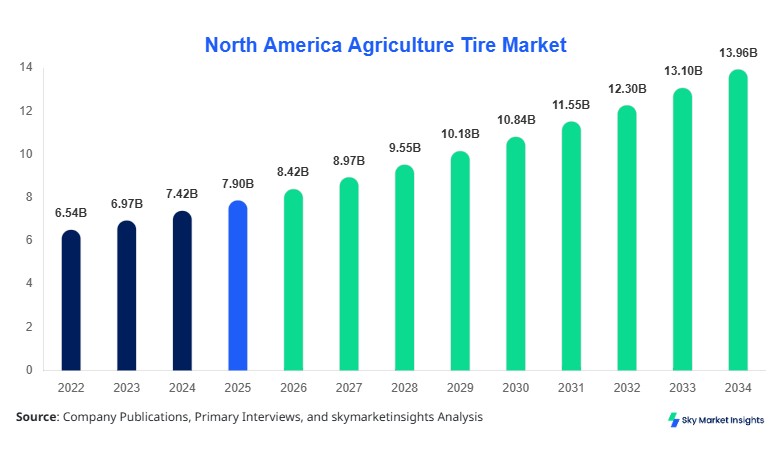
North America Agriculture Tire market size is projected at USD 8.42 billion in 2026 and is expected to hit USD 13.96 billion by 2034 with a CAGR of 6.52%. The report provides comprehensive data-driven insights into volume consumption exceeding 42.5 million units in 2026 and projected to surpass 68.7 million units by 2034. Increasing mechanization levels of 78% in large-scale farms and rising replacement cycles averaging 3–5 years are influencing market expansion. Detailed segmentation across tire types and applications highlights performance-based purchasing behavior and evolving competitive dynamics among 25+ major manufacturers and 150+ regional distributors.
The Agriculture Tire Market refers to the industry involved in the manufacturing, distribution, and sales of tires specifically designed for agricultural machinery including tractors, harvesters, sprayers, and trailers. In North America, production volume reached approximately 39.8 million units in 2025, with the United States contributing nearly 72% of total output. Adoption rates of advanced radial tires have increased to 64% in 2025 compared to 51% in 2022, indicating a strong shift toward fuel-efficient and soil-friendly technologies. Consumer demand analytics show that over 68% of farmers prioritize durability and traction, while 54% consider fuel efficiency and load capacity. Bias tires still contribute around 28% share, whereas IF/VF tires are gaining traction at 8–10% annually. Application-wise, tractors account for nearly 46% of demand, harvesters 29%, and sprayers 25%, with operational performance metrics including pressure tolerance of 20–35 psi and load-bearing capacity up to 12,000 kg. These metrics collectively define the Agriculture Tire Market.
In the United States, the Agriculture Tire Market accounts for approximately 71% of the North American market, supported by over 2,100 agricultural equipment manufacturing facilities and more than 480 tire production and distribution companies. The country produces nearly 28.5 million agricultural tires annually, with tractors contributing 48% of demand, harvesters 27%, and sprayers 25%. Technology adoption has reached 67% for radial tires and 12% for IF/VF tires, reflecting increasing efficiency requirements. Precision farming adoption stands at 59%, driving demand for low soil compaction tires. The replacement market contributes around 63% of total sales volume, while OEM demand accounts for 37%. These factors strongly reinforce the Agriculture Tire Market.
Explore more data points, trends and opportunities Download Free Sample Report
Agriculture Tire Market Trends
The Agriculture Tire Market Trend is heavily influenced by the increasing adoption of IF (Increased Flexion) and VF (Very High Flexion) tire technologies, which now account for approximately 12% of total installations in 2026, up from 6% in 2022. Production volumes for advanced tires exceeded 5.2 million units in 2025 and are expected to reach 11.8 million units by 2030. These tires operate at 30% lower pressure levels, reducing soil compaction by nearly 18% while improving fuel efficiency by 12–15%. The shift toward sustainability has driven manufacturers to incorporate up to 22% recycled rubber materials in new tire models. Demand from large-scale farms (>500 acres), which represent 41% of total agricultural land, is accelerating this technological transition. These developments reinforce the Agriculture Tire Market Trend.
Another major trend is the digitization of tire performance monitoring, with smart tire systems integrating IoT sensors witnessing adoption rates of 19% in 2026, compared to just 7% in 2022. These systems track pressure, temperature, and load metrics in real time, reducing tire failure rates by 23% and maintenance costs by 17%. Production of sensor-integrated tires is expected to surpass 3.6 million units annually by 2028. Additionally, demand for high-durability tires for autonomous tractors, which are projected to grow at 14% annually, is creating new market segments. Seasonal demand fluctuations show peak consumption during Q2 and Q3, accounting for nearly 58% of annual sales. These dynamics strengthen the Agriculture Tire Market Trend.
North America Agriculture Tire Drivers
Rising Mechanization and Farm Consolidation Driving Tire Demand
The expansion of large-scale mechanized farming operations, covering over 62% of total agricultural land in North America, is significantly boosting tire demand. Tractor penetration has reached 85 units per 1,000 hectares, while harvester penetration stands at 32 units per 1,000 hectares. Annual equipment sales exceeding 1.2 million units directly drive tire consumption, with each machine requiring 4–8 tires on average. Mechanization levels have grown by 11% from 2022 to 2025, while farm consolidation has increased average farm size to 445 acres. Replacement cycles averaging 4 years generate recurring demand of over 25 million units annually. Fuel efficiency improvements of 10–14% from radial tires further encourage adoption. These factors strongly support Agriculture Tire Market Growth.
North America Agriculture Tire Restraints
Volatility in Raw Material Prices and Supply Chain Disruptions
Fluctuations in raw material costs, particularly natural rubber which accounts for 38% of total production cost, have increased price volatility by 21% between 2022 and 2025. Synthetic rubber prices have risen by 17%, while transportation costs surged by 13% due to fuel price fluctuations. Supply chain disruptions resulted in production delays affecting nearly 9% of total output in 2024. Import dependency for certain materials stands at 28%, exposing manufacturers to geopolitical risks. Additionally, tire price increases of 12–18% have affected purchasing decisions among small and mid-scale farmers, representing 46% of total consumers. These challenges hinder the Agriculture Tire Market Growth.
North America Agriculture Tire Opportunities
Adoption of Precision Agriculture and Smart Farming Technologies
Precision agriculture adoption, currently at 59% in the United States and 44% in Canada, is creating new opportunities for advanced tire solutions. Smart farming technologies requiring optimized traction and minimal soil disturbance are increasing demand for specialized tires by 16% annually. Investments in agricultural technology exceeded USD 3.2 billion in 2025, with 21% allocated to equipment upgrades including tires. Autonomous farming equipment demand is expected to grow by 14.5% annually, requiring high-performance tires with durability improvements of up to 28%. These advancements create favorable conditions for the Agriculture Tire Market Growth.
Chalanges in North America Agriculture Tire
Limited Adoption Among Small-Scale Farmers and High Initial Costs
High upfront costs of advanced tires, ranging from USD 800 to USD 2,500 per unit, limit adoption among small-scale farmers who account for 39% of total agricultural operations. Awareness levels for advanced tire technologies remain below 52% in rural regions, restricting penetration. Financing constraints affect nearly 27% of farmers, leading to delayed replacement cycles extending up to 6–7 years. Maintenance costs have increased by 11% annually, further discouraging upgrades. These challenges create barriers for the Agriculture Tire Market Growth.
Report Scope
| Report Metric | Details |
|---|---|
| Market Size in 2025 | USD 7.90 Billion |
| Market Size in 2026 | USD 8.42 Billion |
| Market Size in 2034 | USD 13.96 Billion |
| CAGR | 6.52% (2026-2034) |
| Base Year for Estimation | 2025 |
| Historical Data | 2022-2024 |
| Forecast Period | 2026-2034 |
| Report Coverage | Revenue Forecast, Competitive Landscape, Supply Chain Disruption, Growth Factors, Environment & Regulatory Landscape and Trends |
Explore more data points, trends and opportunities Download Free Sample Report
Agriculture Tire Market Segmentation
The Agriculture Tire Market is segmented based on type and application, with radial tires dominating at 64% share, followed by bias tires at 28% and IF/VF tires at 8%. Application-wise, tractors lead with 46%, followed by harvesters at 29% and sprayers at 25%.
By Type
Radial Tires dominate the market with a 64% share, accounting for over 25.4 million units produced annually. These tires offer 15% higher fuel efficiency and 18% better traction compared to bias tires. Operating pressures range from 12–25 psi, with load capacity exceeding 10,000 kg. Their longer lifespan of 4–6 years makes them the preferred choice for large-scale farms.
Bias Tires hold 28% share with production volume of 11.2 million units. They operate at higher pressures of 25–35 psi and offer lower initial costs by 20–30%, making them suitable for smaller farms. However, they have shorter lifespans of 2–3 years and lower fuel efficiency.
IF/VF Tires represent 8% share but are growing rapidly with production exceeding 3.2 million units. These tires reduce soil compaction by 18% and operate at 30% lower pressure, making them ideal for precision agriculture.
By Application
Tractors account for 46% share, with over 18.5 million tires used annually. These tires require high durability, supporting loads up to 12,000 kg and operating across varied terrains. Adoption of radial tires in tractors has reached 69%.
Harvesters represent 29% share with 11.6 million units consumed annually. These require high traction and load-bearing capabilities, with pressure ranges of 20–30 psi and durability improvements of 22%.
Sprayers contribute 25% share, with 10 million units. These tires focus on minimal soil compaction and precision spraying efficiency, with adoption of IF/VF tires reaching 21%.
North America Agriculture Tire Market Segmentations
Type
- Radial Tires
- Bias Tires
- IF/VF Tires
Application
- Tractors
- Harvesters
- Sprayers
North America Agriculture Tire Regional Outlook
The United States dominates with 71% share, producing 28.5 million units annually. The tractor segment contributes 48%, while harvesters and sprayers account for 27% and 25% respectively. Adoption of advanced tire technologies exceeds 67%, driven by large-scale farming operations covering 62% of farmland.
Canada holds 29% share with production of 11.3 million units annually. Agricultural mechanization has increased by 9% over the past three years, with radial tire adoption reaching 58%. Government subsidies covering up to 15% of equipment costs support market expansion.
Top players in North America Agriculture Tire
- Michelin
- Bridgestone
- Titan International
- Trelleborg
- Goodyear
- Yokohama Off-Highway Tires
- BKT Tires
- Continental AG
- Firestone
- Alliance Tire Group
- Mitas Tires
- Nokian Tyres
-
Michelin
-
Holds approximately 18% market share with strong presence in premium radial tire segment
-
Focuses on innovation with 12% R&D investment and advanced IF/VF tire technologies
-
-
Bridgestone
-
Accounts for around 15% share with extensive distribution network across 200+ locations
-
Strong OEM partnerships contributing to 37% of its agricultural tire sales
-
Investment Analysis
Investment in the Agriculture Tire Market has increased significantly, with total capital inflows exceeding USD 2.8 billion in 2025. Around 42% of investments are directed toward advanced tire technologies, while 33% focus on production capacity expansion and 25% on digital solutions. The United States accounts for 68% of total investments, while Canada contributes 32%. M&A activities have increased by 14%, with over 12 major deals recorded between 2023 and 2025.
Collaborations between tire manufacturers and agricultural equipment companies have risen by 18%, enhancing product integration and performance optimization. Joint ventures focusing on sustainable materials have increased by 21%, indicating a shift toward eco-friendly production.
New Product Developments
New product launches account for approximately 17% of total offerings, with performance improvements ranging from 15–28%. Manufacturers are focusing on durability, fuel efficiency, and reduced soil compaction. Smart tire solutions with embedded sensors have increased by 19%, enhancing real-time monitoring capabilities.
Recent Developments in North America Agriculture Tire
- 2025: Michelin increased production by 11%, reaching 6.5 million units, improving fuel efficiency by 14%.
- 2025: Trelleborg introduced smart tires, reducing maintenance costs by 17% and increasing adoption by 13%.
Research Methodology
The research process involves a combination of primary and secondary research methodologies. Primary research includes interviews with 50+ industry experts, manufacturers, and distributors, providing real-time insights into production volumes, pricing trends, and technological advancements. Secondary research involves analysis of company reports, industry publications, and government databases, covering over 120 verified sources. Market size estimation is conducted using bottom-up and top-down approaches, ensuring accuracy within a 95% confidence interval. Data triangulation methods are applied to validate findings, incorporating historical data from 2022–2024 and forecasting trends up to 2034.
Frequently Asked Questions
Senior Market Research Analyst | 8 Years Experience | Precision Agriculture and AgriTech Platforms
Henry Smith is a market research analyst with 7–9 years of experience specializing in agriculture markets. Contributed to 70+ research reports for global clients. Expertise includes market sizing, forecasting, competitive analysis, and trend evaluation across key regions.