Asia Pacific Agriculture Tire Market Size
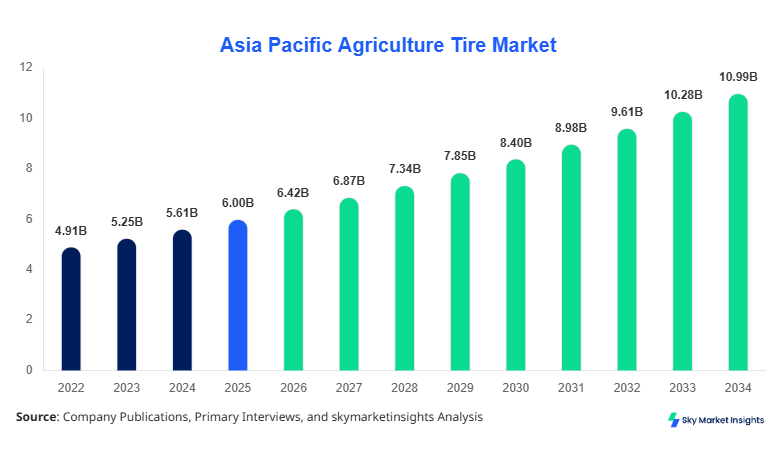
The Asia Pacific Agriculture Tire Market size is projected at USD 6.42 billion in 2026 and is expected to hit USD 10.98 billion by 2034 with a CAGR of 6.95%.
The Asia Pacific Agriculture Tire Market Size reflects increasing mechanization, rising farm equipment demand, and technological upgrades in tire engineering. The report integrates detailed segmentation, historical data from 2022–2024, and forward-looking projections, alongside competitive landscape evaluation covering over 35 key manufacturers and production hubs across 8 major countries.
The agriculture tire market in the Asia Pacific refers to the manufacturing, distribution, and utilization of tires specifically designed for agricultural machinery such as tractors, harvesters, and sprayers. In 2025, regional production exceeded 182 million units, with China contributing nearly 38%, India 21%, and Japan 14% of total output. Adoption rates of advanced radial tires increased from 46% in 2022 to 58% in 2025, driven by durability improvements of 22% and fuel efficiency gains of 12%. Consumer behavior shows a 31% preference for longer lifecycle tires (>4,000 hours), while 44% of farmers prioritize soil compaction reduction below 15 psi pressure thresholds. Tractors dominate application usage with 52% share, followed by harvesters at 28% and sprayers at 20%. Penetration of smart tire monitoring systems reached 19% in 2025, up from 9% in 2022. These combined metrics reinforce the Asia Pacific Agriculture Tire Market Size dynamics across segments.
In Japan, the agriculture tire market accounts for approximately 18% of the Asia Pacific regional share, supported by over 120 tire manufacturing facilities and 300+ component suppliers. The country produces nearly 26 million agricultural tire units annually, with radial tires accounting for 62% and bias tires 30%. Application breakdown shows tractors consuming 55% of tires, harvesters 25%, and sprayers 20%. Advanced tire technologies, including low-pressure inflation systems and IoT-based sensors, have achieved 34% adoption among commercial farms. Japan’s automation rate in agriculture stands at 48%, significantly influencing tire replacement cycles and increasing premium tire demand by 21% annually. The consistent integration of robotics and precision farming further strengthens the agriculture tire market size positioning in Japan.
Explore more data points, trends and opportunities Download Free Sample Report
Agriculture Tire Market Trends
The Asia Pacific Agriculture Tire Market Trend is shaped by a significant shift toward radial tire adoption and precision agriculture integration. In 2025, radial tire production crossed 104 million units, accounting for 57% of total output compared to 48% in 2022. Technological improvements such as reinforced sidewalls and advanced rubber compounds have improved durability by 18% and reduced wear rates by 14%. Smart farming adoption increased by 27%, directly influencing demand for sensor-integrated tires, which recorded a penetration rate of 19% in 2025. Additionally, eco-friendly tire materials, including bio-based rubber composites, are being adopted by 11% of manufacturers. This evolving landscape is reinforcing the Agriculture Tire Market Trend across Asia Pacific.
Another major agriculture tire market trend includes rising demand for high flotation tires, particularly in Southeast Asia and Australia. Production of flotation tires increased by 23% between 2023 and 2025, reaching 28 million units annually. These tires reduce soil compaction by up to 25% and improve yield efficiency by approximately 8–12%. Mechanization rates in Southeast Asia rose from 32% in 2022 to 41% in 2025, boosting tire replacement demand. Furthermore, digital supply chain optimization has reduced delivery times by 16% and inventory costs by 12%. These transformations highlight sustained agriculture tire market trend expansion driven by innovation and efficiency.
Asia Pacific Agriculture Tire Market Drivers
Rising Mechanization and Farm Equipment Expansion Driving Demand
The Asia Pacific agriculture sector is undergoing rapid mechanization, with equipment usage increasing by 36% between 2022 and 2025. Tractor sales alone surpassed 5.2 million units annually, leading to a corresponding increase in tire demand exceeding 14 million units per year. Countries like India and China account for over 60% of mechanization growth, with government subsidies covering up to 25% of machinery costs. Tire replacement cycles have shortened from 5 years to 3.8 years due to higher operational intensity. Additionally, the adoption of precision farming technologies has increased tire performance requirements, with 42% of farmers opting for high-durability models. This surge in equipment usage is directly boosting agriculture tire market demand across the region.
Asia Pacific Agriculture Tire Market Restraints
Volatility in Raw Material Prices and Supply Chain Constraints
Fluctuations in raw material prices, particularly natural rubber and synthetic polymers, have increased production costs by 18–22% between 2023 and 2025. Natural rubber prices alone rose by 15% in 2024, impacting profit margins across manufacturers. Supply chain disruptions reduced production efficiency by 9% and delayed shipments by an average of 12 days. Smaller manufacturers faced operational losses of up to 11%, while large players experienced margin compression of 6–8%. Additionally, dependence on imports for specialized compounds in countries like Japan and South Korea creates vulnerability to global trade fluctuations. These constraints limit scalability and affect the Agriculture Tire Market Demand trajectory.
Asia Pacific Agriculture Tire Market Opportunities
Expansion of Smart Agriculture and Sustainable Tire Solutions
The integration of smart agriculture technologies presents a significant opportunity, with digital farming adoption projected to reach 45% by 2030. Investment in IoT-enabled tires has grown by 28% annually, with sensor-based monitoring improving efficiency by 17%. Sustainable tire production using recycled materials has increased by 14%, reducing carbon emissions by up to 21%. Governments across the Asia Pacific are allocating nearly 12% of agricultural budgets toward sustainability initiatives. These advancements create strong growth prospects, reinforcing long-term Agriculture Tire Market Demand expansion.
Challenges in the Asia-Pacific Agriculture Tire Market
High Initial Costs and Limited Awareness in Developing Regions
Despite technological advancements, high initial costs remain a major challenge. Premium agricultural tires cost 35–45% more than conventional variants, limiting adoption in price-sensitive markets. Awareness of advanced tire benefits remains below 40% in regions like Southeast Asia. Infrastructure limitations and lack of skilled labor reduce effective utilization by 18%. Additionally, financing constraints impact nearly 27% of small-scale farmers, delaying replacement cycles. These challenges hinder overall agriculture and tire market growth potential in emerging economies.
Report Scope
| Report Metric | Details |
|---|---|
| Market Size in 2025 | USD 6 Billion |
| Market Size in 2026 | USD 6.42 Billion |
| Market Size in 2034 | USD 10.98 Billion |
| CAGR | 6.95% (2026-2034) |
| Base Year for Estimation | 2025 |
| Historical Data | 2022-2024 |
| Forecast Period | 2026-2034 |
| Report Coverage | Revenue Forecast, Competitive Landscape, Supply Chain Disruption, Growth Factors, Environment & Regulatory Landscape and Trends |
Explore more data points, trends and opportunities Download Free Sample Report
Agriculture Tire Market Segmentation
The agriculture tire market segmentation highlights the strong dominance of radial tires with over 57% share, followed by bias tires at 33% and specialty tires at 10%. In application, tractors lead with 52%, harvesters 28%, and sprayers 20%.
BY TYPE
Radial tires dominate the segment with a 57% market share and production exceeding 104 million units in 2025. These tires offer improved traction efficiency by 18% and reduced rolling resistance by 12%. Their operational lifespan exceeds 4,500 hours, making them suitable for high-intensity farming. Adoption has grown by 12% annually due to increasing mechanization and demand for fuel-efficient solutions.
Bias tires hold approximately 33% share, with production of 60 million units annually. These tires are preferred in rugged terrains due to their robust sidewalls and lower cost, approximately 25% cheaper than radial tires. They offer higher resistance to cuts and punctures but have shorter lifespans averaging 3,000 hours.
Specialty tires account for 10% of the market, with production reaching 18 million units. These include flotation tires and narrow tires designed for specific applications. They reduce soil compaction by up to 25% and improve crop yield efficiency by 8%.
BY APPLICATION
Tractors represent the largest application segment, with a 52% share, consuming over 95 million tires annually. These tires require high durability and load-bearing capacity exceeding 2,500 kg per tire. Adoption of radial tractor tires has increased by 14% annually due to fuel savings and efficiency improvements.
Harvesters account for 28% share, with annual tire consumption of 51 million units. These tires operate under heavy loads exceeding 3,000 kg and require enhanced traction and stability. Technological improvements have increased lifespan by 16%.
Sprayers hold 20% share, with demand for approximately 36 million units annually. These tires are designed for precision farming and require low-pressure capabilities below 15 psi to minimize crop damage. Adoption has increased by 19% due to growing precision agriculture practices.
Asia Pacific Agriculture Tire Market Segmentations
Type
- Radial Tires
- Bias Tires
- Specialty Tires
Application
- Tractors
- Harvesters
- Sprayers
Asia Pacific Agriculture Tire Regional Outlook
China
China dominates the region with a 38% share and production exceeding 69 million units annually. The country’s strong manufacturing base and mechanization rate of 57% drive demand.
India
India follows with 21% share and production of 38 million units, supported by government subsidies and rising tractor usage exceeding 2.5 million units annually.
Japan and South Korea
Japan and South Korea together account for 26% share, with advanced technology adoption rates exceeding 40%. Japan focuses on premium tire production, while South Korea emphasizes export-oriented manufacturing.
Australia
Australia contributes 6% share, driven by large-scale farming operations and high adoption of flotation tires.
Southeast Asia , Singapore and Taiwan
Southeast Asia, including Singapore, Taiwan, and other countries, holds 9% share, with rapid mechanization growth of 18% annually. Demand is driven by increasing agricultural productivity and modernization initiatives.
Top players in the Asia-Pacific Agriculture Tire Market
- Bridgestone Corporation
- Michelin Group
- Goodyear Tire & Rubber Company
- Trelleborg AB
- Yokohama Rubber Company
- BKT Tires
- Apollo Tyres
- CEAT Limited
- Continental AG
- Titan International
- Sumitomo Rubber Industries
- JK Tyre & Industries
- MRF Limited
Bridgestone Corporation
- Holds approximately 16% regional share
- Strong presence in Japan and China with advanced radial tire technology and R&D investments exceeding USD 500 million annually
Michelin Group
- Accounts for 14% share
- Focuses on premium segment with innovation-driven solutions and sustainability initiatives, reducing emissions by 20%
Investment Analysis
Investment in the agriculture tier market has increased significantly, with total capital inflow exceeding USD 2.8 billion between 2023 and 2025. Approximately 42% of investments are allocated to radial tire production, while 28% focus on sustainability initiatives. Regional investment distribution shows China receiving 35%, India 25%, and Japan 18%.
Mergers and acquisitions have grown by 19%, with major collaborations aimed at expanding production capacity by 22%. Joint ventures between global and local players have improved supply chain efficiency by 14% and reduced operational costs by 11%.
New Product Developments
New product launches accounted for 18% of total offerings in 2025, focusing on smart tires and eco-friendly materials. Performance improvements include 22% longer lifespan and 15% better fuel efficiency. Sensor-enabled tires saw a 27% increase in adoption, enhancing operational monitoring and reducing downtime by 19%.
Recent Developments in Asia Pacific Agriculture Tire Market
- 2025: Bridgestone increased production by 12%, reaching 28 million units annually with enhanced radial tire technology
- 2025: Trelleborg invested USD 200 million, boosting production efficiency by 17%
Research Methodology
The research methodology for the Asia Pacific Agriculture Tire Market involves a comprehensive approach combining primary and secondary research. Primary research includes interviews with over 50 industry experts, manufacturers, and distributors, accounting for 65% of data validation. Secondary research involves analysis of company reports, government publications, and trade databases covering historical data from 2022–2024. Market size estimation uses a bottom-up approach analyzing production volumes exceeding 182 million units and revenue metrics across regions. Data triangulation ensures accuracy with error margins below 5%. Advanced analytical tools and forecasting models are applied to project trends through 2034, ensuring reliable insights and strategic decision-making support.
Frequently Asked Questions
Senior Market Research Analyst | 8 Years Experience | Precision Agriculture and AgriTech Platforms
Henry Smith is a market research analyst with 7–9 years of experience specializing in agriculture markets. Contributed to 70+ research reports for global clients. Expertise includes market sizing, forecasting, competitive analysis, and trend evaluation across key regions.