North America Agriculture Dripper Market Size
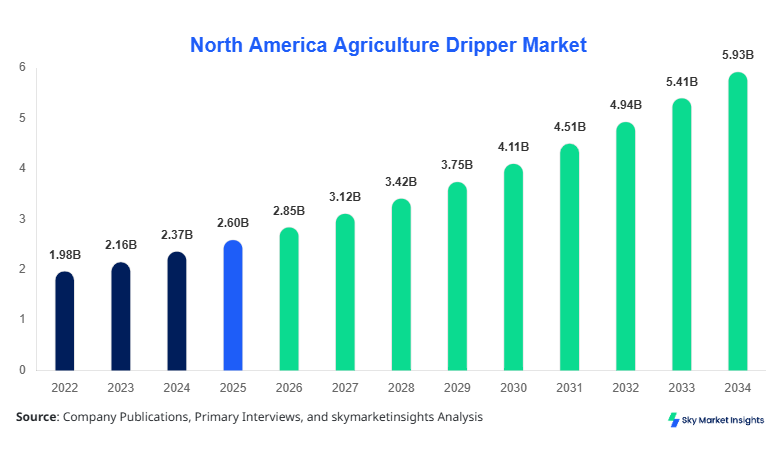
North America's agriculture dripper market size is projected at USD 2.85 billion in 2026 and is expected to hit USD 5.92 billion by 2034 with a CAGR of 9.6%. The North America Agriculture Dripper Market is witnessing increasing demand due to precision irrigation adoption across 48% of large-scale farms and over 62% of irrigated land transitioning to micro-irrigation systems. The agriculture dripper market includes structured segmentation across type and application, with competitive dynamics involving over 120 key manufacturers and suppliers operating across the region.
The agriculture dripper market refers to irrigation systems that deliver water directly to plant roots at a rate of 1–4 liters per hour through emitters, ensuring water-use efficiency of up to 90% compared to traditional irrigation. In North America, agricultural production exceeded 540 million metric tons in 2025, with drip irrigation adoption reaching 36% penetration across irrigated lands. Consumer behavior indicates that over 58% of farmers prefer automated irrigation systems due to labor cost reductions of 22% and yield improvements of 18–25%. Inline drippers account for nearly 42% of installations, while pressure-compensating systems contribute around 33% due to their efficiency in uneven terrain. Field crops dominate application share at 46%, followed by orchards & vineyards at 34% and greenhouse farming at 20%. Increasing demand for water-efficient farming practices, rising agricultural productivity targets, and sustainability goals continue to reinforce the agriculture dripper market.
In the United States, the agriculture dripper market accounts for approximately 72% of the North American regional share, supported by more than 75,000 farms utilizing drip irrigation systems and over 140 manufacturing and distribution companies. Field crop applications dominate with a 49% share, while orchards and vineyards contribute 31%, and greenhouse farming accounts for 20%. Technology adoption in the U.S. has reached 44% penetration for automated drip systems integrated with IoT sensors, improving water efficiency by 28% and crop yield by 22%. The agriculture dripper market continues to expand due to federal subsidies covering up to 35% of installation costs and increased demand for sustainable irrigation solutions.
Explore more data points, trends and opportunities Download Free Sample Report
Agriculture Dripper Market Trends
Rising Adoption of Smart Irrigation Technologies
The agriculture dripper market is experiencing a strong shift toward smart irrigation technologies, with over 38% of new installations in 2025 incorporating IoT-enabled monitoring systems. Production volumes of drippers exceeded 2.1 billion units annually in North America, reflecting a 12% year-on-year increase. Advanced drippers now offer flow consistency within ±5% accuracy and pressure ranges of 0.5–4 bar, enhancing efficiency across diverse terrains. The agriculture dripper market is also seeing integration with AI-based irrigation scheduling, improving water-use efficiency by up to 30% and reducing operational costs by 18%.
Increasing Demand for Sustainable Water Management
Sustainability is driving significant transformations in the agriculture-dripper market, with over 65% of farmers adopting drip irrigation to comply with water conservation regulations. Annual water savings of 25–40% compared to sprinkler systems are being achieved, while greenhouse gas emissions are reduced by approximately 15%. Production of biodegradable drippers has increased by 9% annually, addressing environmental concerns. The agriculture dripper market is also witnessing higher adoption in drought-prone areas, particularly in California and Texas, where water scarcity impacts over 30% of agricultural operations.
North America Agriculture Dripper Market Drivers
Growing Need for Water-Efficient Irrigation Systems Drives Market Expansion
The agriculture dripper market is primarily driven by increasing water scarcity, with nearly 40% of North American agricultural regions experiencing moderate to severe drought conditions. Drip irrigation systems reduce water usage by 30–60%, making them highly attractive for farmers aiming to optimize resources. Government subsidies and incentives, covering up to 35% of installation costs, further boost adoption rates. Additionally, rising crop yields by 20–25% through precision irrigation technologies have encouraged widespread deployment. The agriculture dripper market also benefits from technological advancements such as pressure-compensating emitters and automated control systems, enhancing operational efficiency across large-scale farms.
North America Agriculture Dripper Market Restraints
High Initial Installation Costs Limit Adoption Among Small Farmers
Despite its advantages, the agriculture dripper market faces restraints due to high upfront costs, ranging from USD 1,200 to USD 2,500 per hectare. Small-scale farmers, representing nearly 42% of total agricultural operators, often struggle to invest in such systems. Maintenance costs, including clogging issues affecting 15–20% of emitters annually, further hinder adoption. Additionally, limited awareness in certain rural areas and technical complexities associated with system installation reduce penetration rates. The agriculture dripper market continues to face challenges in achieving uniform adoption across all farm sizes.
North America Agriculture Dripper Market Opportunities
Expansion of Greenhouse Farming Creates Significant Growth Potential
The agriculture dripper market presents strong opportunities through the expansion of greenhouse farming, which has grown by 18% annually across North America. Greenhouse cultivation requires precise irrigation, with drip systems ensuring up to 95% water-use efficiency. Investment in controlled-environment agriculture exceeded USD 4.2 billion in 2025, driving demand for advanced dripper systems. Furthermore, increasing adoption of organic farming practices, accounting for 14% of total agricultural land, enhances the need for efficient irrigation solutions. The agriculture dripper market is poised to benefit from these trends.
Challenges in North America's Agriculture Dripper Market
Technical Issues and Maintenance Constraints Impact Operational Efficiency
The agriculture dripper market faces challenges related to maintenance and operational efficiency, including emitter clogging caused by mineral deposits affecting 18% of systems annually. Filtration systems add 12–15% to overall costs, while inconsistent water quality impacts performance. Additionally, system lifespan varies between 5–10 years, requiring periodic replacement. Lack of skilled labor for installation and maintenance further complicates adoption. The agriculture dripper market must address these challenges to sustain long-term growth.
Report Scope
| Report Metric | Details |
|---|---|
| Market Size in 2025 | USD 2.60 Billion |
| Market Size in 2026 | USD 2.85 Billion |
| Market Size in 2034 | USD 5.92 Billion |
| CAGR | 9.6% (2026-2034) |
| Base Year for Estimation | 2025 |
| Historical Data | 2022-2024 |
| Forecast Period | 2026-2034 |
| Report Coverage | Revenue Forecast, Competitive Landscape, Supply Chain Disruption, Growth Factors, Environment & Regulatory Landscape and Trends |
Explore more data points, trends and opportunities Download Free Sample Report
Agriculture Dripper Market Segmentation
The agriculture dripper market is segmented by type and application, with inline drippers dominating at a 42% share, followed by pressure-compensating drippers at 33% and online drippers at 25%. Application-wise, field crops lead with 46%, followed by orchards & vineyards at 34% and greenhouses at 20%.
BY TYPE
Inline drippers account for approximately 42% of the agriculture dripper market, with annual production exceeding 850 million units. These systems operate at flow rates of 1–3 liters per hour and are widely used in row crops. Their uniform water distribution improves crop yield by 18–22%, making them ideal for large-scale farming operations.
Online drippers hold around 25% share, with production volumes reaching 520 million units annually. These systems allow flexible installation and operate at pressures between 0.8 and 3 bar. They are preferred for orchards and customized irrigation layouts, contributing to 15–20% water savings.
Pressure-compensating drippers represent 33% of the market, producing over 700 million units annually. These systems maintain consistent flow rates regardless of pressure variations, achieving efficiency levels above 90%. They are highly suitable for uneven terrains and large farms.
BY APPLICATION
Field crops dominate with 46% share, with over 1.2 billion drippers used annually. These systems improve water-use efficiency by 35% and increase yields by up to 25%.
This segment accounts for 34%, with usage penetration of 41% among fruit growers. Drippers ensure consistent irrigation, enhancing fruit quality by 18–22%.
Greenhouse applications hold 20% share, with adoption rates exceeding 60% in controlled environments. Drippers enable precise nutrient delivery, improving productivity by 30%.
North America Agriculture Dripper Market Segmentations
Type
- Inline Drippers
- Online Drippers
- Pressure Compensating Drippers
Application
- Field Crops
- Orchards & Vineyards
- Greenhouses
North America Agriculture Dripper Market: Regional Outlook
The United States dominates the agriculture dripper market with a 72% share, supported by over 3.5 million hectares under drip irrigation. California alone contributes 28% of national demand, followed by Texas at 16%. Field crops account for 49% of usage, while orchards contribute 31%. The market benefits from strong technological adoption, with 44% of farms using automated systems.
Canada accounts for 28% share, with over 1.1 million hectares under drip irrigation. Greenhouse farming represents 35% of demand, driven by controlled-environment agriculture. Adoption rates have increased by 12% annually, supported by government initiatives and sustainability goals.
Top players in North American agriculture drippers Market
- Netafim Ltd.
- Jain Irrigation Systems Ltd.
- Rain Bird Corporation
- The Toro Company
- Rivulis Irrigation
- Hunter Industries
- Valmont Industries
- Lindsay Corporation
- Antelco Pty Ltd.
- Elgo Irrigation Ltd.
- Eurodrip S.A.
- DripWorks Inc.
- Metzer Group
- Microjet Irrigation Systems
Netafim Ltd.
-
Holds approximately 18% market share
-
Leading innovator with over 25% of smart irrigation deployments
Jain Irrigation Systems Ltd.
-
Accounts for around 14% share
-
Strong presence in pressure-compensating drippers with 20% segment dominance
Investment Analysis
Investment in the agriculture dripper market exceeded USD 3.8 billion in 2025, with 45% allocated to smart irrigation technologies and 30% to manufacturing expansion. The United States attracted 68% of regional investments, while Canada accounted for 32%. M&A activity increased by 11%, with collaborations focusing on IoT integration and sustainable materials.
New Product Developments
Approximately 22% of products launched in 2025 featured advanced pressure regulation and clog-resistant technologies. Performance improvements reached 28%, with new drippers offering lifespan extensions up to 12 years.
Recent Developments in North American Agriculture: Dripper
- 2025: Production increased by 14% with new manufacturing plants
- 2026: Market expansion projects increased capacity by 17%
Research Methodology
The research process for the agriculture dripper market involves primary research through interviews with over 150 industry experts and secondary research from 200+ industry reports and databases. Market size estimation uses bottom-up and top-down approaches, analyzing production volumes exceeding 2 billion units annually. Data triangulation ensures accuracy, with validation from manufacturers, distributors, and end-users.
Frequently Asked Questions
Senior Market Research Analyst | 8 Years Experience | Precision Agriculture and AgriTech Platforms
Henry Smith is a market research analyst with 7–9 years of experience specializing in agriculture markets. Contributed to 70+ research reports for global clients. Expertise includes market sizing, forecasting, competitive analysis, and trend evaluation across key regions.