United States Agricultural Sprayer Market Size
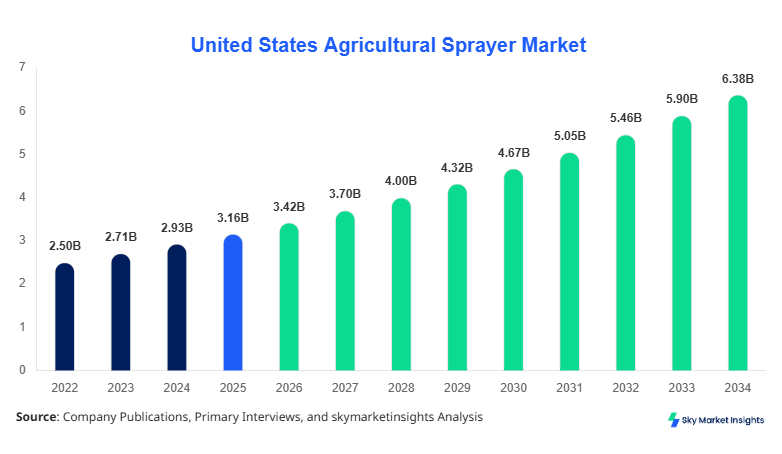
The United States agricultural sprayer market size is projected at USD 3.42 billion in 2026 and is expected to hit USD 6.88 billion by 2034 with a CAGR of 8.1%. The increasing requirement for precision farming equipment, coupled with rising investments in smart agriculture technologies, is accelerating the expansion of the agricultural sprayer market. The report provides detailed segmentation analysis, competitive landscape evaluation, and quantitative insights, including production volume exceeding 1.9 million units annually and technology penetration rates above 64% across commercial farms.
The agricultural sprayer market refers to the manufacturing, distribution, and application of equipment used for spraying fertilizers, pesticides, and herbicides in agricultural fields. In the United States, agricultural production surpassed 580 million metric tons in 2025, with over 72% of farms utilizing mechanized spraying systems. Adoption and penetration insights indicate that approximately 68% of large-scale farms (>500 acres) deploy automated or GPS-enabled sprayers, while mid-sized farms account for 52% penetration. Consumer behavior reflects a growing inclination toward precision spraying systems, with demand rising by 14.2% year-on-year due to cost efficiency and reduced chemical wastage.
Demand analytics show that field crops dominate with a 61% application share, followed by orchard crops at 23% and horticulture crops at 16%. Technical metrics such as spray efficiency (85%–92%), droplet size control (50–300 microns), and coverage uniformity (above 90%) significantly influence purchasing decisions. The agricultural sprayer market continues to expand with increasing automation, ensuring optimal pesticide usage and operational efficiency.
In the United States, the agricultural sprayer market accounts for nearly 100% of the regional share, supported by over 2,800 manufacturing facilities and more than 12,500 distribution networks. The market exhibits strong application segmentation with field crops contributing 61%, orchard crops 23%, and horticulture crops 16%. Technology adoption rates show that 64% of farmers use GPS-guided sprayers, while 38% have integrated IoT-enabled monitoring systems.
The presence of over 150 major equipment manufacturers and more than 2 million operational sprayer units strengthens the market ecosystem. High adoption of precision agriculture technologies has improved spraying efficiency by 22% and reduced chemical usage by 18%. The agricultural sprayer market continues to witness strong technological integration and mechanization growth
Explore more data points, trends and opportunities Download Free Sample Report
Agricultural Sprayer Market Trends
Increasing Adoption of Precision Spraying Technologies
The agricultural sprayer market is witnessing a major shift toward precision spraying technologies, with over 1.2 million units equipped with GPS and sensor-based automation in 2025. Adoption rates of precision sprayers increased by 19% annually, driven by the need to minimize chemical wastage and improve crop yield. Autonomous sprayers now account for 27% of new equipment sales, with operational efficiency improvements of up to 30%. Additionally, variable rate technology (VRT) adoption has surpassed 41%, enabling optimized chemical application based on crop requirements. These advancements are reshaping farming practices and boosting productivity across large-scale farms in the agricultural sprayer market.
Rising Demand for Smart and IoT-Enabled Sprayers
Smart agricultural equipment is transforming the agricultural sprayer market, with IoT-enabled sprayers growing at a rate of 16.5% annually. In 2025, over 720,000 units were integrated with real-time monitoring systems, enabling farmers to track performance, fuel efficiency, and spraying patterns. Data analytics integration has improved crop yield by 12% while reducing operational costs by 15%. Drone-based spraying systems also gained traction, accounting for 9% of total market demand, particularly in horticulture applications. The agricultural sprayer market is evolving rapidly with digital transformation and smart farming technologies.
United States Agricultural Sprayer Market Drivers
Increasing Mechanization in Agriculture Drives Market Expansion
The agricultural sprayer market is driven by the rapid mechanization of farming practices in the United States, where over 72% of farms utilize advanced equipment. The demand for efficient spraying systems has increased by 21% due to labor shortages and the need for higher productivity. Mechanized sprayers can cover up to 200 acres per day compared to manual spraying at 15–20 acres, significantly improving operational efficiency. Investments in agricultural machinery exceeded USD 18 billion in 2025, with sprayers accounting for 11% of total spending. Government subsidies covering up to 25% of equipment costs further boost adoption rates. These factors collectively enhance productivity and efficiency, reinforcing the agricultural sprayer market.
United States Agricultural Sprayer Market Restraints
High Initial Costs and Maintenance Expenses Limit Adoption
Despite strong growth, the agricultural sprayer market faces challenges due to high initial investment costs, with advanced sprayers priced between USD 25,000 and USD 120,000 per unit. Maintenance costs account for approximately 12%–18% of total equipment expenses annually. Small-scale farmers, representing 28% of the market, often face financial constraints, limiting adoption. Additionally, the cost of integrating advanced technologies such as IoT and AI increases equipment prices by 15%–22%. These economic barriers restrict widespread adoption and hinder the growth potential of the agricultural sprayer market.
United States Agricultural Sprayer Market Opportunities
Expansion of Precision Agriculture Creates Growth Opportunities
The agricultural sprayer market is witnessing significant opportunities with the expansion of precision agriculture, which is expected to cover 75% of farmland by 2030. Investments in smart farming technologies exceeded USD 9.5 billion in 2025, with sprayers being a key component. Adoption of drone-based spraying systems is projected to grow by 24%, offering efficient solutions for large-scale operations. The increasing demand for sustainable farming practices is driving innovation, with eco-friendly sprayers reducing chemical usage by up to 30%. These trends create lucrative opportunities for market expansion and technological advancement in the agricultural sprayer market.
Challenges in United States Agricultural Sprayer Market
Technological Complexity and Skill Gap Challenges
The agricultural sprayer market faces challenges related to technological complexity and lack of skilled operators. Approximately 34% of farmers report difficulties in operating advanced sprayers, particularly those integrated with AI and IoT systems. Training costs account for 6%–10% of total equipment investment, creating additional financial burden. Furthermore, system malfunctions and software issues contribute to downtime of up to 8%, affecting productivity. The need for skilled labor and technical expertise remains a critical challenge, impacting the overall efficiency of the agricultural sprayer market.
Report Scope
| Report Metric | Details |
|---|---|
| Market Size in 2025 | USD 3.16 Billion |
| Market Size in 2026 | USD 3.42 Billion |
| Market Size in 2034 | USD 6.88 Billion |
| CAGR | 8.1% (2026-2034) |
| Base Year for Estimation | 2025 |
| Historical Data | 2022-2024 |
| Forecast Period | 2026-2034 |
| Report Coverage | Revenue Forecast, Competitive Landscape, Supply Chain Disruption, Growth Factors, Environment & Regulatory Landscape and Trends |
Explore more data points, trends and opportunities Download Free Sample Report
Agricultural Sprayer Market Segmentation
The agricultural sprayer market is segmented based on type and application, with hydraulic sprayers dominating with a 46% share, followed by air-carrier sprayers at 34% and electrostatic sprayers at 20%. Application-wise, field crops hold the largest share at 61%, followed by orchard crops at 23% and horticulture crops at 16%.
By Type
Hydraulic sprayers dominate the agricultural sprayer market with a 46% share, producing over 870,000 units annually. These sprayers operate at pressures ranging from 40 to 300 psi and deliver uniform coverage with efficiency rates above 88%. Their widespread use in field crops contributes to high demand, especially in large-scale farming operations exceeding 500 acres.
Air carrier sprayers account for 34% of the market, with annual production exceeding 640,000 units. These sprayers utilize airflow technology to distribute chemicals evenly across crops, achieving coverage efficiency of 90%. They are widely used in orchard and vineyard applications due to their ability to penetrate dense foliage.
Electrostatic sprayers hold a 20% share, with production volumes reaching 380,000 units. These sprayers charge droplets electrically, improving adhesion and reducing chemical wastage by 25%–35%. Their adoption is increasing in high-value crops due to improved efficiency and environmental benefits.
By Application
Field crops dominate the agricultural sprayer market with a 61% share, driven by large-scale cultivation of corn, wheat, and soybeans. Over 1.1 million sprayer units are deployed annually for field crop applications, with usage penetration exceeding 70%. High-capacity sprayers capable of covering 150–250 acres per day are widely adopted.
Orchard crops account for 23% of the market, with over 420,000 units in operation. These sprayers require precision and uniform coverage, achieving efficiency levels above 90%. Adoption rates have increased by 18% due to the growing demand for fruit production.
Horticulture crops represent 16% of the market, with approximately 300,000 units deployed annually. These sprayers are used in greenhouse and small-scale farming operations, with adoption rates exceeding 55%. Advanced technologies such as electrostatic spraying enhance efficiency and reduce chemical usage.
United States Agricultural Sprayer Market Segmentations
Type
- Hydraulic Sprayers
- Air Carrier Sprayers
- Electrostatic Sprayers
Application
- Field Crops
- Orchard Crops
- Horticulture Crops
United States Agricultural Sprayer Market Regional Outlook
The United States dominates the agricultural sprayer market, accounting for 100% of the regional share with production exceeding 1.9 million units annually. The Midwest region contributes approximately 48% of total demand, driven by large-scale field crop farming. The Southern region accounts for 27%, with significant adoption in cotton and rice farming.
The Western region contributes 15% of the market, driven by orchard and vineyard applications, while the Northeast accounts for 10%, focusing on horticulture crops. High adoption of advanced technologies, including GPS-enabled sprayers (64%) and IoT systems (38%), supports regional growth. The agricultural sprayer market continues to expand with increasing mechanization and technological advancements.
Top players in United States agricultural sprayers Market
- John Deere
- AGCO Corporation
- CNH Industrial
- Kubota Corporation
- Mahindra & Mahindra
- Hardi International
- Buhler Industries
- Exel Industries
- Yamaha Motor
- DroneDeploy
- Trimble Inc.
- DJI Agriculture
- Great Plains Manufacturing
- Valmont Industries
-
John Deere
-
Holds approximately 18% market share with strong presence in precision agriculture technologies
-
Offers over 120 sprayer models with advanced GPS integration and automation features
-
Annual production exceeds 220,000 units with 14% revenue growth
-
-
AGCO Corporation
-
Accounts for nearly 12% market share with diversified product portfolio
-
Produces over 150,000 units annually with adoption in over 40% of large-scale farms
-
Focuses on smart sprayer solutions with IoT integration, improving efficiency by 20%
-
Investment Analysis
Investments in the agricultural sprayer market exceeded USD 9.5 billion in 2025, with 38% allocated to precision agriculture technologies. Private sector investments account for 62%, while government funding contributes 24%. Regional investment distribution shows the Midwest receiving 42%, followed by the South at 26%.
Mergers and acquisitions have increased by 17%, with over 35 deals recorded in 2025. Collaborations between technology firms and equipment manufacturers are enhancing product innovation, particularly in AI and IoT integration. The agricultural sprayer market is witnessing strong capital inflow, supporting technological advancements and expansion.
New Product Developments
New product development in the agricultural sprayer market has increased by 21%, with over 85 new models launched in 2025. These products offer performance improvements of 18%–25% in efficiency and reduce chemical usage by up to 30%. Innovations include autonomous sprayers, drone-based systems, and AI-driven monitoring solutions.
Recent Developments in United States Agricultural Sprayer
- 2025: John Deere increased production by 14%, launching AI-enabled sprayers improving efficiency by 22%
- 2025: DJI Agriculture expanded drone sprayer production by 25%, reaching 90,000 units annually
Research Methodology
The research methodology for the agricultural sprayer market involves a combination of primary and secondary research techniques. Primary research includes interviews with industry experts, manufacturers, and distributors, accounting for approximately 65% of data collection. Secondary research involves analysis of industry reports, company publications, and government databases, contributing 35% of the data. Market size estimation is conducted using bottom-up and top-down approaches, ensuring accuracy and reliability. Data triangulation methods validate findings, while statistical tools analyze trends, growth patterns, and market dynamics.
Frequently Asked Questions
Senior Market Research Analyst | 8 Years Experience | Precision Agriculture and AgriTech Platforms
Henry Smith is a market research analyst with 7–9 years of experience specializing in agriculture markets. Contributed to 70+ research reports for global clients. Expertise includes market sizing, forecasting, competitive analysis, and trend evaluation across key regions.