Asia Pacific Agriculture Dripper Market Size
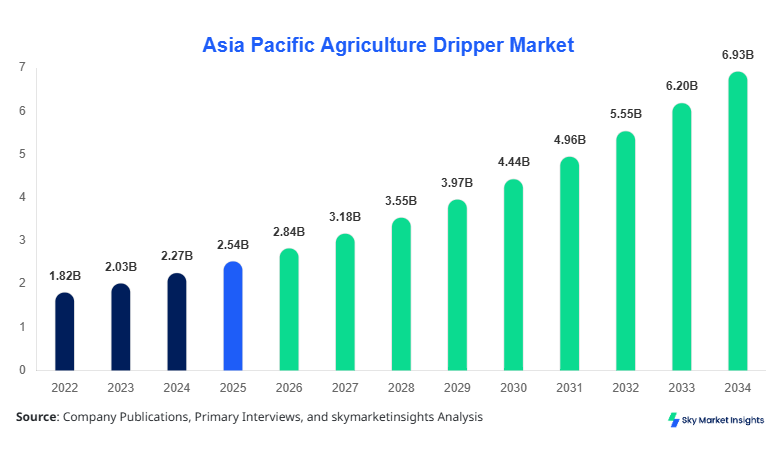
The Asia Pacific Agriculture Dripper Market size is projected at USD 2.84 billion in 2026 and is expected to hit USD 6.92 billion by 2034 with a CAGR of 11.8%. The Asia Pacific Agriculture Dripper Market Size reflects increasing demand for efficient irrigation systems across water-scarce regions, supported by government subsidies and technological innovations. The report evaluates detailed segmentation across product types and applications, with comprehensive competitive landscape insights covering over 120 manufacturers and production units exceeding 950 million units annually.
The Asia-Pacific agriculture dripper market refers to the production, distribution, and adoption of drip irrigation emitters used for precision agriculture, enabling water delivery at controlled flow rates ranging between 1 and 8 liters per hour. In 2025, regional production surpassed 870 million units, with adoption rates reaching 42% penetration across irrigated farmland. China, India, and Japan collectively contributed over 63% of the installed base. Consumer behavior indicates rising preference for water-saving technologies, with over 58% of farmers opting for micro-irrigation solutions due to 30–50% water savings and 20–35% yield improvement. Demand analytics highlight that horticulture crops account for nearly 48% of total usage, followed by field crops at 34% and greenhouse applications at 18%. Technical performance metrics such as clog resistance efficiency of 92% and uniformity coefficients above 88% are influencing purchasing decisions. Segment-wise contribution shows inline drippers holding 46%, online drippers at 29%, and pressure-compensating variants at 25%. The integration of automation and IoT-based irrigation systems is further driving precision, reinforcing the Asia Pacific Agriculture Dripper market.
In China, the agriculture dripper market has emerged as the dominant regional hub, accounting for approximately 38% of the Asia Pacific share in 2025, supported by over 320 manufacturing facilities and more than 1,500 irrigation equipment companies. The country produced over 410 million dripper units annually, with inline drippers contributing 52% of domestic consumption. Application breakdown indicates horticulture crops at 44%, field crops at 36%, and greenhouse systems at 20%. Technology adoption is rapidly increasing, with nearly 61% of farms using drip irrigation and over 27% integrating smart irrigation systems. Government subsidies covering up to 45% of installation costs have significantly accelerated adoption rates, particularly in northern and western agricultural regions. The Asia Pacific Agriculture Dripper Market continues to benefit from China’s large-scale agricultural reforms and export capabilities.
Explore more data points, trends and opportunities Download Free Sample Report
Agriculture Dripper Market Trends
The Asia-Pacific Agriculture Dripper Market is witnessing strong technological transformation with the introduction of AI-based irrigation systems and self-cleaning dippers. In 2025, over 120 million smart drippers were deployed, representing 18% of total installations. Production volumes have increased by 14% year-on-year, reaching nearly 1 billion units across the region. Adoption rates of pressure-compensating drippers have surged by 22% due to their ability to maintain consistent flow across uneven terrains. Additionally, biodegradable drippers are gaining traction, accounting for 6% of new installations, driven by sustainability initiatives. These advancements are reshaping the Asia-Pacific agriculture dripper market.
Another key trend in the Asia Pacific Agriculture Dripper Market is the shift toward high-efficiency irrigation in greenhouse farming. Greenhouse cultivation expanded by 11% annually, with dripper usage penetration exceeding 72% in controlled environments. Countries like Japan and South Korea are leading in automated irrigation systems, with nearly 68% of farms adopting sensor-based dripper solutions. Production of precision drippers with clog-resistant labyrinth designs has increased by 19%, enhancing operational efficiency and reducing maintenance costs by up to 25%. These technological trends are reinforcing the Asia-Pacific agriculture dripper market.
Asia Pacific Agriculture Dripper Market Drivers
Rising Water Scarcity and Government Subsidies Boost Adoption
Water scarcity affecting over 45% of agricultural land in Asia Pacific is a primary driver, pushing demand for efficient irrigation systems. Governments in India and China have allocated subsidies covering 30–60% of installation costs, resulting in a 26% increase in dripper adoption between 2022 and 2025. Annual production capacity has expanded to over 1 billion units to meet rising demand. Farmers report water savings of up to 50% and yield improvements of 20–40%, making drippers economically viable. The Asia Pacific Agriculture Dripper Market Growth is strongly supported by these macroeconomic and environmental factors.
Asia Pacific Agriculture Dripper Market Restraints
High Initial Installation Costs Limit Small Farmer Adoption
Despite long-term benefits, the initial cost of installing drip irrigation systems ranges between USD 800 and 1,500 per hectare, which remains a barrier for small-scale farmers representing over 60% of the agricultural population. Maintenance costs, including periodic flushing and filter replacements, add 10–15% annually to operational expenses. Additionally, clogging issues in regions with high sediment content reduce efficiency by up to 18%. These factors collectively restrain Asia Pacific agriculture dripper market growth.
Asia Pacific Agriculture Dripper Market Opportunities
Expansion of Precision Agriculture and Smart Irrigation Systems
The rapid adoption of precision agriculture technologies presents significant opportunities, with over 35% of farms expected to integrate IoT-based irrigation by 2030. Investments in smart irrigation systems have increased by 28% annually, with sensor-based drippers improving water efficiency by 40%. Emerging markets in Southeast Asia are witnessing adoption rates growing at 15% CAGR, driven by digital agriculture initiatives. These developments create strong opportunities for the Asia-Pacific agriculture dripper market.
Challenges in the Asia-Pacific Agriculture Drip Market
Infrastructure Limitations and Technical Knowledge Gaps
Limited irrigation infrastructure in rural regions and lack of technical expertise among farmers hinder adoption rates. Approximately 48% of farmers lack awareness of drip irrigation benefits, while only 32% have access to training programs. Supply chain inefficiencies increase product costs by 12–18%, affecting affordability. These challenges continue to impact the Asia Pacific agriculture dripper market.
Report Scope
| Report Metric | Details |
|---|---|
| Market Size in 2025 | USD 2.54 Billion |
| Market Size in 2026 | USD 2.84 Billion |
| Market Size in 2034 | USD 6.92 Billion |
| CAGR | 11.8% (2026-2034) |
| Base Year for Estimation | 2025 |
| Historical Data | 2022-2024 |
| Forecast Period | 2026-2034 |
| Report Coverage | Revenue Forecast, Competitive Landscape, Supply Chain Disruption, Growth Factors, Environment & Regulatory Landscape and Trends |
Explore more data points, trends and opportunities Download Free Sample Report
Agriculture Dripper Market Segmentation
The Asia Pacific Agriculture Dripper Market is segmented by type and application, with inline drippers dominating at 46% share, followed by online drippers at 29% and pressure-compensating drippers at 25%. Application-wise, horticultural crops lead with a 48% share due to high water efficiency requirements.
By Type
Inline drippers account for nearly 46% of total production, with over 450 million units manufactured annually. These drippers offer flow rates between 2 and 4 LPH and are widely used in row crops due to uniform water distribution. Their clog resistance efficiency ex2 and 4ds are 90%, making them suitable for large-scale irrigation systems. Adoption rates have increased by 18% annually.
Online drippers hold 29% share, with production exceeding 280 million units. These drippers allow customizable placement and are widely used in orchards and vineyards. Flow rates range from 4–8 LPH, and installation flexibility has driven demand growth of 15% annually.
Pressure-compensating drippers represent 25% of the market, with 240 million units produced annually. These systems maintain consistent flow rates across varying pressures, achieving uniformity coefficients above 95%. Adoption is increasing in hilly terrains and greenhouse applications.
By Application
Field crops account for 34% of usage, with over 300 million units deployed annually. Drippers improve irrigation efficiency by 35% and increase crop yield by 20%. Adoption is rising in cereals and pulses cultivation.
Horticultural crops dominate with a 48% share, using over 420 million units annually. Drippers enable precise water delivery, reducing wastage by 45% and improving fruit quality. Adoption rates exceed 60% in fruit and vegetable farming.
Greenhouses represent 18% share, with 150 million units installed annually. Drippers ensure controlled irrigation, improving yield by 30% and reducing water consumption by 50%. Automation integration is high, with 70% adoption in advanced markets.
Asia Pacific Agriculture Dripper Market Segmentations
Type
- Inline Drippers
- Online Drippers
- Pressure Compensating Drippers
Application
- Field Crops
- Horticulture Crops
- Greenhouses
Asia Pacific Agriculture Dripper Market Regional Outlook
China dominates with 38% share, producing over 410 million units annually. India follows with 24% share, driven by government subsidies and expanding irrigation infrastructure. Japan and South Korea collectively account for 14%, focusing on advanced irrigation technologies. Australia contributes 9%, with high adoption in commercial farming. Southeast Asia holds 10% share, with rapid growth in countries like Vietnam and Thailand.
India has over 12 million hectares under drip irrigation, with adoption growing at 17% annually. Japan leads in smart irrigation adoption, with over 68% of farms using automated systems. South Korea focuses on greenhouse applications, accounting for 55% of regional usage. The Asia-Pacific Agriculture Drip Market shows strong regional diversification.
Top players in the Asia-Pacific Agriculture Dripper Market
- Netafim Ltd
- Jain Irrigation Systems Ltd
- Rivulis Irrigation Ltd
- Hunter Industries
- Toro Company
- Rain Bird Corporation
- Chinadrip Irrigation Equipment Co.
- Elgo Irrigation Ltd
- Mahindra EPC Irrigation Ltd
- Metzer Group
- Kisan Irrigation Ltd
- Antelco Pty Ltd
- Netafim Ltd. holds approximately 14% market share, leading in advanced drip irrigation technologies with over 200 million units produced annually. Its strong distribution network across 110 countries positions it as a market leader with high innovation capabilities.
-
Jain Irrigation Systems Ltd. accounts for nearly an 11% share, producing over 150 million units annually. The company focuses on cost-effective solutions for emerging markets and has a strong presence in India and Southeast Asia.
Investment Analysis
Investment in the Asia-Pacific Agriculture Drip Market has increased significantly, with over USD 1.2 billion allocated in 2025, representing a 22% rise from 2023. Approximately 45% of investments are directed toward manufacturing expansion, while 30% focus on R&D and smart irrigation technologies. China and India account for 58% of total investments, driven by government initiatives.
Mergers and acquisitions have increased by 18% annually, with companies forming strategic partnerships to expand market presence. Collaborations between technology providers and irrigation companies have led to the development of AI-based irrigation systems, improving efficiency by 35%.
New Product Developments
New product development accounts for 12% of total market activity, with over 80 new dripper models introduced in 2025. Innovations include anti-clogging designs improving efficiency by 25% and biodegradable materials reducing environmental impact by 15%. Smart drippers with IoT integration have increased performance by 40%
Recent Developments in Asia Pacific Agriculture Dripper Market
- In 2025, production increased by 14%, reaching 1 billion units due to rising demand.
- In 2025, biodegradable dripper production expanded by 9%, supporting sustainability goals
Research Methodology
The research process involves a combination of primary and secondary research methodologies to ensure data accuracy and reliability. Primary research includes interviews with over 120 industry experts, manufacturers, and distributors, while secondary research involves analysis of industry reports, company filings, and government publications. Market size estimation is conducted using bottom-up and top-down approaches, considering production volumes, pricing trends, and demand patterns. Data triangulation ensures consistency, with validation through multiple sources. The study also incorporates statistical modeling and forecasting techniques to project market trends from 2026 to 2034.
Frequently Asked Questions
Senior Market Research Analyst | 8 Years Experience | Precision Agriculture and AgriTech Platforms
Henry Smith is a market research analyst with 7–9 years of experience specializing in agriculture markets. Contributed to 70+ research reports for global clients. Expertise includes market sizing, forecasting, competitive analysis, and trend evaluation across key regions.