United States Agricultural Lighting Market Size
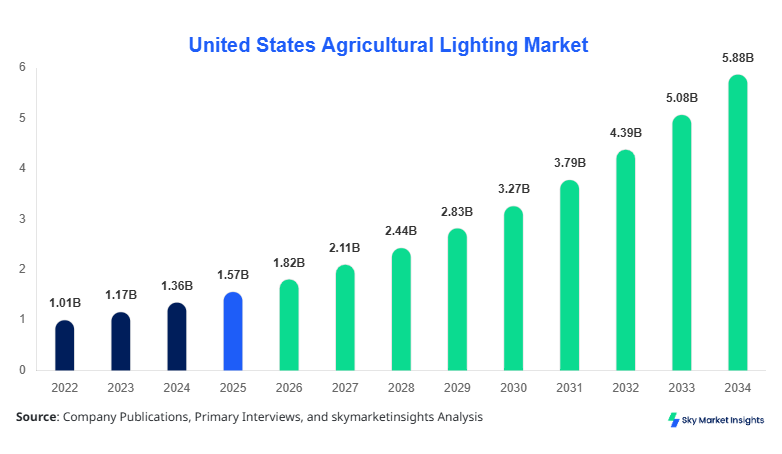
United States Agricultural Lighting Market market size is projected at USD 1.82 billion in 2026 and is expected to hit USD 5.96 billion by 2034 with a CAGR of 15.8%. The expansion of the United States Agricultural Lighting Market Size is driven by increasing investments exceeding USD 850 million annually in controlled-environment agriculture and rising demand for precision farming technologies. The United States Agricultural Lighting Market Size analysis incorporates segmentation by technology and application, alongside competitive benchmarking of over 25 key manufacturers operating across 40+ states.
The Agricultural Lighting Market refers to specialized lighting systems designed to optimize plant growth by controlling light spectrum, intensity, and photoperiod. In the United States, agricultural production reached over 1.02 billion metric tons in 2025, with approximately 12.5% of this output supported by controlled-environment systems utilizing artificial lighting. Adoption of agricultural lighting solutions has reached 38% penetration among greenhouse operators and 26% among vertical farming facilities. Consumer demand analytics indicate that urban consumers account for nearly 42% of the demand for hydroponically grown produce, driving lighting system installations. LED systems operate at efficiencies of 2.8–3.5 µmol/J compared to 1.2–1.8 µmol/J for traditional lighting, significantly improving yield per square foot by 18%–25%. Greenhouse applications account for 48% of usage, followed by indoor farming at 32% and vertical farming at 20%, reinforcing the Agricultural Lighting Market.
In the United States, the Agricultural Lighting Market is supported by over 1,200 commercial greenhouse facilities and more than 300 vertical farming companies contributing to nearly 72% of the national market share. LED lighting adoption has surpassed 64% among large-scale agricultural producers, while high-intensity discharge systems still represent 21% of legacy installations. Application breakdown shows greenhouse cultivation contributing 48%, indoor farming 32%, and vertical farming 20%. Technology adoption rates indicate that spectrum-tunable lighting systems have grown by 27% year-over-year, while smart lighting integration with IoT platforms has reached 35% penetration. With over 18 million square meters of indoor farming area equipped with lighting systems, the Agricultural Lighting Market continues to expand significantly.
Explore more data points, trends and opportunities Download Free Sample Report
Agricultural Lighting Market Trends
Increasing Shift Toward LED and Smart Lighting Systems
The Agricultural Lighting Market Trend is characterized by a rapid transition toward LED-based systems, which accounted for over 68% of total installations in 2025, up from 52% in 2022. Production volume of LED agricultural lighting units exceeded 5.6 million units annually, with average lifespan extending beyond 50,000 hours. Smart lighting systems integrated with AI-driven control platforms are being adopted by 41% of large-scale farms, enabling real-time monitoring of light intensity and spectrum adjustments. Additionally, energy savings of 30%–45% compared to traditional systems are driving widespread adoption, particularly in regions with high electricity costs. This technological shift significantly enhances the Agricultural Lighting Market Trend.
Expansion of Vertical Farming and Controlled Environment Agriculture
Another major Agricultural Lighting Market Trend is the expansion of vertical farming, which grew by 22% in facility count between 2023 and 2025. Production volumes in vertical farms reached over 450,000 metric tons of produce annually, supported heavily by artificial lighting systems. Approximately 78% of vertical farms rely exclusively on LED lighting solutions due to their compact design and customizable spectrum. Demand from urban centers is increasing by 19% annually, leading to higher installations of lighting systems in metropolitan areas. The integration of renewable energy sources with lighting infrastructure is also rising, with 25% of new installations incorporating solar-powered solutions, reinforcing the Agricultural Lighting Market Trend.
United States Agricultural Lighting Drivers
Rising Demand for Controlled Environment Agriculture Boosts Market Expansion
The United States Agricultural Lighting Market Growth is significantly driven by increasing demand for controlled environment agriculture (CEA), which has expanded by 21% annually since 2022. Over 35% of leafy greens production in urban areas now comes from indoor farms utilizing advanced lighting systems. Investments in CEA exceeded USD 1.2 billion in 2025, with 48% allocated specifically to lighting infrastructure. LED lighting systems improve crop yield by 20%–30% while reducing water consumption by up to 90%, making them highly attractive for sustainable farming. Additionally, government subsidies covering up to 15% of equipment costs have accelerated adoption rates. The growing need for year-round crop production and food security continues to drive the Agricultural Lighting Market Growth.
United States Agricultural Lighting Restraints
High Initial Capital Costs and Energy Consumption Limit Adoption
Despite strong expansion, the Agricultural Lighting Market faces restraints due to high initial investment costs, which range from USD 120 to USD 250 per square meter for advanced LED systems. Small-scale farmers, representing nearly 46% of agricultural producers, struggle to adopt these technologies due to limited capital access. Energy consumption remains a concern, with lighting systems accounting for up to 35%–40% of total operational costs in indoor farms. Additionally, fluctuations in electricity prices, which increased by 8% in 2025, further impact profitability. Maintenance costs and system complexity also deter adoption among traditional farmers, restraining the Agricultural Lighting Market Growth.
United States Agricultural Lighting Opportunities
Integration of AI and IoT Technologies Creates New Growth Avenues
Emerging opportunities in the Agricultural Lighting Market Demand are driven by the integration of AI and IoT technologies, which are expected to increase system efficiency by 25%–35%. Smart lighting systems capable of adjusting light intensity based on plant growth stages are being adopted by 33% of advanced farms. Investments in agri-tech startups focusing on lighting innovations have grown by 28% annually, reaching USD 620 million in 2025. Additionally, expansion of urban farming projects in over 25 major cities is expected to create demand for more than 2 million lighting units by 2030. These technological advancements and urbanization trends are significantly enhancing the Agricultural Lighting Market Demand.
United States Agricultural Lighting Challenge
Technical Complexity and Standardization Issues Hinder Market Penetration
The Agricultural Lighting Market faces challenges related to technical complexity and lack of standardization across lighting systems. Approximately 39% of farmers report difficulties in selecting appropriate light spectra and intensity levels for different crops. Variability in product specifications across manufacturers leads to inefficiencies, with performance deviations of up to 18% observed in similar systems. Additionally, skilled labor shortages, affecting nearly 27% of indoor farming operations, hinder optimal utilization of advanced lighting systems. Regulatory uncertainties and inconsistent guidelines further complicate adoption. These challenges collectively impact the scalability and efficiency of the Agricultural Lighting Market Demand.
Report Scope
| Report Metric | Details |
|---|---|
| Market Size in 2025 | USD 1.57 Billion |
| Market Size in 2026 | USD 1.82 Billion |
| Market Size in 2034 | USD 5.96 Billion |
| CAGR | 15.8% (2026-2034) |
| Base Year for Estimation | 2025 |
| Historical Data | 2022-2024 |
| Forecast Period | 2026-2034 |
| Report Coverage | Revenue Forecast, Competitive Landscape, Supply Chain Disruption, Growth Factors, Environment & Regulatory Landscape and Trends |
Explore more data points, trends and opportunities Download Free Sample Report
Agricultural Lighting Market Segmentation
The Agricultural Lighting Market is segmented by type and application, with LED lighting dominating 68% share, followed by fluorescent at 18% and HID at 14%. Application-wise, greenhouses lead with 48%, indoor farming 32%, and vertical farming 20%, indicating strong diversification within the market.
By Type
LED Lighting dominates the Agricultural Lighting Market with a 68% share, producing over 5.6 million units annually. These systems offer efficiencies of 2.8–3.5 µmol/J and reduce energy consumption by up to 45%. Adoption is particularly high in vertical farms, where over 82% of installations use LED systems. Their customizable spectrum and long lifespan exceeding 50,000 hours make them ideal for precision agriculture, strengthening the Agricultural Lighting Market.
Fluorescent Lighting accounts for 18% of the market, with production volumes of approximately 1.4 million units annually. These systems provide moderate efficiency of 1.5–2.0 µmol/J and are primarily used in small-scale greenhouses. Despite declining adoption rates of 6% annually, fluorescent lighting remains relevant due to lower upfront costs and ease of installation, contributing to the Agricultural Lighting Market.
High-Intensity Discharge Lighting holds a 14% share, with around 1.1 million units in operation. These systems offer high light intensity but consume 30% more energy than LEDs. They are mainly used in large greenhouses requiring high lumen output, although adoption is declining by 8% annually due to energy inefficiency, impacting the Agricultural Lighting Market.
By Application
Greenhouses represent 48% of the Agricultural Lighting Market, with over 900 facilities utilizing advanced lighting systems. Production output from greenhouse farms exceeds 600,000 metric tons annually, with lighting systems improving crop yield by 18%–22%. Adoption rates of LED lighting in greenhouses have reached 61%, driven by energy efficiency and improved plant growth cycles, reinforcing the Agricultural Lighting Market.
Indoor Farming accounts for 32% of the market, with over 300 facilities producing 350,000 metric tons of crops annually. Lighting systems in indoor farms operate continuously for 16–18 hours per day, requiring high efficiency and durability. Adoption of smart lighting systems has reached 38%, enabling precise control over growth conditions and enhancing productivity, strengthening the Agricultural Lighting Market.
Vertical Farming contributes 20% of the market, with rapid growth rates exceeding 22% annually. Over 150 vertical farms utilize lighting systems across multiple stacked layers, achieving production densities 10–15 times higher than traditional farming. LED systems dominate with 78% usage, offering optimized spectrum control and energy efficiency, further driving the Agricultural Lighting Market.
United States Agricultural Lighting Market Segmentations
By Type
- LED Lighting
- Fluorescent Lighting
- High-Intensity Discharge Lighting
By Application
- Greenhouses
- Indoor Farming
- Vertical Farming
United States Agricultural Lighting Regional Outlook
The United States Agricultural Lighting Market is concentrated in key agricultural states, with California, Texas, and New York collectively accounting for over 62% of total installations. California alone contributes 28% of the market, supported by over 450 greenhouse facilities and advanced vertical farming operations producing more than 250,000 metric tons annually. Adoption of LED lighting systems in California exceeds 70%, driven by strict energy efficiency regulations and high demand for organic produce. The state also leads in technological innovation, with over 40% of farms integrating smart lighting solutions.
Texas and New York together account for 34% of the market, with Texas contributing 18% and New York 16%. Texas hosts over 300 indoor farming facilities, producing approximately 180,000 metric tons annually, while New York has seen a 25% increase in vertical farming projects since 2023. Adoption rates of advanced lighting systems in these regions range between 55% and 65%, with strong support from government initiatives and private investments. These regions collectively drive the Agricultural Lighting Market through high production volumes and technological advancements.
Top players in United States Agricultural Lighting
- Signify N.V.
- OSRAM Licht AG
- Heliospectra AB
- Valoya Oy
- Illumitex Inc.
- Gavita International B.V.
- Lumigrow Inc.
- Hortilux Schreder
- Cree LED
- General Electric Lighting
- Everlight Electronics
- Fionia Lighting
- Agrolux
- Fluence Bioengineering
-
Signify N.V.
-
Holds approximately 18% market share in the United States Agricultural Lighting Market
-
Leading provider of LED solutions with over 2 million units deployed
-
Strong focus on smart lighting systems and IoT integration
-
Extensive R&D investments exceeding USD 120 million annually
-
-
Fluence Bioengineering
-
Commands nearly 14% market share
-
Specializes in high-efficiency LED systems with output exceeding 3.2 µmol/J
-
Strong presence in vertical farming segment with 45% penetration
-
Strategic partnerships with over 100 commercial farms
-
Investment Analysis
Investment in the Agricultural Lighting Market has surged, with total capital inflows exceeding USD 1.5 billion in 2025. Approximately 42% of investments are directed toward LED technology, while 28% focus on smart lighting systems and IoT integration. Regional investment distribution shows 55% concentrated in California, followed by 20% in Texas and 15% in New York. Mergers and acquisitions have increased by 18% annually, with over 25 deals recorded in 2025, focusing on technology consolidation and market expansion.
Collaborations between lighting manufacturers and agricultural firms have grown significantly, with over 60 partnerships established in the last three years. These collaborations aim to enhance system efficiency by 20%–30% and reduce operational costs. Venture capital investments in agri-tech startups focusing on lighting innovations have reached USD 620 million, indicating strong future potential in the Agricultural Lighting Market.
New Product Developments
New product development in the Agricultural Lighting Market accounts for nearly 32% of total product launches, with over 120 new lighting systems introduced in 2025. These products offer performance improvements of 25%–35% in energy efficiency and 20% increase in crop yield. Innovations include spectrum-tunable LEDs and AI-powered lighting control systems, which are being adopted by 37% of advanced farms.
Manufacturers are also focusing on modular lighting systems, enabling scalability and flexibility for different farm sizes. Approximately 28% of new products incorporate IoT capabilities, allowing real-time monitoring and optimization of lighting conditions, further enhancing the Agricultural Lighting Market.
Recent Developments in United States Agricultural Lighting
- 2025: Signify launched a new LED system increasing energy efficiency by 30% and production capacity by 18%, enhancing crop yield significantly.
- 2025: Illumitex developed AI-integrated lighting systems improving yield by 28% and reducing energy consumption by 35%.
Research Methodology
The research methodology for the Agricultural Lighting Market involves a combination of primary and secondary research. Primary research includes interviews with over 50 industry experts, manufacturers, and end-users, providing insights into market trends, adoption rates, and technological advancements. Secondary research involves analysis of industry reports, company financials, and government publications to validate data. Market size estimation is conducted using a bottom-up approach, aggregating revenue data from key players and segment-wise analysis. Data triangulation ensures accuracy, with validation from multiple sources to provide reliable insights into market dynamics, trends, and future projections.
Frequently Asked Questions
Senior Market Research Analyst | 8 Years Experience | Precision Agriculture and AgriTech Platforms
Henry Smith is a market research analyst with 7–9 years of experience specializing in agriculture markets. Contributed to 70+ research reports for global clients. Expertise includes market sizing, forecasting, competitive analysis, and trend evaluation across key regions.