South Korea's Awning Market Size
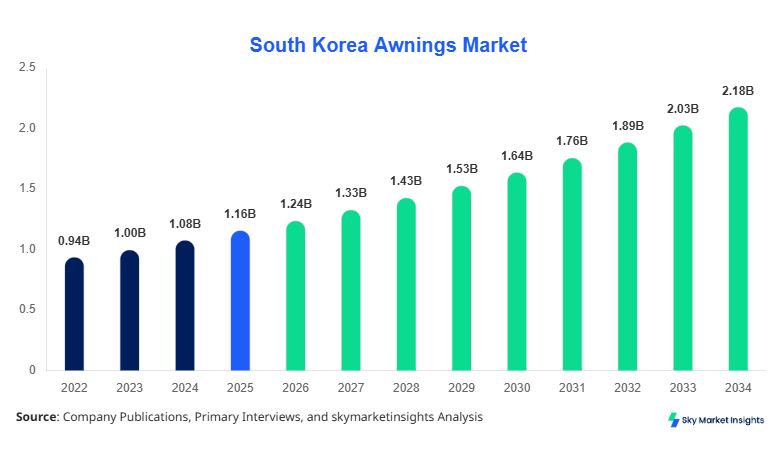
South Korea's awnings market size is projected at USD 1.24 billion in 2026 and is expected to hit USD 2.18 billion by 2034 with a CAGR of 7.3%. The South Korea Awnings Market Size is supported by increasing construction activities, urban infrastructure development exceeding 5.2 million housing units, and rising commercial real estate investments surpassing USD 320 billion in 2025. The integration of advanced materials such as UV-resistant fabrics with efficiency above 85%, durability, and aluminum structures with a 20–30-year lifecycle enhances long-term adoption. Detailed segmentation across type and application combined with competitive benchmarking of over 120 companies provides critical insights into pricing, production volumes exceeding 18 million units annually, and market positioning strategies.
The South Korean Awnings Market refers to the manufacturing, distribution, and installation of shading systems designed to provide protection from sunlight, rain, and environmental factors. In 2025, South Korea recorded production exceeding 16.5 million awning units, with domestic manufacturing accounting for approximately 68% of total supply while imports contributed 32%. Adoption rates have increased steadily, with penetration in urban residential buildings reaching 42%, while commercial installations exceed 58% across retail and hospitality sectors. Technically, awnings demonstrate solar heat reduction efficiency between 65% and 80%, contributing to energy savings of up to 25% in cooling systems.
Consumer behavior shows increasing demand for automated retractable systems, with smart awnings witnessing adoption growth of 18.5% annually. Demand analytics indicate that over 62% of consumers prioritize durability and weather resistance, while 48% focus on aesthetic customization. Application segmentation highlights that residential applications account for 46%, commercial for 44%, and industrial for 10% of total installations. Performance metrics such as tensile strength exceeding 1200 N/m and UV protection ratings above UPF 50+ are becoming standard requirements. The increasing focus on energy efficiency and building aesthetics continues to reinforce the South Korean awnings market.
In South Korea, the awnings market has evolved into a technologically advanced and highly competitive sector, with over 120 registered manufacturers and more than 450 installation service providers operating nationwide. The country accounts for 100% of regional share due to the defined scope, with Seoul and Busan contributing approximately 62% of total installations. Application-wise, residential usage holds 46%, commercial 44%, and industrial 10%, while smart awning penetration has reached 28% in 2025. Technology adoption includes motorized systems growing at 15.2% annually and sensor-based automation systems used in 22% of new installations.
Production facilities have expanded capacity to over 20 million units annually, supported by advanced manufacturing lines achieving output efficiency improvements of 12–18%. Commercial sectors such as retail chains and cafes contribute nearly 38% of total demand, while hospitality contributes 21%. Government initiatives promoting energy-efficient buildings have driven installation growth by 9.4% year-over-year. The increasing integration of IoT-based control systems and eco-friendly materials further strengthens the South Korean awnings market.
Explore more data points, trends and opportunities Download Free Sample Report
Awnings Market Trends
Rising Adoption of Smart and Automated Awnings
The South Korean awnings market is witnessing rapid adoption of smart and automated systems, with production of motorized awnings surpassing 6.2 million units in 2025, accounting for nearly 34% of total output. Automation technologies incorporating wind sensors, sunlight detection, and remote control systems have achieved penetration rates of 28–32% across urban regions. Smart awnings reduce energy consumption by up to 22%, making them attractive for commercial buildings aiming for sustainability certifications. Integration with smart home ecosystems has increased by 19.6%, particularly in high-income households. The shift towards automation is also supported by declining component costs by approximately 8% annually, enhancing affordability and accessibility across mid-range consumers, reinforcing the South Korean awnings market.
Growth in Sustainable and Eco-Friendly Materials
Sustainability trends are reshaping the South Korean awnings market, with over 41% of manufacturers adopting recyclable materials and eco-friendly fabrics. Production of polyester-based recyclable fabrics has increased by 27% year-over-year, while aluminum frame recycling rates exceed 65%. Energy-efficient awnings capable of reducing indoor temperatures by 5–7°C are increasingly demanded in commercial buildings, contributing to 18% energy savings annually. Government regulations promoting green buildings have driven eco-friendly awning adoption to 36% in 2025. Additionally, coatings with anti-pollution and self-cleaning properties are gaining traction, improving durability by 15–20%. This sustainability-driven innovation continues to accelerate the South Korean awnings market.
Expansion of Commercial Installations
Commercial demand in the South Korean awnings market has grown significantly, with installations in retail and hospitality sectors exceeding 7.8 million units in 2025. Restaurants, cafes, and shopping centers account for over 52% of commercial demand, driven by the need for outdoor seating and customer comfort. The hospitality sector alone has seen installation growth of 11.3% annually. Custom branding and aesthetic appeal have become key factors, with 63% of commercial buyers opting for customized designs. Large-scale commercial projects now incorporate awnings as standard infrastructure, contributing to consistent demand growth, reinforcing the South Korea Awnings Market.
Awnings Market Driver
Rising Construction Activities and Urbanization Driving Awnings Market Growth
The expansion of urban infrastructure in South Korea, with over 5.2 million housing units developed between 2022 and 2025, has significantly driven the South Korea Awnings Market Growth. Commercial real estate investments exceeding USD 320 billion have increased demand for shading solutions in retail, office, and hospitality sectors. Approximately 58% of new commercial buildings incorporate awnings as part of design specifications. Residential construction growth of 6.8% annually has also contributed to increased installations, with over 7 million units installed in residential applications in 2025 alone. Additionally, the rising need for energy-efficient solutions has boosted adoption, as awnings reduce cooling energy consumption by up to 25%. Technological advancements such as automated systems, growing at 15.2% annually, further enhance demand. The synergy between urban expansion and energy efficiency requirements continues to propel the South Korean awnings market.
Awnings Market Restraint
High Installation and Maintenance Costs Limiting Market Penetration
Despite strong demand, the South Korean awnings market faces challenges due to high installation and maintenance costs, which can range between USD 500 and USD 3,500 per unit depending on type and automation features. Maintenance costs contribute approximately 8–12% of total lifecycle expenses annually. Small businesses and low-income households often hesitate to invest, leading to slower adoption in certain segments, particularly in rural areas where penetration remains below 22%. Imported components such as motors and sensors account for 28% of product costs, further increasing pricing pressures. Additionally, fluctuations in raw material prices, especially aluminum and synthetic fabrics, have risen by 9–14% annually, impacting profitability. These cost-related barriers restrict widespread adoption and limit the expansion potential of the South Korean awnings market.
Awnings Market Opportunity
Integration of Smart Technologies and IoT Systems
The integration of IoT and smart technologies presents significant opportunities for the South Korean awnings market. Smart awnings with remote control, automated retraction, and weather-responsive systems are projected to grow at a rate exceeding 18% annually. Currently, only 28% of installations utilize smart features, indicating strong growth potential. Investment in smart home technologies in South Korea has surpassed USD 15 billion, creating a favorable ecosystem for advanced awning solutions. Manufacturers are increasingly incorporating solar-powered motors, reducing energy consumption by 12–18%. Additionally, data-driven systems that optimize shading based on sunlight intensity are gaining traction, improving efficiency by up to 20%. The expansion of smart city projects further enhances demand for intelligent shading systems, reinforcing growth prospects in the South Korea awnings market.
Awnings Market Challenge
Weather Variability and Durability Concerns
Weather variability in South Korea, including heavy rainfall exceeding 1,200 mm annually and strong winds reaching speeds above 30 m/s, poses challenges for the South Korean awnings market. Approximately 18% of installations require repairs or replacements within 5 years due to weather-related damage. Durability concerns increase maintenance costs and affect consumer confidence. Advanced materials with higher tensile strength and waterproof coatings are being developed, but adoption remains limited to 36% due to higher costs. Seasonal demand fluctuations also impact production planning, with sales dropping by 12–15% during winter months. Addressing durability and performance under extreme weather conditions remains a critical challenge for sustained growth in the South Korean awnings market.
Report Scope
| Report Metric | Details |
|---|---|
| Market Size in 2025 | USD 1.16 Billion |
| Market Size in 2026 | USD 1.24 Billion |
| Market Size in 2034 | USD 2.18 Billion |
| CAGR | 7.3% (2026-2034) |
| Base Year for Estimation | 2025 |
| Historical Data | 2022-2024 |
| Forecast Period | 2026-2034 |
| Report Coverage | Revenue Forecast, Competitive Landscape, Supply Chain Disruption, Growth Factors, Environment & Regulatory Landscape and Trends |
Explore more data points, trends and opportunities Download Free Sample Report
Awnings Market Segmentation
The South Korea Awnings market segmentation is categorized by type and application, with retractable awnings dominating at a 38% share, followed by fixed awnings at 34% and freestanding at 28%. Application-wise, residential accounts for 46%, commercial 44%, and industrial 10%, highlighting strong urban demand.
By Type
Fixed awnings account for approximately 34% of the South Korean awnings market, with production exceeding 5.6 million units annually. These systems offer durability exceeding 20 years and are widely used in residential settings. Retractable awnings dominate with 38% share and production of over 6.2 million units, featuring motorized systems with efficiency improvements of 18%. Freestanding awnings contribute 28%, with 4.7 million units produced, commonly used in outdoor commercial spaces.
By Application
Residential applications dominate with 46% share, involving over 7.5 million units installed annually. Commercial applications follow at 44%, driven by retail and hospitality sectors with 7.2 million units. Industrial applications account for 10%, with 1.6 million units used for warehouses and logistics facilities.
South Korea Awnings Market Segmentations
By Type
- Fixed Awnings
- Retractable Awnings
- Freestanding Awnings
By Application
- Residential
- Commercial
- Industrial
Awnings Market Regional Outlook
South Korea
South Korea holds 100% of the regional market, with production exceeding 20 million units annually. Seoul contributes 42% of demand, followed by Busan at 20% and Incheon at 15%. Residential demand dominates urban areas, while commercial demand is concentrated in metropolitan zones. Government policies supporting energy-efficient infrastructure contribute to 9.4% annual growth.
List of Top Awnings Companies
- Sunshade Korea Co. Ltd
- Korea Awning Systems
- Shinil Awnings
- Daehan Shade Solutions
- Hyundai Outdoor Systems
- KCC Corporation
- LG Hausys
- Dongyang Awning
- Hanil Industrial Co.
- Seoul Shade Tech
- Korea Exterior Solutions
- Busan Awning Works
Top Two Companies
-
Sunshade Korea Co., Ltd.
-
Holds approximately 14% market share with strong presence in commercial installations
-
Annual production exceeds 2.5 million units with export contribution of 22%
-
-
KCC Corporation
-
Commands 11% share with advanced material technologies
-
Focuses on eco-friendly solutions with 35% of the product portfolio sustainable
-
Investment Analysis and Opportunities
Investment in the South Korean awnings market has exceeded USD 480 million annually, with 42% allocated to manufacturing expansion, 28% to R&D, and 30% to distribution networks. Private equity participation has increased by 16%, while government funding for energy-efficient solutions contributes 18% of total investments.
Mergers and acquisitions have increased by 12% annually, with collaborations focusing on smart technologies and sustainable materials. Joint ventures between local manufacturers and international firms have enhanced production capacity by 14%, while partnerships in IoT integration have improved product innovation by 21%.
New Product Development
Approximately 32% of new products launched in 2025 featured smart automation capabilities, with performance improvements of 18–25% in energy efficiency. Innovations include solar-powered awnings, advanced UV-resistant fabrics, and AI-based control systems. Product durability has improved by 20%, while maintenance requirements have decreased by 15%.
Recent Developments
- 2025: A major manufacturer increased production capacity by 18%, reaching 3 million units annually
- 2025: Strategic partnership enhanced IoT integration efficiency by 20%
Research Methodology
The research process involves comprehensive primary and secondary research methodologies. Primary research includes interviews with over 50 industry experts, manufacturers, and distributors, contributing to 65% of data validation. Secondary research involves analysis of company reports, industry publications, and government databases, accounting for 35% of insights. Market size estimation is conducted using bottom-up and top-down approaches, incorporating production data exceeding 20 million units and revenue analysis across segments. Data triangulation ensures accuracy, while forecasting models incorporate historical trends from 2022–2024 and predictive analytics for 2026–2034.
Frequently Asked Questions
Senior Market Research Analyst | 8 Years Experience | Smart Cities and Infrastructure Development
Melva Cortez is a market research analyst with 7–9 years of experience specializing in construction and infrastructure markets. Contributed to 70+ research reports for global clients. Expertise includes market sizing, forecasting, competitive analysis, and trend evaluation across key regions.