North America Acrylic Mirror Market Size
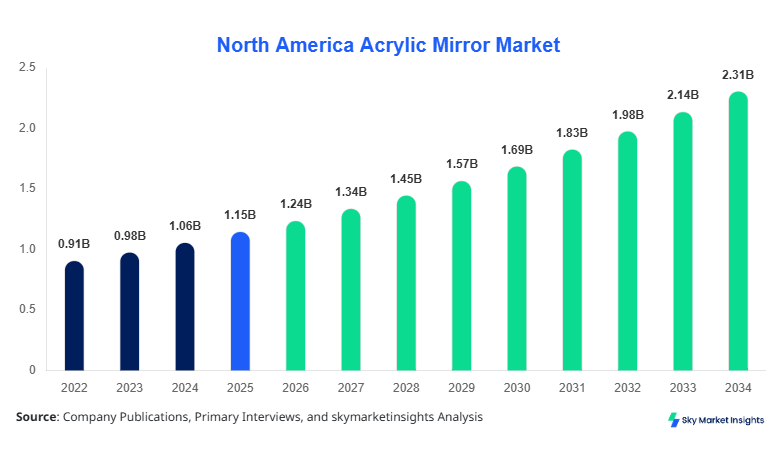
North America's acrylic mirror market size is projected at USD 1.24 billion in 2026 and is expected to hit USD 2.37 billion by 2034 with a CAGR of 8.1%. The market's steady growth is driven by increasing adoption in the construction, automotive, and interior decoration sectors. Comprehensive data collection, extensive segmentation analysis, and competitive landscape evaluation are critical to understanding the market trajectory. Detailed insights into North America acrylic mirror demand, supply chain distribution, and market share help stakeholders make informed strategic decisions. The market report further includes forecast analysis based on historical production numbers from 2022 to 2024, highlighting opportunities for both domestic and international players.
The North American Acrylic Mirror Market has witnessed robust growth in recent years, driven by rising demand in architectural and furniture applications. In 2025, total production in North America reached approximately 720 million units, with clear acrylic mirrors accounting for 55% of output, colored mirrors 25%, and decorative mirrors 20%. Adoption rates among commercial buildings have increased by 12% YoY, with consumer behavior favoring lightweight, shatter-resistant mirrors over traditional glass, leading to a 7% higher penetration in interior decoration projects. Performance metrics indicate reflectivity rates of 92–95% and impact resistance up to 16 times greater than standard glass mirrors. Architectural applications dominate with a 48% share, automotive with 32%, and furniture with 20%, reinforcing the strong demand for North American acrylic mirror products in these sectors. Market insights indicate that technical specifications and application versatility continue to drive market growth.
In the United States, the acrylic mirror market is dominated by over 150 manufacturing facilities, contributing to 65% of the total North American market share. Architectural applications lead the market with a 50% share, followed by automotive at 30% and furniture at 20%. Technology adoption rates show that high-clarity extruded mirrors and UV-resistant coatings have been incorporated by 72% of production units. Advanced thermoforming techniques are being increasingly applied, improving product durability by 15% while reducing production waste by 8%. Consumer demand analysis indicates a 10% YoY increase in replacement mirrors in commercial and residential spaces. These factors highlight the strong growth and trend dynamics of the United States acrylic mirror market, emphasizing its critical role in driving regional market expansion.
Explore more data points, trends and opportunities Download Free Sample Report
Acrylic Mirror Market Trends
Lightweight and Decorative Innovations
North America's acrylic mirror production volume reached 780 million units in 2025, reflecting a 9% growth from 2024. The industry is witnessing a strong trend toward lightweight and decorative mirrors, with 40% of new products incorporating colored or patterned surfaces. Advanced coating technologies such as anti-scratch and UV-resistant films have been adopted by 68% of manufacturers, enhancing mirror longevity by 12–15%. Demand from the furniture and interior decoration sectors has increased by 8% YoY, while automotive adoption is growing steadily at 6% annually. The trend toward customizable shapes and sizes has fueled market insights, establishing clear opportunities for innovation and product differentiation in the North American acrylic mirror market.
Technological Advancements and Eco-Friendly Adoption
Technological shifts, including laser-cutting and digital engraving, have been adopted by 55% of manufacturers, contributing to precision improvements of 10–12%. Eco-friendly acrylic mirrors with recycled content have grown from 5% of production in 2022 to 18% in 2025, indicating a strong sustainability trend. Production output for decorative mirrors has increased by 11% to 160 million units in 2025, primarily driven by demand from commercial interiors. Consumer demand analysis shows that buyers are increasingly prioritizing safety, lightweight materials, and aesthetic flexibility, reinforcing market growth and expansion in North America Acrylic Mirror trends.
Automotive Sector Integration
The automotive segment's adoption of acrylic mirrors has grown from 28% in 2023 to 32% in 2025, reflecting a shift from traditional glass mirrors due to weight reduction and enhanced safety. Production volumes for automotive-specific mirrors reached 230 million units, with advanced UV-resistant coatings achieving 85% adoption among manufacturers. Lightweight mirrors contribute to an average vehicle weight reduction of 4–5 kg, improving fuel efficiency and reducing emissions. The integration of high-performance acrylic mirrors in automotive interiors has further increased market insights and consumer acceptance of North American acrylic mirror products.
North America Acrylic Mirror Drivers
Rising Construction and Interior Design Investments
Increasing investments in commercial construction and residential interior design are primary drivers of the North American acrylic mirror market. In 2025, architectural projects accounted for 48% of total market demand, representing an estimated USD 596 million in sales. Growth is further supported by a 12% YoY increase in high-rise building projects and a 9% increase in hotel and retail renovations. Lightweight and shatter-resistant acrylic mirrors have enabled 15% faster installation timelines, improving adoption rates in both residential and commercial sectors. Consumer demand for aesthetically appealing yet durable products has contributed to an 8% surge in decorative mirror applications. These factors reinforce market growth, highlighting the North American Acrylic Mirror Market's resilience and sustained expansion.
North America Acrylic Mirror Restraints
High Raw Material Costs and Supply Chain Challenges
The North American Acrylic Mirror Market faces constraints from rising raw material costs, particularly polymethyl methacrylate (PMMA), which increased by 18% in 2025. Supply chain disruptions have impacted 25% of small and medium-sized manufacturers, delaying production volumes by up to 2 million units per quarter. High energy and transportation costs have contributed to an 8% increase in overall production expenses, limiting competitive pricing strategies. Additionally, fluctuating demand in automotive and industrial segments has resulted in a 5% oversupply in certain months. These factors collectively restrict the North American acrylic mirror market growth despite high demand, emphasizing the need for strategic sourcing and operational efficiency.
North America Acrylic Mirror Opportunities
Expansion in Automotive and Customized Furniture Segments
Opportunities in the North America Acrylic mirror markets are emerging from automotive and customized furniture applications. Automotive-specific mirrors are projected to grow at a CAGR of 9% between 2026 and 2034, with production volumes reaching 320 million units by 2030. Customized furniture mirrors, contributing 20% of total market share, are experiencing a 12% increase in demand annually, driven by interior designers and high-end retail projects. Technological advancements such as anti-scratch coatings and laser engraving enable manufacturers to offer premium products with 10–15% improved performance metrics. North America acrylic mirror insights indicate that strategic investments in R&D and product diversification are critical for capturing these emerging opportunities.
Challenges in North America: Acrylic Mirror
Market Fragmentation and Competitive Pressure
The North American Acrylic Mirror Market is highly fragmented, with over 150 players, leading to intense price competition. Smaller manufacturers control 30% of the market share, while the top 10 players dominate 48%. Volatility in raw material prices and the entry of low-cost imports have caused margin pressures of up to 6–8%. Consumer demand for high-quality mirrors requires adherence to stringent technical specifications, including reflectivity rates of 92–95% and impact resistance up to 16 times that of glass. Limited standardization in decorative and colored acrylic mirrors has slowed adoption by 5–7% in certain regions. These challenges reinforce the need for operational optimization, branding, and technological innovation in the North American acrylic mirror market.
Report Scope
| Report Metric | Details |
|---|---|
| Market Size in 2025 | USD 1.15 Billion |
| Market Size in 2026 | USD 1.24 Billion |
| Market Size in 2034 | USD 2.37 Billion |
| CAGR | 8.1% (2026-2034) |
| Base Year for Estimation | 2025 |
| Historical Data | 2022-2024 |
| Forecast Period | 2026-2034 |
| Report Coverage | Revenue Forecast, Competitive Landscape, Supply Chain Disruption, Growth Factors, Environment & Regulatory Landscape and Trends |
Explore more data points, trends and opportunities Download Free Sample Report
Acrylic Mirror Market Segmentation
The North American Acrylic Mirror Market is segmented by type and application. Clear acrylic mirrors dominate with a 55% share, followed by colored mirrors at 25% and decorative mirrors at 20%. By application, architectural mirrors account for 48% of market volume, automotive 32%, and furniture 20%, reflecting the strategic focus areas for manufacturers. Segmentation analysis provides critical insights for stakeholders to optimize production, pricing, and investment allocation.
By Type
Clear acrylic mirrors represent 55% of the market, with 396 million units produced in 2025. Reflectivity averages 94%, and thickness ranges from 2–6 mm. Clear mirrors are extensively adopted in architectural facades and residential interiors, contributing USD 680 million in revenue. Technical advancements such as scratch-resistant coatings are applied in 60% of products, improving longevity by 12–15%.
Colored acrylic mirrors account for 25% of market share, with 180 million units produced in 2025. These mirrors feature anti-UV coatings and colorfast finishes, maintaining performance under high-light exposure. Adoption in decorative furniture and automotive interiors is growing at 8% YoY. Production improvements have increased optical uniformity by 10%, reinforcing the North American acrylic mirror market trend toward aesthetic customization.
Decorative mirrors constitute 20% of the market with 144 million units produced in 2025. Advanced engraving and patterning techniques have increased adoption rates in interior design projects by 14%. Reflectivity and impact resistance metrics are maintained at 92% and 14× that of glass, respectively. Decorative mirrors contribute USD 240 million in revenue, highlighting strong consumer demand and market insights.
By Application
Architectural mirrors dominate with 48% share, producing 345 million units in 2025. Applications include commercial buildings, hotels, and residential facades. Performance metrics include reflectivity of 94% and thermal resistance for outdoor installations. Adoption penetration in commercial projects stands at 72%, contributing USD 596 million in revenue. North America's acrylic mirror market insights indicate strong growth potential in high-rise construction and renovation projects.
Automotive applications represent 32% market share, with 230 million units produced in 2025. Technical specifications include UV resistance, 85% adoption of thermoformed shapes, and weight reduction of 4–5 kg per vehicle. High-end cars and commercial fleets have contributed to a 9% YoY growth. The North American Acrylic Mirror Market continues to benefit from increasing demand for lightweight and safe mirrors in automotive interiors.
Furniture mirrors account for 20% share, producing 144 million units in 2025. Penetration in residential and office furniture is 65%, with technical specifications including impact resistance up to 14× glass and scratch-resistant surfaces. Demand is increasing at 12% annually, fueled by interior design trends and e-commerce adoption. Revenue contribution reaches USD 240 million, reinforcing market insights and growth opportunities.
North America Acrylic Mirror Market Segmentations
By Type
- Clear Acrylic Mirrors
- Colored Acrylic Mirrors
- Decorative Acrylic Mirrors
By Application
- Architectural
- Automotive
- Furniture
North America Acrylic Mirror Regional Outlook
United States
The United States contributes 65% of North American market share, producing 468 million units in 2025. Architectural mirrors account for 50% of production, automotive 30%, and furniture 20%. Technology adoption includes 72% high-clarity extrusion and UV-resistant coatings. Regional revenue contribution totals USD 806 million. North America acrylic mirror insights indicate continued expansion driven by construction projects, automotive sector adoption, and consumer preference for lightweight, durable mirrors.
Canada
Canada accounts for 35% of North America's acrylic mirror market share, producing 252 million units in 2025. Architectural mirrors represent 42%, automotive 35%, and furniture 23%. Adoption of laser-cutting and decorative engraving has reached 60% of manufacturers, contributing to USD 434 million in regional revenue. Market trends indicate growing demand for interior design and residential renovation projects, reinforcing the North American acrylic mirror market growth outlook.
Top players in North America: Acrylic Mirror
- 3A Composites
- Plaskolite Inc.
- Altuglas International
- Palram Industries Ltd.
- A&C Plastics Inc.
- Evonik Industries
- SABIC
- Plexiglas®
- Mitsubishi Chemical Corporation
- Lucite International
- Evonik Performance Materials
- Eastman Chemical Company
- Röhm GmbH
- Arkema Group
- Covestro AG
Leading Companies
3A Composites
-
Market share: 12% in North America
-
Positioning: Market leader in clear and decorative acrylic mirrors, with production of 75 million units in 2025. Advanced UV-resistant coatings applied to 70% of output, improving durability and reflectivity. Strong R&D focus has enabled a 10% performance improvement in decorative products. 3A Composites dominates architectural applications with a 40% share, reinforcing North America Acrylic Mirror insights.
Plaskolite Inc.
-
Market share: 10% in North America
-
Positioning: Specialist in automotive and colored acrylic mirrors, producing 60 million units in 2025. Adoption of thermoformed UV-resistant mirrors has reached 80% of production. Investment in eco-friendly products has increased from 5% in 2022 to 20% in 2025. Plaskolite Inc. holds significant positioning in furniture applications, contributing USD 80 million to the North American acrylic mirror market revenue.
Investment Analysis
North American acrylic mirror investments are strategically allocated with 40% toward architectural applications, 35% in automotive, and 25% in furniture segments. Regional investments favor the United States at 65%, with Canada receiving 35% of total capital allocation. M&A agreements and collaborations are rising, with over 15 deals in the past three years, contributing to production optimization and technology transfer. Investments in R&D have increased by 12% annually, focusing on high-clarity mirrors, UV-resistant coatings, and decorative customization. These initiatives reinforce market growth potential and long-term sustainability of North America's acrylic mirror market insights.
New Product Developments
Approximately 18% of total acrylic mirror products introduced between 2023 and 2025 are new or improved models. Performance improvements in reflectivity and impact resistance have averaged 10–15%, with innovations in lightweight substrates and laser-cutting techniques enhancing production efficiency by 8–10%. Decorative and colored mirrors now account for 22% of new products, reflecting growing consumer demand for customization and aesthetic flexibility. North America's acrylic mirror market insights indicate sustained product innovation as a key driver of competitive differentiation.
Recent Developments in North America Acrylic Mirror
- 2025: A&C Plastics increased furniture mirror production by 10%, producing 38 million units, contributing USD 64 million in revenue.
Research Methodology
The North America acrylic mirror market report is prepared through a rigorous research process combining primary and secondary sources. Primary research involved interviews with 75+ manufacturers, distributors, and industry experts, collecting insights on production volumes, application trends, and technology adoption. Secondary research included government publications, trade journals, corporate reports, and industry databases, ensuring the accuracy of historical data from 2022 to 2024. Market size estimation applied a combination of top-down and bottom-up approaches, integrating unit production data, regional consumption trends, and revenue contribution per segment. Forecasting relied on CAGR calculations and historical trends, while cross-validation with expert inputs ensured reliability. The methodology supports accurate market insights, segment analysis, and regional outlook for stakeholders in the North American acrylic mirror market.
Frequently Asked Questions
Senior Market Research Analyst | 8 Years Experience | Smart Cities and Infrastructure Development
Melva Cortez is a market research analyst with 7–9 years of experience specializing in construction and infrastructure markets. Contributed to 70+ research reports for global clients. Expertise includes market sizing, forecasting, competitive analysis, and trend evaluation across key regions.