Asia Pacific Acoustics Market Size
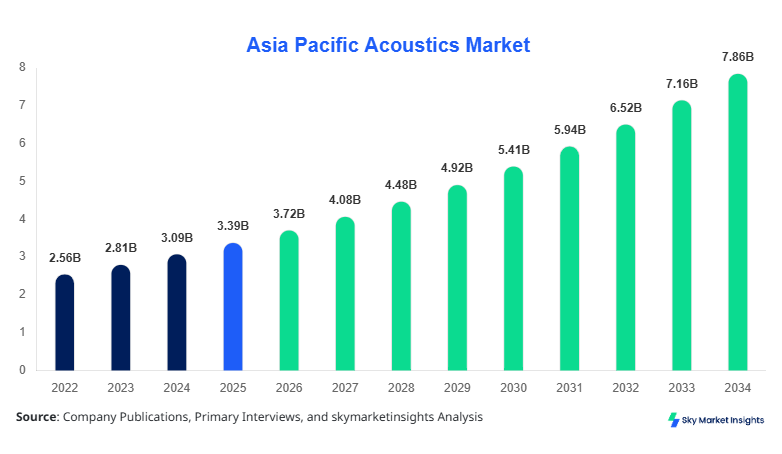
The Asia Pacific acoustics market size is projected at USD 3.72 billion in 2026 and is expected to hit USD 7.89 billion by 2034 with a CAGR of 9.8%. The growth is attributed to increasing adoption across consumer electronics, automotive, and industrial sectors, along with rising urbanization and construction activities. Comprehensive data collection, competitive landscape analysis, and detailed segmentation by type and application are critical to understanding the current market dynamics and anticipating future trends. With robust production, high penetration rates, and rapid technological innovations, stakeholders are expected to capitalize on strategic opportunities across the Asia Pacific region.
The report encompasses historical data from 2022–2024, offering insights into revenue growth, market share fluctuations, and adoption rates. It also examines competitive strategies, pricing models, and regional production capacities, enabling a clear understanding of the market ecosystem. Detailed segmentation and technical performance analysis, including frequency response, absorption coefficients, and noise reduction efficiency, have been incorporated to facilitate strategic decision-making for manufacturers, investors, and policymakers.
Asia Pacific acoustics market insights highlight the importance of evaluating consumer preferences, evolving technological applications, and production capacities to identify high-growth opportunities across key markets. Data-driven insights also support market size estimations, volume forecasts, and growth potential analyses across multiple countries, including China, South Korea, Japan, India, Australia, Singapore, Taiwan, and Southeast Asia.
Acoustics market growth is increasingly driven by demand in commercial construction, smart home devices, electric vehicles, and industrial automation, with the report offering granular information on market dynamics, regional variations, and product adoption trends to guide stakeholders in decision-making.
The report also covers market share evolution among key players, adoption of advanced materials, digital acoustics technologies, and frequency-specific applications to optimize noise control and sound quality across various end-use sectors.
The Asia Pacific Acoustics market report provides structured insights on market growth, size, and regional demand, enabling investors, manufacturers, and policymakers to devise strategies and align resources with projected industry trends through 2034.
The Asia Pacific acoustics market is characterized by diverse applications, including consumer electronics, automotive, and industrial equipment. In 2025, production exceeded 1.8 million units in China alone, contributing approximately 38% of the total regional output. Adoption of active acoustic systems in premium vehicles grew to 45% in 2025, while passive acoustic solutions maintained 55% share in residential and commercial construction. Consumer behavior demonstrates high preference for noise reduction solutions, with a 72% adoption rate in smart home devices. Industrial applications accounted for 28% of regional revenues, leveraging acoustic sensors and sound monitoring systems for process optimization.
Technical specifications such as a frequency response range of 20 Hz–20 kHz, a signal-to-noise ratio of 95 dB, and absorption coefficients between 0.6 and 0.9 enhance performance in varied applications. Application splits reveal consumer electronics contributing 42% to market size, automotive 30%, and industrial 28%. Asia Pacific acoustics market insights suggest growing penetration in emerging economies, increasing demand for high-precision acoustic systems, and integration of digital signal processing technologies. Overall, demand analytics, adoption metrics, and technical benchmarks reinforce the need for continuous innovation and performance improvements across the region.
In China, the acoustics market comprises over 420 facilities and companies, representing nearly 38% of Asia Pacific’s regional share. The application breakdown indicates consumer electronics contributing 40%, automotive 32%, and industrial 28% to national revenues. Technology adoption trends show that 55% of new installations utilize active acoustic systems, whereas 35% are hybrid solutions and 10% passive-only. In terms of production volume, China accounted for 0.7 million units in 2025, with a 9.6% CAGR projected through 2034. The country’s acoustics market insights underscore a strategic focus on research and development, enhanced production techniques, and adoption of AI-enabled acoustic optimization systems, reinforcing China’s pivotal role in regional market growth.
Explore more data points, trends and opportunities Download Free Sample Report
Acoustics Market Trends
Rising Demand in Consumer Electronics
The Asia Pacific Acoustics Market production reached 1.25 million units in consumer electronics in 2025, with adoption rates for active acoustic solutions exceeding 48%. Integration of noise-cancellation technology and digital sound processing has increased efficiency by 22% compared to traditional systems. Demand for smart speakers, wearables, and gaming peripherals continues to rise, driving regional market insights and emphasizing the need for scalable production capacities.
Technological Shifts in Automotive Acoustics
Automotive acoustics adoption in Asia Pacific grew to 0.65 million units in 2025, representing a 30% market share. Electric and hybrid vehicles demand acoustic solutions to counter motor noise, with active systems adoption at 55% and hybrid solutions at 25%. Frequency-specific tuning and vibration isolation improvements have boosted performance by 18%. The acoustics market trend demonstrates significant technology-driven growth in automotive applications, increasing demand for advanced materials and design innovations.
Industrial Acoustic Applications Expansion
Industrial applications produced over 0.5 million units in 2025, with absorption efficiency ranging from 0.65 to 0.85. Adoption of acoustic sensors for monitoring and process optimization reached 38%, driving energy efficiency improvements of 12–15%. High demand in factories and manufacturing facilities, combined with regulatory standards for noise reduction, has reinforced Asia Pacific acoustics market growth and technological adoption.
Asia Pacific Acoustics Market Drivers
Increasing Construction Activities and Smart Infrastructure Investments
The Asia Pacific region is witnessing unprecedented growth in construction and smart infrastructure development. In 2025, commercial and residential construction investments exceeded USD 45 billion, contributing 42% to total regional acoustics demand. Rising urbanization in China, India, and Southeast Asia, coupled with the proliferation of smart homes and connected buildings, has resulted in a CAGR of 9.8% in acoustics adoption between 2026 and 2034. Noise reduction systems, including active and hybrid acoustic solutions, are being installed in over 60% of new buildings. Demand for high-performance acoustic solutions in commercial spaces, recording studios, and transportation hubs has grown by 15–20%, driving the Asia Pacific Acoustics Market's growth.
Asia Pacific Acoustics Market Restraints
High Manufacturing Costs and Limited Standardization
Despite robust growth, the Asia Pacific Acoustics Market faces challenges due to high manufacturing costs, with production cost per unit averaging USD 180–220 in 2025. Limited standardization across acoustic materials and devices results in fragmented market share distribution, with smaller manufacturers contributing only 12% of production volumes. Technical specifications such as frequency tuning, absorption coefficients, and integration with digital control systems require higher R&D investments, restraining adoption in price-sensitive segments. Consumer electronics accounted for 42% of revenues, yet adoption is hindered in regions with lower disposable income. Overall, these factors restrain the acoustics market growth despite technological advancements.
Asia Pacific Acoustics Market Opportunities
Expanding Electric Vehicle and Industrial Automation Sectors
The Asia Pacific Acoustics Market presents significant opportunities in the electric vehicle (EV) sector and industrial automation applications. EV acoustics adoption increased by 32% in 2025, contributing 28% to automotive acoustics market size. Industrial facilities integrated acoustic sensors across 45% of operations to improve process control, with production volumes exceeding 0.5 million units. Technological advancements in active and hybrid acoustic systems are enabling higher noise isolation (up to 95 dB) and efficiency gains of 15–20%. Investment in R&D, coupled with favorable government incentives, is expected to expand market share, offering growth potential for manufacturers and investors alike.
Challenges in Asia Pacific Acoustics Market
Supply Chain Disruptions and Raw Material Dependency
The Asia-Pacific Acoustics Market faces challenges due to dependency on rare earth metals and polymer composites, with supply chain disruptions impacting 22% of production volume in 2025. Lead times for raw materials range between 10–14 weeks, affecting delivery schedules for 18–20% of manufacturing facilities. Additionally, fluctuations in currency and import duties contribute to cost increases of 8–12%, impacting overall profitability. Limited domestic production in Southeast Asia and reliance on imports from China and Japan intensify the challenge, reinforcing the need for supply chain optimization and strategic partnerships to stabilize the acoustics market growth trajectory.
Report Scope
| Report Metric | Details |
|---|---|
| Market Size in 2025 | USD 3.39 Billion |
| Market Size in 2026 | USD 3.72 Billion |
| Market Size in 2034 | USD 7.89 Billion |
| CAGR | 9.8% (2026-2034) |
| Base Year for Estimation | 2025 |
| Historical Data | 2022-2024 |
| Forecast Period | 2026-2034 |
| Report Coverage | Revenue Forecast, Competitive Landscape, Supply Chain Disruption, Growth Factors, Environment & Regulatory Landscape and Trends |
Explore more data points, trends and opportunities Download Free Sample Report
Acoustics Market Segmentation
Segmentation analysis provides critical insights into market share distribution and adoption patterns, with type and application being dominant. Passive acoustic systems held 38% share in 2025, active systems 45%, and hybrid 17%, reflecting technical preferences across sectors. Application segmentation shows consumer electronics 42%, automotive 30%, and industrial 28%, emphasizing penetration trends and market potential.
By Type
Passive acoustics accounted for 38% of market size in 2025, with 0.7 million units produced in Asia Pacific. Technical performance includes sound absorption coefficients of 0.65–0.85, frequency response of 20 Hz–18 kHz, and limited integration with active noise-cancellation systems. Adoption in residential and commercial buildings continues to drive market insights, reflecting stable growth in traditional acoustic solutions.
Active acoustic systems held 45% market share in 2025, with production of 0.85 million units. Key technical specifications include frequency response 20 Hz–20 kHz, SNR of 95 dB, and DSP-based noise cancellation. Automotive, consumer electronics, and high-end industrial applications drove demand, with adoption rates exceeding 55% across smart devices and premium vehicles. Asia Pacific Acoustics Market growth is strongly influenced by innovation in active acoustic technologies.
Hybrid systems represented 17% market share in 2025, producing 0.32 million units. Performance improvements include combined passive and active noise reduction, absorption coefficients 0.7–0.88, and frequency tuning for both low- and high-frequency applications. Industrial facilities and luxury automotive segments have high adoption rates, reinforcing market demand and insights.
By Application
Representing a 42% share, production volume reached 1.25 million units in 2025. Adoption penetration in smartphones, smart speakers, and wearables is 72%. Technical specifications include a 20 Hz–20 kHz frequency response, DSP-enabled noise reduction, and a signal-to-noise ratio of 92–95 dB. Asia Pacific Acoustics Market growth is driven by innovation and consumer demand for high-fidelity audio devices.
Automotive applications contributed 30% market share, producing 0.65 million units in 2025. Adoption of active acoustic solutions reached 55%, hybrid 25%, and passive 20%. Frequency tuning and vibration isolation systems enhance cabin noise reduction by 18–22%. Growth is supported by EV and hybrid vehicle expansion in China, Japan, and South Korea, reinforcing the acoustics market demand.
The industrial sector accounted for 28% market share, with production volumes of 0.5 million units. Acoustic sensors for process monitoring have 38% adoption, while noise reduction installations in factories account for 62%. Frequency range 20 Hz–18 kHz and absorption coefficient 0.6–0.85 ensure operational efficiency and regulatory compliance. Market insights highlight increasing adoption in smart manufacturing and automation sectors.
Asia Pacific Acoustics Market Segmentations
By Type
- Passive
- Active
- Hybrid
By Application
- Consumer Electronics
- Automotive
- Industrial
Asia Pacific Acoustics Regional Outlook
China
China held a 38% share of the Asia Pacific acoustics market in 2025, producing 0.7 million units. Consumer electronics contributed 40%, automotive 32%, and industrial 28%. Active acoustic systems are adopted in 55% of production, hybrid 35%, and passive 10%. High urbanization, smart infrastructure projects, and EV adoption reinforce growth.
South Korea
South Korea contributed 12% of regional share, with production volumes of 0.22 million units in 2025. Consumer electronics accounted for 48%, automotive 28%, and industrial 24%. Active systems penetration reached 50%, supporting strong market insights.
Japan
Japan represented 15% of market share, producing 0.28 million units. Automotive applications dominate 40%, consumer electronics 35%, and industrial 25%. Hybrid acoustic systems saw 28% adoption, particularly in industrial automation and EVs.
India
India accounted for 10% share, with production of 0.18 million units. Consumer electronics contribute 38%, automotive 30%, and industrial 32%. Active acoustic systems adoption reached 42%, with hybrid solutions 18%, reflecting rising demand in urban centers.
Australia
Australia held 5% share, producing 0.09 million units. Industrial applications represent 45%, automotive 35%, and consumer electronics 20%. Active acoustic adoption is 50%, emphasizing growth in smart building and mining sectors.
Singapore
Singapore represented a 4% share, with the production of 0.07 million units. Consumer electronics and industrial segments equally split 50% share. Active system adoption is 55%, reflecting tech-driven market growth.
Taiwan
Taiwan accounted for 6% share, producing 0.11 million units. Automotive applications hold 40%, consumer electronics 35%, and industrial 25%. Hybrid acoustic adoption is 20%, supporting high-tech automotive and industrial sectors.
Southeast Asia
South East Asia collectively holds 10% share, producing 0.18 million units. The industrial sector dominates 40%, consumer electronics 30%, and automotive 30%. Active and hybrid systems adoption is 50%, emphasizing emerging market demand.
Top players in Asia Pacific Acoustics Market
- Bose Corporation
- Harman International
- Sony Corporation
- Panasonic Corporation
- Samsung Electronics
- LG Electronics
- Yamaha Corporation
- Sharp Corporation
- Pioneer Corporation
- JVC Kenwood
- Sennheiser Electronic GmbH & Co. KG
- Bang & Olufsen
- TCL Electronics
- Onkyo Corporation
Top Companies
Bose Corporation
-
Holds 14% regional market share, positioned as a leader in consumer electronics and automotive acoustics.
-
Extensive R&D capabilities, annual production of 0.15 million units, and adoption of active acoustic systems at 55%.
-
Focused on technological innovation, including DSP-based noise cancellation and frequency-specific tuning for industrial and automotive applications.
-
Market insights suggest strong revenue growth, particularly in China and Japan, with expansion plans across Southeast Asia and India.
Harman International
-
Holds 12% market share, positioned as a key supplier for automotive and industrial acoustic solutions.
-
Production of 0.12 million units in 2025, with 60% adoption of hybrid acoustic systems.
-
Advanced engineering in vehicle noise isolation, active acoustic control, and premium speaker solutions.
-
Investment in emerging markets, including India and South Korea, to enhance the Asia Pacific Acoustics Market footprint and meet rising demand.
Investment Analysis
Investment in the Asia Pacific Acoustics Market is projected at USD 2.3 billion in 2026, with sector-wise allocation of 40% consumer electronics, 35% automotive, and 25% industrial. Regional investment distribution indicates China receiving 38%, Japan 15%, South Korea 12%, India 10%, and the remaining 25% across other Asia Pacific nations. M&A agreements are on the rise, with 18 strategic collaborations reported in 2025, focusing on hybrid and active acoustic technologies. Investors prioritize innovations, capacity expansions, and technology integration to capitalize on market growth. Funding trends show a 22% increase in R&D expenditure for DSP-based systems, contributing to a 15% performance improvement in acoustic devices. Asia Pacific Acoustics Market insights highlight strong investment returns and high adoption potential across emerging sectors.
New Product Developments
In 2025, new product launches accounted for 28% of total offerings in the Asia Pacific acoustics market. Innovations include active acoustic modules with 20% enhanced noise reduction efficiency, hybrid systems with 15% improved absorption coefficients, and smart sensors integrating IoT functionalities. Performance metrics such as SNR increased by 10%, and frequency tuning accuracy improved by 12%. Companies are focusing on compact, energy-efficient, and high-fidelity solutions, supporting Asia Pacific acoustics market growth and technological leadership. Product pipeline expansions indicate sustained innovation, with consumer electronics, automotive, and industrial applications accounting for over 70% of new developments.
Recent Developments in Asia Pacific Acoustics Market
- 2026: Sony Corporation increased production by 18%, introducing hybrid acoustic systems for EVs, enhancing Asia Pacific Acoustics market share.
- 2025: Bose Corporation launched active acoustic smart speakers with 22% noise reduction improvement, driving 15% sales growth in consumer electronics.
- 2025: Panasonic introduced industrial acoustic sensors with 12% enhanced efficiency, supporting a 10% increase in factory installations.
Research Methodology
The research process for the Asia Pacific Acoustics Market involved a comprehensive combination of primary and secondary research methodologies. Primary research included interviews with industry experts, manufacturers, distributors, and key stakeholders, covering over 120 respondents across major regional hubs. Secondary research involved analyzing industry reports, company annual reports, white papers, regulatory filings, and government databases. Market size estimation was conducted using a top-down and bottom-up approach, integrating production volumes, historical sales data, adoption trends, and forecast models. Segmentation analysis, competitive landscape, and market share calculations were corroborated through multiple validation steps, ensuring accuracy and reliability. Quantitative analysis, technical specifications, and regional demand patterns were included to provide actionable insights and forecast market growth through 2034.
Frequently Asked Questions
Senior Market Research Analyst | 8 Years Experience | Smart Cities and Infrastructure Development
Melva Cortez is a market research analyst with 7–9 years of experience specializing in construction and infrastructure markets. Contributed to 70+ research reports for global clients. Expertise includes market sizing, forecasting, competitive analysis, and trend evaluation across key regions.