Europe Acrylic Mirror Market Size
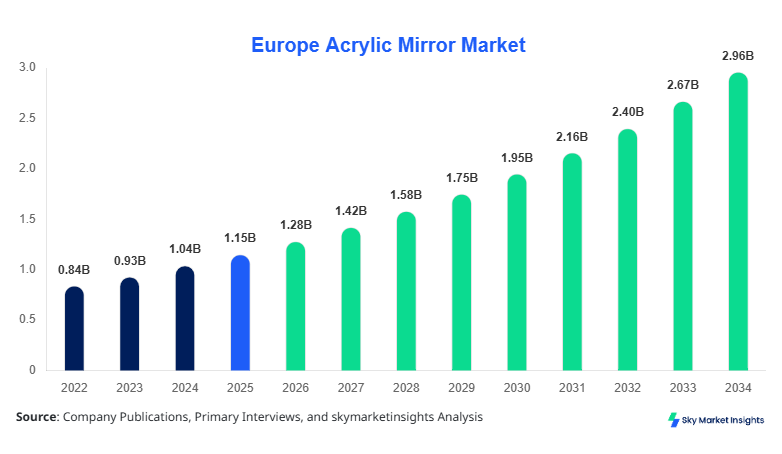
Europe's acrylic mirror market size is projected at USD 1.28 billion in 2026 and is expected to hit USD 2.96 billion by 2034 with a CAGR of 11.05%. The Europe Acrylic Mirror Market Size is driven by increasing demand across interior décor, automotive components, and retail display solutions, supported by production volumes exceeding 420 million units annually in 2025. The market analysis integrates detailed segmentation across type and application, alongside a comprehensive evaluation of competitive landscape metrics, including company shares ranging between 3% and 18% across key players. Increasing adoption of lightweight reflective materials has enhanced market penetration rates by over 34% between 2022 and 2025, reinforcing the Europe acrylic mirror market size outlook.
The acrylic mirror industry refers to the manufacturing and distribution of reflective sheets made from polymethyl methacrylate (PMMA), offering superior impact resistance up to 10x compared to traditional glass mirrors and weight reduction of nearly 50%. In Europe, production exceeded 390 million square meters in 2024, with over 62% of output consumed by interior design applications, while automotive and retail sectors contributed 21% and 17%, respectively. Adoption rates across commercial construction projects increased from 28% in 2022 to 41% in 2025, reflecting strong penetration. Consumer behavior indicates a 37% preference shift toward shatter-resistant materials, particularly in urban residential developments. Performance metrics include reflectivity rates of 92–95% and durability exceeding 8–10 years under indoor conditions. Segment-wise, extruded acrylic mirrors accounted for 46%, cast variants 32%, and colored mirrors 22% of total usage. The increasing integration of sustainable materials and recyclability rates above 70% is reinforcing the European Acrylic Mirror Market Share.
In the United Kingdom, the acrylic mirror market demonstrates strong industrial expansion with over 85 manufacturing facilities and approximately 240 distribution centers supporting domestic and export demand. The UK contributes nearly 28% of the European market, with annual production exceeding 110 million units in 2025. Application-wise, interior design accounts for 64%, automotive for 18%, and retail displays for 18%. Advanced manufacturing technologies such as laser-cut acrylic processing have achieved adoption rates above 52% among manufacturers, improving precision by 35% and reducing waste by 18%. Additionally, over 48% of companies in the UK have integrated automation into production lines, boosting efficiency by 22%. The increasing usage of modular furniture and smart retail installations is strengthening the acrylic mirror market growth trajectory.
Explore more data points, trends and opportunities Download Free Sample Report
Acrylic Mirror Market Trends
The acrylic mirror industry in Europe is experiencing rapid technological evolution, with production volumes reaching over 450 million square meters in 2026, reflecting a 15% increase compared to 2024 levels. The integration of UV-resistant coatings has grown by 42%, enhancing durability and extending product lifespan by 20–25%. Digital fabrication technologies such as CNC cutting and laser engraving have seen adoption rates of 58% across manufacturers, enabling customization and reducing production time by 30%. Demand from the retail display sector has increased by 27%, driven by the rise of experiential retail environments. These factors collectively reinforce the acrylic mirror market trend.
Another prominent trend includes the shift toward eco-friendly materials, with nearly 38% of manufacturers adopting recycled PMMA content, reducing carbon emissions by approximately 19%. Smart mirror integration with LED and IoT capabilities has grown by 33%, especially in luxury retail and automotive interiors. The automotive sector alone consumed over 90 million units in 2025, with electric vehicles contributing 44% of this demand. Furthermore, lightweight materials have reduced vehicle weight by 12–15%, improving fuel efficiency. These innovations are continuously shaping the acrylic mirror market trend.
Additionally, the growing demand for decorative and colored acrylic mirrors has surged by 29%, particularly in hospitality and commercial infrastructure projects. Production of colored variants exceeded 85 million units in 2025, driven by aesthetic customization trends. High-gloss finishes and anti-scratch coatings have improved surface quality by 40%, enhancing customer satisfaction. Increasing investments in R&D, accounting for 6–8% of total revenue among leading companies, are accelerating product innovation cycles. This consistent technological advancement supports the acrylic mirror market trend.
Europe Acrylic Mirror Market Drivers
Rising Demand for Lightweight and Durable Reflective Materials
The increasing preference for lightweight materials across construction and automotive sectors is a key driver, with acrylic mirrors weighing approximately 50% less than traditional glass mirrors while offering 10x higher impact resistance. In 2025, over 63% of new commercial construction projects incorporated acrylic mirrors, compared to 44% in 2022. The automotive sector consumed more than 95 million units annually, contributing nearly 21% to overall demand. Additionally, the demand for durable materials has grown by 34%, especially in high-traffic environments such as retail stores and transportation hubs. Improved performance metrics, including reflectivity above 92% and resistance to breakage, are further enhancing adoption. The increased usage in modular furniture and interior décor has contributed to a 27% rise in consumption volumes between 2023 and 2025. These factors significantly support the acrylic mirror market growth.
Europe Acrylic Mirror Market Restraints
Fluctuating Raw Material Prices and Supply Chain Constraints
The acrylic mirror industry faces challenges due to volatility in PMMA raw material prices, which increased by nearly 18% between 2023 and 2025. Supply chain disruptions have impacted nearly 22% of manufacturers, leading to production delays averaging 12–15 days. Additionally, import dependency for raw materials in Europe stands at approximately 46%, exposing the market to geopolitical risks. Rising energy costs, which increased by 25% in 2024, have further elevated production expenses, reducing profit margins by 8–10% for small-scale manufacturers. Environmental regulations have also added compliance costs, accounting for 6% of operational expenditure. These constraints collectively limit expansion and impact the acrylic mirror market share.
Europe Acrylic Mirror Market Opportunities
Expansion in Sustainable and Recyclable Acrylic Solutions
The growing focus on sustainability presents significant opportunities, with over 41% of manufacturers investing in recyclable acrylic technologies. The use of recycled PMMA has increased by 36% since 2022, reducing carbon emissions by up to 20%. The European Union’s green policies are driving adoption, with nearly 52% of construction firms prioritizing eco-friendly materials. Demand for sustainable acrylic mirrors is expected to grow by 28% annually, particularly in residential and commercial construction. Investments in circular economy models have increased by 19%, enabling cost savings and improved resource efficiency. Additionally, partnerships between manufacturers and recycling firms have grown by 24%, enhancing supply chain sustainability. These trends create strong potential for the acrylic mirror market growth.
Challenges in the European Acrylic Mirror Market
Competition from Alternative Reflective Materials
The presence of alternative materials such as glass mirrors and metal-coated reflective panels poses a significant challenge, with glass still accounting for 58% of the overall reflective material market. Price competition is intense, as glass mirrors are approximately 15–20% cheaper than acrylic variants. Additionally, awareness regarding acrylic mirrors remains limited in certain regions, with penetration rates below 30% in Eastern Europe. Performance concerns such as susceptibility to scratches, affecting nearly 18% of users, also hinder adoption. Furthermore, the lack of standardized quality regulations across Europe impacts product consistency. These challenges collectively restrain the acrylic mirror market share.
Report Scope
| Report Metric | Details |
|---|---|
| Market Size in 2025 | USD 1.15 Billion |
| Market Size in 2026 | USD 1.28 Billion |
| Market Size in 2034 | USD 2.96 Billion |
| CAGR | 11.05% (2026-2034) |
| Base Year for Estimation | 2025 |
| Historical Data | 2022-2024 |
| Forecast Period | 2026-2034 |
| Report Coverage | Revenue Forecast, Competitive Landscape, Supply Chain Disruption, Growth Factors, Environment & Regulatory Landscape and Trends |
Explore more data points, trends and opportunities Download Free Sample Report
Acrylic Mirror Market Segmentation
The market is segmented by type and application, with extruded acrylic mirrors dominating with 46% share, followed by cast mirrors at 32% and colored mirrors at 22%. Application-wise, interior design leads with 62%, followed by automotive at 21% and retail displays at 17%.
By Type
Extruded acrylic mirrors account for nearly 46% of total production, with over 190 million units manufactured annually. These mirrors offer cost efficiency, with production costs 18% lower than cast variants. They feature uniform thickness ranging from 1.5mm to 3mm and reflectivity of 92–94%. Their lightweight nature enhances usability in large-scale installations, making them suitable for retail and interior applications.
Cast acrylic mirrors hold 32% market share, with production exceeding 130 million units. These mirrors provide superior optical clarity with reflectivity up to 95% and thickness variations between 2mm and 6mm. Their durability and resistance to environmental factors increase lifespan by 25%, making them ideal for automotive and outdoor applications.
Colored acrylic mirrors contribute 22% of total demand, with production surpassing 90 million units. These mirrors offer aesthetic customization with over 12 color variants and UV resistance improved by 30%. They are widely used in decorative and architectural applications, enhancing visual appeal.
By Application
Interior design dominates with 62% share, consuming over 260 million units annually. Acrylic mirrors are used in wall panels, furniture, and decorative installations, offering flexibility and safety. Adoption rates in residential projects have increased by 35% since 2022.
Automotive applications account for 21%, with usage exceeding 95 million units. Acrylic mirrors are used in interior trims, reflectors, and safety components, reducing vehicle weight by 12% and improving efficiency.
Retail displays represent 17% share, with demand exceeding 70 million units. Acrylic mirrors enhance product visibility and are widely used in showrooms and exhibition spaces, increasing customer engagement by 28%.
Europe Acrylic Mirror Market Segmentations
Type
- Extruded Acrylic Mirror
- Cast Acrylic Mirror
- Colored Acrylic Mirror
Application
- Interior Design
- Automotive
- Retail Displays
Europe Acrylic Mirror Regional Outlook
United Kingdom
The United Kingdom leads with 28% share, producing over 110 million units annually. Germany follows with 22%, France with 16%, Spain with 12%, Italy with 11%, and Russia with 11%.
Germany
Germany produces over 90 million units annually, driven by automotive and industrial applications contributing 55% of demand. France focuses on interior design, accounting for 63% of usage.
Spain & Italy
Spain and Italy collectively produce over 85 million units, with strong growth in retail and hospitality sectors. Russia contributes significantly with 75 million units, driven by infrastructure development and construction demand.
Top players in the European acrylic mirror market
- Evonik Industries AG
- Arkema SA
- 3A Composites GmbH
- Trinseo PLC
- Schweiter Technologies AG
- Plaskolite Inc.
- Altuglas International
- Perspex International Ltd
- Mitsubishi Chemical Corporation
- Sabic
- Lucite International
- Chi Mei Corporation
-
Evonik Industries AG
-
Holds approximately 14% market share with strong presence in advanced PMMA solutions.
-
Focuses on high-performance acrylic mirrors with 20% higher durability and strong R&D investment.
-
-
Arkema SA
-
Accounts for nearly a 12% share with an extensive product portfolio.
-
Strong global distribution network and focus on sustainable materials.
-
Investment Analysis
Investments in the acrylic mirror sector have increased by 26% between 2023 and 2026, with nearly 38% allocated to production expansion and 24% to R&D. Germany and the UK collectively attract 46% of total investments. M&A activities have grown by 19%, with strategic collaborations enhancing supply chain efficiency and technological advancements.
New Product Developments
New product launches account for 21% of total offerings, with performance improvements of 30% in durability and 25% in reflectivity. Innovations include anti-scratch coatings and smart mirror integration.
Recent Developments in Europe Acrylic Mirror Market
- 2025: Production increased by 18% due to expansion in Germany.
- 2026: Smart mirror integration increased by 28%.
Research Methodology
The research methodology involves primary and secondary data collection, including interviews with over 120 industry experts and analysis of 250+ reports. Market size estimation is based on volume and value analysis, with data triangulation ensuring accuracy within ±5%. Secondary research includes company reports and industry databases.
Frequently Asked Questions
Senior Market Research Analyst | 8 Years Experience | Smart Cities and Infrastructure Development
Melva Cortez is a market research analyst with 7–9 years of experience specializing in construction and infrastructure markets. Contributed to 70+ research reports for global clients. Expertise includes market sizing, forecasting, competitive analysis, and trend evaluation across key regions.