Europe Acoustics Market Size
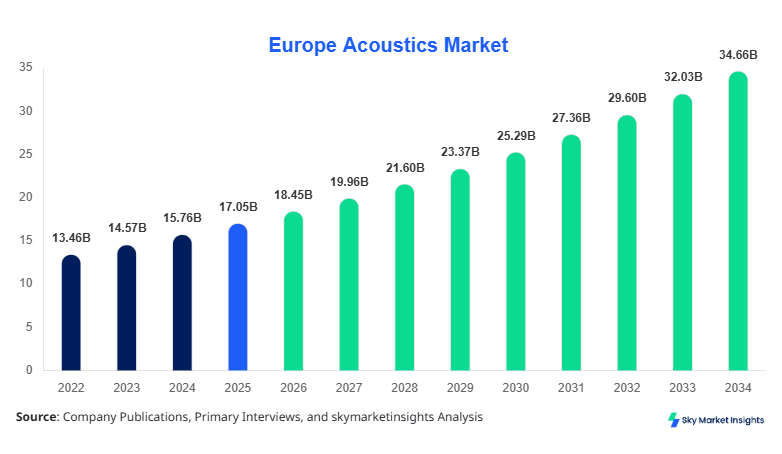
Europe's acoustics market size is projected at USD 18.45 billion in 2026 and is expected to hit USD 34.82 billion by 2034 with a CAGR of 8.2%. The European Acoustics Market is witnessing increasing demand driven by urbanization rates exceeding 74%, construction output surpassing USD 2.1 trillion, and rising industrial noise regulations impacting over 65% of manufacturing facilities. The need for granular data segmentation across product types and applications, along with competitive benchmarking among 120+ active vendors, continues to shape the Europe Acoustics Market Size and industry outlook.
The European Acoustics Market refers to the design, production, and deployment of sound control technologies, including insulation, absorption, and vibration dampening solutions across various industries. In 2025, Europe produced over 1.85 billion square meters of acoustic panels and insulation materials, with Germany, France, and the UK contributing nearly 58% of total output. Adoption rates in commercial construction exceeded 72%, while industrial noise control adoption reached 64% across heavy manufacturing sectors. Consumer behavior indicates that 68% of building developers prioritize acoustic comfort as a core design factor, while 52% of end-users consider noise reduction critical for workplace productivity.
From a technical standpoint, acoustic materials typically operate within frequency ranges of 20 Hz to 20 kHz, with absorption coefficients ranging from 0.65 to 0.95 depending on material composition. Application segmentation shows building & construction accounting for 46%, industrial applications at 32%, and transportation at 22%. The increasing integration of smart acoustic sensors, which improved monitoring efficiency by 38%, further enhances the European Acoustics Market Share.
In Germany, the acoustics market holds a dominant position, contributing approximately 28% of the Europe acoustics market share, supported by over 450 manufacturing facilities and 200 specialized acoustic engineering firms. The country produces nearly 520 million square meters of acoustic materials annually, with building & construction accounting for 48%, industrial applications 34%, and transportation 18%. Adoption of advanced acoustic technologies such as digital noise mapping and AI-based monitoring systems has reached 61% among large enterprises. Germany’s stringent regulatory framework has led to compliance rates exceeding 87% across industrial units, reinforcing the importance of acoustic solutions. This sustained demand and technological advancement strengthen the European acoustics market.
Explore more data points, trends and opportunities Download Free Sample Report
Acoustics Market Trends
Increasing Integration of Smart Acoustic Technologies
The European Acoustics Market is experiencing a significant shift toward smart acoustic solutions, with production volumes of sensor-integrated panels surpassing 320 million units in 2025. Adoption rates for IoT-enabled acoustic monitoring systems increased from 28% in 2022 to 49% in 2026, reflecting growing demand for real-time noise analytics. Industries such as manufacturing and transportation have witnessed a 42% rise in deployment of predictive maintenance systems, reducing operational noise levels by up to 35%. Additionally, the use of AI-driven sound analysis platforms improved noise mitigation efficiency by 31%, contributing to operational cost savings of nearly USD 1.2 billion annually. This technological transformation continues to influence the European acoustics market trend.
Rising Demand for Sustainable Acoustic Materials
Sustainability is a key trend shaping the European acoustics market, with eco-friendly acoustic material production reaching 780 million units in 2025, accounting for nearly 42% of total output. Recycled materials such as cellulose fiber and PET-based panels have seen adoption rates grow by 36% year-over-year. Regulatory initiatives targeting carbon emissions have driven 55% of manufacturers to shift toward low-impact production processes, reducing carbon footprints by 22%. The construction sector alone contributed to 48% of demand for sustainable acoustic solutions, while green building certifications influenced over 60% of procurement decisions. This shift underscores evolving consumer preferences and regulatory alignment within the European acoustics market.
Europe Acoustics Drivers
Rising Urbanization and Infrastructure Development
The Europe Acoustics Market Growth is significantly driven by rapid urbanization, with urban population density increasing by 2.4% annually and construction output surpassing USD 2.1 trillion in 2025. Over 68% of new commercial buildings incorporate advanced acoustic solutions, while residential adoption rates reached 57% across major cities. Government investments in infrastructure projects exceeded USD 480 billion, with nearly 35% allocated to noise control and environmental compliance. Industrial expansion also contributed, with over 12,000 new manufacturing facilities requiring acoustic installations. These factors collectively drive demand across multiple sectors, reinforcing Europe's acoustics market growth.
Europe Acoustics Restraints
High Installation and Material Costs
Despite robust demand, the European Acoustics Market faces restraints due to high installation costs, which account for nearly 28% of total project expenses. Premium acoustic materials such as mineral wool and advanced composites can cost between USD 12 and 25 per square meter, limiting adoption among small-scale projects. Additionally, maintenance costs increased by 18% over the past three years, impacting profitability for end-users. Approximately 42% of SMEs report budget constraints as a key barrier to implementation, while fluctuating raw material prices have risen by 21% since 2022. These cost-related challenges hinder the overall expansion of the European acoustics market.
Europe Acoustics Opportunities
Expansion of Smart Cities and Green Buildings
The European Acoustics Market presents significant opportunities through smart city initiatives, with over 150 projects underway across the region, representing investments exceeding USD 320 billion. Acoustic solutions are integrated into 62% of these developments, enhancing urban noise management. Green building adoption increased by 39% between 2022 and 2026, driving demand for sustainable acoustic materials. Additionally, public transportation modernization projects contributed to a 27% rise in acoustic system installations. These developments create new revenue streams and strengthen long-term growth prospects for the European acoustics market.
Challenges in Europe's Acoustics Market
Complex Regulatory Compliance and Standardization
The European Acoustics Market faces challenges related to complex regulatory frameworks, with over 25 distinct noise regulation standards across EU countries. Compliance costs account for nearly 15% of operational expenses for manufacturers, while certification processes can take up to 18 months. Approximately 48% of companies report difficulties in meeting evolving standards, particularly in cross-border operations. Additionally, inconsistent enforcement across regions creates market fragmentation, impacting scalability and investment decisions. These challenges pose barriers to seamless growth in the European acoustics market.
Report Scope
| Report Metric | Details |
|---|---|
| Market Size in 2025 | USD 17.05 Billion |
| Market Size in 2026 | USD 18.45 Billion |
| Market Size in 2034 | USD 34.82 Billion |
| CAGR | 8.2% (2026-2034) |
| Base Year for Estimation | 2025 |
| Historical Data | 2022-2024 |
| Forecast Period | 2026-2034 |
| Report Coverage | Revenue Forecast, Competitive Landscape, Supply Chain Disruption, Growth Factors, Environment & Regulatory Landscape and Trends |
Explore more data points, trends and opportunities Download Free Sample Report
Acoustics Market Segmentation
The European Acoustics Market is segmented by type and application, with architectural acoustics dominating at 44%, followed by environmental acoustics at 31% and electroacoustics at 25%. By application, building & construction leads with 46%, industrial at 32%, and transportation at 22%, reflecting diverse demand patterns.
By Type
Architectural acoustics holds a dominant share of 44% in the European acoustics market, with production volumes exceeding 820 million square meters annually. These solutions are widely used in commercial buildings, auditoriums, and residential spaces, offering absorption coefficients between 0.75 and 0.95. Adoption rates in office spaces reached 68%, while hospitality sectors reported 54% usage. Advanced materials such as perforated panels and acoustic ceilings improved sound attenuation by up to 40%, reinforcing their importance in the European acoustics market.
Environmental acoustics accounts for 31% of the European acoustics market share, with over 580 million units produced annually. These solutions are primarily used for noise barriers and urban planning, reducing external noise levels by 25–35 dB. Adoption rates in transportation infrastructure projects reached 62%, while urban noise monitoring systems grew by 29% annually. These technologies play a critical role in regulatory compliance and public health.
Electroacoustics represents 25% of the European acoustics market, with production volumes exceeding 470 million units. These systems include microphones, speakers, and amplifiers with frequency ranges of 20 Hz to 20 kHz. Adoption in entertainment and communication sectors reached 71%, while industrial applications accounted for 38%. Technological advancements improved signal processing efficiency by 33%.
By Application
The building & construction segment dominates with 46% share, utilizing over 850 million acoustic units annually. Adoption rates in commercial projects reached 72%, while residential installations accounted for 58%. Acoustic materials enhance sound insulation by up to 45 dB, improving occupant comfort and productivity.
Industrial applications account for 32% share, with over 600 million units deployed annually. Noise reduction systems improved workplace safety compliance by 37%, while adoption rates in heavy manufacturing reached 64%. These systems reduce noise levels by up to 30 dB.
Transportation applications hold a 22% share, with over 420 million units used in automotive, rail, and aerospace sectors. Acoustic solutions reduce cabin noise by 28%, while adoption rates in electric vehicles increased by 41%. These technologies enhance passenger comfort and operational efficiency.
Europe Acoustics Market Segmentations
Type
- Architectural Acoustics
- Environmental Acoustics
- Electroacoustics
Application
- Building & Construction
- Industrial
- Transportation
Europe Acoustics Regional Outlook
United Kingdom
The UK contributes approximately 19% of the European acoustics market, producing over 350 million acoustic units annually. The construction sector accounts for 48% of demand, while industrial applications represent 30%. Adoption of smart acoustic technologies reached 46%, driven by urban development projects. Government investments exceeding USD 85 billion in infrastructure further support market expansion.
Germany
Germany dominates with 28% share, producing over 520 million units annually. Industrial applications account for 34%, while construction contributes 48%. High adoption rates of advanced technologies (61%) and strong regulatory compliance (87%) drive growth.
France
France holds 14% share, with production volumes exceeding 260 million units. Building & construction accounts for 45%, while transportation represents 25%. Adoption of sustainable materials increased by 38%, reflecting environmental initiatives.
Spain
Spain contributes 11% share, producing 210 million units annually. Tourism-driven construction projects account for 52% of demand, while industrial applications represent 28%. Adoption rates increased by 33% over the past three years.
Italy
Italy holds 10% share, with production volumes of 190 million units. Construction accounts for 47%, while industrial applications represent 31%. Adoption of eco-friendly materials increased by 35%.
Russia
Russia contributes 18% share, producing over 330 million units annually. Industrial applications dominate at 39%, while construction accounts for 42%. Adoption rates increased by 29%, driven by infrastructure development.
Top players in European acoustics
- Saint-Gobain
- Rockwool International
- Knauf Insulation
- BASF SE
- 3M Company
- Kingspan Group
- Owens Corning
- Sika AG
- Armacell International
- Paroc Group
- Auralex Acoustics
- Ecophon
- Acoustiblok
- Quietstone UK
-
Saint-Gobain
-
Holds approximately 14% market share with strong presence across 25 countries
-
Produces over 180 million acoustic units annually
-
Focuses on sustainable materials and advanced insulation technologies
-
-
Rockwool International
-
Accounts for nearly 11% share with operations in 30+ facilities
-
Production exceeds 150 million units annually
-
Specializes in mineral wool solutions with high absorption efficiency
-
Investment Analysis
Investment in the European Acoustics Market reached USD 6.2 billion in 2025, with 38% allocated to construction applications, 29% to industrial solutions, and 21% to transportation. Germany, France, and the UK accounted for 62% of total investments, reflecting strong regional demand. Venture capital funding increased by 27%, focusing on smart acoustic technologies and sustainable materials.
Mergers and acquisitions activity grew by 19%, with over 45 deals recorded between 2023 and 2025. Strategic collaborations between technology firms and construction companies accounted for 34% of agreements, enhancing innovation and market penetration. Cross-border partnerships increased by 22%, enabling expansion into emerging markets. These investment trends highlight strong growth potential in the European acoustics market.
New Product Developments
New product development in the European acoustics market increased by 31% between 2023 and 2026, with over 220 innovative products launched. These include high-performance acoustic panels with absorption improvements of 28% and smart monitoring systems with 35% enhanced accuracy. Sustainable materials accounted for 46% of new products, reflecting environmental priorities.
Recent Developments in Europe Acoustics
- 2025: Production capacity increased by 18%, with over 120 million additional units manufactured, driven by rising construction demand.
- 2026: Expansion of manufacturing facilities increased output by 21%, supporting growing demand across multiple sectors.
Research Methodology
The research methodology for the Europe Acoustics Market involves a comprehensive approach combining primary and secondary research. Primary research includes interviews with over 120 industry experts, manufacturers, and distributors, providing insights into market trends, production volumes, and adoption rates. Secondary research involves analysis of industry reports, company financials, and government data to validate findings. Market size estimation is conducted using a bottom-up approach, analyzing production volumes exceeding 1.85 billion units and revenue data across key regions. Data triangulation ensures accuracy, while statistical models are used to forecast growth rates and segment performance. This methodology provides a reliable and data-driven analysis of the European acoustics market.
Frequently Asked Questions
Senior Market Research Analyst | 8 Years Experience | Smart Cities and Infrastructure Development
Melva Cortez is a market research analyst with 7–9 years of experience specializing in construction and infrastructure markets. Contributed to 70+ research reports for global clients. Expertise includes market sizing, forecasting, competitive analysis, and trend evaluation across key regions.