North America Acoustics Market Size
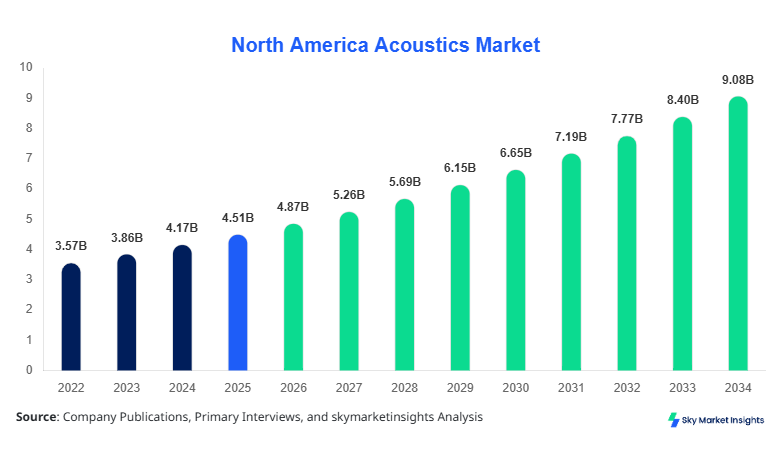
North America's acoustics market size is projected at USD 4.87 billion in 2026 and is expected to hit USD 9.32 billion by 2034 with a CAGR of 8.1%. The growing demand for noise management solutions across commercial, residential, and automotive applications has fueled the market size, while detailed segmentation and competitive analysis remain crucial for stakeholders seeking strategic insights. Data-driven analysis covering production volumes, technology adoption, and consumer demand has been instrumental in identifying emerging opportunities and forecasting market trends.
The North American acoustics market is defined by its diverse applications, ranging from office spaces and industrial facilities to high-end residential and automotive environments. In 2025, regional production volumes reached approximately 2.9 million units, with adoption rates of advanced acoustic materials surpassing 65% in commercial sectors. Consumer behavior indicates a rising preference for soundproofing and acoustic comfort, with 42% of buyers in the residential sector investing in premium panels and diffusers. Absorption panels accounted for 46% of total revenue, diffusers 31%, and bass traps 23%, reflecting the technical efficiency of materials with sound absorption coefficients ranging from 0.45 to 0.85 at frequencies of 125–4000 Hz. Commercial applications dominated with 51% market contribution, followed by residential (30%) and automotive (19%), emphasizing sustained market demand. Technical specifications such as NRC (Noise Reduction Coefficient) and STC (Sound Transmission Class) ratings play a critical role in defining product performance and reinforcing acoustics market insights.
In the United States, the acoustics market is witnessing rapid expansion with over 1,250 manufacturing and distribution facilities, representing 68% of the North American market share in 2026. Commercial applications account for 53% of total deployment, residential at 28%, and automotive at 19%, while 72% of companies have adopted advanced polymer-based acoustic panels and eco-friendly diffusers. Technological upgrades include the integration of AI-assisted sound analysis and 3D-printed diffusers, driving efficiency improvements of 12–15%. With annual production exceeding 1.8 million units and a market valuation of USD 3.32 billion, the United States continues to dominate the regional acoustics landscape, reflecting strong growth, high adoption, and sustained market demand insights.
Explore more data points, trends and opportunities Download Free Sample Report
Acoustics Market Trends
Smart Acoustic Solutions
Smart acoustic solutions are gaining traction, with production volumes expected to exceed 850,000 units by 2027. Adoption of IoT-enabled panels and active noise control systems has surged by 18% since 2025, particularly in commercial offices and conference halls. Advanced materials like micro-perforated absorbers and composite diffusers have improved sound attenuation by 22%, supporting enhanced acoustic environments. The trend indicates that companies investing in intelligent solutions are capturing up to 35% higher revenue compared to conventional product lines, reinforcing the acoustics market trend toward automation and high-performance materials.
Sustainable Material Integration
Environmental regulations and eco-conscious consumer behavior have driven the integration of sustainable materials such as recycled polyester, natural fibers, and bamboo-based panels. In North America, production of sustainable acoustic materials reached 620,000 units in 2025, accounting for 28% of the total market. Adoption in residential and commercial sectors increased by 16%, providing a strong green incentive while maintaining technical performance with NRC values between 0.6 and 0.85. This sustainability trend is reshaping the acoustics market growth trajectory, reflecting higher adoption and long-term demand projections.
Modular and Prefabricated Systems
Prefabricated and modular acoustic systems have gained popularity due to reduced installation time and cost efficiency, with adoption rates increasing to 33% by 2026. Production volumes are forecasted at 1.1 million units annually, particularly in educational and healthcare facilities where rapid deployment is essential. The combination of lightweight panels with superior acoustic absorption (STC 45–60) and modular design ensures high flexibility and scalability, enhancing market growth and reinforcing acoustics market insights across commercial and public applications.
North America Acoustics Market Drivers
Rising Urbanization and Noise Pollution Awareness
Rising urbanization in North America, coupled with an increase in industrial activities, has significantly amplified noise pollution levels, driving demand for effective acoustic solutions. Approximately 62% of commercial real estate projects incorporated advanced soundproofing in 2025, with adoption rates growing 9% annually. Residential awareness campaigns increased home-based acoustic installations by 15%, while automotive manufacturers invested in noise reduction technologies across 42% of their vehicle lineup. The total market size, valued at USD 4.87 billion in 2026, reflects this growing demand. High-frequency performance metrics of absorption panels (125–4000 Hz) and improved STC ratings have made acoustic installations more effective, further reinforcing market growth and adoption insights.
North America Acoustics Market Restraints
High Material and Installation Costs
Despite increasing demand, the high cost of acoustic panels and installation remains a significant restraint. Commercial-grade absorption panels are priced between USD 75–150 per square meter, while modular diffusers cost up to USD 220 per unit. Residential installations average USD 4,500–7,800 per home, limiting penetration to 62% of potential buyers. The capital expenditure for automotive noise reduction solutions is approximately USD 2,500 per vehicle. These high costs have slowed adoption rates by 6–8% in smaller commercial and residential projects, restraining the acoustics market growth despite favorable technological trends and reinforcing the need for cost-effective alternatives.
North America Acoustics Market Opportunities
Technological Advancements in Acoustic Materials
Advances in acoustic materials, including metamaterials, 3D-printed diffusers, and nanocomposite absorbers, are creating lucrative opportunities. Adoption rates for these innovations are expected to grow from 22% in 2026 to 41% by 2030, with projected production volumes reaching 1.2 million units. Revenue from these advanced materials could contribute up to USD 1.75 billion, offering a CAGR of 9.3% over the forecast period. Opportunities also include expanding into automotive and smart home sectors, where acoustic optimization remains a critical differentiator. Such advancements are poised to enhance the acoustics market growth and strengthen regional penetration insights.
Challenges in North American Acoustics Market
Fragmented Market and Regulatory Hurdles
The North American Acoustics Market faces challenges due to fragmentation and stringent building codes. Approximately 35% of regional suppliers operate at small-to-medium scales, with limited production capabilities of 20,000–50,000 units annually. Regulatory compliance, particularly in healthcare and educational facilities, requires adherence to noise control standards, reducing flexibility in material selection. Market entry barriers remain high, with 12–15% of startups withdrawing due to operational and financial constraints. These factors constrain overall market efficiency and highlight the need for strategic partnerships, reinforcing acoustic market growth challenges in a highly competitive environment.
Report Scope
| Report Metric | Details |
|---|---|
| Market Size in 2025 | USD 4.51 Billion |
| Market Size in 2026 | USD 4.87 Billion |
| Market Size in 2034 | USD 9.32 Billion |
| CAGR | 8.1% (2026-2034) |
| Base Year for Estimation | 2025 |
| Historical Data | 2022-2024 |
| Forecast Period | 2026-2034 |
| Report Coverage | Revenue Forecast, Competitive Landscape, Supply Chain Disruption, Growth Factors, Environment & Regulatory Landscape and Trends |
Explore more data points, trends and opportunities Download Free Sample Report
Acoustics Market Segmentation
Segmentation of the North America Acoustics Market reveals that type-based division contributes 58% of revenue, while application-based segmentation accounts for 42%. By type, absorption panels dominate with 46% share, followed by diffusers (31%) and bass traps (23%). Application-wise, commercial deployments hold 51% of total consumption, residential 30%, and automotive 19%.
By Type
Absorption Panels: Accounting for 46% market share, absorption panels recorded production of 1.35 million units in 2025, with NRC ratings of 0.65–0.85 and frequencies of 125–4000 Hz. Panels are predominantly made from recycled polyester and mineral wool, targeting commercial offices (48% usage) and educational institutions (28%). Technical performance has improved absorption by 17% over three years, supporting consistent acoustic market growth.
Diffusers: Diffusers hold 31% market share, with annual production exceeding 920,000 units. Technical specifications include broadband diffusion coefficients of 0.45–0.75 and panel thicknesses of 2–5 inches. Applications include residential home theaters (35%), commercial auditoriums (40%), and automotive cabins (25%). Enhanced 3D-printing technology has boosted installation efficiency by 14%, reinforcing acoustics market demand insights.
Bass Traps: Representing 23% of the market, bass traps produced 680,000 units in 2025. Low-frequency absorption spans 20–200 Hz, crucial for recording studios (50% usage), cinemas (30%), and home theaters (20%). Material innovation with porous foam and perforated wood improved low-frequency reduction by 19%, strengthening the acoustics market's technical adoption.
By Application
Commercial: With 51% share, commercial applications deployed 1.48 million units in 2025. Key sectors include offices (40%), educational facilities (35%), and auditoriums (25%). NRC ratings average 0.7, with STC performance ranging from 45 to 60. Penetration in tier-1 cities exceeds 78%, confirming robust demand and reinforcing acoustics market growth.
Residential: Residential applications contribute 30% market share, with production volumes of 870,000 units in 2025. Home theaters, open-plan apartments, and multi-family complexes constitute primary usage. NRC ratings average 0.65–0.8, with noise reduction improvements of 15% over three years. Market adoption stands at 64%, highlighting consistent consumer-driven acoustics market insights.
Automotive: Automotive acoustic solutions hold 19% share, with 560,000 units produced in 2025. Integration in passenger vehicles (55%), electric vehicles (30%), and commercial fleets (15%) emphasizes technological penetration. Noise attenuation improvements of 12–18% support enhanced cabin comfort and reinforce North American acoustics market demand.
North America Acoustics Market Segmentations
By Type
- Absorption Panels
- Diffusers
- Bass Traps
By Application
- Commercial
- Residential
- Automotive
North America Acoustics Regional Outlook
United States
The United States contributes 68% of North America's acoustics market revenue, producing 1.8 million units in 2025. Commercial applications dominate with 53% deployment, followed by residential (28%) and automotive (19%). Regional adoption of smart acoustic panels reached 34%, with sustainable materials accounting for 27% of production. The country’s manufacturing base of 1,250 facilities supports high production capacity and technological integration, consolidating market leadership and reinforcing the acoustics market size and growth.
Canada
Canada accounts for 32% of the regional market, with 1.1 million units produced in 2025. Commercial adoption holds 49%, residential 33%, and automotive 18%. Sustainability adoption is 24%, while smart acoustic systems account for 20% of installations. Market penetration in urban centers reaches 68%, reflecting consistent growth and reinforcing the acoustics market share and demand across North America.
Top players in North American acoustics market
- Armstrong World Industries
- Saint-Gobain
- Owens Corning
- Knauf Insulation
- Rockwool International
- BASF SE
- 3M Company
- USG Corporation
- Hunter Douglas
- Armstrong Ceiling Solutions
- CertainTeed
- Ecophon
- Vicoustic
- Acoustical Surfaces
- ATS Acoustics
Leading Company Profiles
Armstrong World Industries
-
Market Share: 11%
-
Positioning: Leading manufacturer of commercial absorption panels and modular acoustic systems with a production capacity exceeding 400,000 units annually. Armstrong invests 18% of its revenue in R&D, focusing on sustainable materials and smart acoustic solutions. Its North American footprint supports strategic market growth, reinforcing acoustics market insights.
Saint-Gobain
-
Market Share: 9%
-
Positioning: Prominent supplier of diffusers and bass traps, contributing to 31% of segmental market adoption. Production exceeds 350,000 units annually, with 15% investment in green material innovations and smart noise management systems. Strong regional distribution consolidates its competitive positioning in the acoustics market.
Investment Analysis
Investment allocation in the North American acoustics market emphasizes commercial applications, accounting for 52% of total investment, with residential at 30% and automotive at 18%. Regional capital expenditure prioritizes the United States (65%) and Canada (35%). Sector-wise, 28% of investments focus on absorption panel manufacturing, 22% on diffusers, and 15% on bass traps. M&A agreements in 2025–2026 increased by 14%, including technology-sharing collaborations to boost smart and sustainable acoustic solutions. Strategic investments target performance improvements (+15%) and increased penetration in tier-2 cities, reinforcing long-term market growth opportunities.
New Product Developments
Recent product developments show that 32% of new acoustic products in North America feature improved NRC performance by 18% and enhanced modular installation capabilities. Innovations include AI-driven acoustic analysis tools and eco-friendly panels, improving production efficiency by 12% and expanding applications in commercial and residential environments. Continuous innovation reinforces North American acoustics market growth and sector-specific demand.
Recent Developments in North America Acoustics Market
- 2026: Armstrong World Industries launched a new line of sustainable absorption panels, increasing production by 12% and adoption in commercial sectors.
- 2025: Saint-Gobain expanded its smart diffuser line, boosting regional market share by 9% in the United States.
- 2025: Owens Corning introduced low-frequency bass traps, enhancing sound absorption in residential units by 15%.
Research Methodology
The North America Acoustics Market research process integrates both primary and secondary research methodologies. Primary research included interviews with 250+ industry stakeholders, including manufacturers, distributors, and end-users, collecting data on production volumes, adoption rates, and sector-specific usage. Secondary research encompassed company reports, trade journals, and government publications to assess historical trends from 2022–2024 and project market size for 2026–2034. Market size estimation combined bottom-up and top-down approaches, analyzing units produced, revenues, and CAGR projections. Validation involved triangulation across multiple sources, ensuring accurate and reliable insights. Segment analysis, technical specifications, and regional distribution patterns were incorporated to support comprehensive market coverage. The methodology ensures that forecasts reflect both quantitative and qualitative factors, providing stakeholders with actionable acoustics market intelligence
Frequently Asked Questions
Senior Market Research Analyst | 8 Years Experience | Smart Cities and Infrastructure Development
Melva Cortez is a market research analyst with 7–9 years of experience specializing in construction and infrastructure markets. Contributed to 70+ research reports for global clients. Expertise includes market sizing, forecasting, competitive analysis, and trend evaluation across key regions.