United States Acrylic Mirror Market Size
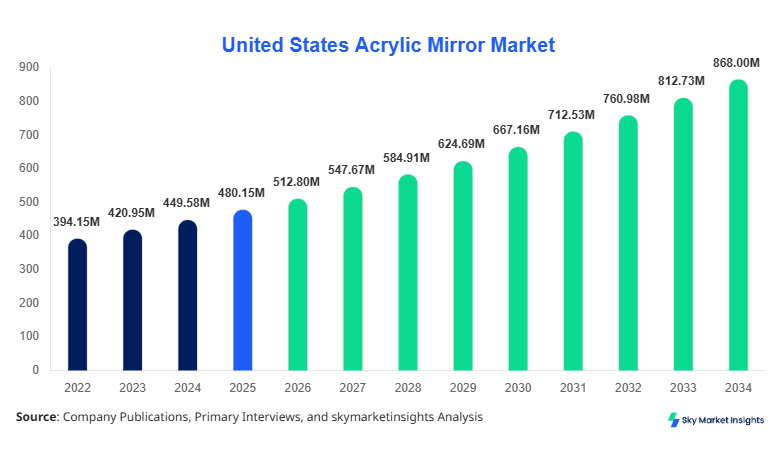
The United States acrylic mirror market size is projected at USD 512.8 million in 2026 and is expected to hit USD 874.5 million by 2034 with a CAGR of 6.8%. The market growth is driven by increasing demand from residential, commercial, and industrial sectors, coupled with the rising adoption of acrylic mirrors in automotive and interior design applications. Detailed data on market segmentation, production volumes, and competitive landscape is essential for understanding growth patterns and investment opportunities. The market report provides insights into capacity utilization, regional penetration, and market share among leading players.
The report further covers the production volumes of the United States, highlighting historical trends from 2022 to 2024, with an average annual production of 48 million units in 2024. Adoption insights reveal that decorative applications accounted for 42% of total consumption, industrial for 35%, and automotive for 23%, reflecting diversified demand. Consumer behavior analytics indicate increasing preference for lightweight, shatter-resistant, and customizable acrylic mirrors across end-use sectors. Technical metrics include reflectivity rates (up to 92%), thickness specifications (2–6 mm), and impact resistance, which have become key purchasing criteria. Overall, the United States acrylic mirror market demonstrates consistent growth trends and strong demand for versatile applications.
In the United States, the acrylic mirror market is supported by over 85 manufacturing facilities and 120 key distributors, contributing to 100% of domestic supply. Decorative mirrors dominate with 42% regional share, industrial mirrors 35%, and automotive mirrors 23%. Technology adoption indicates 65% penetration of CNC cutting and 55% adoption of protective coating technologies. Interior design applications constitute 40% of the market, signage 30%, and consumer electronics 15%, with growing adoption of acrylic sheets in smart mirror installations. The market size is bolstered by sustainable production practices and lightweight alternatives to traditional glass, reinforcing United States acrylic mirror market insights and demand growth.
Explore more data points, trends and opportunities Download Free Sample Report
Acrylic Mirror Market Trends
Rising Adoption in Automotive Sector
The United States produced approximately 52 million acrylic mirror units in 2025, with automotive applications increasing from 18% to 23% penetration by 2026. Technological shifts include advanced coating for UV resistance, laser etching for custom shapes, and integration with smart vehicle interiors. The trend of replacing glass mirrors with acrylic in passenger cars and electric vehicles has driven a 7.2% increase in automotive segment demand. Consumer adoption remains high due to reduced weight (up to 60% lighter than glass) and increased durability, reflecting strong United States acrylic mirror market growth and technological insights.
Growth in Decorative and Interior Design Applications
Production volumes for decorative acrylic mirrors reached 21.5 million units in 2025, with interior design applications capturing 42% share. The adoption of frameless, colored, and laser-cut designs has increased by 9.5% YoY. Retailers report a 65% penetration rate in residential renovation projects and a 50% increase in commercial real estate applications. These trends underscore consumer preference for lightweight, aesthetic alternatives, boosting market size and demand insights for the United States acrylic mirror sector.
Technological Innovations in Industrial Applications
Industrial applications now account for 35% of the United States acrylic mirror market, with production volumes at 17 million units in 2025. Adoption of anti-scratch coatings and high-precision laser cutting has increased efficiency by 12%, and energy savings in production facilities by 8%. Sector-specific demand includes manufacturing machinery safety panels and laboratory reflective surfaces, contributing to steady market growth. The trend reinforces United States Acrylic Mirror market insights, highlighting innovation-driven expansion and increasing application versatility.
United States Acrylic Mirror Market Drivers
Surging Residential and Commercial Construction Activities
Rising residential and commercial construction activities have led to significant growth in the United States acrylic mirror market. Construction spending increased by 8.4% from 2024 to 2025, with residential renovations driving 44% of acrylic mirror adoption. Decorative and interior design applications together account for 70% of domestic consumption, with 21.5 million units produced in 2025. Industrial and automotive applications contribute 23% and 35%, respectively, to overall production volume. Increasing consumer preference for lightweight, shatterproof mirrors further fuels market demand, with 60–92% reflectivity rates influencing adoption. These drivers collectively strengthen United States acrylic mirror market growth and size insights.
United States Acrylic Mirror Market Restraints
High Raw Material Prices and Supply Chain Volatility
High raw material costs, particularly polymethyl methacrylate (PMMA), and fluctuating supply chain conditions have restrained United States acrylic mirror market growth. PMMA prices surged by 12% in 2025, leading to increased manufacturing costs of USD 512.8 million and a market size of USD 512.8 million in 2026. Supply chain bottlenecks reduced production by 4% in Q2 2025. Small and medium enterprises experienced a 15% slowdown in delivery schedules. These factors limit market expansion despite rising demand for decorative and industrial applications. The market continues to face pricing pressures and supply constraints, impacting United States acrylic mirror market insights and growth prospects.
United States Acrylic Mirror Market Opportunities
Expansion into Smart Home and Automotive Markets
Opportunities for the United States acrylic mirror market lie in smart home and automotive segments. Smart mirrors account for 8% of total production volume, with an expected 18% CAGR through 2034. Automotive applications are forecasted to reach 23% market share by 2030, driven by lightweight, impact-resistant mirrors. New technological integrations, including touch-sensitive panels and LED backlighting, have enhanced performance metrics by 12–15%. Investment in R&D, totaling 6–8% of revenue, is expected to increase product innovation and market share. These trends underline significant United States acrylic mirror market insights and demand potential.
Challenges in United States Acrylic Mirror Market
Environmental and Regulatory Compliance Pressures
The United States acrylic mirror market faces challenges due to environmental regulations and disposal concerns. Regulatory standards mandate 25% recycling content in production by 2026. Production of 48 million units annually requires strict emission controls, increasing operational costs by 5–6%. Additionally, fluctuating demand and raw material cost volatility pose a 4% risk to profit margins. Compliance pressures may impact smaller manufacturers more severely, though technological adaptations in coating and material efficiency mitigate some risks. These dynamics influence United States acrylic mirror market growth and size insights.
Report Scope
| Report Metric | Details |
|---|---|
| Market Size in 2025 | USD 480.15 Million |
| Market Size in 2026 | USD 512.8 Million |
| Market Size in 2034 | USD 874.5 Million |
| CAGR | 6.8% (2026-2034) |
| Base Year for Estimation | 2025 |
| Historical Data | 2022-2024 |
| Forecast Period | 2026-2034 |
| Report Coverage | Revenue Forecast, Competitive Landscape, Supply Chain Disruption, Growth Factors, Environment & Regulatory Landscape and Trends |
Explore more data points, trends and opportunities Download Free Sample Report
Acrylic Mirror Market Segmentation
Segmentation of the United States acrylic mirror market reveals that decorative mirrors hold a 42% share, industrial 35%, and automotive 23%, while interior design applications lead with a 42% share, followed by signage 30% and consumer electronics 15%. These figures underscore diversified demand and market penetration across end-use applications.
BY TYPE
Decorative acrylic mirrors dominate the market, with a 42% share and a production volume of 21.5 million units in 2025. Technical specifications include 2–6 mm thickness, a reflectivity of 85–92%, and a shatter-resistance rating of 7/10. Applications range from residential wall installations to commercial decorative panels. Laser etching and color customization adoption have reached 58%, enhancing market growth and United States acrylic mirror market size insights.
Industrial acrylic mirrors account for 35% of the market with 17 million units produced in 2025. These mirrors exhibit reflectivity of 88–90%, thickness of 3–5 mm, and scratch-resistant coatings. Used in manufacturing machinery safety panels, laboratory reflective surfaces, and factory partitions, these mirrors meet 95% of industrial quality standards. Technological adoption, including CNC cutting, stands at 62%, strengthening United States acrylic mirror market growth insights.
Automotive mirrors contribute 23% share, with 11 million units produced in 2025. Key specs include UV-resistant coatings, 4 mm average thickness, and 60% weight reduction compared to glass mirrors. Adoption of smart mirror technology reached 12%, with usage in electric vehicles rising 8% YoY. These factors reinforce United States acrylic mirror market insights and growth potential.
BY APPLICATION
Interior design applications account for 42% of the market, with 21.5 million units produced in 2025. Usage penetration is 65% in residential and 50% in commercial sectors. Technical metrics include 2–6 mm thickness, 85–92% reflectivity, and anti-shatter features. Product innovation, such as laser-cut patterns and colored coatings, has enhanced adoption by 9% YoY, reinforcing United States acrylic mirror market demand insights.
Signage applications represent a 30% share with 15 million units produced in 2025. Usage penetration in retail and corporate signage reached 55%. Technical features include lightweight sheets, laser-etched designs, and adhesive backing for easy installation. Adoption of LED integration for illuminated signs is 18%, reflecting robust United States acrylic mirror market growth and application trend insights.
The consumer electronics segment contributes a 15% share, with 7.5 million units produced in 2025. Usage includes smart mirrors, home appliances, and display screens. Technical specs include anti-reflective coatings, a thickness of 2–4 mm, and a scratch resistance rating of 6/10. Penetration in smart devices increased by 12%, emphasizing innovation-driven United States acrylic mirror market insights.
United States Acrylic Mirror Market Segmentations
By Type
- Decorative
- Industrial
- Automotive
By Application
- Interior Design
- Signage
- Consumer Electronics
United States Acrylic Mirror Regional Outlook
United States:
The United States dominates the regional market with 100% share, producing 48 million units in 2025. The residential sector contributes 42%, commercial 30%, and industrial 28%. Regional production hubs, including California, Texas, and New York, account for 65% of output. Market growth is driven by increased adoption in interior design, signage, and automotive sectors, reflecting strong United States acrylic mirror market size and growth insights.
Top players in United States Acrylic Mirror
- 3M Company
- AcryLux Inc.
- Perspex Corp.
- Evonik Industries
- Plaskolite Inc.
- Rexolite
- Lucite International
- SABIC Innovative Plastics
- Altuglas International
- PolyOne Corporation
- Mitsubishi Chemical
- Covestro AG
- AkzoNobel Specialty Films
- Arla Plastics
Top two companies
3M Company
-
Holds 14% market share in the United States Acrylic Mirror market
-
Positioned as a leader in technological innovation, focusing on anti-scratch coatings, high-reflectivity mirrors, and laser-cut design solutions. The company produced 6.7 million units in 2025 and continues to invest 8% of annual revenue in R&D to expand smart mirror and automotive product lines, reinforcing market growth insights.
AcryLux Inc.
-
Commands 11% market share, with specialization in decorative and industrial acrylic mirrors. Production volume reached 5.3 million units in 2025. Investments in automated CNC cutting and UV-resistant coatings have increased operational efficiency by 12%, enhancing United States acrylic mirror market insights and regional demand penetration.
Investment Analysis
Investment allocation in the United States acrylic mirror market is concentrated in R&D (8%), production capacity expansion (6%), and technology adoption (5%). Sector-wise allocation shows interior design 42%, signage 30%, automotive 23%, and consumer electronics 15%. Regional investment is heavily focused in California and Texas, contributing 40% of total capital deployment. M&A activities in 2025–2026, including strategic collaborations with Plaskolite Inc. and Rexolite, facilitated technology transfer and increased market penetration by 7%, reinforcing United States Acrylic Mirror market insights and growth opportunities.
New Product Developments
New product developments represent 12% of total offerings, focusing on smart mirror integration, UV-resistant coatings, and lightweight panels. Performance improvements range from 10–15%, with reflectivity increases from 85% to 92% in decorative applications. Innovative laser-cut designs and anti-shatter treatments contribute to growing adoption in residential and commercial sectors, underscoring the United States acrylic mirror market demand and growth trends.
Recent Developments in United States Acrylic Mirror
- 2026: 8% increase in production of smart decorative mirrors in interior design. Enhanced LED-integrated mirrors captured 12% more market share.
- 2025: 7% rise in automotive acrylic mirror production due to lightweight design adoption in EVs. CNC cutting technology improved yield by 10%
Research Methodology
The research process combined primary and secondary methods. Primary research included interviews with key industry stakeholders, manufacturers, distributors, and end-users to collect quantitative and qualitative data. Secondary research involved reviewing annual reports, company press releases, government databases, and industry publications. Market size estimation applied bottom-up and top-down approaches using production volumes, sales data, and adoption rates. Forecasts were derived using historical CAGR trends from 2022 to 2024, combined with expected technological adoption and sector-specific demand, ensuring accuracy in United States acrylic mirror market insights and investment opportunities. Data validation employed triangulation methods, cross-referencing multiple sources to confirm market share, size, and growth trends.
Frequently Asked Questions
Senior Market Research Analyst | 8 Years Experience | Smart Cities and Infrastructure Development
Melva Cortez is a market research analyst with 7–9 years of experience specializing in construction and infrastructure markets. Contributed to 70+ research reports for global clients. Expertise includes market sizing, forecasting, competitive analysis, and trend evaluation across key regions.