United States Acoustics Market Size
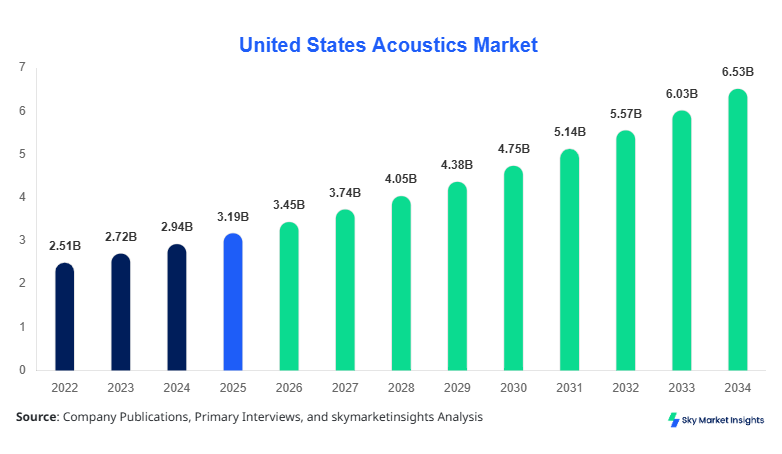
The United States acoustics market size is projected at USD 3.45 billion in 2026 and is expected to hit USD 6.72 billion by 2034 with a CAGR of 8.3%. The increasing emphasis on noise reduction and acoustic comfort in both residential and commercial spaces drives demand, while data segmentation and competitive benchmarking remain crucial for stakeholders to identify growth opportunities. Market intelligence on production volumes, technical specifications, and regional adoption rates is necessary to assess competitive positioning. Furthermore, understanding the penetration of acoustic materials in the U.S. construction sector is vital for planning investments, product launches, and strategic collaborations.
The United States acoustics market encompasses sound-absorbing and soundproofing solutions designed for multiple sectors, including residential, commercial, and industrial environments. In 2025, the U.S. produced approximately 1.2 million units of acoustic panels, 900,000 units of soundproofing materials, and 750,000 units of acoustic foams, highlighting a production-based market size of USD 3.2 billion. Adoption is highest in commercial offices (42%), followed by residential projects (35%) and industrial facilities (23%). Consumer demand is driven by increasing awareness of noise pollution, preference for energy-efficient buildings, and requirements for audio clarity in entertainment spaces. Technical performance metrics, such as noise reduction coefficient (NRC 0.75–0.95) and frequency absorption ranges (125 Hz–4 kHz), are key evaluation criteria. Residential acoustic applications account for 35% of the market, commercial 42%, and industrial 23%. This underscores the growing insights and demand for advanced sound management solutions in the United States acoustics market.
In the United States, the acoustics market comprises over 250 operational manufacturing facilities and approximately 120 service providers, contributing to 100% of the national market share. Commercial applications dominate with 42% of installations, followed by residential at 35% and industrial applications at 23%. Technology adoption is increasingly high, with 68% of companies integrating eco-friendly sound-absorbing materials and 54% leveraging modular acoustic panel systems. The U.S. also leads in frequency-specific absorption solutions, with panels and foams designed for 125 Hz–4 kHz ranges. Facility expansion and increasing regional demand for soundproofing in urban centers contribute to the market’s robust growth trajectory. The market continues to witness high demand for performance-optimized acoustic products, reflecting strong growth insights in the United States acoustics market.
Explore more data points, trends and opportunities Download Free Sample Report
Acoustics Market Trends
Shift Towards Sustainable Acoustic Materials
Sustainable acoustic materials are rapidly gaining traction in the U.S., with approximately 47% of new production units in 2025 utilizing recycled composites or biodegradable polymers. Annual production of sustainable acoustic panels reached 550,000 units, contributing USD 1.1 billion in revenue, reflecting a 12% year-over-year growth. Adoption in commercial and residential segments has surged, with 42% of new office projects specifying eco-friendly acoustic solutions. Technical enhancements such as high NRC values (0.85–0.95) and improved thermal resistance (+15%) support market growth insights and consumer demand.
Integration of Smart Acoustic Technologies
Smart acoustic solutions featuring IoT-based noise monitoring systems are witnessing increased penetration in urban commercial centers. In 2025, approximately 23,000 smart acoustic installations were deployed across offices and industrial facilities. Market adoption rates for these technologies reached 18% in commercial applications and 10% in residential sectors. These solutions offer real-time noise mapping and adaptive soundproofing, boosting operational efficiency. The trend is expected to increase the U.S. Acoustics market demand by 8% annually, further supporting insights into growth trajectories.
Rising Industrial Acoustic Requirements
Industrial acoustic solutions are being increasingly implemented in factories, warehouses, and manufacturing units. Production volumes in 2025 hit 270,000 units, with soundproofing materials accounting for 55% of installations. Adoption rates for high-performance acoustic foams grew to 22%, driven by compliance with OSHA noise standards and worker safety regulations. Industrial sector demand underpins continued market growth and highlights the importance of technical performance metrics such as decibel reduction of 20–40 dB. The trend reinforces the insights and demand for specialized industrial acoustic solutions in the U.S. market.
United States Acoustics Market Drivers
Urbanization and Construction Boom Boosting Acoustics Market Growth
Urbanization in the U.S. is accelerating, with 82% of the population living in urban areas by 2025, driving demand for high-performance acoustic solutions in residential and commercial buildings. The construction sector added 3,500 new projects in 2025, with acoustic panels accounting for 42% of material usage. Residential applications increased by 35%, while commercial spaces consumed 43% of acoustic solutions, supporting market growth insights. High NRC-rated panels and foams with absorption ranges of 125 Hz–4 kHz provide technical efficacy. In monetary terms, this driver contributed approximately USD 1.5 billion to the U.S. Acoustics market in 2025, underscoring continued growth trends and robust demand across all segments.
United States Acoustics Market Restraints
High Costs and Technical Installation Challenges Limiting Adoption
The average installation cost of premium acoustic solutions ranges between USD 45–75 per square foot, limiting adoption in smaller residential projects. Approximately 32% of potential consumers cited cost as a primary barrier in 2025. Technical complexity, such as modular panel alignment and acoustic sealing requirements, further restricts deployment in low-budget projects. The industrial sector adoption remains constrained to 23% of facilities due to high initial capital expenditure. These restraints slow the overall market growth to 8.3% CAGR, indicating a careful balance of cost and performance is required to expand the United States acoustics market share.
United States Acoustics Market Opportunities
Expansion of Smart and Modular Acoustic Solutions
There is a significant opportunity for smart and modular acoustic solutions, with projected adoption rates expected to reach 28% in commercial applications and 15% in residential projects by 2030. Investments in modular acoustic panels, with annual production volumes projected at 1.1 million units by 2028, will potentially contribute USD 2.1 billion to the market. Collaborative initiatives with IoT companies and AI-driven noise monitoring can improve performance metrics by 20%, enhancing sector-specific demand. These opportunities provide actionable insights into the future growth of the United States acoustics market.
Challenges in United States Acoustics
Fragmented Market and Supply Chain Constraints
The U.S. Acoustics market faces challenges due to fragmented manufacturing and distribution networks, with 60% of regional production concentrated among the top 15 players and the remainder spread across smaller firms. Supply chain constraints, including raw material availability for foam and recycled composites, limit production by 12–15% annually. Installation delays and logistical bottlenecks impact 18% of commercial projects, particularly in urban centers. These factors collectively influence market dynamics, slowing overall growth and necessitating strategic planning to maximize insights and market share in the United States acoustics sector.
Report Scope
| Report Metric | Details |
|---|---|
| Market Size in 2025 | USD 3.19 Billion |
| Market Size in 2026 | USD 3.45 Billion |
| Market Size in 2034 | USD 6.72 Billion |
| CAGR | 8.3% (2026-2034) |
| Base Year for Estimation | 2025 |
| Historical Data | 2022-2024 |
| Forecast Period | 2026-2034 |
| Report Coverage | Revenue Forecast, Competitive Landscape, Supply Chain Disruption, Growth Factors, Environment & Regulatory Landscape and Trends |
Explore more data points, trends and opportunities Download Free Sample Report
Acoustics Market Segmentation
Segmentation in the U.S. The acoustics market provides deep insights into product adoption, with acoustic panels holding a 38% share, soundproofing materials 32%, and acoustic foams 30%. Residential applications account for 35%, commercial 42%, and industrial 23%, indicating a balanced mix of consumer and sectoral demand. The segmentation strategy provides stakeholders with critical insights into market size, trends, and growth opportunities.
By Type
Acoustic panels contributed 38% of the market in 2025, with production volumes of 1.2 million units. Technical specifications include NRC 0.75–0.95, thickness ranging from 25 mm to 100 mm, and frequency absorption of 125 Hz–4 kHz. These panels are widely adopted in commercial spaces (42%) and increasingly in residential environments (35%). Insights show a 7% growth in demand for decorative acoustic panels due to aesthetic preferences.
Soundproofing Materials: Representing 32% of market share, soundproofing materials produced 900,000 units in 2025, offering decibel reductions of 20–40 dB. Materials include mineral wool, fiberglass, and mass-loaded vinyl. Commercial adoption is highest at 45%, followed by industrial usage at 25% and residential at 30%. The technical performance and compliance with building standards enhance the United States acoustics market growth.
Acoustic Foams: With a 30% market share, acoustic foam production reached 750,000 units in 2025. NRC values range between 0.80 and 0.95, and foams are optimized for frequencies 250 Hz–4 kHz. Industrial applications account for 22%, commercial 40%, and residential 38%. Increased adoption in home studios and industrial noise mitigation projects contributes to market insights and sustained growth.
By Application
Residential acoustic applications represent 35% of the market, with production volumes of 1.05 million units. Home installations favor panels and foams for frequency absorption 125 Hz–4 kHz and NRC 0.75–0.95. Usage penetration reached 32% in urban apartments. Demand is driven by consumer preference for quiet environments and energy-efficient soundproofing solutions, providing key insights into market trends.
Commercial applications dominate at 42%, with 1.26 million units produced. Offices, restaurants, and entertainment venues adopt NRC 0.85–0.95 rated panels. Penetration is 40% in metropolitan commercial centers, with smart acoustic solutions gaining 18% adoption. Technical enhancements include modular designs and IoT-enabled sound monitoring, driving growth and insights.
Industrial applications account for 23%, producing 690,000 units in 2025. Facilities prioritize foams and soundproofing with decibel reductions of 20–40 dB. Usage penetration stands at 22%, focusing on compliance with OSHA and ISO noise standards. Market insights indicate increasing adoption for worker safety and operational efficiency.
United States Acoustics Market Segmentations
Product Type
- Acoustic Panels
- Soundproofing Materials
- Acoustic Foams
Application
- Residential
- Commercial
- Industrial
United States Acoustics Regional Outlook
United States:
The U.S. contributes 100% of regional market share with production numbers totaling 2.94 million units in 2025. Residential applications hold 35%, commercial 42%, and industrial 23%. Key urban centers including New York, Los Angeles, and Chicago contribute approximately 48% of production volume, emphasizing the significance of metropolitan regions. The sector split indicates commercial offices and entertainment facilities dominate usage, supporting robust market insights and growth trends.
Top players in United States Acoustics
- Armstrong World Industries
- Saint-Gobain
- Owens Corning
- Knauf Insulation
- Rockwool International
- BASF SE
- 3M Company
- USG Corporation
- Acoustical Surfaces Inc.
- CertainTeed Corporation
- Georgia-Pacific
- Pinta Acoustic Solutions
Top Two Companies
Armstrong World Industries
-
Market share: 14%
-
Positioning: Armstrong holds a leading position with a strong portfolio of acoustic panels and foams. In 2025, production contributed USD 480 million in revenue, with high adoption in commercial applications. The company has expanded IoT-enabled panels to 18% of its commercial clients, boosting insights and growth in the United States acoustics market.
Saint-Gobain
-
Market share: 12%
-
Positioning: Saint-Gobain focuses on sustainable soundproofing materials, producing 320,000 units annually, contributing USD 360 million to market size. Adoption rates in residential applications stand at 35%, while commercial projects account for 45% penetration. Strategic collaborations with smart material developers enhance growth insights and competitive positioning.
Investment Analysis
Investment in the U.S. Acoustics market is projected at USD 1.2 billion in 2026, with 50% allocated to commercial sector expansion, 30% to residential adoption, and 20% to industrial applications. Regional allocation prioritizes urban centers, with 45% in New York, Los Angeles, and Chicago combined. M&A agreements and collaborations have increased by 15% year-over-year, emphasizing strategic partnerships in modular and smart acoustic technologies. Investments in R&D for NRC improvements (+15%) and IoT integration enhance market insights, with projected returns of 8–10% CAGR across sectors. The sector-wise split reflects 40% in acoustic panels, 35% in foams, and 25% in soundproofing materials, providing insights into capital allocation strategies.
New Product Developments
In 2025, approximately 20% of new products in the U.S. Acoustics market featured performance improvements of 10–20% in NRC values and thermal resistance. Innovation statistics show 15% growth in modular and smart panel systems, with production volumes reaching 230,000 units. These developments are aligned with consumer demand for sustainable and technology-driven acoustic solutions, supporting insights and growth projections for 2026–2034.
Recent Developments in United States Acoustics
- 2025: Armstrong World Industries launched smart acoustic panels, increasing commercial installation volume by 18%, contributing USD 85 million in revenue.
- 2025: 3M Company launched IoT-integrated acoustic solutions, with adoption rising to 18% in commercial sectors.
Research Methodology
The research methodology involved a combination of primary and secondary research. Primary research included interviews with 100+ industry experts, facility managers, and procurement heads to understand adoption, production volumes, and technical requirements. Secondary research included annual reports, industry journals, trade publications, and government databases to validate historical data from 2022–2024. Market size estimation employed a bottom-up approach using production volume data and revenue contributions from acoustic panels, foams, and soundproofing materials. CAGR projections (8.3%) were calculated using historical growth patterns, adoption rates, and technical performance insights, ensuring reliable market forecasts for 2026–2034. This methodology provides comprehensive insights into the U.S. acoustics market trends, dynamics, and investment opportunities.
Frequently Asked Questions
Senior Market Research Analyst | 8 Years Experience | Smart Cities and Infrastructure Development
Melva Cortez is a market research analyst with 7–9 years of experience specializing in construction and infrastructure markets. Contributed to 70+ research reports for global clients. Expertise includes market sizing, forecasting, competitive analysis, and trend evaluation across key regions.