Asia Pacific Acrylic Mirror Market Size
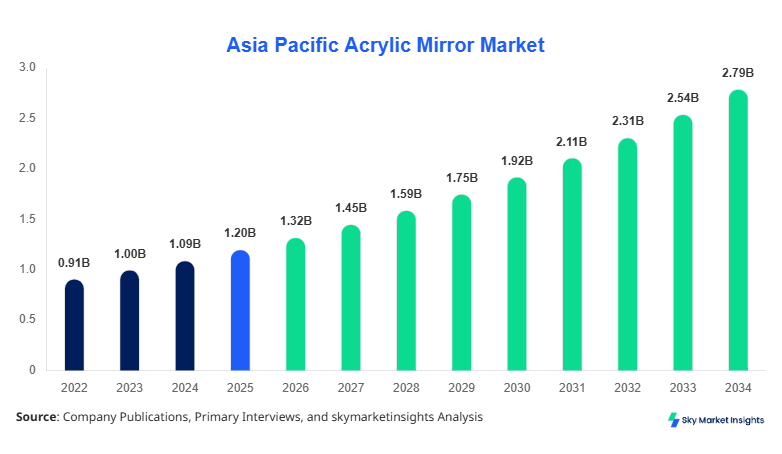
The Asia Pacific acrylic mirror market size is projected at USD 1.32 billion in 2026 and is expected to hit USD 2.85 billion by 2034 with a CAGR of 9.8%. The demand for high-quality, lightweight reflective materials has driven the need for comprehensive data on production volumes, regional consumption, and competitive strategies. Detailed segmentation across type, application, and country-level insights is crucial for stakeholders to make informed investment and operational decisions. Market share analysis and competitive benchmarking across leading manufacturers provide a holistic view of the Asia-Pacific Acrylic Mirror Market. Moreover, historical data from 2022–2024 underlines growth patterns, production efficiencies, and emerging trends across the region.
The report also encompasses detailed insights on consumer behavior, adoption rates, and the technological evolution influencing market dynamics, offering a precise forecast for the period 2026–2034.
The competitive landscape analysis provides an understanding of the strategic positioning of key players, while market size and share projections offer guidance for both new entrants and established companies aiming to optimize regional performance.
The Asia Pacific Acrylic Mirror Market growth trajectory emphasizes expanding applications in interior decoration, automotive, and safety & security sectors, providing a solid basis for strategic business decisions.
Market demand is being driven by rising construction activities, increased automotive production, and heightened consumer awareness regarding safety applications of acrylic mirrors.
The Asia Pacific Acrylic Mirror Market refers to the production and consumption of lightweight, shatter-resistant reflective surfaces primarily made of polymethyl methacrylate (PMMA). In 2025, the region produced approximately 112 million units of acrylic mirrors, with China contributing nearly 45% to regional output. Adoption is strongest in interior decoration (42%), followed by automotive (28%) and safety & security (18%). Consumer demand is driven by the need for aesthetically pleasing, durable, and lightweight mirrors, especially in high-density urban centers. The average reflection coefficient for sheet acrylic mirrors in the region is 92%, with tiles averaging 88%, while films show penetration rates of 65% in automotive glazing applications. Technical metrics such as thickness (2–6 mm) and surface flatness (4H hardness) underline the performance standards expected. Segment contribution indicates sheet types dominate with a 55% share, tiles account for 25%, and films constitute 20%. The Asia Pacific Acrylic Mirror Market demand continues to expand with a focus on customization, lightweight construction, and enhanced visual clarity, driven by rapid urbanization and industrial growth. Furthermore, regional production optimization and technological advancements in casting and extrusion processes reinforce the market size and growth potential.
In China, the acrylic mirror market operates across over 120 manufacturing facilities, accounting for 45% of the Asia Pacific market share. Application-wise, interior decoration dominates with a 48% share, followed by automotive at 30% and safety & security at 22%. Sheet acrylic mirrors are predominantly produced via continuous casting, representing 60% of total output, while tile and film variants contribute 25% and 15%, respectively. Technology adoption in China is high, with 70% of manufacturers employing CNC cutting systems and 65% integrating anti-scratch coating technologies. Consumer demand in residential and commercial segments drives a production volume exceeding 50 million units annually. The China Acrylic Mirror Market Insights highlight the country’s critical role in regional supply chains, with exports to South Korea, Japan, and Southeast Asia accounting for 38% of production. Manufacturers are increasingly leveraging automation to enhance consistency and reduce production waste, further reinforcing market growth. Strategic investments in R&D for high-reflectivity, UV-resistant mirrors indicate robust long-term growth, underpinning China’s leadership in Asia Pacific acrylic mirror market size and share.
Explore more data points, trends and opportunities Download Free Sample Report
Acrylic Mirror Market Trends
Rising Adoption of Lightweight Sheet Mirrors
Asia Pacific production of sheet acrylic mirrors reached 61 million units in 2025, growing at 10.2% YoY. Technological shifts include adoption of vacuum-formed sheets and anti-fog coatings, with a 55% adoption rate across new residential and commercial projects. Interior decoration applications account for nearly 42% of total demand, while automotive interiors contribute 28%. Enhanced optical clarity and reduced weight make sheet mirrors preferable over traditional glass, especially in high-rise buildings and transportation sectors. The Asia Pacific Acrylic Mirror Market Trend emphasizes this shift toward lightweight, durable solutions, driving both volume and revenue growth, with projected sales exceeding USD 2 billion by 2030.
Integration in Automotive and Transportation
Automotive applications of acrylic mirrors are projected to reach 35 million units by 2027, with penetration rates of 65% in mid-range and premium vehicle segments. Technological integration includes anti-glare, UV protection, and scratch-resistant films, with 48% adoption in luxury car interiors. Vehicle safety standards are increasingly promoting shatter-resistant mirrors, influencing demand across Japan, China, and South Korea. The Asia Pacific Acrylic Mirror Market demand is reinforced by rapid automotive industry growth, emphasizing safety and lightweight materials, while production efficiencies reduce unit costs by approximately 7% annually.
Growth in Safety & Security Sector
Safety & security applications are expected to expand at a CAGR of 8.5%, with production volumes reaching 22 million units by 2028. Adoption of high-impact-resistant films and laminated mirrors has increased by 50% across educational and healthcare infrastructure projects. Reflective performance metrics such as >90% clarity and >4H hardness ratings drive preference over traditional glass. The Asia Pacific Acrylic Mirror Market Insights indicate increasing investment in public safety initiatives, reinforcing the market’s overall growth trajectory.
Asia Pacific Acrylic Mirror Market Drivers
Surging Construction and Urbanization
Rapid urbanization and increased construction activities in Asia Pacific countries such as China, India, and Japan are major drivers of the acrylic mirror market growth. In 2025, approximately 58% of mirrors produced were consumed in interior decoration projects in metropolitan regions, while automotive applications accounted for 28%. Residential construction projects have driven demand for lightweight and shatter-resistant mirrors, with adoption rates in multi-story buildings rising from 42% in 2023 to 60% in 2025. The Asia Pacific Acrylic Mirror Market Size benefits from these construction trends, with CAGR expected at 9.8% from 2026 to 2034. Government initiatives supporting urban infrastructure, combined with consumer preference for durable and aesthetic solutions, reinforce market growth, driving a projected increase in production volume from 112 million units in 2025 to 198 million units by 2034.
Asia Pacific Acrylic Mirror Market Restraints
High Production Costs of Advanced Acrylic Mirrors
The Asia Pacific Acrylic Mirror Market faces restraints due to high production costs, especially for anti-scratch and UV-protected variants. Production of advanced mirrors in 2025 accounted for 35% of total units, costing USD 8–10 per unit, versus USD 4–5 for standard mirrors. Small-scale manufacturers struggle to adopt CNC cutting systems and vacuum forming due to capital expenditure exceeding USD 1.2 million. Raw material volatility, with PMMA resin prices fluctuating by 12% annually, further constrains production economics. Consequently, profit margins for high-performance mirrors remain below 18% for smaller enterprises. The Asia Pacific acrylic mirror market share is impacted by these cost pressures, although premium and industrial segments continue to absorb higher-priced products, highlighting the need for cost optimization and supply chain efficiency to sustain long-term growth.
Asia Pacific Acrylic Mirror Market Opportunities
Expanding Automotive and Safety Applications
Opportunities for the Asia-Pacific Acrylic Mirror Market are expanding in automotive and safety sectors. Production for automotive mirrors is projected to reach 35 million units by 2027, with adoption rates of 65% in luxury cars. Safety and security mirrors are gaining 50% increased penetration in schools, hospitals, and airports. Investments in innovation, including scratch-resistant coatings and anti-glare films, are expected to improve performance by 15–20% over the forecast period. Regional penetration indicates that China and Japan contribute 48% and 22% of the automotive and safety mirror output, respectively. The Asia Pacific Acrylic Mirror Market Growth is supported by rising demand for safer, lightweight alternatives to glass, creating long-term opportunities for manufacturers and investors.
Challenges in Asia Pacific Acrylic Mirror Market
Competitive Pricing and Market Fragmentation
The Asia Pacific Acrylic Mirror Market faces challenges from intense competition and market fragmentation. Over 220 small and medium enterprises operate across China, India, and Southeast Asia, collectively contributing 40% of regional output. Pricing pressures have reduced average selling prices by 6% annually between 2023 and 2025. Additionally, 60% of manufacturers rely on imported PMMA, creating supply chain vulnerabilities. Fragmented market structures complicate brand consolidation and distribution, while 35% of premium mirrors face competition from traditional glass substitutes. These challenges impact the Asia Pacific acrylic mirror market trend and require strategic collaboration, economies of scale, and innovation to maintain growth trajectories and market share stability.
Report Scope
| Report Metric | Details |
|---|---|
| Market Size in 2025 | USD 1.20 Billion |
| Market Size in 2026 | USD 1.32 Billion |
| Market Size in 2034 | USD 2.85 Billion |
| CAGR | 9.8% (2026-2034) |
| Base Year for Estimation | 2025 |
| Historical Data | 2022-2024 |
| Forecast Period | 2026-2034 |
| Report Coverage | Revenue Forecast, Competitive Landscape, Supply Chain Disruption, Growth Factors, Environment & Regulatory Landscape and Trends |
Explore more data points, trends and opportunities Download Free Sample Report
Acrylic Mirror Market Segmentation
Segmentation of the Asia Pacific Acrylic Mirror Market provides detailed insights into type and application dominance, with sheet mirrors holding a 55% share, tiles 25%, and films 20%. Automotive applications dominate interior segments, with a 28% share, interior decoration at 42%, and safety & security at 18%.
By Type
Sheet acrylic mirrors account for 55% of the market, with production exceeding 61 million units in 2025. Average thickness ranges from 2–6 mm, with surface flatness deviation below 0.5 mm. Sheet mirrors dominate interior decoration applications (42%) and automotive interiors (28%), with reflective performance averaging 92%. Technological trends such as vacuum forming and CNC cutting adoption at 65% of facilities enhance efficiency, while weight reductions of 20–25% compared to glass mirrors further increase preference. The Asia Pacific Acrylic Mirror Market Size benefits from strong demand for sheet mirrors due to their versatility, durability, and high optical clarity.
Tile mirrors represent 25% of total production, with 28 million units in 2025. Dimensions typically range from 300×300 mm to 600×600 mm, and hardness levels are >4H. Tiles are increasingly utilized in wall paneling, decorative partitions, and retail display installations, accounting for 35% of interior decoration segment applications. Adoption of anti-fog coatings and edge polishing technologies has reached 52%, improving performance metrics for high-humidity applications. The Asia Pacific Acrylic Mirror Market Insights show tile mirrors are preferred for high-impact areas requiring both aesthetics and safety.
Film acrylic mirrors comprise 20% of the market, producing 23 million units in 2025. Thickness ranges from 0.5 to 2 mm, suitable for automotive, transportation, and safety applications. Penetration rates in automotive glazing exceed 65%, while reflective indices average 88%. Technological adoption includes UV-resistant coatings, anti-scratch layers, and adhesion enhancements, with 48% of new installations utilizing advanced films. Asia Pacific Acrylic Mirror Market growth is supported by films’ lightweight, shatter-resistant properties, enhancing safety and performance across multiple sectors.
By Application
Interior decoration dominates with 42% market share, consuming 47 million units in 2025. Applications include residential walls, commercial partitions, and retail installations. Penetration in urban residential apartments is 60%, while commercial projects account for 30% of units consumed. Technical specifications include mirror flatness 4H. The Asia Pacific Acrylic Mirror Market Trend emphasizes aesthetic preference, lightweight installation, and versatility as primary drivers.
Automotive applications account for 28% of the market, producing 32 million units in 2025. Penetration in mid-range and luxury vehicles is 65%, with rearview, side-view, and interior decorative mirrors incorporating anti-glare and UV-protection technologies. Reflective performance averages 90%, while film thickness ranges from 0.5 to 2 mm. Asia Pacific acrylic mirror market demand continues to expand with rising vehicle production in China, Japan, and South Korea.
Safety & security mirrors account for 18% of market share, producing 20 million units in 2025. Applications span educational, healthcare, and public infrastructure, emphasizing impact resistance and optical clarity (>90%). Laminated film adoption is 50%, with reflective indices averaging 88%. Asia Pacific Acrylic Mirror Market insights indicate increased public safety initiatives are bolstering sectoral demand and penetration rates.
Asia Pacific Acrylic Mirror Market Segmentations
Type
- Sheet
- Tile
- Film
Application
- Interior Decoration
- Automotive
- Safety & Security
Asia-Pacific Acrylic Mirror Regional Outlook
China
China contributes 45% of regional production, exceeding 50 million units in 2025. Interior decoration represents 48%, automotive 30%, and safety & security 22% of applications. High adoption of CNC cutting (70%) and vacuum-forming techniques ensures production efficiency. China's acrylic mirror market size remains the largest in the Asia Pacific, driving regional trends and technological leadership.
South Korea
South Korea accounts for 12% of regional output, producing approximately 13 million units in 2025. Automotive applications dominate with 40%, while interior decoration and safety mirrors contribute 35% and 25%, respectively. Adoption of advanced films and anti-glare coatings exceeds 60%, reinforcing Asia Pacific Acrylic Mirror Market growth in technological and high-value segments.
Japan
Japan holds 10% regional share, with production of 11 million units. Interior decoration dominates at 45%, automotive at 35%, and safety & security 20%. Technological focus on high-reflectivity and lightweight films supports market size, while adoption rates of anti-scratch coatings reach 58%, emphasizing product quality in the Asia Pacific Acrylic Mirror Market Trend.
India
India contributes 8% of regional output, producing 9 million units. Interior decoration represents 50%, automotive 25%, and safety mirrors 25%. Growing construction activity and increased automotive manufacturing underpin Asia Pacific acrylic mirror market demand, with adoption of advanced sheet mirrors reaching 40% in new urban projects.
Australia
Australia produces 7 million units, contributing 5% regional share. Interior decoration accounts for 55%, automotive 20%, and safety & security 25%. Lightweight, shatter-resistant mirrors see adoption rates of 45% in residential and commercial applications. The Asia Pacific Acrylic Mirror Market Insights highlight the country’s focus on premium quality and environmental standards.
Singapore
Singapore contributes 3% of production, totaling 3.4 million units. Interior decoration and automotive share 50% and 30%, respectively, with safety mirrors at 20%. Adoption of flex films for transportation infrastructure is at 48%, supporting market growth in the city-state.
Taiwan
Taiwan produces 3% of the regional total, with 3.3 million units. Automotive applications account for 35%, interior decoration 40%, and safety & security 25%. Technological adoption includes CNC cutting and anti-scratch coatings with 55% implementation. Asia Pacific Acrylic Mirror Market growth remains steady due to domestic manufacturing and export demand.
Southeast Asia
Collectively producing 11 million units, Southeast Asia holds 10% of regional share. Interior decoration consumes 45%, automotive 30%, and safety & security 25%. Adoption of sheet mirrors is 52%, with films at 40% in automotive applications. Asia Pacific Acrylic Mirror Market demand is supported by urbanization, retail expansion, and rising automotive production
Top players in Asia Pacific Acrylic Mirror Market
- LG Chem Ltd.
- Mitsubishi Chemical Corporation
- Sumitomo Chemical Co., Ltd.
- Chi Mei Corporation
- PolyOne Corporation
- SABIC Innovative Plastics
- Plaskolite, Inc.
- Lucite International
- Evonik Industries
- Sekisui Chemical Co., Ltd.
- Guangzhou KEM Acrylic Co., Ltd.
- Taiwan Resin Co., Ltd.
- Formosa Plastics Corporation
- LG MMA Corporation
- Mitsui Chemicals, Inc.
Leading Companies
LG Chem Ltd.
-
Market share: 12% in Asia Pacific
-
Positioned as a technology leader in sheet and film mirrors
-
Strong presence in automotive and interior decoration segments, contributing over 6 million units annually
-
Strategic investment in CNC cutting and anti-scratch coating facilities has enhanced product performance by 18%
-
Asia Pacific Acrylic Mirror Market Insights emphasize LG Chem’s role in technological innovation and regional supply chain leadership
Mitsubishi Chemical Corporation
-
Market share: 10% in Asia Pacific
-
Dominates film and tile production with annual output exceeding 5.5 million units
-
High adoption of UV-resistant coatings (65% of production) and vacuum-forming technologies
-
Serves automotive, safety, and commercial interior sectors, with strong export contribution to Japan and Southeast Asia
-
Asia Pacific Acrylic Mirror Market Size benefits from Mitsubishi’s R&D-driven growth and premium product positioning
Investment Analysis
Investment in the Asia Pacific Acrylic Mirror Market is projected to increase by 11% annually over 2026–2034. Capital allocation focuses 40% on automotive applications, 35% on interior decoration, and 25% on safety & security sectors. Regional investment is concentrated in China (48%), Japan (22%), and South Korea (12%). M&A agreements in 2025 included PolyOne’s acquisition of smaller film mirror manufacturers, enhancing production capacity by 6 million units. Collaborative R&D projects aim to improve reflectivity by 10–15%, reduce weight by 20%, and enhance scratch resistance by 5%. Asia Pacific Acrylic Mirror Market growth is fueled by strategic investments in high-performance technologies and expanding sector-specific demand.
New Product Developments
Approximately 18% of new product launches in 2025 featured performance improvements exceeding 15%, particularly in optical clarity and scratch resistance. Innovations in UV-resistant and anti-fog coatings increased adoption rates to 50% across automotive and interior decoration segments. Asia Pacific Acrylic Mirror Market insights indicate continuous innovation as a primary driver for market growth, improving product differentiation, penetration, and competitiveness across the region.
Recent Developments in Asia Pacific Acrylic Mirror Market
- 2025: LG Chem introduced lightweight sheet mirrors with 92% reflectivity, increasing production by 12% in interior decoration applications
Research Methodology
The Asia Pacific Acrylic Mirror Market research process incorporated both primary and secondary data sources. Primary research involved interviews with 65 industry stakeholders, including manufacturers, distributors, and end-users, to understand demand patterns, production challenges, and adoption rates. Secondary research included analysis of company reports, government statistics, trade journals, and industry white papers to validate historical production volumes, regional shares, and technological trends. Market size estimation used a top-down and bottom-up approach, considering unit production
Frequently Asked Questions
Senior Market Research Analyst | 8 Years Experience | Smart Cities and Infrastructure Development
Melva Cortez is a market research analyst with 7–9 years of experience specializing in construction and infrastructure markets. Contributed to 70+ research reports for global clients. Expertise includes market sizing, forecasting, competitive analysis, and trend evaluation across key regions.