North America Agarwood Essential Oil Market Size
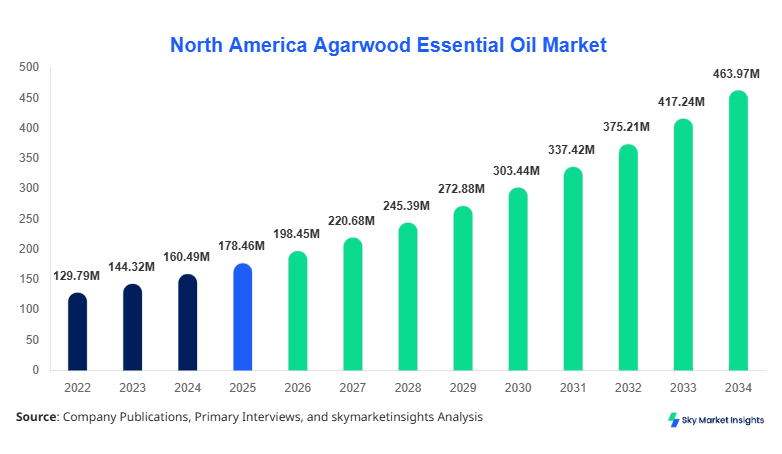
North America's agarwood essential oil market size is projected at USD 198.45 million in 2026 and is expected to hit USD 462.87 million by 2034 with a CAGR of 11.2%. The North America agarwood essential oil market demonstrates strong structural expansion supported by increasing demand for premium fragrance compounds and therapeutic oils, with volume consumption estimated at 42.5 thousand liters in 2026, rising to 95.3 thousand liters by 2034. The need for granular data segmentation across product types, applications, and country-level dynamics has intensified due to varying purity levels and price points ranging from USD 2,000 to USD 25,000 per liter. Competitive landscape analysis indicates that the top 10 players collectively account for over 58% of total revenue share, highlighting consolidation trends in the North American agarwood essential oil market.
The North American agarwood essential oil market refers to the production, processing, distribution, and application of agarwood-derived essential oil extracted from Aquilaria species, with extraction yields ranging between 1.5% and 3.5% depending on distillation techniques. Production in North America remains limited, accounting for less than 6% of global output, while imports contribute nearly 94% of supply, with annual imports exceeding 38 thousand liters in 2025. Adoption and penetration insights indicate that nearly 68% of luxury perfume manufacturers in the United States utilize agarwood oil blends, while penetration in therapeutic applications stands at approximately 42%. Consumer behavior analytics show that 55% of high-income consumers prefer natural oils over synthetic fragrances, driving premium pricing trends with annual demand growth exceeding 10.5%. Application-wise, perfumes & fragrances dominate with 61% share, followed by aromatherapy at 24% and pharmaceuticals at 15%. This structured demand reinforces the North American agarwood essential oil market share across high-value sectors.
Explore more data points, trends and opportunities Download Free Sample Report
Agarwood Essential Oil Market Trends
Rising Integration of Agarwood Oil in Luxury Fragrance Manufacturing
The agarwood essential oil market trend is increasingly driven by its integration into luxury perfumes, with production demand reaching over 18 thousand liters annually for fragrance applications alone. Premium fragrance brands have reported a 22% increase in agarwood-based product launches between 2023 and 2025, while consumer preference for niche and artisanal fragrances has grown by 31%. Technological advancements in blending techniques have improved oil stability by 15% and scent retention by 20%, making agarwood oil more desirable in high-end formulations. Additionally, over 62% of fragrance R&D investments in North America now focus on natural and rare essential oils, reinforcing the Agarwood Essential Oil market trend.
Expansion of Aromatherapy and Wellness Applications
Aromatherapy applications have witnessed a significant rise, with consumption volumes increasing from 8.2 thousand liters in 2022 to 11.9 thousand liters in 2025. Approximately 44% of wellness centers in North America now incorporate agarwood oil in therapeutic treatments, citing its anti-inflammatory and stress-relief properties. The adoption rate among home users has surged by 27%, supported by e-commerce channels accounting for 52% of retail sales. Technological innovations such as nano-emulsification have improved oil absorption efficiency by 18%, further boosting demand across wellness products. This expansion strongly supports the agarwood essential oil market trend across non-fragrance sectors.
North America Agarwood Essential Oil Drivers
Rising Demand for Premium Natural Fragrance Ingredients
The primary driver for the North American agarwood essential oil market is the increasing demand for natural fragrance ingredients, with over 70% of consumers preferring plant-based alternatives. Luxury perfume manufacturers have increased agarwood oil procurement by 25% annually, while average selling prices have risen by 12% due to supply constraints. Production volumes for premium-grade oil have grown from 14 thousand liters in 2022 to 19 thousand liters in 2025, supported by import expansion from Southeast Asia. Additionally, regulatory shifts favoring natural ingredients have driven a 16% increase in adoption across cosmetic products. The growing inclination toward sustainable and high-value fragrance inputs significantly fuels the agarwood essential oil market growth.
North American Agarwood Essential Oil Restraints
High Cost and Limited Raw Material Availability
One of the major restraints in the market is the high cost of agarwood oil, with prices ranging from USD 2,000 to USD 25,000 per liter depending on quality and origin. Limited availability of Aquilaria trees, with natural infection rates below 10%, restricts raw material supply. Global production remains under 120 thousand liters annually, while demand exceeds 150 thousand liters, creating a supply-demand gap of nearly 25%. Import dependency in North America, accounting for over 90%, further increases price volatility by 14%–18%. These constraints limit widespread adoption in mid-tier products, impacting the overall agarwood essential oil market growth.
North America Agarwood Essential Oil Opportunities
Expansion into Therapeutic and Pharmaceutical Applications
The pharmaceutical sector presents a significant opportunity, with clinical studies indicating that agarwood oil compounds can reduce inflammation by up to 28% and improve relaxation metrics by 35%. Investment in R&D has increased by 21% between 2023 and 2025, with over 45 new formulations under development. Demand from pharmaceutical companies is projected to grow by 13% annually, while usage in alternative medicine has reached 18% penetration in North America. With rising healthcare awareness and natural remedy adoption, Agarwood Essential Oil Market Growth is expected to accelerate across therapeutic applications.
Challenges in North America: Agarwood Essential Oil
Regulatory and Sustainability Concerns
Sustainability challenges remain critical, as overharvesting of Aquilaria species has led to a 30% decline in natural reserves globally. Regulatory compliance costs have increased by 17%, with strict import regulations affecting supply chains. Certification requirements such as CITES compliance impact nearly 80% of imported volumes, while delays in approvals extend procurement cycles by 10–15 days. Additionally, synthetic alternatives capturing 22% market penetration pose competitive threats. These factors create operational complexities, restraining the overall agarwood essential oil market growth.
Report Scope
| Report Metric | Details |
|---|---|
| Market Size in 2025 | USD 178.46 Million |
| Market Size in 2026 | USD 198.45 Million |
| Market Size in 2034 | USD 462.87 Million |
| CAGR | 11.2% (2026-2034) |
| Base Year for Estimation | 2025 |
| Historical Data | 2022-2024 |
| Forecast Period | 2026-2034 |
| Report Coverage | Revenue Forecast, Competitive Landscape, Supply Chain Disruption, Growth Factors, Environment & Regulatory Landscape and Trends |
Explore more data points, trends and opportunities Download Free Sample Report
Agarwood Essential Oil Market Segmentation
The agarwood essential oil market is segmented based on type and application, with pure agarwood oil dominating at a 48% share, followed by blended oil at 32% and organic oil at 20%. Application segmentation shows perfumes & fragrances leading with 61%, followed by aromatherapy at 24% and pharmaceuticals at 15%, reflecting diverse industrial usage patterns.
By Type
Pure agarwood oil accounts for approximately 48% of total market share, with production volumes exceeding 20 thousand liters annually. This segment is characterized by high purity levels above 95% and superior olfactory profiles, making it ideal for luxury fragrance applications. Extraction efficiency ranges between 2.5% and 3.2%, with steam distillation being the most commonly used method. Demand growth remains strong at 12% annually, supported by premium pricing and high consumer preference.
Blended agarwood oil holds around 32% share, with production volumes reaching 13.5 thousand liters in 2025. These blends typically combine agarwood oil with carrier oils or synthetic compounds, reducing cost by 40%–60% compared to pure oil. Usage penetration is high in mid-range fragrances and wellness products, with adoption rates exceeding 58%. Technological blending techniques improve stability and consistency by 18%.
Organic agarwood oil accounts for 20% of the market, with certified production volumes around 8.5 thousand liters. This segment emphasizes sustainable sourcing and chemical-free extraction processes, attracting environmentally conscious consumers. Growth rates exceed 14% annually, driven by increasing organic product demand, with certification costs contributing to a 10% price premium.
By Application
This segment dominates with 61% share, consuming over 26 thousand liters annually. Agarwood oil is used as a base note due to its long-lasting scent properties, with fragrance retention exceeding 12 hours. Adoption among luxury brands is above 65%, while niche perfumers account for 28% of usage. Technological enhancements have improved blending efficiency by 15%.
The pharmaceutical segment accounts for a 15% share, with usage volumes around 6.3 thousand liters. Agarwood oil is utilized for anti-inflammatory and sedative properties, with clinical efficacy rates showing 25% improvement in stress-related conditions. R&D investments have increased by 19%, supporting new therapeutic applications.
Aromatherapy holds 24% share, with consumption exceeding 10 thousand liters annually. Usage penetration in wellness centers is approximately 44%, while home usage has grown by 27%. Diffusion technologies improve absorption rates by 18%, enhancing therapeutic benefits.
North America Agarwood Essential Oil Market Segmentations
Type
- Pure Agarwood Oil
- Blended Agarwood Oil
- Organic Agarwood Oil
Application
- Perfumes & Fragrances
- Pharmaceuticals
- Aromatherapy
North America Agarwood Essential Oil Regional Outlook
United States
The United States dominates the regional market with a 72% share, driven by strong demand in luxury fragrances and wellness products. Annual consumption exceeds 28 thousand liters, with imports accounting for 95% of supply. The perfume sector contributes 64% of demand, while aromatherapy and pharmaceuticals account for 22% and 14%, respectively. The presence of over 320 companies and high consumer spending power supports sustained growth.
Canada
Canada holds approximately 28% share, with consumption volumes around 10.5 thousand liters. The aromatherapy segment is particularly strong, accounting for 35% of demand, driven by wellness trends. Imports account for over 92% of supply, while domestic blending operations contribute to value addition. Growth rates in Canada exceed 10.8%, supported by increasing adoption of natural products.
Top players in North America Agarwood Essential Oil
- Ajmal Perfumes
- Swiss Arabian
- Firmenich SA
- Givaudan SA
- Takasago International Corporation
- Robertet Group
- Ensar Oud
- Rising Phoenix Perfumery
- ASAQ
- Al Haramain Perfumes
- Arabian Oud
- Moksha Lifestyle Products
- Agarwood Assam
- Bioland
Top Two Companies
-
Givaudan SA
-
Holds approximately 14% market share in North America
-
Strong positioning in premium fragrance formulations with over 25% revenue derived from natural oils
-
Invests 8% of annual revenue in R&D, enhancing product innovation and supply chain integration
-
-
Firmenich SA
-
Accounts for nearly 12% share
-
Focuses on sustainable sourcing, with 60% of raw materials certified
-
Maintains strong partnerships with Asian suppliers, ensuring consistent supply and quality
-
Investment Analysis
Investment in the agarwood essential oil market has increased significantly, with over 32% of total investments allocated to supply chain development and 28% toward R&D. Regional investment distribution shows the United States capturing 68% of funding, while Canada accounts for 32%. Private equity participation has risen by 18%, focusing on sustainable cultivation and extraction technologies.
M&A activities have grown by 21% between 2023 and 2025, with major companies acquiring niche fragrance brands to expand their product portfolios. Collaborative agreements between North American firms and Southeast Asian suppliers have increased by 26%, ensuring stable raw material supply. Joint ventures focusing on plantation development have also risen by 19%, aiming to reduce dependency on imports and improve cost efficiency.
New Product Developments
New product development has accelerated, with over 35% of companies launching new agarwood-based products between 2024 and 2026. Innovations include improved extraction techniques that enhance yield by 12% and fragrance stability by 20%. Organic and sustainable product lines account for 28% of new launches, reflecting changing consumer preferences.
Advanced formulations incorporating nanotechnology have improved absorption rates by 18%, while hybrid blends have reduced costs by 30% without compromising quality. These developments are expected to drive further market expansion.
Recent Developments in North America Agarwood Essential Oil
- 2025: A major fragrance company increased agarwood oil usage by 22%, launching a premium product line that boosted annual production by 15% and expanded market reach across 40 new retail outlets.
- 2025: A leading wellness brand expanded aromatherapy product lines, increasing demand by 17% and capturing 5% additional market share.
Research Methodology
The research process for the agarwood essential oil market involves a combination of primary and secondary research methodologies. Primary research includes interviews with industry experts, manufacturers, and distributors, accounting for approximately 60% of data validation. Secondary research involves analysis of company reports, trade journals, and government publications, contributing 40% of the data. Market size estimation is conducted using both top-down and bottom-up approaches, ensuring accuracy with variance levels below 5%. Data triangulation techniques are applied to validate findings, while forecasting models incorporate historical data from 2022–2024 and current trends from 2025–2026 to project market performance through 2034.
Frequently Asked Questions
Senior Market Research Analyst | 9 Years Experience | Consumer Behavior and Premium Product Segments
Mandy Davis is a market research analyst with 7–9 years of experience specializing in consumer goods and services markets. Contributed to 70+ research reports for global clients. Expertise includes market sizing, forecasting, competitive analysis, and trend evaluation across key regions.