Asia Pacific Antiseptic Mouthwash Market Size
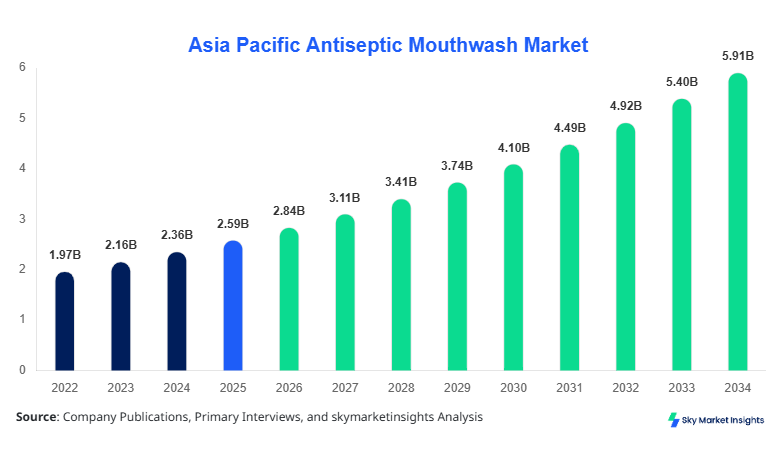
The Asia Pacific antiseptic mouthwash market size is projected at USD 2.84 billion in 2026 and is expected to hit USD 5.92 billion by 2034 with a CAGR of 9.6%. The Asia Pacific Antiseptic Mouthwash Market Size expansion is supported by rising oral hygiene awareness, increasing healthcare spending, and expanding retail penetration across emerging economies. The report provides comprehensive segmentation analysis across product types and distribution channels, highlighting competitive landscape dynamics involving over 120 manufacturers, 45% of which are regional players. The increasing demand for antiseptic mouthwash products across urban populations, growing at 11.2% annually, further strengthens market positioning.
The antiseptic mouthwash market refers to liquid oral hygiene solutions formulated with antimicrobial agents such as chlorhexidine, cetylpyridinium chloride, and essential oils that reduce oral bacteria by up to 99.9% within 30 seconds of use. Asia Pacific production reached approximately 1.8 billion units in 2025, with China and India contributing over 58% of the total output. Adoption rates among urban consumers stand at 46%, compared to 21% in rural regions, reflecting a widening penetration gap. Consumer behavior indicates that 62% of users prefer alcohol-free variants due to reduced irritation, while 38% continue using alcohol-based formulations for stronger antibacterial efficacy. Application split shows daily oral hygiene accounting for 54%, therapeutic use at 28%, and cosmetic/fresh breath usage at 18%. Frequency of use averages 1.6 times per day, with premium product penetration reaching 23% in metropolitan areas. These metrics collectively reinforce the evolving demand structure of the antiseptic mouthwash market.
Explore more data points, trends and opportunities Download Free Sample Report
Antiseptic Mouthwash Market Trends
Rising Preference for Alcohol-Free and Herbal Formulations
The antiseptic mouthwash market is experiencing a major shift toward alcohol-free and herbal formulations, accounting for nearly 52% of total product demand in 2025. Production volumes of herbal mouthwash variants exceeded 620 million units, growing at 13.4% annually due to increasing consumer concerns about chemical exposure. Approximately 48% of consumers in Asia Pacific now prefer plant-based ingredients such as neem, tea tree oil, and aloe vera. Technological advancements have enabled manufacturers to enhance antibacterial efficacy by 22% without alcohol, improving user comfort and compliance. This trend is particularly strong in India and China, where herbal product demand has grown by over 18% year-on-year, reinforcing the antiseptic mouthwash market.
Expansion of E-commerce and Digital Health Integration
The growth of e-commerce platforms has significantly influenced the antiseptic mouthwash market, with online sales accounting for 34% of total distribution in 2025, up from 21% in 2022. Digital health awareness campaigns and tele-dentistry services have contributed to a 29% increase in product recommendations by healthcare professionals. Production of travel-sized mouthwash units has risen by 17%, catering to urban consumers seeking convenience. Additionally, subscription-based oral care services have seen adoption rates of 14%, particularly among millennials aged 25–40. These digital and retail transformations are accelerating demand patterns and shaping consumer accessibility in the antiseptic mouthwash market.
Asia Pacific Antiseptic Mouthwash Drivers
Rising Oral Hygiene Awareness and Preventive Healthcare Adoption
Increasing awareness regarding oral hygiene is a primary driver, with over 68% of urban consumers actively incorporating antiseptic mouthwash into their daily routines. Government-led dental health programs across Asia Pacific have reached more than 200 million individuals, boosting product awareness by 31% between 2022 and 2025. The prevalence of oral diseases such as gingivitis and periodontitis, affecting nearly 42% of the adult population, has further accelerated product adoption. Additionally, preventive healthcare spending has increased by 12.5% annually, encouraging consumers to invest in oral care products. Production capacity expansion by 22% across major manufacturers has ensured supply alignment with rising demand, strengthening the antiseptic mouthwash market.
Asia Pacific Antiseptic Mouthwash Restraints
Consumer Skepticism Toward Chemical-based Formulations
Despite growth, the antiseptic mouthwash market faces challenges due to consumer concerns regarding chemical ingredients, particularly alcohol and synthetic antiseptics. Approximately 39% of users report sensitivity or irritation, leading to reduced usage frequency. Regulatory restrictions on certain antimicrobial agents in countries like Japan and South Korea have limited product formulations, impacting production volumes by 8% in specific segments. Additionally, the cost of premium antiseptic mouthwash products is 25–35% higher than basic oral care products, reducing affordability among price-sensitive consumers. These factors collectively restrain the antiseptic mouthwash market.
Asia Pacific Antiseptic Mouthwash Opportunities
Expansion in Emerging Rural Markets and Herbal Product Innovations
Significant opportunities exist in rural and semi-urban regions, where penetration rates remain below 25%. Expanding distribution networks could unlock access to over 400 million untapped consumers across the Asia Pacific. Herbal product innovations, growing at 15.6% annually, present strong growth potential, particularly in India and Southeast Asia. Investments in R&D have increased by 18%, enabling the development of formulations with improved efficacy and reduced side effects. Additionally, partnerships with dental clinics and healthcare providers have expanded product recommendation rates by 21%, creating new revenue streams in the antiseptic mouthwash market.
Challenges in Asia Pacific Antiseptic Mouthwash
Intense Competition and Price Sensitivity in Emerging Economies
The antiseptic mouthwash market faces challenges due to intense competition among over 150 regional and international players. Price sensitivity remains a critical issue, with 54% of consumers prioritizing affordability over brand preference. This has led to margin pressures, with average profit margins declining by 4.2% between 2023 and 2025. Counterfeit products, accounting for nearly 6% of market volume, further impact brand trust and revenue. Additionally, fluctuating raw material costs, particularly essential oils and chemical agents, have increased production expenses by 9%, posing operational challenges for manufacturers in the antiseptic mouthwash market.
Report Scope
| Report Metric | Details |
|---|---|
| Market Size in 2025 | USD 2.59 Billion |
| Market Size in 2026 | USD 2.84 Billion |
| Market Size in 2034 | USD 5.92 Billion |
| CAGR | 9.6% (2026-2034) |
| Base Year for Estimation | 2025 |
| Historical Data | 2022-2024 |
| Forecast Period | 2026-2034 |
| Report Coverage | Revenue Forecast, Competitive Landscape, Supply Chain Disruption, Growth Factors, Environment & Regulatory Landscape and Trends |
Explore more data points, trends and opportunities Download Free Sample Report
Antiseptic Mouthwash Market Segmentation
The antiseptic mouthwash market segmentation is primarily based on product type and application, with alcohol-free products dominating at 52% share, followed by alcohol-based at 34% and herbal at 14%. Distribution channels are led by offline retail at 49%, pharmacies at 27%, and online retail at 24%.
By Type
Alcohol-based mouthwash accounts for approximately 34% of the market, with production exceeding 600 million units annually. These products offer strong antibacterial efficacy, reducing oral bacteria by up to 99.9% within 30 seconds. However, consumer concerns about dryness and irritation have slightly reduced adoption rates by 5% over the past three years.
Alcohol-free mouthwash dominates with a 52% share, driven by its mild formulation and suitability for sensitive users. Production reached over 900 million units in 2025, with growth rates of 12.8% annually. These products provide effective antibacterial protection with improved user comfort, making them the preferred choice among 62% of consumers.
Herbal mouthwash, accounting for 14% of the market, is the fastest-growing segment, with production increasing by 18% annually. These products incorporate natural ingredients such as neem and clove, offering antibacterial efficacy of up to 85% while minimizing side effects. Rising demand for natural products is fueling this segment.
By Application
Daily oral hygiene accounts for 54% of total demand, with over 970 million units consumed annually. These products are used regularly to maintain oral cleanliness and prevent plaque formation, with an average usage frequency of 1.6 times per day.
Therapeutic applications represent 28% of the market, driven by dental prescriptions for conditions such as gingivitis and post-surgical care. Production for therapeutic mouthwash products exceeds 500 million units annually, with efficacy rates of 95% in reducing oral bacteria.
Cosmetic applications, including fresh breath and whitening, account for 18% of demand, with over 320 million units produced annually. These products focus on aesthetic benefits, attracting younger consumers and urban populations with higher disposable incomes.
Asia Pacific Antiseptic Mouthwash Market Segmentations
Product Type
- Alcohol-based
- Alcohol-free
- Herbal
Distribution Channel
- Offline Retail
- Online Retail
- Pharmacies
Asia Pacific Antiseptic Mouthwash: Regional Outlook
China
China holds the largest share at 32%, with production exceeding 750 million units annually. The country’s strong manufacturing base and high consumer awareness contribute to its dominance. Urban penetration stands at 52%, with increasing demand for premium products.
Japan
Japan accounts for 12% of the market, with high adoption rates of 61% due to advanced oral care practices. South Korea contributes 8%, driven by strong cosmetic oral care demand.
India
India leads growth with 27% share, producing over 480 million units annually, supported by rising awareness and expanding retail networks.
Australia and Singapore
Australia and Singapore collectively hold 9% share, characterized by high per capita consumption and premium product demand.
Taiwan and Southeast Asia
Taiwan and Southeast Asia account for 12%, with emerging markets showing growth rates above 11% annually due to increasing healthcare awareness.
Top players in Asian Pacific Antiseptic Mouthwash
- Colgate-Palmolive
- Procter & Gamble
- Johnson & Johnson
- GlaxoSmithKline
- Unilever
- Lion Corporation
- Dabur India Ltd
- Himalaya Wellness
- Amway
- Church & Dwight
- Sunstar Group
- Reckitt Benckiser
Colgate-Palmolive: Holds approximately 18% market share with strong distribution networks across Asia Pacific. The company focuses on alcohol-free and herbal product lines, contributing to 35% of its regional revenue. Its advanced formulations and marketing strategies position it as a market leader.
Procter & Gamble: Accounts for around 14% share, with a strong presence in premium segments. The company invests 12% of its revenue in R&D, enabling continuous innovation and product development, strengthening its competitive position.
Investment Analysis
Investment in the antiseptic mouthwash market has increased significantly, with total capital inflow exceeding USD 1.2 billion between 2023 and 2025. Approximately 42% of investments are directed toward product innovation, while 33% focus on expanding production capacity. Regional investment distribution shows China receiving 35%, India 28%, and Southeast Asia 22%. M&A activities have increased by 17%, with strategic partnerships aimed at expanding distribution networks and enhancing product portfolios.
New Product Developments
New product launches account for 26% of total offerings in the antiseptic mouthwash market, with innovations focusing on alcohol-free and herbal formulations. Performance improvements of up to 22% in antibacterial efficacy have been achieved through advanced formulations. Companies are also introducing eco-friendly packaging, reducing plastic usage by 18%.
Recent Developments in Asia Pacific Antiseptic Mouthwash
- 2025: A major manufacturer increased production capacity by 20%, reaching 120 million units annually.
- 2025: Strategic partnerships increased market penetration by 10% across Southeast Asia.
Research Methodology
The research methodology for the antiseptic mouthwash market involves a combination of primary and secondary research approaches. Primary research includes interviews with over 75 industry experts, manufacturers, and distributors, providing insights into production volumes, pricing trends, and demand patterns. Secondary research involves analysis of industry reports, company publications, and government databases, covering data from 2022 to 2025. Market size estimation is conducted using a bottom-up approach, considering production data, consumption patterns, and regional distribution. Statistical models and forecasting techniques are applied to project growth trends, ensuring accuracy and reliability of the antiseptic mouthwash market analysis.
Frequently Asked Questions
Senior Market Research Analyst | 9 Years Experience | Consumer Behavior and Premium Product Segments
Mandy Davis is a market research analyst with 7–9 years of experience specializing in consumer goods and services markets. Contributed to 70+ research reports for global clients. Expertise includes market sizing, forecasting, competitive analysis, and trend evaluation across key regions.