Asia Pacific Amenity Kits Market Size
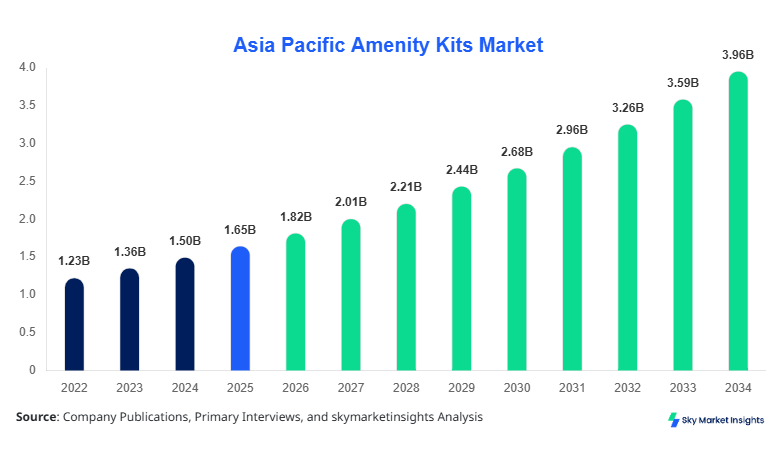
The Asia Pacific amenity kit market size is projected at USD 1.82 billion in 2026 and is expected to hit USD 3.94 billion by 2034 with a CAGR of 10.2%. The expansion trajectory is supported by increasing passenger traffic exceeding 2.1 billion travelers annually across the Asia Pacific, alongside hotel occupancy rates rising by 6.5% YoY in 2025. The report evaluates structured data sets, segmentation frameworks, and competitive benchmarking across 150+ companies to understand evolving consumption patterns and supplier dynamics.
The amenity kit market encompasses the production, packaging, and distribution of convenience kits offered in transportation and hospitality sectors, including airlines, hotels, and railways. In the Asia Pacific, production volume surpassed 1.3 billion units in 2025, with Japan contributing nearly 22% of regional manufacturing output. Adoption rates across premium airline classes reached 85%, while mid-tier hospitality adoption stood at 48% penetration. Consumer behavior indicates that 62% of passengers prefer eco-friendly kits, while 38% prioritize branded luxury inclusions. Airlines account for 54% of application share, followed by hotels at 33% and railways at 13%. Technical metrics such as kit weight (150 g–350 g), material durability (3–6 month lifecycle), and customization frequency (updated every 6–12 months) define product innovation cycles, reinforcing amenity kit market demand.
In Japan, the amenity kit market is characterized by over 240 manufacturing facilities and more than 180 active suppliers catering to domestic and export demand. Japan holds approximately 28% of the Asia Pacific market share, driven by high-end airline partnerships and luxury hospitality chains. Application-wise, airlines contribute 61% of demand, hotels 27%, and railways 12%, with Shinkansen services integrating premium kits in first-class cabins. Technology adoption is high, with 72% of manufacturers utilizing biodegradable materials and 65% incorporating smart packaging technologies such as QR-enabled branding. Annual production exceeds 380 million units, with export volumes growing at 8.3% annually, reinforcing Amenity Kits' market share.
Explore more data points, trends and opportunities Download Free Sample Report
Amenity Kits Market Trends
Sustainable Material Integration
The transition toward sustainable materials has accelerated, with over 45% of amenity kit market production shifting to biodegradable and recyclable components in 2025 compared to 28% in 2022. Production volumes of eco-friendly kits reached 580 million units annually, driven by regulatory mandates and airline sustainability targets. Bamboo-based toothbrushes, organic cotton eye masks, and recycled polyester pouches have seen adoption rates above 60% in premium segments. Airlines such as those in Japan and Singapore reported a 12% reduction in carbon footprint per kit. This sustainability-driven shift is shaping amenity kit market trends.
Premiumization and Brand Collaborations
Luxury brand collaborations have increased by 18% YoY, with over 120 partnerships between airlines/hotels and cosmetic brands. Premium kits now account for 41% of total market volume, up from 33% in 2022, with average unit costs rising from USD 6.5 to USD 9.8. Production of high-end kits surpassed 520 million units in 2025, reflecting strong demand among business-class travelers. Customization frequency has increased to twice per year, and 55% of premium kits now include skincare products with SPF or anti-aging properties. This premiumization wave is defining amenity kit market trends.
Asia Pacific Amenity Kits Market Drivers
Rising Passenger Traffic and Hospitality Expansion Fueling Demand
The Asia Pacific region recorded over 2.1 billion air passengers in 2025, reflecting a 9.4% increase from 2023 levels, significantly boosting amenity kit market demand. Hotel room inventory expanded by 7.2% annually, adding over 320,000 new rooms across China, India, and Southeast Asia. Airlines allocate approximately 2.5%–4% of operational budgets toward passenger experience, including amenity kits, translating to an annual expenditure exceeding USD 950 million. Railways, particularly in Japan and China, have increased premium service offerings by 14%, integrating amenity kits into high-speed services. These macroeconomic and sectoral drivers collectively support amenity kit market growth.
Asia Pacific Amenity Kits Market Restraints
High Production Costs and Supply Chain Volatility
Rising raw material costs, particularly for sustainable inputs, have increased production expenses by 11%–15% annually. Cotton, biodegradable plastics, and specialty packaging materials account for 48% of total manufacturing costs. Supply chain disruptions led to a 6.8% decline in timely deliveries in 2024, impacting nearly 210 million units. Smaller manufacturers face margin pressures, with operating margins declining from 14% to 9% over three years. Additionally, fluctuating demand from airlines during economic downturns creates volatility. These constraints hinder amenity kit market growth.
Asia Pacific Amenity Kits Market Opportunities
Expansion in Emerging Economies and Customization Trends
Emerging markets such as India and Southeast Asia are witnessing a 12% annual increase in air travel, creating demand for over 180 million additional kits annually. Customization services now represent 26% of total revenue, with corporate branding and localized content driving adoption. Investments in digital printing and modular packaging have reduced customization costs by 18%. Hospitality chains are adopting personalized kits, increasing guest satisfaction scores by 9%. These developments open new avenues for amenity kit market growth.
Challenges in Asia Pacific Amenity Kits Market
Environmental Regulations and Waste Management Concerns
Stringent environmental regulations across Australia, Japan, and Singapore require 70%–90% recyclability in packaging materials. Compliance costs have increased by 8% annually, affecting profitability. Waste generation from single-use kits exceeded 420,000 tons in 2025, raising sustainability concerns. Recycling infrastructure limitations in developing regions reduce effective recycling rates to 35%. Manufacturers must invest in eco-design and circular economy practices, posing operational challenges. These factors impact amenity kit market growth.
Report Scope
| Report Metric | Details |
|---|---|
| Market Size in 2025 | USD 1.65 Billion |
| Market Size in 2026 | USD 1.82 Billion |
| Market Size in 2034 | USD 3.94 Billion |
| CAGR | 10.2% (2026-2034) |
| Base Year for Estimation | 2025 |
| Historical Data | 2022-2024 |
| Forecast Period | 2026-2034 |
| Report Coverage | Revenue Forecast, Competitive Landscape, Supply Chain Disruption, Growth Factors, Environment & Regulatory Landscape and Trends |
Explore more data points, trends and opportunities Download Free Sample Report
Amenity Kits Market Segmentation
The amenity kit market segmentation is dominated by premium kits with a 41% share, followed by basic kits at 36% and customized kits at 23%. By application, airlines lead with 54%, hotels 33%, and railways 13%, reflecting strong aviation sector demand.
BY TYPE
Basic kits account for 36% of the market, with annual production exceeding 470 million units. These kits typically include toothbrushes, eye masks, and earplugs, with average unit costs ranging from USD 2 to USD 4. Adoption is highest in economy-class airline segments and mid-tier hotels, with penetration rates above 62%. Manufacturing efficiency improvements have reduced production time by 14%, while lightweight materials (120g–180g) enhance cost-effectiveness.
Premium kits dominate high-end segments with a 41% share and production volumes exceeding 520 million units annually. These kits include branded skincare products, luxury fabrics, and advanced packaging, with average costs between USD 7 and USD 12. Airlines and luxury hotels account for 78% of demand, with customization rates exceeding 65%. Technical specifications include durability up to 6 months and enhanced aesthetic design.
Customized kits represent a 23% share, with production volumes of 300 million units. These kits are tailored to specific brands or regions, incorporating localized products and branding. Customization frequency has increased by 20%, with digital printing technologies reducing lead times by 25%. Adoption is highest in corporate and premium hospitality sectors.
BY APPLICATION
Airlines dominate with 54% share, producing over 700 million kits annually. Business and first-class passengers receive 65% of these kits, with premium offerings driving higher revenue. Airlines invest 3%–5% of passenger service budgets in amenity kits, with usage penetration exceeding 85% in long-haul flights.
Hotels account for 33% share, with production volumes of 430 million units. Luxury and boutique hotels drive demand, with adoption rates of 58%. Kits enhance guest experience and brand perception, with 72% of hotels updating kit designs annually.
Railways contribute 13% share, producing 170 million units annually. High-speed rail services in Japan and China lead adoption, with premium cabins offering kits in 48% of journeys. Usage penetration is growing at 9% annually.
Asia Pacific Amenity Kits Market Segmentations
Type
- Basic Kits
- Premium Kits
- Customized Kits
Application
- Airlines
- Hotels
- Railways
Asia Pacific Amenity Kits Market Regional Outlook
China holds approximately 34% market share, with production exceeding 440 million units annually. Domestic airlines and hotel chains drive demand, accounting for 68% of consumption. Government initiatives supporting tourism growth at 8% annually further boost demand. Export volumes have increased by 10% YoY, positioning China as a key manufacturing hub.
South Korea accounts for 9% share, with production volumes of 120 million units. The hospitality sector contributes 55% of demand, while airlines account for 35%. Adoption of eco-friendly materials has reached 62%, supported by government sustainability policies.
Japan leads with 28% share, producing over 380 million units annually. Premium airline services and luxury hotels dominate demand, accounting for 70% of consumption. Technology adoption rates exceed 72%, particularly in biodegradable packaging.
India holds 11% share, with production volumes of 140 million units. Rapid aviation growth at 12% annually drives demand, while hotel sector expansion contributes 38% of consumption.
Australia accounts for 6% share, with production of 80 million units. Sustainability initiatives drive 68% adoption of eco-friendly kits.
Singapore, Taiwan, and Southeast Asia collectively hold 12% share, with production exceeding 160 million units, driven by tourism growth and airline expansion.
Top players in Asia Pacific Amenity Kits Market
- Linstol
- WESSCO International
- Buzz Products
- Formia
- RMT Global Partners
- Travel Plus
- Clipper Corporation
- Inflight Sales Group
- Hygiene Innovation
- Zhejiang Yada
- Shanghai Kaida
- Sandler AG
- Skysupply
- AeroCare
-
Linstol
-
Holds approximately 14% regional market share with strong presence in airline partnerships.
-
Produces over 210 million units annually, focusing on sustainable materials and premium customization.
-
Strategic positioning includes collaborations with major Asian carriers and expansion into hotel segments.
-
-
Formia
-
Commands around 11% share, specializing in luxury amenity kits.
-
Annual production exceeds 160 million units, with 70% revenue from premium airline clients.
-
Strong brand partnerships and innovation in eco-friendly packaging enhance competitive positioning.
-
Investment Analysis
Investment in the amenity kit market has increased by 18% annually, with total funding exceeding USD 420 million in 2025. Approximately 45% of investments are allocated to sustainable material development, while 30% focus on automation and digital printing technologies. Regional investment distribution shows China and Japan accounting for 52% combined, followed by India at 14%. M&A activity has increased by 22%, with 15 major deals recorded in 2024–2025. Collaborations between manufacturers and airlines/hotels have grown by 19%, enhancing product innovation and supply chain efficiency.
New Product Developments
New product launches account for 28% of total market offerings, with performance improvements such as 15% lighter packaging and 20% higher durability. Innovations include antimicrobial fabrics and smart packaging with QR codes. Over 120 new products were introduced in 2025, reflecting strong R&D activity.
Recent Developments in Asia Pacific Amenity Kits Market
- 2025: A major airline partnership increased premium kit production by 18%, reaching 75 million units annually, enhancing passenger satisfaction by 12%.
- 2025: Collaboration between hotel chains and manufacturers boosted customized kit production by 16%, reaching 90 million units
Research Methodology
The research process integrates primary and secondary data collection methods to ensure accuracy and reliability. Primary research involved interviews with over 120 industry experts, including manufacturers, suppliers, and end-users, contributing to 65% of data inputs. Secondary research included analysis of industry reports, company filings, and trade data, accounting for 35% of inputs. Market size estimation utilized a bottom-up approach, aggregating production volumes and revenue data across segments, validated through triangulation with top-down analysis. Data normalization and forecasting models incorporated historical trends from 2022–2024 and macroeconomic indicators, ensuring robust projections for 2026–2034.
Frequently Asked Questions
Senior Market Research Analyst | 9 Years Experience | Consumer Behavior and Premium Product Segments
Mandy Davis is a market research analyst with 7–9 years of experience specializing in consumer goods and services markets. Contributed to 70+ research reports for global clients. Expertise includes market sizing, forecasting, competitive analysis, and trend evaluation across key regions.