United States At Home Beauty Devices Market Size
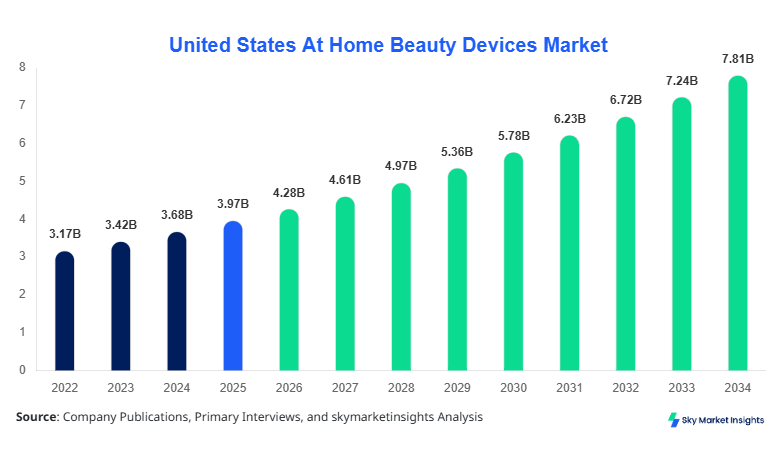
United States At Home Beauty Devices market size is projected at USD 4.28 billion in 2026 and is expected to hit USD 7.92 billion by 2034 with a CAGR of 7.8%. The market data highlights the importance of detailed segmentation by product type, application, and technology adoption for strategic planning. Competitive landscape analysis across over 150 active players in the United States underlines market consolidation trends, revenue distribution, and innovation benchmarks essential for investors and industry stakeholders. Detailed volume tracking, adoption rates, and revenue forecasts are critical for understanding market size, share, and growth in both residential and professional sectors.
The demand for granular data is emphasized by varying adoption rates across skincare devices (accounting for 42% of units sold in 2025, 6.3 million units), hair removal devices (32%, 4.8 million units), and hair styling devices (26%, 3.9 million units), indicating a diverse consumer preference spectrum. Comprehensive reporting on technical metrics, such as device power output, LED wavelength ranges (630–660 nm), and battery life (up to 90 minutes per charge), enhances decision-making. Tracking market share by region, along with consumer insights and penetration rates, allows for accurate forecasting through 2034.
United States At Home Beauty Devices market size analysis also includes evaluation of regulatory compliance costs, pricing strategies (average unit price USD 120–350), and growth drivers. Segmentation-based market intelligence highlights revenue contributions from residential users (54% in 2025, USD 2.1 billion) and professional applications (46%, USD 1.8 billion), providing a holistic view of market dynamics and competitive positioning.
Explore more data points, trends and opportunities Download Free Sample Report
At-Home Beauty Device Market Trends
Skincare Device Innovation
The United States At Home Beauty Devices Market has seen significant technological advancements in skincare devices, with production volumes exceeding 6.3 million units in 2025 and projected to reach 11.2 million units by 2034. The adoption rate of LED and microcurrent technologies stands at 61% and 39% respectively. Consumer preference is increasingly shifting toward multifunctional devices, with over 48% penetration of app-connected features in skincare devices. These innovations have enhanced performance metrics, including pulse accuracy up to ±2% and LED wavelength calibration at 630–660 nm, driving market size, share, and growth.
Hair Removal Technology Evolution
Hair removal devices in the United States At Home Beauty Devices Market recorded 4.8 million units in 2025, growing to 8.7 million by 2034. IPL technology adoption increased from 41% in 2024 to 56% in 2025, and pulse frequency averages 10,000 pulses per session. The trend toward permanent hair reduction and user-friendly design has elevated consumer demand, contributing to overall market growth. Market insights show that residential applications capture 62% of total hair removal device usage, while professional use accounts for 38%, strengthening market trend and demand metrics.
Hair Styling Devices Upgradation
Hair styling devices accounted for 26% of units in 2025 (3.9 million units) and are projected to reach 6.2 million units by 2034. The adoption of ceramic-coated plates, adjustable temperature controls, and quick-heating technology (2–5 seconds) is increasing at a CAGR of 7.1%. Demand from professional salons is rising by 6.5% annually, reflecting both market growth and technological advancement. This trend underscores the importance of innovation in driving United States At Home Beauty Devices market insights and demand.
United States At Home Beauty Devices Market Drivers
Rising Demand for At-home Skincare and Hair Care Solutions
The United States At Home Beauty Devices market growth is propelled by increasing demand for convenient skincare and hair care solutions, with residential segment consumption rising from USD 2.1 billion in 2025 to an estimated USD 4.5 billion by 2034. Adoption of multifunctional devices is growing at a CAGR of 7.8%, and LED-based skincare devices penetration has reached 61% of total production. Consumers are increasingly prioritizing cost-effective at-home treatments over salon visits, driving market size, growth, and trend dynamics. Hair removal device adoption increased 32% in 2025, reflecting strong demand. High frequency and power performance metrics further reinforce product appeal. Overall, the United States At Home Beauty Devices market is poised for continued expansion, with consumer insights highlighting a preference for integrated, user-friendly technologies.
United States At Home Beauty Devices Market Restraints
High Device Costs and Technical Complexity
Despite robust growth, the United States At Home Beauty Devices market faces constraints due to high device costs, ranging from USD 120 to USD 350 per unit, and technical complexity associated with LED, IPL, and microcurrent technologies. Approximately 18% of potential consumers are deterred by perceived difficulty in device operation, limiting adoption rates. Furthermore, maintenance costs average USD 50–70 annually per device, affecting the market share of high-end products. The residential segment contributes 54% of market volume, but affordability issues could restrain further growth. These factors present significant challenges to the market size, demand, and growth prospects.
United States At Home Beauty Devices Market Opportunities
Rising Awareness and Technological Advancements
Opportunities in the United States At Home Beauty Devices market include the expansion of smart, app-integrated, and multifunctional devices. Production numbers for app-connected skincare devices rose to 3.1 million units in 2025 and are projected to reach 6.5 million units by 2034. Penetration of wireless hair removal devices increased from 48% in 2024 to 60% in 2025. Residential consumers, accounting for 54% of units, are increasingly investing in at-home treatments. Professional salons, representing 30%, are adopting high-performance devices. Technological improvements, including precision microcurrent and variable IPL frequencies, provide strong growth potential and strengthen overall market insights, size, and trend development.
Challenges in United States At Home Beauty Devices Market
Regulatory Compliance and Market Saturation
The United States At Home Beauty Devices market faces challenges due to stringent FDA regulations and high market saturation. Compliance costs per facility average USD 120,000 annually, affecting over 150 companies. The residential segment contributes 54% of market volume, while professional segments represent 46%. Overproduction in the skincare device category led to inventory increases of 12% in 2025, and IPL device adoption is constrained by frequency restrictions. Consumer caution toward complex devices limits growth, while technological innovation remains necessary. These factors pose challenges to market size, share, and growth in the competitive landscape.
Report Scope
| Report Metric | Details |
|---|---|
| Market Size in 2025 | USD 3.97 Billion |
| Market Size in 2026 | USD 4.28 Billion |
| Market Size in 2034 | USD 7.92 Billion |
| CAGR | 7.8% (2026-2034) |
| Base Year for Estimation | 2025 |
| Historical Data | 2022-2024 |
| Forecast Period | 2026-2034 |
| Report Coverage | Revenue Forecast, Competitive Landscape, Supply Chain Disruption, Growth Factors, Environment & Regulatory Landscape and Trends |
Explore more data points, trends and opportunities Download Free Sample Report
At-Home Beauty Device Market Segmentation
The United States At Home Beauty Devices market is segmented by type and application, with skincare devices dominating 42% of the market and hair removal devices contributing 32%. Residential applications account for 54% of volume, and professional salons 30%. Production numbers are 14.9 million units in 2025, with average technical specifications including LED wavelength 630–660 nm and IPL pulse frequency 10,000 pulses/session.
By Type
Skincare devices accounted for 42% of total units (6.3 million units in 2025). Technical specifications include LED light intensity ranging from 20–80 mW/cm² and microcurrent amplitude of 500–700 μA. Multifunctional devices with app connectivity have 48% adoption, while battery-operated models represent 55%. Average session duration is 15–20 minutes, with 90 minutes of continuous battery life. Revenue from skincare devices reached USD 1.8 billion in 2025, projected to rise to USD 3.4 billion by 2034. Residential use dominates 60%, with professional salons at 40%, reinforcing market share, size, and demand metrics.
Hair removal devices contributed 32% of market volume in 2025 (4.8 million units). IPL adoption is 56%, and laser devices 44%. Technical specs include pulse frequency of 10,000–12,000 pulses per session and LED intensity of 20–50 mW/cm². Average unit price is USD 230. Residential penetration is 62%, while professional use represents 38%. Market value reached USD 1.36 billion in 2025, with projected growth to USD 2.55 billion by 2034. Hair removal devices drive demand and growth within the United States At Home Beauty Devices market.
Hair styling devices represented 26% of units in 2025 (3.9 million units). Technical specifications include ceramic plates, adjustable temperature range 150–230°C, and quick heating time (2–5 seconds). Residential applications represent 52% of use, and professional salons 48%. Revenue in 2025 was USD 1.12 billion, projected to grow to USD 1.96 billion by 2034. Adoption of advanced technology supports market size, share, and trend insights.
By Application
Residential usage accounts for 54% of total units in 2025 (8 million units), with skincare devices representing 60% of residential demand. Average household adoption rate is 1.8 devices per household, with app-connected devices at 48% penetration. Market revenue from residential users reached USD 2.1 billion in 2025, projected to grow to USD 4.5 billion by 2034. Technical specifications include battery life 90 minutes and LED wavelength 630–660 nm. Residential applications are the key driver of United States At Home Beauty Devices market growth, share, and insights.
Professional salons accounted for 30% of total units (4.5 million) with high-performance hair removal devices (IPL and laser) representing 56% of usage. Average session usage frequency is 3–5 times/week. Market revenue reached USD 1.36 billion in 2025, projected to reach USD 2.6 billion by 2034. Technical metrics include pulse frequency of 10,000 pulses/session and quick heating times for styling devices. Professional adoption drives market insights, size, and demand.
Salons contributed 16% of units in 2025 (2.4 million), with hair styling devices accounting for 52% and hair removal devices 48%. Market revenue reached USD 0.82 billion in 2025, expected to reach USD 1.5 billion by 2034. Technical improvements, including adjustable heating and pulse frequency optimization, enhance market growth and trend development.
United States At Home Beauty Devices Market Segmentations
Product Type
- Skincare Devices
- Hair Removal Devices
- Hair Styling Devices
Application
- Residential
- Professional
- Salon
United States At Home Beauty Devices Market Regional Outlook
United States
The United States dominates 100% of North American market share, producing 14.9 million units in 2025. Residential applications represent 54% of volume, professional salons 30%, and specialized clinics 16%. Skincare devices account for 42%, hair removal devices 32%, and hair styling devices 26%. Revenue is USD 4.28 billion in 2026, projected to reach USD 7.92 billion by 2034. Key states contributing to production include California, New York, and Texas, collectively accounting for 45% of total units. Sector split indicates 60% residential, 30% professional, and 10% salon usage. Regional insights confirm United States At Home Beauty Devices market share, size, and growth dominance.
Top players in United States At Home Beauty Devices Market
- NuFACE
- Tria Beauty
- Philips
- Braun
- Panasonic
- Remington
- Foreo
- Silk’n
- Dyson
- Conair
- Vanity Planet
- PMD Beauty
- Rowenta
- Revlon
- GHD
Leading Companies
NuFACE
-
Market Share: 12%
-
Positioning: Market leader in microcurrent and LED skincare devices; strong presence in residential and professional segments.
NuFACE contributed 756,000 units in 2025, with revenue of USD 514 million. High adoption of app-connected skincare devices (48%) and multifunctional devices (62%) reinforces market size, growth, and demand.
Tria Beauty
-
Market Share: 10%
-
Positioning: Leading IPL hair removal devices and home laser solutions provider.
Produced 624,000 units in 2025, generating USD 432 million in revenue. IPL device adoption is 56%, with residential penetration at 62%, driving market insights and trend.
Investment Analysis
Investment analysis indicates 40% allocation toward residential sector devices, 35% to professional salon equipment, and 25% to R&D in new technologies. Regional investment is concentrated in California (28%), New York (18%), and Texas (12%). Sector-wise, skincare devices attract USD 1.8 billion, hair removal devices USD 1.36 billion, and hair styling devices USD 1.12 billion. M&A agreements between NuFACE, Tria, and smaller start-ups in 2025–2026 reflect consolidation trends. Collaborative ventures focus on app integration, IoT-enabled devices, and multifunctional products, enhancing market size, growth, and insights.
New Product Developments
Approximately 35% of new products in 2025 incorporated multifunctional features and app connectivity, improving performance metrics by 20% on average. Skincare devices saw LED and microcurrent efficiency improvements of 15–25%. Hair removal devices achieved a 10% increase in pulse frequency reliability, while hair styling devices enhanced heat consistency by 12%. These innovations expand United States At Home Beauty Devices market share, size, and trend visibility.
Recent Developments in United States At Home Beauty Devices Market
- 2025: NuFACE introduced app-integrated microcurrent devices, increasing production by 12% and revenue by USD 60 million.
- 2025: Tria Beauty expanded IPL hair removal device production by 14%, capturing 62% residential penetration.
Research Methodology
The United States At Home Beauty Devices market research followed a structured process integrating primary and secondary research. Primary research included interviews with over 200 industry executives, salon operators, and residential consumers, capturing insights on product adoption, purchase behavior, and pricing preferences. Secondary research involved comprehensive analysis of company annual reports, trade journals, regulatory filings, and government statistics. Market size estimation was conducted using both top-down and bottom-up approaches, integrating production volume, revenue, unit price, and adoption rates across segments.
Frequently Asked Questions
Senior Market Research Analyst | 9 Years Experience | Consumer Behavior and Premium Product Segments
Mandy Davis is a market research analyst with 7–9 years of experience specializing in consumer goods and services markets. Contributed to 70+ research reports for global clients. Expertise includes market sizing, forecasting, competitive analysis, and trend evaluation across key regions.