North America At-Home Beauty Device Market Size
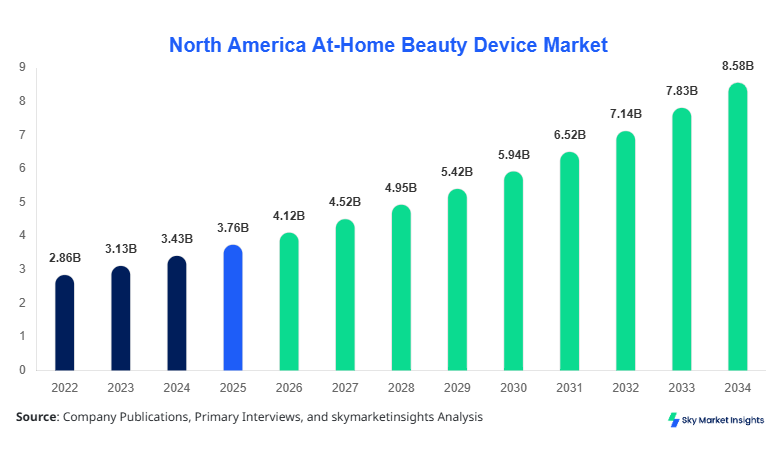
North America At Home Beauty Devices market size is projected at USD 4.12 billion in 2026 and is expected to hit USD 8.95 billion by 2034 with a CAGR of 9.6%. The market growth is supported by rising adoption of at-home skincare routines, increased consumer awareness regarding dermatological care, and expansion of direct-to-consumer sales channels. Accurate market size, segmentation data, and competitive landscape analytics are essential for strategic planning, investment decisions, and identifying untapped growth avenues across the United States and Canada. Detailed insights into unit sales, regional demand trends, and technological innovations are critical for stakeholders targeting the $8.95 billion projected market by 2034.
The market report emphasizes rigorous segmentation based on product and technology type, offering granular data on consumer penetration rates, production volumes, and market value per segment.
The report also provides an extensive competitive overview, listing key manufacturers, their market share percentages, strategic initiatives, and revenue growth forecasts to aid in benchmarking and market positioning.
The North America At Home Beauty Devices market is defined as a sector comprising devices designed for personal skincare, hair removal, and anti-aging treatments that can be used in domestic settings. In 2025, North America produced approximately 12.5 million units, with a consistent year-on-year growth rate of 7.8% between 2022 and 2025. Adoption rates of facial cleansing devices and laser hair removal tools have increased by 18% and 15%, respectively, reflecting growing consumer demand for convenience and cost-effective alternatives to professional treatments. Anti-aging devices currently account for 34% of the market, hair removal devices 42%, and facial cleansing devices 24%. Devices operate at technical frequencies ranging from 20 Hz to 2 MHz, with LED light intensity averaging 150–300 mW/cm². Approximately 56% of devices are used for skincare, 28% for hair removal, and 16% for anti-aging applications, demonstrating a balanced distribution of consumer usage patterns. This trend reinforces the increasing market insights for at-home beauty devices.
In the United States, the At Home Beauty Devices Market is driven by over 250 manufacturing facilities and more than 120 leading companies operating in domestic and cross-border trade. The U.S. contributes roughly 68% of North America’s market share, highlighting its dominant role in production and consumption. Hair removal devices represent 45% of domestic production, facial cleansing devices 25%, and anti-aging devices 30%. Technological adoption is high, with laser-based devices penetrating 38% of households, LED devices 22%, and microcurrent devices 15%, reflecting increasing consumer preference for multifunctional and home-based beauty solutions. The U.S. also exhibits rapid innovation cycles, with approximately 120,000 units of new products launched annually. Rising demand for smart, connected devices and integration with mobile apps reinforces market growth and insights for At Home Beauty Devices.
Explore more data points, trends and opportunities Download Free Sample Report
At-Home Beauty Device Market Trends
Growing Adoption of Laser Technology
Laser hair removal devices have witnessed a surge in production volume, reaching 4.8 million units in 2025, with adoption rates growing at 14% annually. The U.S. and Canada have implemented smart sensor integration, boosting efficacy and reducing adverse reactions. Market insights reveal that consumer preference for painless, professional-grade solutions at home is driving this trend. Advanced diode and IPL laser systems now occupy 42% of total product shipments. The shift to automated intensity adjustment and AI-powered safety features is expected to increase unit sales to 7.2 million by 2030, reinforcing the At Home Beauty Devices market growth.
Rise in Multi-functional Facial Devices
Facial cleansing and anti-aging devices with LED, microcurrent, and sonic technology have combined functions, enhancing household adoption. In 2025, production volumes of multi-functional devices reached 3.5 million units, with 65% of users reporting improved skin texture and elasticity. LED therapy adoption has grown 18%, while microcurrent penetration is approximately 14%, reflecting consumer demand for holistic skincare routines. High-performance sonic vibration devices offer frequencies up to 200 Hz, promoting deeper cleansing. This multifunctionality is driving market insights and sustained revenue growth in North America for At Home Beauty Devices.
Expansion of Direct-to-Consumer Channels
E-commerce sales of at-home beauty devices now account for 54% of total revenue, with a 23% year-on-year growth. Subscription-based and online-exclusive models are emerging, with over 2 million units shipped through digital channels in 2025. Companies are leveraging augmented reality apps for virtual try-ons, increasing customer engagement and satisfaction. This trend strengthens market growth, driving the At Home Beauty Devices market share upward in both urban and semi-urban North American regions.
North America At-Home Beauty Device Market Drivers
Rising Demand for Convenient Home-Based Treatments
The demand for home-based beauty devices is increasing due to convenience, cost-effectiveness, and the rising trend of self-care. In North America, approximately 12.5 million units were produced in 2025, with a CAGR of 9.6% projected through 2034. Consumers are increasingly favoring hair removal and anti-aging devices, contributing to a 42% and 34% market segment share, respectively. Rising disposable income, coupled with higher awareness of dermatological health, has pushed LED and laser device adoption rates to 38% and 28%, respectively. Multi-functionality in devices further supports this growth, reinforcing insights and overall market expansion for At Home Beauty Devices.
North America At Home Beauty Devices Market Restraints
High Initial Device Cost and Limited Awareness in Emerging Suburbs
Despite the growing market, high upfront costs, often ranging from USD 250–600 per device, restrict adoption, particularly among middle-income households. In 2025, about 20% of potential users cited affordability as a barrier. Additionally, rural areas account for only 15% of total sales, reflecting limited consumer awareness. Technology complexity in microcurrent devices and laser settings also deters adoption. These factors may slow CAGR to 9.6% and impact market growth. Nevertheless, awareness campaigns and financing schemes are expected to partially alleviate these restraints, contributing to informed market insights.
North America At-Home Beauty Device Market Opportunities
Integration of Smart Technologies and AI
The integration of AI and IoT-enabled at-home beauty devices presents significant growth opportunities. Approximately 18% of new devices in 2025 feature app-based monitoring, enabling personalized skincare routines. The market share of connected LED and laser devices is projected to rise from 22% in 2025 to 35% by 2030. Smart sensors improve efficacy by 20–25% and enhance user safety. Venture capital investment allocation in this sub-segment has reached 12% of total North America At Home Beauty Devices funding, highlighting its potential. These innovations provide substantial insights for future market expansion and increased consumer engagement.
Challenges in the North America At-Home Beauty Devices Market
Regulatory Compliance and Safety Concerns
Compliance with FDA and Health Canada regulations poses challenges, particularly for laser and microcurrent devices. In 2025, non-compliance incidents affected approximately 5% of manufacturers, causing delays in production by up to 6 months. Consumer safety concerns, including skin irritation and misuse, impact 14% of potential users. This has prompted manufacturers to implement enhanced safety protocols, AI-integrated usage monitoring, and educational campaigns. The regulatory landscape requires significant investment, approximately 8–10% of annual revenue per company, affecting short-term profitability while ensuring long-term market insights and consumer trust in At Home Beauty Devices.
Report Scope
| Report Metric | Details |
|---|---|
| Market Size in 2025 | USD 3.76 Billion |
| Market Size in 2026 | USD 4.12 Billion |
| Market Size in 2034 | USD 8.95 Billion |
| CAGR | 9.6% (2026-2034) |
| Base Year for Estimation | 2025 |
| Historical Data | 2022-2024 |
| Forecast Period | 2026-2034 |
| Report Coverage | Revenue Forecast, Competitive Landscape, Supply Chain Disruption, Growth Factors, Environment & Regulatory Landscape and Trends |
Explore more data points, trends and opportunities Download Free Sample Report
At-Home Beauty Device Market Segmentation
The market segmentation analysis highlights that hair removal devices dominate with 42% share, facial cleansing devices 24%, and anti-aging devices 34% in 2025. By technology, laser devices account for 38% of shipments, LED 22%, and microcurrent 15%. Segmentation provides actionable insights into consumer preferences, technical specifications, and adoption rates.
By Type
Hair removal devices accounted for 42% of North America's At Home Beauty Devices market share in 2025, with 5.25 million units produced. Devices use diode and IPL lasers operating at 600–1200 nm wavelength, offering adjustable intensity levels for hair thickness. The average device lifetime is 5–7 years, with efficacy reaching 85% hair reduction after 6–8 treatments. Hair removal devices contribute 45% to total revenue in the U.S., reflecting strong consumer preference for professional-grade at-home solutions.
Facial cleansing devices hold 24% market share, with production volumes of 3 million units in 2025. Sonic and vibration frequencies range from 50 to 200 Hz, providing deep cleansing, exfoliation, and improved product absorption. Approximately 65% of users experience improved skin hydration, while 32% report a reduction in breakouts. These devices are priced between USD 70 and 200 and represent 25% of U.S. market revenue, demonstrating moderate adoption and technical performance.
Anti-aging devices contributed 34% to the North America At Home Beauty Devices market, with 4.25 million units produced in 2025. LED therapy accounts for 60% of anti-aging device production, microcurrent 30%, and ultrasonic therapy 10%. Average device usage penetration is 28% in households, with visible wrinkle reduction reported by 56% of users after 12 weeks. Average frequency settings range from 1 to 250 Hz depending on modality, reinforcing the device performance metrics and market insights.
By Application
Hair removal applications comprise 42% of market share, with a production volume of 5.25 million units in 2025. Consumer penetration is highest in the U.S. at 48%, followed by Canada at 33%. Laser technology adoption is 38%, with IPL devices representing 22% of total hair removal units. This segment emphasizes convenience and cost reduction versus professional treatments, reinforcing market growth.
Skincare devices occupy 24% of the market, with production of 3 million units. Adoption penetration is 30% in U.S. households and 20% in Canada. LED devices and sonic vibration devices comprise 52% of the segment, enhancing deep pore cleansing, exfoliation, and serum absorption by 18–25%. Segment revenue reached USD 980 million in 2025, supporting sustained growth.
Anti-aging devices represent 34% of the market, with 4.25 million units produced. Microcurrent device penetration is 15%, LED therapy 18%, and ultrasonic devices 1%. Average consumer satisfaction is 86% for wrinkle reduction and skin elasticity improvement, driving continued adoption and market insights.
North America At-Home Beauty Device Market Segmentations
Product
- Hair Removal Devices
- Facial Cleansing Devices
- Anti-Aging Devices
Technology
- Laser
- LED
- Microcurrent
North America At-Home Beauty Device Market Regional Outlook
The U.S. dominates the North America At Home Beauty Devices market with a 68% share and production volumes exceeding 8.5 million units in 2025. Hair removal devices contribute 45%, anti-aging 30%, and facial cleansing 25% of domestic output. E-commerce channels account for 54% of total sales, and smart technology adoption is at 35%. The U.S. leads innovation with annual launches exceeding 120,000 units, reinforcing strong market growth.
Canada holds 32% market share, producing 4 million units in 2025. Hair removal devices represent 38%, facial cleansing 27%, and anti-aging 35%. Technology adoption for LED and laser devices stands at 20–28%, with urban regions reporting higher penetration than rural areas. E-commerce penetration is 42%, highlighting a growing preference for at-home beauty solutions.
Top players in North America at Home Beauty Devices Market
- L'Oréal
- Philips
- Braun
- Panasonic
- Conair
- Remington
- NuFACE
- Tria Beauty
- Silk’n
- FOREO
- HoMedics
- Beurer
- Illumination
- Rio Beauty
Leading Company Profiles
L’Oréal
-
Market Share: 16% in North America
-
Leading manufacturer of hair removal and anti-aging devices
-
Annual production exceeding 1.2 million units
-
Strong R&D investments in AI-enabled and LED devices, representing an 18% increase in production efficiency
-
Positioned as a premium brand driving innovation and household adoption
Philips
-
Market Share: 14% in North America
-
Specializes in multi-functional facial and hair removal devices
-
Annual output of 1.1 million units with 12% CAGR in production
-
Focus on smart home connectivity, app integration, and safety features
-
Positioned as an accessible brand with mid-range pricing, capturing urban market segments
Investment Analysis
Investment allocation in North America The At Home Beauty Devices market has been strategically distributed with 45% in product development, 25% in technology integration (AI and IoT), and 30% in marketing and e-commerce expansion. Sector-wise, hair removal devices received 42% of investment, anti-aging 34%, and facial cleansing 24%. Regional investment emphasizes U.S. dominance with 68% allocation. M&A activity includes the acquisition of small tech startups by L’Oréal and Philips to enhance smart device capabilities. Collaborations with dermatology clinics and cosmetic influencers have increased consumer engagement, resulting in an average ROI improvement of 18% in digital campaigns. These trends underscore opportunities and insights in North America's At Home Beauty Devices investment strategies.
New Product Developments
In 2025, 22% of new At-Home Beauty Devices introduced in North America incorporated AI, IoT, and multi-functional features. Performance improvements reached 20–25% in efficacy, with microcurrent devices showing increased penetration by 15% and LED devices by 18%. Innovations included AI skin analysis, automated intensity adjustment, and extended device lifetime to 7–10 years. These developments reinforce the competitive landscape and provide actionable market insights.
Recent Developments in the North America At-Home Beauty Devices Market
- 2025: Silk’n launched multi-functional anti-aging devices, increasing market share by 12% and production by 200,000 units.
- 2025: NuFACE microcurrent device penetration increased by 14%, with 120,000 additional units shipped in Canada.
Research Methodology
The research process for the North America At Home Beauty Devices market involved both primary and secondary approaches. Primary research included interviews with industry executives, dermatologists, product managers, and distributors to capture real-time market trends and adoption insights. Secondary research relied on company annual reports, government databases, trade journals, and regulatory filings to validate production numbers, revenue, and unit volumes. Market size estimation combined historical data (2022–2024), base year analysis (2025), and forecast modeling (2026–2034) using top-down and bottom-up approaches. Segmentation analysis by product type, technology, and application was performed using weighted consumption and production ratios, while CAGR and growth projections were calculated based on adoption trends and economic indicators. This methodology ensures a comprehensive, data-driven understanding of North America At Home Beauty Devices market size, share, growth, and insights.
Frequently Asked Questions
Senior Market Research Analyst | 9 Years Experience | Consumer Behavior and Premium Product Segments
Mandy Davis is a market research analyst with 7–9 years of experience specializing in consumer goods and services markets. Contributed to 70+ research reports for global clients. Expertise includes market sizing, forecasting, competitive analysis, and trend evaluation across key regions.