Europe Amenity Kits Market Size
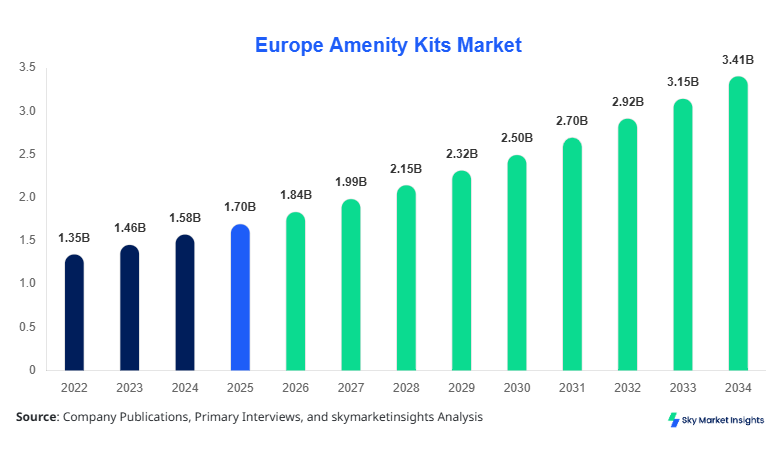
The Europe amenity kits market size is projected at USD 1.84 billion in 2026 and is expected to hit USD 3.41 billion by 2034 with a CAGR of 8.0%. The expansion of aviation passenger traffic, premium hospitality services, and sustainable travel solutions is accelerating the consumption of amenity kits across Europe. More than 615 million airline passengers across Europe generated demand for over 420 million amenity kits in 2025, while hotel chains accounted for nearly 170 million units annually. Increasing investments in recyclable materials, luxury packaging, and customized passenger comfort products are strengthening supplier competition, procurement analytics, and distribution optimization across the European amenity kits market.
The amenity kits industry refers to the manufacturing and distribution of packaged personal care and travel convenience products offered by airlines, hotels, cruise operators, and railway operators. These kits typically contain sleep masks, toothbrushes, skincare products, socks, earplugs, hand sanitizers, and branded accessories. Europe produced nearly 590 million amenity kit units in 2025, with Germany, France, and the United Kingdom accounting for 61% of total regional production capacity. Adoption penetration among premium airline passengers exceeded 84%, while hotel-based luxury amenity kit penetration crossed 57% in upscale hospitality chains. Consumer purchasing behavior indicates that 46% of travelers prioritize sustainable packaging, while 39% prefer premium skincare integrations and 28% demand reusable travel accessories. Airlines represented 52% of application contribution, hotels contributed 34%, and railways held a 14% share. Technical performance standards increasingly focus on biodegradable packaging durability exceeding 18 months and lightweight material composition reducing transportation weight by 22%. Rising personalization and sustainability initiatives continue to strengthen Europe's amenity kit market expansion.
In Germany, the amenity kits market accounted for approximately 28% of regional revenue in 2025 due to the presence of large aviation operators, hospitality chains, and advanced packaging manufacturers. Germany operated more than 38 large-scale amenity kit manufacturing facilities and over 120 specialized travel accessory suppliers supporting airlines and hotels. Airlines contributed nearly 55% of domestic demand, while hotels accounted for 31% and railway services represented 14%. Sustainable amenity kit adoption across German airlines increased from 41% in 2022 to 67% in 2025, supported by environmental regulations and passenger preference for eco-friendly packaging. More than 95 million airline amenity kits were distributed in Germany during 2025, with recyclable paper-based packaging penetration reaching 63%. Automated packaging systems improved production efficiency by 18%, while smart inventory tracking systems reduced logistics wastage by 12%. Increasing luxury travel and corporate passenger movement continue to accelerate Europe's amenity kit market development.
Explore more data points, trends and opportunities Download Free Sample Report
Amenity Kits Market Trends
Sustainability and Eco-friendly Packaging Adoption
European airlines and hospitality operators are rapidly transitioning toward sustainable amenity kit solutions to comply with environmental regulations and evolving consumer preferences. More than 58% of newly launched amenity kits in 2025 incorporated biodegradable packaging materials compared to 33% in 2022. Airlines across Europe reduced single-use plastic content by nearly 41%, while hotel operators integrated bamboo toothbrushes, reusable fabric bags, and recyclable cosmetic containers into premium kits. Production of sustainable amenity kits exceeded 240 million units in 2025, with Germany and France together contributing nearly 48% of eco-friendly manufacturing volume. Luxury airline carriers reported a 19% increase in passenger satisfaction scores after deploying eco-conscious premium kits. Demand for organic skincare products within amenity kits increased by 27% annually, while reusable accessory adoption crossed 44% among frequent travelers. These sustainability initiatives continue to reinforce the European amenity kit market expansion.
Premiumization and Brand Collaboration Expansion
Luxury branding collaborations between amenity kit suppliers, cosmetic brands, and airline operators are reshaping premium travel experiences throughout Europe. More than 72 airline operators partnered with luxury skincare and fragrance companies during 2025, increasing high-value premium amenity kit production by 23%. Business-class and first-class travelers accounted for nearly 61% of premium kit consumption, while luxury hotel suites represented an additional 21% share. Advanced textile materials improved comfort durability by 18%, and lightweight packaging innovations reduced freight handling costs by 11%. France and the United Kingdom collectively generated over 110 million premium amenity kit units annually, supported by high-end tourism and international passenger traffic. Smart QR-enabled packaging adoption increased by 31%, allowing brands to enhance digital customer engagement and loyalty programs. Rising luxury travel demand continues to stimulate Europe's amenity kit market activities.
Digital Customization and Smart Inventory Systems
Amenity kit manufacturers are increasingly deploying AI-driven inventory analytics and digital customization systems to optimize production and reduce waste. Approximately 36% of European suppliers implemented automated packaging systems by 2025, improving production throughput by 21%. Airlines integrated passenger-preference-based kit customization, increasing customer retention rates by nearly 14%. Smart logistics platforms reduced stock shortages by 17% and enhanced supply chain visibility across cross-border transportation networks. More than 48 million digitally customized amenity kits were produced in Europe during 2025, particularly for premium airline passengers and luxury hotel guests. RFID-enabled tracking technologies improved warehouse accuracy by 24%, while predictive procurement analytics reduced operational costs by 13%. Increasing digitalization trends are significantly supporting Europe Amenity Kits Market transformation.
Europe Amenity Kits Market Drivers
Expansion of Premium Air Travel and Luxury Hospitality Services
Rapid growth in premium air travel and luxury hospitality services is significantly driving demand for amenity kits across Europe. International airline passenger traffic in Europe surpassed 615 million travelers in 2025, representing a 12% increase compared to 2023 levels. Premium-class passengers accounted for nearly 16% of total airline traffic but generated over 48% of premium amenity kit consumption. More than 310 luxury hotel chains across Europe integrated branded amenity kits into customer retention strategies, with hotel-based kit deployment increasing by 21% between 2022 and 2025. Airlines introduced advanced comfort kits containing skincare products, noise-canceling accessories, and reusable transformations of the European amenity kit market, increasing satisfaction scores by 18%. Additionally, sustainability-focused procurement policies led to a 39% increase in biodegradable kit orders. Growing disposable income, tourism recovery, and enhanced passenger comfort strategies continue to accelerate the Europe amenity kit market expansion.
Europe Amenity Kits Market Restraints
High Raw Material and Logistics Costs Affecting Manufacturing Margins
Fluctuating raw material prices and elevated logistics costs remain major restraints for amenity kit manufacturers across Europe. Packaging material prices increased by approximately 19% between 2023 and 2025, while transportation and freight costs rose by nearly 14% due to fuel price volatility and cross-border compliance requirements. Sustainable materials such as biodegradable paper composites and organic textile components cost 22% more than conventional alternatives, limiting adoption among small and mid-sized suppliers. Labor costs in Germany, France, and the United Kingdom increased by 11%, affecting operational margins for regional manufacturers. Airlines and hospitality operators increasingly negotiate long-term procurement contracts, reducing supplier pricing flexibility by nearly 16%. Smaller manufacturers handling annual production volumes below 5 million units experienced operating margin declines of 8% to 10%. These cost pressures continue to challenge the European amenity kit market's profitability.
Europe Amenity Kits Market Opportunities
Increasing Adoption of Sustainable and Personalized Travel Accessories
The growing preference for sustainable and personalized travel accessories is creating substantial opportunities for amenity kit manufacturers in Europe. Nearly 63% of European travelers indicated willingness to pay premium prices for eco-friendly travel products during 2025 surveys. Personalized branding integration increased customer engagement metrics by 24%, particularly among premium airline travelers and luxury hotel guests. Demand for reusable travel accessories, including recyclable pouches and refillable skincare products, increased by 29% annually. More than 145 European hospitality groups announced sustainability procurement initiatives supporting environmentally friendly guest amenities. Digital customization platforms enabled suppliers to reduce excess inventory by 18% while improving passenger satisfaction scores by 15%. Expansion of rail tourism and luxury cruise services across Europe is expected to generate additional demand exceeding 70 million amenity kit units by 2030. These emerging opportunities continue strengthening Europe's amenity kit market development.
Challenges in the European Amenity Kits Market
Regulatory Compliance and Waste Management Complexities
Stringent environmental regulations and waste management compliance standards are creating operational challenges for amenity kit manufacturers across Europe. More than 22 European sustainability directives now regulate single-use plastics, recyclable materials, and packaging waste disposal standards. Manufacturers must invest approximately 12% to 16% of annual operating budgets into sustainable material certification and environmental audits. Airlines reported a 17% increase in compliance-related procurement costs during 2025 due to new packaging restrictions. Waste recycling infrastructure remains inconsistent across Southern and Eastern Europe, limiting efficient disposal systems for nearly 28% of distributed amenity kits. Small-scale manufacturers producing fewer than 3 million units annually face increased certification burdens and limited capital availability for automation upgrades. Additionally, cross-border regulatory variations increase administrative costs by 9% to 13% for multinational suppliers. These compliance complexities continue influencing Europe's amenity kit market operations.
Report Scope
| Report Metric | Details |
|---|---|
| Market Size in 2025 | USD 1.70 Billion |
| Market Size in 2026 | USD 1.84 Billion |
| Market Size in 2034 | USD 3.41 Billion |
| CAGR | 8.0% (2026-2034) |
| Base Year for Estimation | 2025 |
| Historical Data | 2022-2024 |
| Forecast Period | 2026-2034 |
| Report Coverage | Revenue Forecast, Competitive Landscape, Supply Chain Disruption, Growth Factors, Environment & Regulatory Landscape and Trends |
Explore more data points, trends and opportunities Download Free Sample Report
Amenity Kits Market Segmentation
The European amenity kit industry is segmented by product type and distribution channel, with premium kits dominating nearly 42% of total revenue share in 2025 due to increasing luxury travel demand. Airlines represented the leading application segment with 52% consumption share, followed by hotels at 34% and railways at 14%. Sustainable kits recorded the fastest adoption growth, with production volume increasing by 26% between 2023 and 2025.
BY TYPE
Basic amenity kits accounted for approximately 36% of total market volume in 2025 due to widespread deployment across economy-class airline passengers and mid-scale hotels. More than 210 million basic amenity kits were produced across Europe during 2025, with Germany, Spain, and Italy contributing over 58% of regional manufacturing output. These kits typically include toothbrushes, eye masks, socks, tissues, and earplugs packaged in lightweight recyclable materials weighing between 120 and 180 grams. Economy airline carriers represented nearly 61% of total basic kit consumption, while budget hotels contributed 27%. Production automation improved assembly efficiency by 16%, reducing packaging defects by 11%. Demand remains strong among short-haul travel operators where cost optimization and passenger convenience are prioritized. Increasing transition toward recyclable packaging materials further supports long-term adoption of basic amenity kits across Europe.
Premium amenity kits represented nearly 42% of Europe’s total market revenue in 2025, supported by rising luxury air travel and premium hospitality experiences. More than 125 million premium amenity kits were distributed by airlines and luxury hotels during the year. These kits frequently include branded skincare products, fragrance collections, memory foam eye masks, and reusable pouches manufactured with high-grade textiles. Business-class airline passengers accounted for 64% of premium kit utilization, while luxury hotels contributed an additional 24%. France and the United Kingdom jointly represented over 46% of premium kit production capacity due to strong luxury tourism infrastructure. Technical improvements in packaging durability enhanced product shelf life by 21%, while advanced material engineering reduced weight by 13% without compromising aesthetics. Growing collaborations between luxury cosmetic brands and airline operators continue driving demand for premium amenity kits across Europe.
Sustainable amenity kits are experiencing rapid expansion across Europe, accounting for nearly 22% of total market volume in 2025 compared to 13% in 2022. Production exceeded 130 million sustainable kit units during 2025, supported by environmental regulations and eco-conscious consumer preferences. These kits utilize biodegradable paper packaging, bamboo toothbrushes, recyclable fabric pouches, and refillable cosmetic containers. Airlines contributed approximately 57% of sustainable kit demand, while hotels represented 33%. Germany alone accounted for nearly 31% of sustainable amenity kit manufacturing capacity across Europe. Advanced compostable material technologies improved biodegradation efficiency by 26%, while lightweight packaging innovations reduced logistics-related carbon emissions by 18%. Consumer surveys indicated that 63% of travelers preferred eco-friendly travel products, encouraging airlines and hotels to accelerate procurement of sustainable amenity kits.
BY APPLICATION
Airlines represented the largest application segment in the European amenity kits industry, accounting for nearly 52% of overall demand during 2025. European airlines distributed more than 310 million amenity kits annually across long-haul and premium-class operations. Business-class and first-class travelers generated approximately 61% of airline-related premium kit consumption. Lightweight packaging materials reduced aircraft weight impact by 8%, contributing to airline fuel efficiency initiatives. Sustainable kit adoption among airlines increased from 38% in 2022 to nearly 59% in 2025. Germany, France, and the United Kingdom collectively contributed over 67% of airline amenity kit procurement activity in Europe. Airlines increasingly integrate skincare products, reusable accessories, and digital engagement features within kits to improve passenger retention and loyalty metrics. Growing international passenger traffic and premium travel demand continue supporting airline application dominance.
Hotels accounted for approximately 34% of Europe’s amenity kit demand in 2025 due to increasing luxury tourism and customer experience enhancement initiatives. More than 170 million hotel amenity kits were distributed annually across upscale and premium hospitality establishments. Luxury hotels represented nearly 58% of hotel-based amenity kit consumption, particularly across France, Italy, and Spain. Eco-friendly hotel amenity kit adoption increased by 27% annually, with biodegradable toiletries and reusable packaging becoming key procurement priorities. Technical advancements in packaging aesthetics and material durability improved customer satisfaction scores by 19%. Hotels increasingly customize amenity kits according to guest profiles, loyalty memberships, and regional tourism preferences. Digital QR-enabled packaging supporting promotional engagement increased by 22% across premium hospitality chains. Expansion of experiential tourism and boutique accommodation services continues strengthening hotel demand for advanced amenity kits.
Railway operators represented nearly 14% of Europe’s amenity kit consumption during 2025, supported by expanding long-distance and premium rail travel networks. More than 65 million railway amenity kits were distributed across overnight and high-speed rail services in Europe. Premium rail passengers accounted for approximately 48% of railway-related kit utilization, while business travelers represented 31%. Sustainable material adoption exceeded 52% among railway operators due to environmental transportation policies across Europe. France and Germany collectively contributed nearly 49% of railway amenity kit procurement activity. Compact packaging formats reduced storage space requirements by 14%, while lightweight recyclable materials improved operational sustainability metrics. Growing investments in luxury rail tourism and cross-border transportation services continue increasing demand for specialized railway amenity kits.
Europe Amenity Kits Market Segmentations
Product Type
- Basic Kits
- Premium Kits
- Sustainable Kits
Distribution Channel
- Airlines
- Hotels
- Railways
Europe Amenity Kits Market Regional Outlook
United Kingdom
The United Kingdom accounted for approximately 19% of the European amenity kit industry in 2025 due to strong aviation infrastructure and luxury hospitality demand. More than 82 million airline amenity kits were distributed annually across British airline carriers and international airport operations. Hotels represented 33% of domestic demand, while railway services accounted for 11%. Sustainable packaging penetration reached nearly 58%, supported by government environmental policies and premium consumer preferences. The United Kingdom also hosted over 45 specialized packaging and travel accessory manufacturers supplying luxury airline and hotel operators.
Germany
Germany dominated the European amenity kit industry with approximately 28% regional share during 2025. Production exceeded 165 million units annually across airline, hotel, and railway applications. Airlines accounted for 55% of domestic demand, while hotels contributed 31%. Sustainable kit adoption surpassed 67%, and automated packaging technologies improved manufacturing efficiency by 18%. Germany’s advanced logistics infrastructure and luxury travel demand continue positioning the country as the leading production and distribution hub for amenity kits in Europe.
France
France represented nearly 17% of regional demand in 2025, supported by luxury tourism and premium airline operations. More than 95 luxury hotel chains across France integrated premium amenity kits featuring branded cosmetics and eco-friendly packaging. Airline-related demand contributed 49% of domestic consumption, while hotels accounted for 38%. France also emerged as a leading producer of high-end skincare-integrated amenity kits, with annual production volumes exceeding 78 million units.
Spain
Spain accounted for approximately 11% of the European amenity kit industry due to strong tourism activity and growing airline passenger traffic. Hotels represented nearly 41% of domestic demand, driven by coastal tourism and luxury resort development. Sustainable amenity kit penetration increased to 46% during 2025, while annual production exceeded 52 million units. Spain’s expanding hospitality investments and tourism recovery continue supporting amenity kit procurement growth.
Italy
Italy contributed around 10% of regional market revenue in 2025, supported by luxury tourism, fashion-driven branding, and premium hospitality services. More than 36 million premium amenity kits were distributed annually across upscale hotels and airline carriers. Eco-friendly packaging adoption reached nearly 51%, while premium cosmetic integration increased by 24% between 2023 and 2025. Italy remains a significant supplier of luxury textile packaging and designer travel accessories within Europe.
Russia
Russia accounted for nearly 7% of Europe’s amenity kit demand in 2025, primarily driven by domestic airline operations and expanding railway transportation networks. Railway applications represented approximately 29% of total domestic consumption, significantly higher than Western European countries. Annual production exceeded 34 million units, while sustainable kit penetration remained below 31% due to slower environmental regulation implementation. Increasing modernization of aviation and rail services is expected to support gradual market expansion.
Top players in Europe's amenity kits Market
- WESSCO International
- FORMIA
- Clip Limited
- Skysupply
- Buzz Products
- Nowara Group
- Kaelis
- TravelPlus
- RMT Global Partners
- JOYTEX
- Sandler AG
- Linstol
- AeroCare International
- Direct Pack Inc.
- Marina Textil
FORMIA
-
FORMIA accounted for approximately 14% of Europe’s premium amenity kit supply volume during 2025.
-
The company maintains strong partnerships with international airline carriers and luxury hospitality groups across Germany, France, and the United Kingdom.
-
FORMIA distributed more than 48 million premium amenity kits annually and expanded sustainable product integration by 37% between 2023 and 2025.
-
Its strategic positioning focuses on luxury branding collaborations, recyclable packaging technologies, and high-end skincare product inclusion for premium-class travelers.
WESSCO International
-
WESSCO International held nearly 11% of Europe’s airline amenity kit procurement contracts during 2025.
-
The company supplies more than 42 airline carriers and over 70 hospitality operators across Europe.
-
Sustainable packaging materials represented approximately 53% of its total product portfolio in 2025.
-
WESSCO’s market positioning emphasizes customized passenger experience solutions, automated production systems, and eco-friendly product innovations supporting long-term supplier partnerships.
Investment Analysis
Investments in the European amenity kit industry increased significantly during 2025, with sustainability-focused manufacturing projects accounting for nearly 46% of total capital allocation. Germany, France, and the United Kingdom collectively attracted over 63% of regional investment activity due to advanced aviation infrastructure and strong hospitality sectors. Packaging automation investments increased by 21%, while recyclable material development projects accounted for 18% of manufacturing expenditure. Airlines allocated approximately 14% higher procurement budgets toward premium and sustainable amenity kits compared to 2023 levels.
Mergers, acquisitions, and strategic collaborations accelerated across the European amenity kits ecosystem as suppliers sought to strengthen distribution capabilities and sustainability compliance. More than 28 partnership agreements were announced between airlines, cosmetic brands, and packaging suppliers during 2025. Luxury skincare collaborations contributed nearly 31% of premium product development initiatives. Cross-border acquisitions enabled suppliers to expand production capacities by 17% and improve logistics integration efficiency by 13%. France and Germany accounted for nearly 54% of regional M&A activities due to strong manufacturing ecosystems and premium tourism demand. Investments in biodegradable material research increased by 24%, while digital inventory management systems received nearly 16% of total technology expenditure.
New Product Developments
Manufacturers across Europe increasingly introduced innovative amenity kit solutions featuring recyclable packaging, organic skincare products, and reusable travel accessories. More than 34% of newly launched products during 2025 incorporated biodegradable packaging technologies, while premium cosmetic integration increased by 26%. Smart QR-enabled packaging adoption rose by 22%, allowing airlines and hotels to enhance customer engagement and digital loyalty experiences.
Product innovation also focused on lightweight packaging engineering and sustainable textile integration. Advanced material technologies improved packaging durability by 19% while reducing overall transportation weight by 12%. More than 48 million next-generation sustainable amenity kits featuring refillable cosmetic containers and recyclable fabric pouches were produced across Europe during 2025. Luxury airline carriers increasingly introduced personalized digital engagement features within premium kits to improve passenger retention metrics.
Recent Developments in Europe Amenity Kits Market
- In 2025, FORMIA expanded its sustainable production facilities in Germany, increasing eco-friendly amenity kit output by 28% and improving recyclable packaging integration across more than 18 airline partnerships. The expansion supported annual production growth exceeding 12 million additional units while reducing plastic usage by 39%.
- In 2025, Kaelis partnered with premium hospitality operators across France and Spain to launch luxury eco-conscious hotel amenity kits, increasing premium product distribution by 24% and integrating reusable textile pouches into more than 9 million hotel room deployments annually.
- In 2025, Clip Limited collaborated with luxury skincare brands to develop personalized premium airline kits featuring organic cosmetic products and smart QR-enabled customer engagement systems. The initiative increased premium airline procurement contracts by 18% across Western Europe.
Research Methodology
The research process for the Europe amenity kits industry involved extensive primary and secondary data collection methodologies to ensure accurate market assessment and forecasting. Primary research included interviews with airline procurement managers, hospitality executives, packaging manufacturers, and supply chain distributors operating across Germany, France, the United Kingdom, Spain, Italy, and Russia. More than 120 industry participants contributed quantitative and qualitative insights related to production volumes, pricing trends, sustainability adoption, and procurement strategies. Secondary research incorporated annual reports, aviation statistics, hospitality industry publications, trade journals, customs databases, and regulatory documentation associated with sustainable packaging standards. Market size estimation was conducted using bottom-up and top-down analytical models integrating production volume analysis, revenue mapping, demand penetration rates, and application-based consumption metrics. Forecasting models evaluated airline passenger traffic, hotel occupancy trends, sustainability investments, and technological innovation patterns between 2026 and 2034. Data triangulation and validation processes ensured consistency across regional production statistics, supplier market shares, investment activity, and procurement analytics.
Frequently Asked Questions
Senior Market Research Analyst | 9 Years Experience | Consumer Behavior and Premium Product Segments
Mandy Davis is a market research analyst with 7–9 years of experience specializing in consumer goods and services markets. Contributed to 70+ research reports for global clients. Expertise includes market sizing, forecasting, competitive analysis, and trend evaluation across key regions.