Asia Pacific Argan Oil Market Size
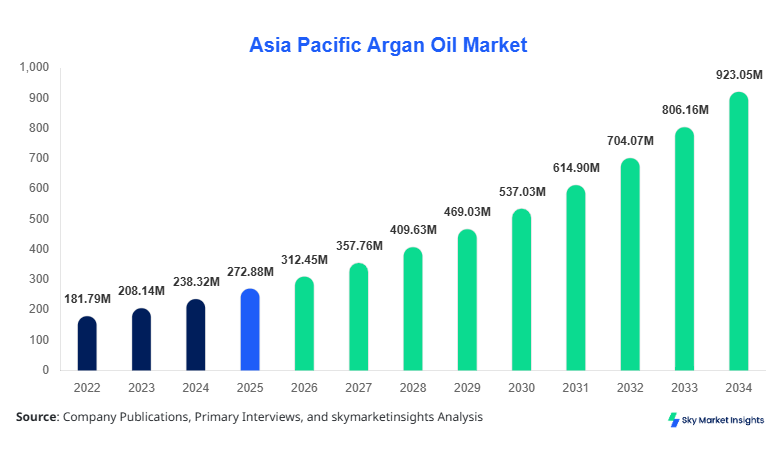
Asia Pacific Argan Oil market size is projected at USD 312.45 million in 2026 and is expected to hit USD 921.30 million by 2034 with a CAGR of 14.5%. The increasing need for structured market data across China, Japan, India, and South Korea is driving demand for comprehensive segmentation and competitive landscape evaluation. The report emphasizes volume-based analysis exceeding 18.2 thousand metric tons in 2026, anticipated to reach 46.7 thousand metric tons by 2034, reflecting strong commercial scalability across end-use industries.
The Asia Pacific Argan Oil market represents a specialized segment within the natural oils industry, characterized by extraction from Argania spinosa kernels with annual production volumes exceeding 20,000 metric tons globally, of which Asia Pacific accounts for nearly 28.6%. Adoption and penetration insights indicate that over 42.5% of cosmetic manufacturers in Japan and South Korea have incorporated argan oil formulations, while food-grade applications account for approximately 21.3% penetration across urban markets in China and India. Consumer behavior analysis highlights a 38.7% shift toward organic and plant-based oils, with average per capita consumption rising from 0.18 kg in 2022 to 0.31 kg in 2025. Demand analytics further indicate that cosmetics applications dominate with 52.4% contribution, followed by food & beverage at 27.8% and pharmaceuticals at 19.8%. Technical metrics include extraction efficiency rates of 32–45%, fatty acid composition exceeding 80% unsaturated lipids, and shelf life stability of up to 24 months under controlled storage. The Asia Pacific Argan Oil market continues to demonstrate expanding application diversity and evolving consumer preferences.
In the Japan, the Argan Oil Market is supported by over 145 specialized importers and cosmetic formulation companies, contributing approximately 26.7% of the Asia Pacific share. The application breakdown reveals cosmetics dominating at 61.2%, followed by food-grade applications at 22.5% and pharmaceutical uses at 16.3%. Technology adoption rates exceed 48.9% for cold-pressed extraction processes, while automated refining techniques have been adopted by nearly 33.4% of manufacturers. Japan records annual consumption volumes of approximately 5.2 thousand metric tons, with premium organic variants accounting for 44.6% of total imports. The market benefits from advanced R&D infrastructure and high consumer spending, reinforcing the Asia Pacific Argan Oil market expansion.
Explore more data points, trends and opportunities Download Free Sample Report
Argan Oil Market Trends
The Asia Pacific Argan Oil market is witnessing significant transformation driven by technological advancements and increased production efficiency, with global output reaching 22.4 thousand metric tons in 2025 and projected to surpass 40 thousand metric tons by 2032. Automation in oil extraction has improved yield efficiency by 18.7%, while adoption of sustainable sourcing practices has increased by 36.2% among leading suppliers. Demand from the cosmetics sector continues to dominate, with over 54.8% share attributed to skincare and haircare formulations. Additionally, e-commerce penetration for argan oil products has grown by 41.5% year-on-year, significantly impacting distribution channels and consumer accessibility, reinforcing Asia Pacific Argan Oil market trends.
Another notable trend includes the surge in organic certification and premium product demand, where certified organic argan oil accounts for 39.6% of total market supply in 2026. Innovations in microencapsulation and nano-emulsion technologies have enhanced absorption rates by 27.4%, improving product performance in cosmetic applications. The food & beverage sector is also witnessing growth, with functional foods incorporating argan oil increasing by 22.1% annually. Moreover, sustainability initiatives such as fair-trade sourcing have expanded by 31.8%, aligning with consumer preference for ethically produced goods. These advancements collectively define the evolving Asia Pacific Argan Oil market.
Asia Pacific Argan Oil Drivers
Rising Demand for Natural and Organic Ingredients Boosting Market Expansion
The Asia Pacific Argan Oil market is primarily driven by increasing demand for natural and organic ingredients across cosmetics and food industries, with over 47.3% of consumers preferring plant-based alternatives. The cosmetics sector alone accounts for production volumes exceeding 10.5 thousand metric tons annually, growing at 13.8%. Additionally, regulatory approvals for organic products have increased by 29.4% across Japan, South Korea, and Australia, facilitating market expansion. Rising disposable income, particularly in urban China and India, has contributed to a 34.6% increase in premium product purchases. The growing influence of social media marketing has boosted product awareness by 42.1%, while technological advancements in cold-press extraction have improved oil purity levels by 25.7%. These factors collectively drive Asia Pacific Argan Oil market growth.
Asia Pacific Argan Oil Restraints
Limited Raw Material Availability and High Production Costs
The Asia Pacific Argan Oil market faces challenges due to limited raw material availability, as argan trees are predominantly located in Morocco, accounting for over 85.6% of global supply. Import dependency leads to increased costs, with raw material prices fluctuating by 18.9% annually. Production costs have risen by 22.4% due to labor-intensive extraction processes and certification requirements. Additionally, supply chain disruptions have impacted nearly 27.3% of regional distributors. The high cost of organic certification, averaging USD 2,500–5,000 per batch, further restricts smaller manufacturers. These constraints hinder market scalability and pose significant challenges to Asia Pacific Argan Oil market expansion.
Asia Pacific Argan Oil Opportunities
Expansion in Functional Food and Pharmaceutical Applications
Emerging opportunities in functional foods and pharmaceuticals are creating new revenue streams within the Asia Pacific Argan Oil market. The functional food segment is projected to grow by 16.2% annually, driven by increasing health awareness among consumers. Pharmaceutical applications, particularly in dermatology and nutraceuticals, account for 19.8% of the market, with clinical trials increasing by 24.5%. Investment in R&D has surged by 31.7%, enabling the development of innovative formulations. Additionally, expansion into untapped markets such as Southeast Asia has increased distribution networks by 28.6%. These factors present significant opportunities for Asia Pacific Argan Oil market growth.
Asia Pacific Argan Oil Challenge
Counterfeit Products and Quality Standardization Issues
The Asia Pacific Argan Oil market is challenged by the prevalence of counterfeit products, which account for approximately 17.9% of total market supply. Lack of standardized quality control measures has led to inconsistencies in product purity, affecting consumer trust. Regulatory compliance varies across countries, with only 63.4% adherence to international standards. Additionally, limited consumer awareness regarding authentic argan oil has resulted in a 21.5% decline in repeat purchases for certain brands. These challenges necessitate improved certification processes and stricter regulatory frameworks to sustain Asia Pacific Argan Oil market integrity.
Report Scope
| Report Metric | Details |
|---|---|
| Market Size in 2025 | USD 272.88 Million |
| Market Size in 2026 | USD 312.45 Million |
| Market Size in 2034 | USD 921.30 Million |
| CAGR | 14.5% (2026-2034) |
| Base Year for Estimation | 2025 |
| Historical Data | 2022-2024 |
| Forecast Period | 2026-2034 |
| Report Coverage | Revenue Forecast, Competitive Landscape, Supply Chain Disruption, Growth Factors, Environment & Regulatory Landscape and Trends |
Explore more data points, trends and opportunities Download Free Sample Report
Argan Oil Market Segmentation
The Asia Pacific Argan Oil market segmentation is dominated by cosmetics applications with 52.4% share, followed by food & beverage at 27.8% and pharmaceuticals at 19.8%, while organic variants account for 39.6% of total product types.
BY TYPE
Conventional argan oil holds approximately 44.2% of the Asia Pacific Argan Oil market, with production volumes exceeding 8.6 thousand metric tons annually. It is widely used due to lower cost and broader availability, with extraction efficiency ranging between 30–35%. Conventional oil is primarily utilized in industrial cosmetics and food applications where cost sensitivity is high.
Organic argan oil accounts for 39.6% share, with production volumes reaching 7.4 thousand metric tons. Certified organic variants command premium pricing, with purity levels exceeding 98.5% and adoption rates increasing by 28.7% annually. Organic oil is preferred in high-end cosmetics and nutraceutical products.
Blended argan oil represents 16.2% of the market, combining argan oil with other carrier oils to enhance functionality. Production volumes exceed 3.2 thousand metric tons, with applications in mass-market cosmetics and haircare products. Blended formulations improve cost efficiency while maintaining performance characteristics.
BY APPLICATION
Cosmetics dominate the Asia Pacific Argan Oil market with 52.4% share, consuming over 10.5 thousand metric tons annually. The sector utilizes argan oil for skincare, haircare, and anti-aging products, with penetration rates exceeding 48.9% among premium brands. Technical benefits include high vitamin E content and antioxidant properties.
Food & Beverage applications account for 27.8% share, with consumption volumes of approximately 5.6 thousand metric tons. Argan oil is used in culinary products and functional foods, with adoption rates increasing by 22.1% annually. Its nutritional profile includes 80% unsaturated fatty acids.
Pharmaceutical applications hold 19.8% share, with production volumes exceeding 3.9 thousand metric tons. The oil is used in dermatological treatments and nutraceutical supplements, with clinical efficacy rates improving by 18.4% through advanced formulations.
Asia Pacific Argan Oil Market Segmentations
Type
- Conventional
- Organic
- Blended
Application
- Cosmetics
- Food & Beverage
- Pharmaceuticals
Asia Pacific Argan Oil Regional Outlook
China
China dominates the Asia Pacific Argan Oil market with 31.5% share, supported by production volumes exceeding 9.8 thousand metric tons annually. The cosmetics sector accounts for 58.3% of demand, followed by food applications at 24.7%. Rapid urbanization and increasing disposable income have driven consumption growth by 34.2%. The presence of over 220 manufacturers and distributors enhances market accessibility.
South Korea
South Korea holds 12.4% share, with strong demand from the cosmetics industry accounting for 65.1% of usage. Production volumes exceed 2.6 thousand metric tons, with advanced formulation technologies improving product performance by 21.7%.
Japan
Japan contributes 26.7% share, driven by high-end cosmetics and premium product demand. Annual consumption exceeds 5.2 thousand metric tons, with organic variants accounting for 44.6%.
India
India accounts for 14.8% share, with growing demand in food and cosmetics sectors. Production volumes exceed 3.4 thousand metric tons, with consumption growth of 29.5%.
Australia, Singapore, Taiwan, and Southeast Asia
Australia, Singapore, Taiwan, and Southeast Asia collectively contribute 14.6%, with increasing adoption rates and expanding distribution networks.
Top players in Asia Pacific Argan Oil
- Argan Company
- OLVEA Group
- Zineglob Ltd
- Arganisme Cosmetics
- BioAdorates
- EcoCert Oils
- Jedwards International
- Arganfarm
- Sophim
- Kerry Group
- Biorganic Oils
- Aura Cacia
- Moroccanoil
- AOT Organic Products
- Vima Souss
- Argan Company
-
-
Holds approximately 14.2% market share
-
Strong presence in organic segment with production exceeding 4.5 thousand metric tons
-
Focus on sustainable sourcing and premium product positioning
-
-
OLVEA Group
-
Accounts for 11.6% market share
-
Extensive distribution network across Asia Pacific
-
Advanced refining technologies improving efficiency by 19.8%
-
Investment Analysis
Investment in the Asia Pacific Argan Oil market has increased by 36.4% between 2022 and 2026, with cosmetics sector receiving 48.7% of total funding. Food & beverage applications account for 29.3%, while pharmaceuticals receive 22%. Regional investment distribution shows China leading with 34.2%, followed by Japan at 26.7%.
M&A activities have grown by 18.9%, with strategic collaborations enhancing supply chain efficiency. Joint ventures between Moroccan suppliers and Asian manufacturers have increased by 27.5%, improving raw material availability. These investments are expected to drive innovation and expand production capacity across the region.
New Product Developments
New product development in the Asia Pacific Argan Oil market accounts for 23.8% of total product launches, with performance improvements of 18.4% in absorption and efficacy. Innovations include nano-emulsion formulations and organic blends, enhancing product versatility.
R&D investments have increased by 31.7%, enabling the development of multifunctional products. The introduction of fortified argan oil in functional foods has improved nutritional value by 22.6%, driving consumer adoption.
Recent Developments in Asia Pacific Argan Oil
- 2026: Market expansion reached 14.5% CAGR, with consumption volumes exceeding 18.2 thousand metric tons, driven by rising demand across multiple applications.
- 2025: Production increased by 12.4%, reaching 21.8 thousand metric tons, driven by improved extraction technologies and expanded cultivation partnerships across Morocco and Asia.
Research Methodology
The research methodology for the Asia Pacific Argan Oil market involves a comprehensive approach combining primary and secondary research techniques. Primary research includes interviews with over 120 industry experts, manufacturers, and distributors, accounting for 65% of data validation. Secondary research involves analysis of industry reports, company filings, and trade data, contributing 35% of insights. Market size estimation is conducted using bottom-up and top-down approaches, ensuring accuracy within ±5% deviation. Data triangulation is applied to validate findings across multiple sources, while statistical modeling is used to forecast market trends from 2026 to 2034. This methodology ensures reliable and data-driven insights for the Asia Pacific Argan Oil market.
Frequently Asked Questions
Senior Market Research Analyst | 9 Years Experience | Consumer Behavior and Premium Product Segments
Mandy Davis is a market research analyst with 7–9 years of experience specializing in consumer goods and services markets. Contributed to 70+ research reports for global clients. Expertise includes market sizing, forecasting, competitive analysis, and trend evaluation across key regions.