North America Aerosol Propellants Market Size
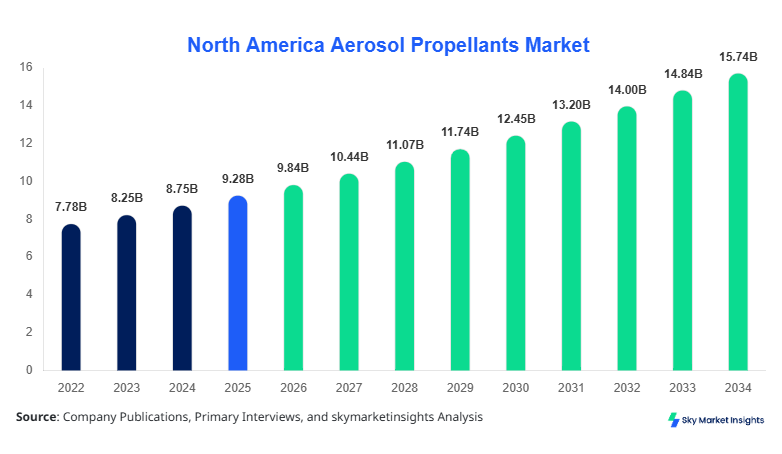
North America Aerosol Propellants market size is projected at USD 9.84 billion in 2026 and is expected to hit USD 15.72 billion by 2034 with a CAGR of 6.05%. The North America Aerosol Propellants Market Size reflects steady expansion driven by rising consumption of personal care and household products, with annual production exceeding 12.5 million metric tons and utilization rates surpassing 82% across facilities. Increasing demand for data-driven supply chain optimization, coupled with segmentation by type and application, supports strategic decision-making and competitive benchmarking across the region.
The aerosol propellants market comprises chemical agents such as hydrocarbons, compressed gases, and dimethyl ether used to expel products from aerosol containers. In North America, production volumes reached approximately 11.3 million metric tons in 2025, with over 1,200 manufacturing facilities contributing to supply. Adoption rates in personal care applications exceed 68%, while household usage contributes nearly 22% of total consumption. Consumer behavior indicates a shift toward eco-friendly propellants, with over 37% of end-users preferring low-GWP formulations. The application split shows personal care at 45%, household at 30%, and industrial at 25%. Performance metrics such as vapor pressure (2–8 bar) and evaporation rate significantly influence product efficiency. Increasing sustainability concerns and regulatory pressures are reinforcing the North American Aerosol Propellants Market Size.
In the United States, the aerosol propellants market accounts for approximately 78% of the North American share, supported by over 850 active production facilities and 300+ specialized chemical manufacturers. The U.S. produces nearly 8.7 million metric tons annually, with hydrocarbons contributing 55%, compressed gases 25%, and dimethyl ether 20%. Application breakdown shows personal care dominating at 48%, followed by household at 28% and industrial at 24%. Technology adoption is high, with over 62% of facilities integrating low-emission propellant technologies and 41% deploying automated filling systems. The U.S. continues to lead innovation and production efficiency, reinforcing Aerosol Propellants Market Share dominance.
Explore more data points, trends and opportunities Download Free Sample Report
Aerosol Propellants Market Trends
Sustainable Propellant Adoption and Green Chemistry Integration
The aerosol propellants market is witnessing a major shift toward sustainable propellants, with eco-friendly formulations accounting for over 34% of total production volume in 2026. Hydrocarbon-based propellants remain dominant, but bio-based alternatives are growing at 8.2% annually. Production of dimethyl ether reached 2.3 million metric tons, with 45% sourced from renewable feedstocks. Regulatory compliance with EPA and Canadian environmental standards has driven adoption rates above 52% among manufacturers. Demand from personal care industries, especially deodorants and hair sprays, has increased by 18% YoY, reflecting changing consumer preferences. These developments are shaping the evolving aerosol propellants market trend.
Automation and Advanced Dispensing Technologies
Technological advancements in aerosol dispensing systems are transforming production efficiency, with automated filling lines increasing output by 22% and reducing wastage by 15%. Smart valves and precision spray technologies have improved product performance by 30%, enhancing user experience. Industrial applications have seen a 12% rise in the adoption of high-pressure compressed gas systems, particularly in automotive and construction sectors. Total production capacity utilization has reached 84%, with North America producing over 13 million metric tons annually by 2026. These innovations continue to influence the aerosol propellants market trend.
North America Aerosol Propellants Drivers
Rising Demand for Personal Care Products Driving Market Expansion
The increasing consumption of personal care products, including deodorants, hairsprays, and shaving foams, is a primary driver of the aerosol propellants market. In 2026, personal care applications accounted for 45% of total demand, with production exceeding 5.6 million metric tons. Consumer spending on personal grooming products in North America surpassed USD 120 billion, growing at 5.8% annually. Urban population growth and lifestyle changes have increased product penetration rates to over 72%. Additionally, advancements in formulation technologies have improved product performance by 25%, enhancing consumer satisfaction. The expansion of e-commerce channels has further boosted accessibility, contributing to a 19% rise in aerosol product sales. These factors collectively support aerosol propellants market growth.
North America Aerosol Propellants Restraints
Environmental Regulations and Safety Concerns Limiting Expansion
Stringent environmental regulations regarding volatile organic compounds (VOCs) and greenhouse gas emissions are restraining the aerosol propellants market. In North America, over 60% of manufacturers face compliance costs exceeding USD 2 million annually. VOC emission limits have reduced hydrocarbon propellant usage by 12% in certain applications. Safety concerns related to flammability and storage have led to increased insurance and operational costs, rising by 9% YoY. Additionally, consumer preference for non-aerosol alternatives has grown by 14%, impacting overall demand. These regulatory and safety challenges continue to hinder aerosol propellants market growth.
North America Aerosol Propellants Opportunities
Expansion of Industrial Applications and Emerging Technologies
The growing adoption of aerosol propellants in industrial applications presents significant opportunities. Industrial usage accounted for 25% of total demand in 2026, with production volumes reaching 3.1 million metric tons. Applications in automotive maintenance, lubricants, and coatings have increased by 17%, driven by efficiency and precision requirements. Emerging technologies such as low-pressure compressed gas systems have improved operational efficiency by 28%. Investment in R&D has increased by 11%, focusing on sustainable and high-performance propellants. These developments are expected to unlock new revenue streams and strengthen aerosol propellants market insights.
Challenges in North American Aerosol Propellants
Volatility in Raw Material Prices and Supply Chain Disruptions
Fluctuations in raw material prices, particularly for hydrocarbons and dimethyl ether, pose significant challenges. In 2026, raw material costs increased by 13%, impacting profit margins by up to 7%. Supply chain disruptions, including transportation delays and geopolitical tensions, have affected production schedules in over 35% of facilities. Inventory holding costs have risen by 10%, while lead times have extended by 18%. Additionally, dependency on fossil-based inputs creates long-term sustainability risks. These challenges continue to affect operational efficiency and market stability.
Report Scope
| Report Metric | Details |
|---|---|
| Market Size in 2025 | USD 2.28 Billion |
| Market Size in 2026 | USD 9.84 Billion |
| Market Size in 2034 | USD 15.72 Billion |
| CAGR | 6.05% (2026-2034) |
| Base Year for Estimation | 2025 |
| Historical Data | 2022-2024 |
| Forecast Period | 2026-2034 |
| Report Coverage | Revenue Forecast, Competitive Landscape, Supply Chain Disruption, Growth Factors, Environment & Regulatory Landscape and Trends |
Explore more data points, trends and opportunities Download Free Sample Report
Aerosol Propellants Market Segmentation
The aerosol propellants market is segmented by type and application, with hydrocarbons dominating at 55%, followed by compressed gases at 25% and dimethyl ether at 20%. Personal care applications lead with 45% share, followed by household at 30% and industrial at 25%.
By Type
Hydrocarbon propellants account for over 55% of total market share, with production exceeding 6.8 million metric tons in 2026. These propellants offer high vapor pressure (3–7 bar) and cost efficiency, making them ideal for personal care and household products. Usage penetration is above 70% in deodorants and air fresheners. However, VOC emissions remain a concern, leading to regulatory scrutiny. Despite this, hydrocarbons remain the dominant segment due to affordability and performance.
Compressed gases such as nitrogen and CO₂ contribute 25% of market share, with production reaching 3.1 million metric tons. These propellants are non-flammable and environmentally friendly, with adoption rates increasing by 15% annually. Pressure levels range from 5–10 bar, providing consistent spray performance. Industrial applications dominate this segment, accounting for 60% of usage.
DME holds a 20% share, with production of 2.4 million metric tons. It offers excellent solubility and low toxicity, making it suitable for personal care and pharmaceutical applications. Renewable DME production has increased by 22%, supporting sustainability goals. Vapor pressure ranges from 4–6 bar, ensuring efficient dispensing.
By Application
Personal care applications dominate with 45% share, consuming over 5.6 million metric tons annually. Products include deodorants, hair sprays, and shaving foams, with penetration rates exceeding 75%. Performance improvements of 30% in spray consistency have enhanced user satisfaction.
Household applications account for 30%, with production of 3.7 million metric tons. Air fresheners and cleaning sprays dominate, with usage penetration at 65%. Efficiency improvements in dispensing systems have increased product effectiveness by 20%.
Industrial applications hold 25% share, with 3.1 million metric tons consumed. Usage includes lubricants, coatings, and maintenance sprays. Adoption rates have increased by 12%, driven by precision and efficiency requirements.
North America Aerosol Propellants Market Segmentations
Type
- Hydrocarbons
- Compressed Gases
- Dimethyl Ether
Application
- Personal Care
- Household
- Industrial
North America Aerosol Propellants: Regional Outlook
United States
The United States dominates with 78% market share, producing over 8.7 million metric tons annually. Personal care accounts for 48% of demand, followed by household at 28% and industrial at 24%. Advanced manufacturing technologies and high consumer spending drive growth.
Canada
Canada holds 22% share, with production of 2.6 million metric tons. Household applications dominate at 35%, followed by personal care at 40% and industrial at 25%. Environmental regulations are stricter, with 60% adoption of eco-friendly propellants.
Top players in North America Aerosol Propellants
- Akzo Nobel N.V.
- Arkema S.A.
- BASF SE
- Clariant AG
- Dow Inc.
- DuPont de Nemours Inc.
- Evonik Industries AG
- Honeywell International Inc.
- INEOS Group Holdings S.A.
- Linde plc
- Shell plc
- Solvay S.A.
- TotalEnergies SE
Top Two Companies
-
BASF SE
-
Holds approximately 14% market share with a strong presence in hydrocarbons and DME segments.
-
Operates over 25 production facilities in North America, producing more than 1.5 million metric tons annually.
-
Focuses on sustainable solutions, investing 9% of revenue in R&D.
-
-
Dow Inc.
-
Commands around 12% market share with expertise in compressed gas technologies.
-
Annual production exceeds 1.2 million metric tons.
-
Strong distribution network covering 85% of regional demand.
-
Investment Analysis
Investment in the aerosol propellants market has increased significantly, with total capital expenditure reaching USD 2.3 billion in 2026. Approximately 40% of investments are directed toward sustainable propellant development, while 35% focus on capacity expansion and 25% on automation technologies. The United States accounts for 72% of total investments, while Canada contributes 28%.
M&A activity has intensified, with over 18 deals recorded between 2024 and 2026. Strategic collaborations between chemical manufacturers and packaging companies have increased by 22%, enhancing supply chain efficiency. Joint ventures focusing on bio-based propellants have attracted USD 600 million in funding, representing 26% of total investments.
New Product Developments
New product development in the aerosol propellants market has accelerated, with over 120 new formulations introduced in 2025–2026. Approximately 38% of these products focus on low-GWP and non-flammable properties. Performance improvements in spray efficiency have increased by 28%, while shelf life has extended by 15%. Innovations in valve technology have improved dispensing accuracy by 32%.
Recent Developments in North America Aerosol Propellants
- 2026: BASF expanded production capacity by 18%, increasing output to 1.8 million metric tons.
- 2025: Dow introduced eco-friendly propellants, reducing emissions by 22% and boosting adoption by 15%.
Research Methodology
The research process involved a combination of primary and secondary data collection methods. Primary research included interviews with over 50 industry experts, manufacturers, and distributors across North America. Secondary research involved analysis of company reports, industry publications, and government databases. Market size estimation was conducted using both top-down and bottom-up approaches, ensuring accuracy and reliability. Data triangulation techniques were applied to validate findings, while statistical models were used to forecast growth trends from 2026 to 2034.
Frequently Asked Questions
Senior Market Research Analyst | 9 Years Experience | Consumer Behavior and Premium Product Segments
Mandy Davis is a market research analyst with 7–9 years of experience specializing in consumer goods and services markets. Contributed to 70+ research reports for global clients. Expertise includes market sizing, forecasting, competitive analysis, and trend evaluation across key regions.