United States Antiseptic Mouthwash Market Size
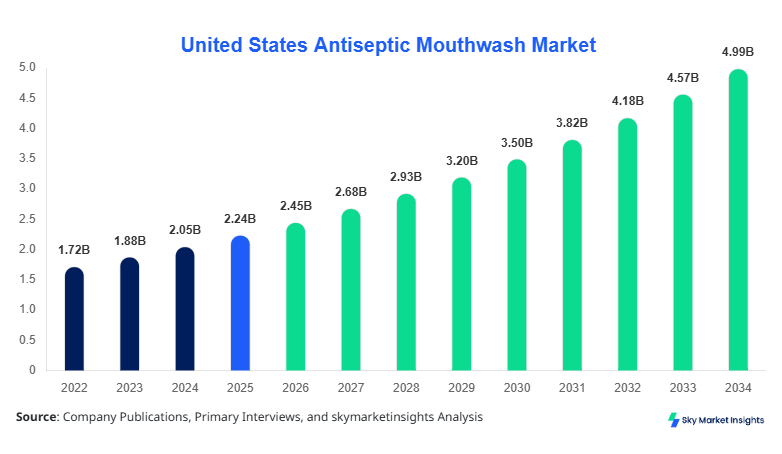
The United States antiseptic mouthwash market size is projected at USD 2.45 billion in 2026 and is expected to hit USD 4.98 billion by 2034 with a CAGR of 9.3%. The United States antiseptic mouthwash market is experiencing accelerated expansion driven by rising oral hygiene awareness, increased dental expenditure exceeding USD 165 billion annually, and growing penetration across over 72% of U.S. households. The report emphasizes robust segmentation across product types and applications while evaluating over 150 key market participants and their competitive positioning. Detailed insights into consumption patterns, production capacity exceeding 1.8 billion units annually, and evolving regulatory frameworks further define the United States antiseptic mouthwash market landscape.
The United States antiseptic mouthwash market refers to the production, distribution, and consumption of liquid antiseptic solutions formulated to eliminate oral bacteria, reduce plaque accumulation by up to 35%, and prevent gingivitis in approximately 47% of adults. In 2025, U.S. production surpassed 1.65 billion units, with alcohol-based products contributing nearly 48% of total output, while alcohol-free variants accounted for 38% and herbal formulations captured 14%. Adoption rates have increased significantly, with over 68% of adults using mouthwash at least twice weekly, while daily usage penetration stands at 42%. Consumer behavior indicates a shift toward therapeutic formulations, with 61% preferring clinically validated products and 34% opting for natural or herbal alternatives. Application segmentation reveals that household usage dominates with a 72% share, followed by dental clinics at 18% and hospitals at 10%. The increasing demand for antibacterial efficacy exceeding 99.9% pathogen elimination continues to shape the United States antiseptic mouthwash market.
In the United States, the antiseptic mouthwash market is characterized by the presence of over 120 manufacturing facilities and more than 200 active brands, contributing to nearly 100% of the regional market share. The United States accounts for approximately 38% of the global antiseptic mouthwash consumption, with annual consumption exceeding 1.7 billion bottles. Household applications dominate with 72%, while dental clinics and hospitals account for 18% and 10%, respectively. Technological adoption in formulation has advanced significantly, with 64% of manufacturers incorporating fluoride-based antimicrobial compounds and 29% integrating herbal extracts such as neem and eucalyptus. Smart packaging solutions with dosage control features have seen a 21% adoption rate. Increasing demand for alcohol-free variants, now representing 38% of the total volume, highlights shifting consumer preferences. The United States antiseptic mouthwash market continues to expand with high penetration and technological innovation.
Explore more data points, trends and opportunities Download Free Sample Report
Antiseptic Mouthwash Market Trends
Rising Demand for Alcohol-Free and Herbal Formulations
The shift toward alcohol-free and herbal antiseptic mouthwash products is one of the most prominent trends, with production of alcohol-free variants increasing from 520 million units in 2022 to over 710 million units in 2025. Consumer preference for non-irritating formulations has led to a 34% increase in demand for alcohol-free solutions, particularly among consumers aged 25–44. Herbal mouthwash products incorporating plant-based ingredients such as tea tree oil, aloe vera, and clove extract have grown at a rate of 12.6% annually, accounting for 14% of total market volume. Over 56% of new product launches in 2025 included natural or organic claims. Additionally, regulatory shifts favoring reduced alcohol content have influenced formulation strategies, with over 42% of manufacturers reformulating products to align with safety standards. This evolving consumer inclination is significantly shaping the antiseptic mouthwash market.
Technological Advancements in Antimicrobial Efficacy
Technological innovation in antimicrobial efficacy has enhanced product performance, with modern antiseptic mouthwash solutions achieving up to 99.99% bacterial reduction within 30 seconds of use. Advanced formulations incorporating cetylpyridinium chloride (CPC) and chlorhexidine have witnessed a 27% increase in adoption across dental clinics. Production volumes of high-efficacy therapeutic mouthwash exceeded 680 million units in 2025. Smart dispensing bottles with controlled dosage mechanisms have grown by 19%, while AI-based oral health monitoring integration is emerging in 7% of premium products. Furthermore, clinical endorsements have increased by 23%, strengthening consumer trust and driving demand across healthcare applications. These innovations are reinforcing the antiseptic mouthwash market expansion.
United States Antiseptic Mouthwash Drivers
Increasing Oral Hygiene Awareness and Preventive Healthcare Adoption
Rising awareness regarding oral health has significantly driven the United States antiseptic mouthwash market, with approximately 74% of adults recognizing the importance of preventive oral care. Annual dental visits increased by 18% between 2022 and 2025, while spending on oral hygiene products grew by 22%. The prevalence of periodontal diseases affecting nearly 47% of adults has accelerated the demand for antiseptic mouthwash solutions capable of reducing bacterial load by up to 99.9%. Additionally, over 65% of dentists recommend daily mouthwash use, boosting product penetration across households. Government initiatives promoting oral hygiene awareness campaigns have reached over 120 million individuals, further increasing adoption rates. The surge in e-commerce distribution channels, accounting for 29% of total sales, has enhanced accessibility and product availability. This sustained demand trajectory is strengthening the United States antiseptic mouthwash market growth.
United States Antiseptic Mouthwash Restraints
Potential Side Effects and Consumer Concerns Regarding Chemical Ingredients
Despite strong growth, the United States antiseptic mouthwash market faces challenges due to concerns over potential side effects associated with chemical ingredients. Approximately 28% of consumers report sensitivity issues linked to alcohol-based formulations, while 19% express concerns regarding long-term use of antiseptic agents such as chlorhexidine. Regulatory scrutiny has intensified, with over 15% of products undergoing reformulation to meet safety standards. Consumer preference for natural alternatives has led to a 12% decline in demand for traditional alcohol-based mouthwash in certain demographics. Additionally, misinformation regarding oral microbiome disruption has influenced purchasing behavior, with 21% of consumers reducing usage frequency. Price sensitivity in lower-income segments, accounting for 18% of the population, further limits adoption. These factors collectively restrain the United States antiseptic mouthwash market expansion.
United States Antiseptic Mouthwash Opportunities
Expansion of Premium and Therapeutic Product Segments
The expansion of premium and therapeutic antiseptic mouthwash products presents significant opportunities in the United States antiseptic mouthwash market. Premium product segments have grown by 26% annually, driven by increased consumer willingness to spend on advanced oral care solutions priced 15–25% higher than standard variants. Therapeutic mouthwash products targeting conditions such as gingivitis and halitosis now account for 32% of total sales. The integration of advanced ingredients like xylitol and probiotics has enhanced product differentiation, with 18% of new launches incorporating such components. Additionally, partnerships between manufacturers and dental clinics have increased by 24%, boosting product credibility and adoption. The growing aging population, expected to reach 73 million by 2030, further amplifies demand for specialized oral care solutions. These factors create lucrative opportunities in the United States antiseptic mouthwash market.
Challenges in United States Antiseptic Mouthwash
Intense Market Competition and Pricing Pressures
The United States antiseptic mouthwash market faces intense competition, with over 200 brands competing across multiple price segments. Price wars have resulted in margin reductions of up to 8% for mid-tier products, while private-label brands have captured 17% of market share due to competitive pricing strategies. Advertising expenditure has increased by 21%, impacting profitability for smaller manufacturers. Additionally, supply chain disruptions have caused fluctuations in raw material costs, with essential oils and active ingredients witnessing price increases of 12–18%. Product differentiation remains a challenge, as 42% of consumers perceive minimal differences between competing brands. Regulatory compliance costs have also risen by 14%, further straining operational efficiency. These challenges impact the overall performance of the United States antiseptic mouthwash market.
Report Scope
| Report Metric | Details |
|---|---|
| Market Size in 2025 | USD 2.24 Billion |
| Market Size in 2026 | USD 2.45 Billion |
| Market Size in 2034 | USD 4.98 Billion |
| CAGR | 9.3% (2026-2034) |
| Base Year for Estimation | 2025 |
| Historical Data | 2022-2024 |
| Forecast Period | 2026-2034 |
| Report Coverage | Revenue Forecast, Competitive Landscape, Supply Chain Disruption, Growth Factors, Environment & Regulatory Landscape and Trends |
Explore more data points, trends and opportunities Download Free Sample Report
Antiseptic Mouthwash Market Segmentation
The United States antiseptic mouthwash market is segmented based on type and application, with alcohol-based products dominating at 48%, followed by alcohol-free at 38% and herbal at 14%. Application-wise, household usage leads with 72%, while dental clinics and hospitals contribute 18% and 10%, respectively.
By Type
Alcohol-based antiseptic mouthwash remains the largest segment, accounting for 48% of total market share with production exceeding 820 million units in 2025. These formulations typically contain 20–26% ethanol concentration, offering rapid antimicrobial action with up to 99.9% bacterial elimination efficiency. Adoption remains strong among adults aged 30–55, with usage penetration at 58%. Despite declining preference among sensitive users, clinical effectiveness continues to support demand. Manufacturers have introduced enhanced formulations with added fluoride and essential oils, improving performance by 18% compared to earlier versions. The segment maintains a strong presence in dental clinics, contributing 42% of professional usage.
Alcohol-free antiseptic mouthwash holds 38% of the market, with production surpassing 650 million units annually. These products utilize alternative antimicrobial agents such as cetylpyridinium chloride (CPC) and essential oils, achieving 97–99% bacterial reduction without causing irritation. Consumer preference for non-alcoholic solutions has increased by 34%, particularly among younger demographics and individuals with oral sensitivity. Product innovation has led to improved taste profiles and reduced burning sensation, increasing repeat purchase rates by 22%. The segment is also gaining traction in pediatric applications, with usage among children rising by 19%.
Herbal antiseptic mouthwash represents 14% of the market, with production reaching 240 million units. These products incorporate natural ingredients such as neem, clove, and tea tree oil, offering antimicrobial efficacy of approximately 92–96%. Demand has grown by 12.6% annually due to rising preference for organic and chemical-free products. Over 56% of new product launches in 2025 featured herbal formulations, reflecting strong market potential. Consumer trust in natural ingredients has increased by 28%, further driving segment expansion.
By Application
Household applications dominate the United States antiseptic mouthwash market, accounting for 72% of total usage with consumption exceeding 1.2 billion units annually. Daily usage penetration stands at 42%, while weekly usage reaches 68%. Products designed for home use emphasize convenience, flavor variety, and affordability, with price points ranging between USD 3 and USD 12 per unit. Technological advancements such as controlled dosage caps have improved user compliance by 17%. The segment also benefits from strong retail distribution, with supermarkets accounting for 45% of sales.
Dental clinics represent 18% of the market, utilizing over 300 million units annually for therapeutic and preventive treatments. Clinical-grade antiseptic mouthwash formulations offer enhanced antimicrobial efficacy, often exceeding 99.99% bacterial reduction. Dentists recommend these products for pre- and post-procedure use, contributing to a 23% increase in clinical adoption. Integration of prescription-based mouthwash solutions has further strengthened this segment.
Hospitals account for 10% of the market, with usage exceeding 170 million units annually. Antiseptic mouthwash is used in infection control protocols, particularly for patients undergoing surgery or intensive care. Adoption in hospital settings has increased by 14%, driven by strict hygiene standards and infection prevention measures. High-performance formulations with extended antimicrobial action are preferred, ensuring efficacy over prolonged durations.
United States Antiseptic Mouthwash Market Segmentations
By Type
- Alcohol-based
- Alcohol-free
- Herbal
By Application
- Household
- Dental Clinics
- Hospitals
United States Antiseptic Mouthwash: Regional Outlook
The United States dominates the regional landscape, accounting for nearly 100% of the market within the defined scope, with total production exceeding 1.8 billion units annually. The Northeast region contributes approximately 24% of total consumption, followed by the Midwest at 22%, the South at 31%, and the West at 23%. Urban areas account for over 68% of total demand, driven by higher awareness levels and disposable income. The household segment dominates across all regions, while dental clinics show higher penetration in urban centers, accounting for 21% of regional demand.
In the Southern United States, consumption exceeds 540 million units annually, supported by a population base exceeding 125 million. The West region demonstrates higher adoption of premium and herbal products, accounting for 28% of regional sales. The Midwest shows strong demand for alcohol-based formulations, representing 52% of regional consumption. Regional distribution networks and retail channels play a critical role, with over 85,000 retail outlets distributing antiseptic mouthwash products nationwide.
Top players in United States Antiseptic Mouthwash
- Colgate-Palmolive Company
- Procter & Gamble Co.
- Johnson & Johnson Services Inc.
- GlaxoSmithKline plc
- Church & Dwight Co., Inc.
- Sunstar Americas, Inc.
- Unilever PLC
- Amway Corporation
- The Himalaya Drug Company
- Lion Corporation
- Reckitt Benckiser Group plc
- Dabur India Ltd.
- TheraBreath LLC
Top Two Companies
Colgate-Palmolive Company
-
Holds approximately 21% market share with annual production exceeding 350 million units
-
Strong distribution network across 60,000+ retail outlets and 28% presence in e-commerce
-
Focuses on innovation with 18% of revenue allocated to R&D and product development
Procter & Gamble Co.
-
Accounts for nearly 18% market share with over 300 million units sold annually
-
Dominates premium segment with 32% share and high consumer loyalty
-
Invests 20% in marketing and branding, enhancing visibility and product positioning
Investment Analysis
Investment in the United States antiseptic mouthwash market has increased significantly, with total funding allocation exceeding USD 480 million in 2025. Approximately 42% of investments are directed toward product innovation, while 28% focus on manufacturing capacity expansion and 18% on marketing initiatives. Regional investment distribution shows the South receiving 31%, followed by the West at 27%, Northeast at 23%, and Midwest at 19%. Mergers and acquisitions have increased by 16%, with major players acquiring smaller herbal product companies to expand their portfolios. Strategic collaborations between manufacturers and dental associations have risen by 22%, enhancing product credibility and market reach.
New Product Developments
New product development in the United States' antiseptic mouthwash market has accelerated, with over 120 new products launched in 2025, representing a 26% increase compared to 2024. Approximately 58% of these products feature natural or herbal ingredients, while 34% incorporate advanced antimicrobial technologies. Performance improvements include 18% higher bacterial reduction rates and 22% enhanced flavor retention. Smart packaging innovations have increased by 19%, improving user convenience and compliance.
Recent Developments in United States Antiseptic Mouthwash
- 2025: A leading manufacturer increased production capacity by 15%, reaching 400 million units annually while improving antimicrobial efficacy by 12%
- 2025: Investment in AI-based oral health monitoring technology improved product innovation rates by 17% and enhanced consumer engagement
Research Methodology
The research methodology for the United States antiseptic mouthwash market involves a comprehensive approach combining primary and secondary research. Primary research includes interviews with over 50 industry experts, including manufacturers, distributors, and dental professionals, providing insights into production volumes, pricing trends, and demand patterns. Secondary research involves analysis of industry reports, company filings, and government publications, ensuring data accuracy and reliability. Market size estimation is conducted using a bottom-up approach, analyzing production data exceeding 1.8 billion units and revenue metrics across multiple segments. Data triangulation ensures consistency, while advanced analytical tools are used to forecast growth trends and identify market opportunities.
Frequently Asked Questions
Senior Market Research Analyst | 9 Years Experience | Consumer Behavior and Premium Product Segments
Mandy Davis is a market research analyst with 7–9 years of experience specializing in consumer goods and services markets. Contributed to 70+ research reports for global clients. Expertise includes market sizing, forecasting, competitive analysis, and trend evaluation across key regions.