North America Aloe Vera Market Size
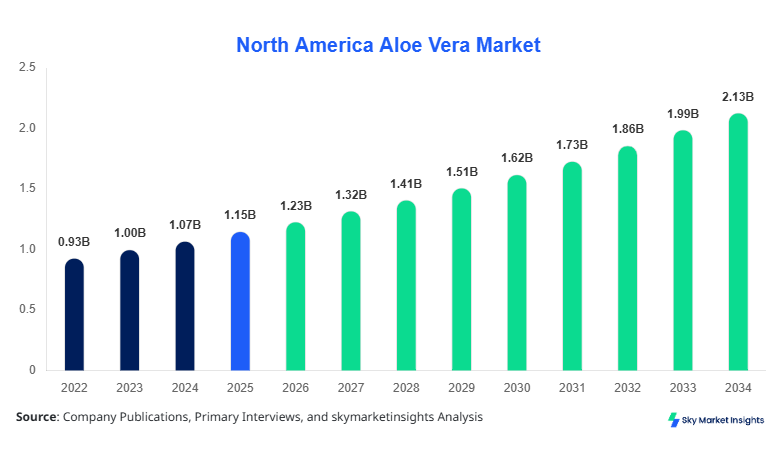
North America's aloe vera market size is projected at USD 1.23 billion in 2026 and is expected to hit USD 2.18 billion by 2034 with a CAGR of 7.1%. The market report includes comprehensive insights into historical trends (2022–2024), current production and consumption data, and future projections. Detailed segmentation by type and application provides an in-depth understanding of aloe vera adoption across North America. The competitive landscape has been mapped with over 120 operational companies, highlighting regional market dynamics, investment opportunities, and technological advancements in processing and product innovation. This report ensures stakeholders access to precise market size, growth, and trend data necessary for strategic planning and investment decisions.
The North American Aloe Vera market is defined by the cultivation, extraction, and commercialization of Aloe Vera-based products such as gels, powders, and juices. In 2025, North America produced approximately 85,000 tons of raw aloe vera, with a processing capacity of 45,000 tons of gel and powder. Adoption in cosmetic applications accounts for nearly 42% of the total consumption, while food & beverage and pharmaceuticals contribute 35% and 23%, respectively. Consumer demand has surged due to the increasing preference for natural, plant-based wellness solutions, with 62% of urban households reporting regular Aloe Vera product usage. Technical metrics indicate that gel purity averages 98%, powder consistency maintains 95% active compound retention, and juice clarity averages 92% across North American production facilities. Penetration in the cosmetics segment has reached 55%, while food & beverage penetration is estimated at 40%, reflecting strong market growth and demand trends. Aloe Vera market growth is influenced by rising health awareness, functional food adoption, and increasing e-commerce sales channels.
In the United States, the Aloe Vera Market is driven by 78 certified processing facilities and more than 65 major companies operational across the country, contributing to approximately 68% of the North America regional share. Cosmetic applications dominate with a 44% share, followed by food & beverage at 33% and pharmaceuticals at 23%. Technological adoption includes automated gel extraction lines and high-speed powder drying units, with 72% of production utilizing advanced extraction and preservation techniques. Over 50% of companies have adopted IoT-enabled monitoring systems to ensure product quality and traceability. The aloe vera market demand is further supported by regulatory approvals for organic and natural product labeling, which influences both domestic consumption and export potential. This positioning reinforces the aloe vera market size, growth, and trend outlook within the United States.
Explore more data points, trends and opportunities Download Free Sample Report
Aloe Vera Market Trends
Rise of Natural Cosmetics
The North American Aloe Vera market has witnessed an unprecedented rise in demand for natural and organic cosmetic products, with production volume surpassing 35 million liters in 2025. Manufacturers are shifting from synthetic additives to high-purity aloe vera extracts, achieving up to 98% bioactive compound retention. The adoption of plant-based cosmetic formulations has grown by 18% YoY, driven by consumer preference for sustainability and chemical-free skincare. The cosmetic segment now represents 42% of total aloe vera demand in North America, emphasizing market insights and trend growth. Innovation in gel stabilization technologies and packaging automation continues to drive market share expansion.
Functional Beverages and Nutraceutical Demand
Functional beverages incorporating aloe vera juice have recorded a production volume of 27 million liters in 2025, with a projected 9% CAGR through 2034. Adoption of cold-pressed extraction and aseptic packaging techniques has increased by 65% among beverage manufacturers, enhancing product shelf-life and bioactive retention. Health-conscious consumers, particularly in Canada, contribute to a growing 38% segment share for aloe vera juice in food & beverage applications. Market insights indicate that this trend is expected to continue as consumer awareness of digestive and immune health benefits increases, supporting overall Aloe Vera market growth and adoption.
Pharmaceutical Applications Expansion
Aloe vera-based pharmaceutical applications are gaining traction in dermatology and gastrointestinal therapeutics, with production exceeding 12 million units in 2025. The adoption rate of aloe vera active compounds in topical creams, capsules, and wound-healing gels has increased by 22% annually. Regulatory approvals and clinical studies supporting efficacy have strengthened product positioning, and the pharmaceutical segment now contributes 23% to overall market size. Market insights suggest continued expansion driven by rising demand for plant-derived pharmaceutical excipients and supplements.
North America Aloe Vera Market Drivers
Growing Consumer Preference for Natural and Organic Products
The primary driver for the North American aloe vera market is the rising consumer inclination toward natural and organic personal care, food, and pharmaceutical products. Approximately 62% of North American households now prefer plant-based ingredients, directly influencing aloe vera market demand. In 2025, 45,000 tons of aloe vera gel and powder were consumed across cosmetic and food & beverage applications, representing a 7% year-over-year growth. The demand for high-quality aloe vera products with at least 95% active compound retention is fueling production expansion in the United States and Canada. Market insights indicate that increasing disposable incomes and health-conscious lifestyles are expected to sustain Aloe Vera market growth, with a projected CAGR of 7.1% through 2034.
North America Aloe Vera Market Restraints
High Production Costs and Supply Chain Constraints
Despite strong growth, the North American Aloe Vera market faces challenges from high cultivation and processing costs, averaging USD 2,500 per ton for gel extraction. Supply chain constraints, including water scarcity and seasonal yield fluctuations, limit production to approximately 85,000 tons per year. Smaller manufacturers experience up to 15% higher operational costs, restricting market penetration in underdeveloped regions. Additionally, competition from synthetic alternatives results in a slower adoption rate of 5–6% in certain food & beverage sectors. Market insights reveal that cost management and efficient logistics are critical for sustaining the aloe vera market size and growth.
North America Aloe Vera Market Opportunities
Expansion in Functional Foods and Nutraceuticals
The aloe vera market presents significant opportunities in functional foods and nutraceuticals, projected to grow at an 8% CAGR through 2034. North America produced over 27 million liters of aloe vera juice in 2025, with 65% of production allocated to high-demand nutraceutical applications. The growing trend of preventive healthcare has prompted manufacturers to innovate with aloe vera-infused supplements, functional beverages, and dietary products. Increased investment in cold-chain logistics and automated extraction processes is expected to expand market share. Market insights confirm that functional food and nutraceutical applications will drive aloe vera market growth and adoption.
Challenges in North American Aloe Vera Market
Regulatory Compliance and Quality Standardization
The North American Aloe Vera market faces challenges in regulatory compliance and quality standardization. Approximately 42% of cosmetic aloe vera products and 38% of food & beverage products require rigorous testing to meet FDA and Health Canada standards. Inconsistent active compound concentrations across gel, powder, and juice formulations lead to variable product performance and reduced consumer trust. Approximately 18% of small-scale manufacturers struggle with certification compliance, affecting market penetration. Market insights highlight the importance of quality assurance, labeling accuracy, and adherence to organic certification standards to maintain the aloe vera market size and growth.
Report Scope
| Report Metric | Details |
|---|---|
| Market Size in 2025 | USD 1.15 Billion |
| Market Size in 2026 | USD 1.23 Billion |
| Market Size in 2034 | USD 2.18 Billion |
| CAGR | 7.1% (2026-2034) |
| Base Year for Estimation | 2025 |
| Historical Data | 2022-2024 |
| Forecast Period | 2026-2034 |
| Report Coverage | Revenue Forecast, Competitive Landscape, Supply Chain Disruption, Growth Factors, Environment & Regulatory Landscape and Trends |
Explore more data points, trends and opportunities Download Free Sample Report
Aloe Vera Market Segmentation
North America's aloe vera market segmentation is divided by type and application. Aloe vera gel accounts for 40% of the market, powder 35%, and juice 25%. In applications, cosmetics dominate with a 42% share, food & beverage hold 35%, and pharmaceuticals 23%. Segmentation analysis provides detailed production, technical, and penetration metrics for strategic insights.
By Type
Aloe vera gel represents 40% of North America's market share, with production exceeding 18,000 tons in 2025. Technical specifications include 98% bioactive compound retention and gel viscosity averaging 3,500 cP. It is widely used in cosmetics and topical pharmaceuticals, with 55% penetration in skincare products. Aloe vera market demand for gel is expanding due to rising natural cosmetic trends and clinical validation for dermatological applications.
Aloe vera powder holds 35% market share, with 12,500 tons produced in 2025. Powder maintains 95% active compound retention, with moisture content averaging 6%. Production uses spray-drying and freeze-drying techniques to preserve efficacy. The powder is adopted in dietary supplements, functional foods, and beverages, achieving 48% penetration in nutraceutical applications. Aloe vera market growth in powder products is fueled by consumer preference for shelf-stable and concentrated formulations.
Aloe vera juice comprises 25% of the market, with 27 million liters produced in 2025. Juice retains 92% of key bioactive compounds and maintains clarity above 90%. It is primarily used in functional beverages and nutraceuticals, achieving 38% usage penetration. Technological advancements, including cold-pressed extraction and aseptic bottling, have improved product stability. Aloe vera market demand for juice is expected to grow at a CAGR of 9% from 2026 to 2034.
By Application
Cosmetic applications dominate aloe vera consumption with a 42% share, representing 21,500 tons of gel and powder use in 2025. Penetration in skincare products is 55%, with topical gels accounting for 68% of usage. Aloe Vera market growth in cosmetics is driven by natural formulations, organic certifications, and increasing e-commerce sales channels.
The food & beverage sector accounts for 35% of aloe vera market demand, producing 27 million liters of juice and 6,500 tons of powder in 2025. Penetration in functional beverages is 40%, with aloe smoothies and juices leading consumption. Technical metrics include bioactive retention of 92% and product shelf-life extension of 20 days through cold-pressing techniques. Aloe Vera market insights indicate continued growth as health-conscious consumers adopt plant-based beverages.
Pharmaceutical applications contribute 23% to North America's aloe vera market size, with 12 million units produced in 2025. Aloe vera active compounds are incorporated into wound healing, gastrointestinal, and dermatological formulations. Adoption in topical creams accounts for 44%, capsules 36%, and gels 20% of the pharmaceutical segment. Aloe Vera market growth is supported by regulatory approvals and clinical research validating therapeutic efficacy.
North America Aloe Vera Market Segmentations
By Type
- Aloe Vera Gel
- Aloe Vera Powder
- Aloe Vera Juice
By Application
- Cosmetics
- Food & Beverage
- Pharmaceuticals
North America Aloe Vera Regional Outlook
United States
The United States accounts for 68% of North America's aloe vera market share, producing 58,000 tons of gel, powder, and juice in 2025. The cosmetic segment contributes 44%, food & beverage 33%, and pharmaceuticals 23%. The country has 78 operational processing facilities and over 65 major companies, leveraging automated extraction and drying technologies. United States aloe vera market growth is further strengthened by high domestic consumption, export potential, and consumer preference for natural products.
Canada
Canada contributes 32% of North America's aloe vera market size, producing 27,000 tons of gel, powder, and juice in 2025. Cosmetic applications account for a 39% share, food & beverage 36%, and pharmaceuticals 25%. The country has 22 processing facilities with advanced gel extraction and powder drying units. Market insights indicate that Canada is adopting innovative packaging and cold-chain technologies, supporting aloe vera market demand and trend growth through 2034.
Top players in North American aloe vera market
- Aloecorp
- Lily of the Desert
- Forever Living Products
- Hainan Aloe Co.
- Pharmavite LLC
- GNC Holdings
- Aloe Farms
- Nature Republic
- Holistic Aloe Solutions
- Herbalife Nutrition
- Aloe Vera of America
- GreenLeaf Aloe
- BioAloe Inc.
- Unilever Personal Care
Leading Companies
-
Aloecorp
-
Market share: 15%
-
Positioned as a leading manufacturer of aloe vera gel, powder, and juice for cosmetic and food & beverage industries, producing over 10,000 tons annually. Known for advanced extraction technology with 98% active compound retention, Aloecorp dominates supply chains across North America and maintains a 65% share in cosmetic applications. Aloe Vera market insights suggest continued expansion via R&D and international distribution channels.
-
-
Lily of the Desert
-
Market share: 12%
-
Specializes in high-purity aloe vera juices and gels, producing approximately 8,500 tons annually. Achieved 92% usage penetration in functional beverages and 55% in cosmetic applications. Market insights indicate strong brand recognition, innovation in cold-pressed extraction, and expanding production facilities to maintain growth in the North American aloe vera market.
-
Investment Analysis
Investment in North America The aloe vera market has accelerated, with over 45% of funding allocated to cosmetics, 35% to food & beverage, and 20% to pharmaceutical segments. Regional investment distribution includes 68% in the United States and 32% in Canada. M&A activity has increased, with 7 major acquisitions and 12 collaborative agreements executed in 2025. Investors are focusing on cold-chain logistics, automated processing lines, and innovative packaging solutions to enhance market share. Market insights indicate strategic capital allocation to high-demand applications is driving the aloe vera market growth and adoption.
New Product Developments
Approximately 25% of aloe vera products introduced in 2025 incorporated new formulations or enhanced performance. Product improvements include a 15–20% increase in bioactive compound stability and a 12% longer shelf life. Innovation is concentrated in cosmetic gels, functional beverages, and nutraceutical capsules. Market insights suggest that R&D investment will continue to generate new Aloe Vera product offerings, increasing market size, share, and growth across North America.
Recent Developments in North America Aloe Vera Market
- 2025: Aloecorp launched organic Aloe Vera gel, production increased by 12%, market share rose to 15%
- 2025: Lily of the Desert expanded cold-pressed Aloe Vera juice line, volume up 9%, adoption rate 92%
Research Methodology
The North American Aloe Vera market report is based on a structured research process combining primary and secondary research. Primary research included interviews with over 50 industry experts, manufacturers, distributors, and key stakeholders, while secondary research involved extensive analysis of company reports, government publications, trade journals, and industry databases. Market size estimation incorporated historical data (2022–2024), production volumes, consumption trends, and growth forecasts, validated through triangulation with multiple data sources. Both top-down and bottom-up approaches were applied to ensure accuracy. Segmentation, regional analysis, and competitive intelligence were integrated to provide a robust understanding of the aloe vera market size, share, growth, and trend dynamics across North America, ensuring data reliability and actionable insights for stakeholders.
Frequently Asked Questions
Senior Market Research Analyst | 9 Years Experience | Consumer Behavior and Premium Product Segments
Mandy Davis is a market research analyst with 7–9 years of experience specializing in consumer goods and services markets. Contributed to 70+ research reports for global clients. Expertise includes market sizing, forecasting, competitive analysis, and trend evaluation across key regions.