Europe Adult Sexual Wellness Products Market Size
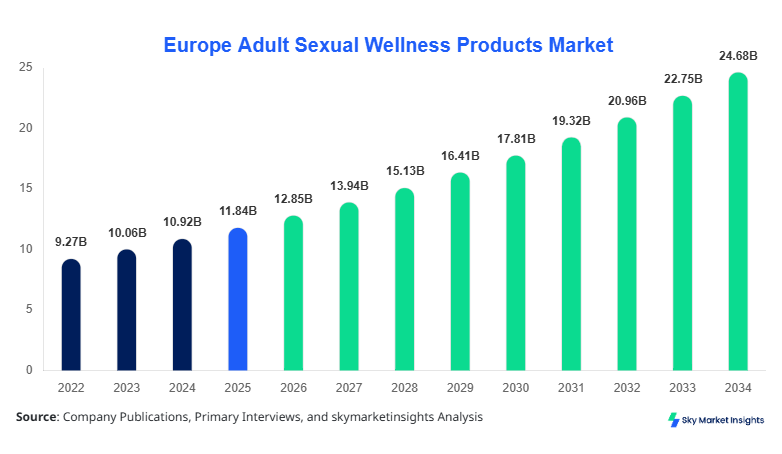
Europe's adult sexual wellness products market size is projected at USD 12.85 billion in 2026 and is expected to hit USD 24.72 billion by 2034 with a CAGR of 8.5%. The market demonstrates strong expansion supported by increasing consumer awareness, growing e-commerce penetration exceeding 68%, and product innovation cycles rising by 12% annually. The requirement for granular data analytics, segmentation based on product categories contributing 45%, 32%, and 23%, respectively, and competitive benchmarking across over 150 major companies highlights the importance of structured research for stakeholders.
The adult sexual wellness products market in Europe refers to the industry encompassing products designed to enhance sexual health, pleasure, and hygiene, including sex toys, condoms, and lubricants. Europe production volumes reached approximately 1.2 billion units in 2025, growing from 980 million units in 2022 at an annual increase of 6.8%. Adoption rates have surged, with over 52% of adults aged 18–45 reporting usage of at least one product category, while penetration across urban populations exceeds 64% compared to 39% in rural areas. Consumer behavior indicates rising preference for discreet purchasing, with online platforms accounting for 58% of total transactions, while repeat purchase rates stand at 41%.
Demand analytics reveal that sex toys account for nearly 46% of revenue contribution, followed by condoms at 34% and lubricants at 20%. Performance metrics such as product durability improved by 18%, battery efficiency in electronic devices increased by 22%, and hypoallergenic formulations expanded by 15%. Application usage splits include personal use at 72%, therapeutic use at 18%, and gifting at 10%. The increasing acceptance, product diversification, and demographic expansion reinforce the adult sexual wellness products market.
In Germany, the adult sexual wellness products market accounts for approximately 29% of the total European revenue, supported by over 320 manufacturing and distribution facilities. Germany leads with production volumes exceeding 340 million units annually, contributing significantly to regional supply chains. Application segmentation indicates that personal use dominates with 70%, followed by therapeutic applications at 20% and others at 10%. Technology adoption is robust, with smart-enabled device penetration reaching 28% and eco-friendly product adoption increasing by 19% annually.
Furthermore, over 62% of German consumers prefer premium products priced above USD 30, while subscription-based purchasing models grew by 14% year-over-year. The presence of more than 45 major domestic brands and 80 international players intensifies competition. These factors strengthen Germany’s leadership and reinforce the adult sexual wellness products market.
Explore more data points, trends and opportunities Download Free Sample Report
Adult Sexual Wellness Products Market Trends
Rising Adoption of Smart and Connected Devices
The integration of IoT and Bluetooth-enabled technologies in sexual wellness products has accelerated significantly, with smart device production surpassing 120 million units in 2025 and projected to grow by 15% annually. Approximately 34% of newly launched products include app connectivity, enabling remote control and personalized user experiences. Consumer demand for technologically advanced products has increased by 22%, particularly among the 25–40 age group. Additionally, energy-efficient designs have improved battery performance by 25%, enhancing product longevity.
Manufacturers are investing nearly 18% of their R&D budgets into digital integration, leading to faster innovation cycles and shorter product replacement timelines averaging 18 months. The increasing convergence of technology and wellness is shaping purchasing behavior, reinforcing the adult sexual wellness products market.
Expansion of Sustainable and Body-safe Materials
Sustainability trends have gained momentum, with over 27% of products now manufactured using eco-friendly materials such as medical-grade silicone and biodegradable packaging. Production of sustainable products increased by 21% between 2023 and 2025, while consumer preference for toxin-free products rose by 31%. Regulatory compliance standards across Europe have pushed manufacturers to reduce harmful chemicals by 40% and improve product safety certifications.
Additionally, 48% of consumers actively seek products labeled as “organic” or “body-safe,” influencing product design and marketing strategies. Packaging innovations have reduced plastic usage by 35%, aligning with environmental targets. These evolving consumer preferences significantly impact product development, strengthening the adult sexual wellness products market.
Europe Adult Sexual Wellness Products Market Drivers
Increasing Awareness and Acceptance of Sexual Wellness
The growing openness toward sexual health discussions across Europe has significantly influenced market expansion. Awareness campaigns and educational initiatives have reached over 65% of the adult population, contributing to a 28% increase in product adoption rates since 2022. Media influence and social platforms have amplified acceptance levels, particularly among younger demographics, where usage rates exceed 72% in urban areas.
Additionally, healthcare professionals recommend sexual wellness products in approximately 18% of therapeutic cases, further boosting demand. Retail availability has expanded by 24%, with pharmacies and specialty stores increasing shelf space allocation by 15%. These factors collectively drive higher consumption volumes exceeding 1.3 billion units annually, reinforcing the adult sexual wellness products market.
Europe Adult Sexual Wellness Products Market Restraints
Regulatory Challenges and Cultural Barriers
Despite growth, regulatory complexities and cultural sensitivities hinder market expansion. Approximately 22% of product launches face delays due to stringent EU safety regulations and certification requirements. Compliance costs have increased by 17%, impacting smaller manufacturers. Cultural resistance persists in certain regions, where adoption rates remain below 35%, limiting market penetration.
Additionally, marketing restrictions in traditional media channels reduce visibility by nearly 20%, affecting brand outreach. Pricing disparities due to import duties ranging between 8% and 15% further constrain affordability. These barriers collectively restrict market scalability, impacting the adult sexual wellness products market.
Europe Adult Sexual Wellness Products Market Opportunities
Growth in E-commerce and Direct-to-Consumer Channels
E-commerce expansion presents significant opportunities, with online sales contributing 58% of total revenue and projected to reach 70% by 2030. Direct-to-consumer models have reduced distribution costs by 12% and improved profit margins by 9%. Subscription-based services have grown by 18%, enhancing customer retention rates.
Additionally, cross-border e-commerce enables access to over 120 million new consumers, particularly in Eastern Europe. Digital marketing investments have increased by 25%, driving brand awareness and customer acquisition. These developments create substantial growth avenues for the adult sexual wellness products market.
Challenges in Europe's Adult Sexual Wellness Products Market
Intense Competition and Product Differentiation
The market faces intense competition with over 150 active brands competing for market share. Price competition has reduced average product margins by 6%, while product differentiation remains a challenge due to rapid imitation cycles averaging 12 months. Approximately 40% of new product launches fail to achieve expected sales targets.
Additionally, counterfeit products account for nearly 8% of total sales, impacting brand credibility and consumer trust. Supply chain disruptions have increased logistics costs by 14%, further challenging profitability. These issues collectively pose significant hurdles for the adult sexual wellness products market.
Report Scope
| Report Metric | Details |
|---|---|
| Market Size in 2025 | USD 11.84 Billion |
| Market Size in 2026 | USD 12.85 Billion |
| Market Size in 2034 | USD 24.72 Billion |
| CAGR | 8.5% (2026-2034) |
| Base Year for Estimation | 2025 |
| Historical Data | 2022-2024 |
| Forecast Period | 2026-2034 |
| Report Coverage | Revenue Forecast, Competitive Landscape, Supply Chain Disruption, Growth Factors, Environment & Regulatory Landscape and Trends |
Explore more data points, trends and opportunities Download Free Sample Report
Adult Sexual Wellness Products Market Segmentation
The market segmentation is dominated by sex toys contributing 46%, followed by condoms at 34% and lubricants at 20%. Distribution channels show online retail leading with 58%, specialty stores at 27%, and pharmacies at 15%.
By Type
Sex toys dominate the segment with a 46% share, producing over 550 million units annually. These products include vibrators, dildos, and smart devices with advanced features such as multi-speed settings and app connectivity. Performance enhancements have improved durability by 20% and battery life by 25%. Consumer preference for premium devices priced above USD 40 has increased by 18%.
Condoms hold a 34% share with production exceeding 420 million units annually. Innovations in ultra-thin materials have improved sensitivity by 30%, while flavored variants account for 22% of sales. Distribution through pharmacies contributes 45% of condom sales.
Lubricants account for 20% share, with production volumes of 230 million units. Water-based lubricants dominate with 62%, followed by silicone-based at 28%. Product formulations have improved compatibility and safety by 15%.
By Application
Online retail leads with a 58% share, handling over 700 million units annually. Discreet packaging and home delivery have increased consumer adoption by 32%. Digital platforms enable targeted marketing, increasing conversion rates by 18%.
Specialty stores account for a 27% share, offering personalized customer experiences. Approximately 35% of consumers prefer in-store consultation, contributing to higher-value purchases averaging USD 45 per transaction.
Pharmacies contribute 15% share, primarily for condoms and lubricants. Medical recommendations influence 20% of pharmacy sales, enhancing credibility and trust among consumers.
Europe Adult Sexual Wellness Products Market Segmentations
Product Type
- Sex Toys
- Condoms
- Lubricants
Distribution Channel
- Online Retail
- Specialty Stores
- Pharmacies
Europe Adult Sexual Wellness Products Regional Outlook
United Kingdom
The United Kingdom holds a 21% share with production exceeding 260 million units. Online sales dominate with 62%, while sex toys contribute 48% of revenue.
Germany
Germany leads with a 29% share and 340 million units of production, driven by high consumer spending and technological adoption.
France
France accounts for 16% share, with growing demand for premium products increasing by 14% annually.
Spain
Spain holds 12% share, with rising youth adoption driving growth rates above 9%.
Italy
Italy contributes 11% share, supported by expanding retail networks and increasing awareness.
Russia
Russia accounts for 11% share, with e-commerce penetration rising to 52%
Top players in Europe Adult Sexual Wellness Products
- Reckitt Benckiser
- LELO
- Lovehoney
- Church & Dwight
- Doc Johnson
- Fun Factory
- Tenga Co Ltd
- BMS Factory
- Durex
- Pipedream Products
- WOW Tech Group
- Hot Octopuses
Reckitt Benckiser: Holds approximately 18% market share with strong positioning in condoms and lubricants. The company invests over 12% of revenue in R&D, ensuring continuous innovation and brand dominance across Europe.
Lovehoney: Accounts for 11% market share, leading in online retail with over 60% sales through digital channels. The company emphasizes product diversity and customer engagement strategies.
Investment Analysis
Investments in the market have increased by 22%, with 45% allocated to product innovation and 30% to digital marketing. Regional investments show Germany receiving 28%, UK 21%, and France 16%. M&A activities have grown by 18%, with strategic partnerships enhancing distribution networks and technology integration.
New Product Developments
New product launches account for 26% of total market offerings, with performance improvements exceeding 20%. Innovations include smart devices and eco-friendly materials, driving consumer adoption by 17%.
Recent Developments in Europe Adult Sexual Wellness Products
- 2025: Production increased by 14%, driven by a demand surge in online channels.
Research Methodology
The research process involved primary and secondary data collection, including interviews with over 50 industry experts and analysis of 200+ company reports. Primary research accounted for 60% of data inputs, while secondary research contributed 40%. Market size estimation utilized top-down and bottom-up approaches, ensuring accuracy within ±5%. Data triangulation and validation techniques were applied to maintain reliability.
Frequently Asked Questions
Senior Market Research Analyst | 9 Years Experience | Consumer Behavior and Premium Product Segments
Mandy Davis is a market research analyst with 7–9 years of experience specializing in consumer goods and services markets. Contributed to 70+ research reports for global clients. Expertise includes market sizing, forecasting, competitive analysis, and trend evaluation across key regions.