Europe Alpine Skiing Market Size
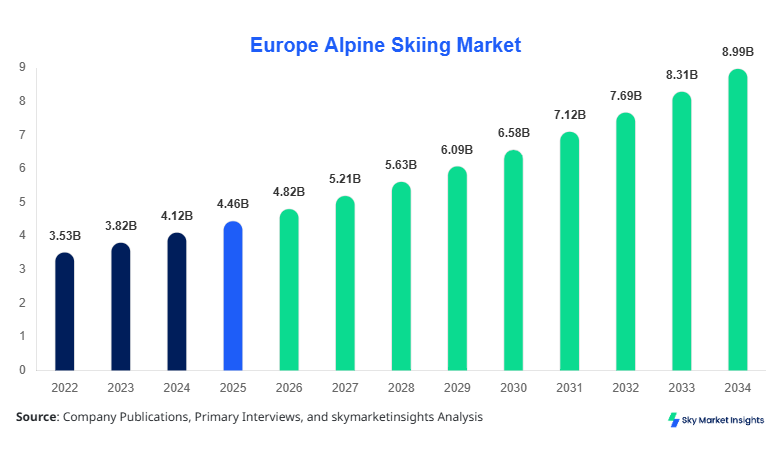
Europe's Alpine skiing market size is projected at USD 4.82 billion in 2026 and is expected to hit USD 8.97 billion by 2034 with a CAGR of 8.1%. The market is witnessing substantial expansion due to increasing winter tourism participation, rising investments in ski infrastructure, and the growing adoption of technologically advanced skiing equipment across European countries. More than 78 million ski visits were recorded across Europe in 2025, while over 4,200 operational ski facilities contributed significantly to equipment consumption and tourism revenue generation. The competitive landscape remains fragmented with major manufacturers focusing on carbon composite skis, lightweight bindings, and digital performance tracking systems to strengthen their market positioning.
The Alpine Skiing Market encompasses the manufacturing, distribution, and commercialization of alpine ski equipment, apparel, accessories, ski resort services, and professional training infrastructure across Europe. Europe accounted for nearly 46% of global alpine skiing participation in 2025, supported by over 6,000 ski lifts and approximately 3,900 mountain resort operations. France, Germany, Italy, and Switzerland collectively generated more than USD 11 billion in winter tourism expenditure linked directly to alpine skiing activities. Recreational alpine skiing contributed around 57% of total equipment consumption, while professional sports activities represented approximately 18% of overall revenue generation. Carbon-fiber ski production increased by 21% during 2024–2025 due to demand for lightweight performance-enhancing equipment capable of operating at speeds exceeding 130 km/h during professional competitions. Digital ski monitoring systems recorded a penetration rate of 34% among premium ski consumers, while smart ski boot adoption exceeded 18% in Western Europe. Consumer behavior indicates that nearly 63% of European ski participants prefer all-inclusive ski resort packages incorporating equipment rentals, accommodation, and guided training programs. More than 39 million consumers purchased alpine skiing accessories and apparel during 2025, with online channels contributing nearly 31% of total sales transactions. Rising consumer spending on winter recreational activities continues to reinforce the alpine skiing market expansion across Europe.
In France, the alpine skiing market accounted for nearly 28% of the overall European regional revenue during 2025, supported by over 350 ski resorts and more than 3,200 ski lift installations across the French Alps and Pyrenees regions. France recorded approximately 15.4 million alpine skiing participants in 2025, while winter tourism revenue exceeded USD 4.6 billion. Recreational skiing represented around 61% of total ski activity in the country, whereas professional sports and competitive skiing contributed close to 17% of market demand. More than 4.8 million ski equipment units were sold in France during 2025, including skis, boots, helmets, and smart wearable systems. Advanced ski equipment featuring vibration reduction technology and AI-assisted performance monitoring witnessed adoption rates exceeding 26% among premium consumers. France also hosts more than 40 international alpine skiing championships annually, generating strong demand for racing-grade skis capable of sustaining speeds above 140 km/h under extreme snow conditions. Ski resort occupancy rates in France surpassed 74% during peak winter months, supported by international tourist inflows from Germany, the United Kingdom, Belgium, and Italy. Government-supported winter tourism investments exceeding USD 920 million between 2023 and 2025 further accelerated Alpine skiing market development throughout France.
Explore more data points, trends and opportunities Download Free Sample Report
Alpine Skiing Market Trends
Expansion of Smart Ski Technologies
The integration of smart technologies into alpine skiing equipment has emerged as a major transformation trend across Europe. More than 7.8 million smart ski devices, including GPS-enabled helmets, AI-driven ski boots, and digital performance trackers, were sold in 2025 compared with 5.9 million units in 2023. Manufacturers are increasingly incorporating carbon nanotube materials and motion-sensing technologies to improve ski responsiveness by nearly 28% while reducing overall equipment weight by 19%. Smart ski goggles capable of displaying weather conditions, altitude measurements, and real-time navigation data achieved adoption rates of 22% among premium consumers in France, Germany, and Italy. The demand for integrated safety systems, including avalanche detection sensors and emergency communication devices, rose by 31% across ski resorts. Rising investments in connected ski infrastructure continue accelerating Alpine skiing market expansion.
Rising Popularity of Sustainable Ski Equipment
Sustainability-focused production methods are becoming increasingly important in the European alpine skiing industry. More than 38% of ski manufacturers operating in Europe adopted recycled composite materials and biodegradable resins during 2025. Eco-friendly ski equipment production volumes exceeded 3.1 million units across France, Germany, and Austria, representing a 24% increase compared with 2024. Ski apparel companies also increased recycled polyester usage by nearly 41% to reduce environmental impact associated with winter sports manufacturing. Consumers aged between 18 and 35 accounted for approximately 47% of sustainable ski equipment purchases due to growing environmental awareness. Ski resorts across Europe reduced carbon emissions by nearly 16% through electrified ski lifts and renewable energy-powered snowmaking systems. Government-backed sustainability initiatives totaling USD 1.2 billion across the European Union are further encouraging environmentally responsible innovation within the Alpine Skiing Market.
Growth of Winter Tourism and Ski Resort Modernization
Winter tourism across Europe experienced substantial growth during 2024–2025, with ski resort visitor numbers surpassing 78 million annual visits. France, Italy, and Switzerland collectively invested over USD 3.4 billion in resort modernization programs, including advanced snowmaking systems, high-speed gondolas, and automated ticketing platforms. More than 1,200 ski lifts across Europe underwent digital upgrades capable of increasing passenger handling capacity by 18%. Artificial snow production technologies improved snow reliability rates by nearly 27%, ensuring operational continuity during fluctuating climate conditions. Luxury ski tourism packages grew by 21% among affluent travelers from the United Kingdom, Germany, and Scandinavia. Demand for the alpine skiing market. Grams also increased by 14%, particularly among first-time participants aged 16–30 years. Continuous infrastructure modernization remains a critical alpine skiing market driver across Europe.
European Alpine Skiing Market Drivers
Growing Winter Sports Participation and Ski Tourism Expansion
The rapid increase in winter sports participation across Europe remains a major factor supporting market expansion. More than 82 million individuals participated in winter recreational activities during 2025, while alpine skiing accounted for approximately 46 million active participants. France, Italy, Austria, and Switzerland collectively generated more than USD 18 billion in ski tourism-related spending. Ski resort occupancy rates exceeded 71% during peak seasonal periods, while international tourist arrivals to alpine regions increased by 13% compared with 2024. More than 9.4 million beginner-level consumers enrolled in skiing instruction programs, driving strong demand for entry-level equipment and rental services. Government tourism development initiatives worth over USD 2 billion supported infrastructure modernization, transportation improvements, and promotional campaigns targeting international visitors. Technological enhancements in snowmaking systems improved ski season reliability by nearly 24%, increasing resort operating days and boosting equipment utilization rates. Rising disposable income among middle-income households in Germany, France, and the United Kingdom further accelerated consumer spending on winter recreational experiences. The expanding tourism ecosystem continues strengthening Alpine skiing market performance across Europe.
Europe Alpine Skiing Market Restraints
High Equipment Costs and Climate Variability
The relatively high cost associated with alpine skiing participation remains a significant barrier affecting broader consumer adoption. Premium skiing equipment packages including skis, boots, bindings, helmets, and apparel frequently exceed USD 2,500 per consumer, while annual ski resort vacation costs range between USD 3,000 and USD 7,000 for family groups. Rental services accounted for approximately 44% of recreational equipment usage during 2025 due to affordability concerns among occasional participants. Climate variability also continues impacting ski resort operational stability, particularly in lower-altitude regions of Spain and Italy, where natural snowfall declined by nearly 12% between 2022 and 2025. Artificial snow production costs increased by 18% due to rising energy prices and water consumption requirements. Approximately 16% of small ski resorts across Europe faced shortened operating seasons because of insufficient snow coverage. Insurance premiums for professional alpine skiing events also increased by nearly 11% following injury-related compensation claims and extreme weather disruptions. These cost-related and environmental challenges continue limiting Alpine skiing market expansion potential in several European regions.
Europe Alpine Skiing Market Opportunities
Emergence of Adventure Tourism and Digital Booking Platforms
Adventure tourism expansion presents significant opportunities for the alpine skiing industry across Europe. Nearly 37% of European travelers aged 20–40 years preferred adventure-based winter tourism packages in 2025, while multi-activity ski resorts experienced visitor growth exceeding 19%. Digital booking platforms facilitating ski package reservations, equipment rentals, and guided experiences generated more than USD 2.8 billion in transaction value during 2025. Online ski equipment customization services also increased by 23%, allowing consumers to personalize ski dimensions, materials, and performance specifications. Cross-border ski tourism within Europe expanded by 14% due to integrated transportation and hospitality partnerships between France, Italy, Switzerland, and Austria. Emerging luxury wellness ski resorts offering spa integration, ecotourism experiences, and personalized training programs achieved occupancy rates above 76% among premium travelers. Investments in indoor ski centers across Germany and the United Kingdom exceeded USD 480 million between 2023 and 2025, enabling year-round participation and equipment testing opportunities. These evolving tourism and digitalization trends create substantial long-term Alpine skiing market opportunities throughout Europe.
Challenges in European Alpine Skiing Market
Environmental Sustainability and Seasonal Dependency
Environmental sustainability challenges remain a critical concern within the European alpine skiing industry. Approximately 62% of ski resorts depend heavily on artificial snow generation systems, consuming over 95 million cubic meters of water annually across Europe. Energy consumption associated with ski lifts, resort heating systems, and snow production increased operational costs by nearly 17% during 2025. Climate-related temperature fluctuations shortened average natural snow coverage duration by approximately 9% in lower-altitude ski destinations. Seasonal dependency also creates workforce instability, with nearly 31% of resort employees engaged through temporary winter contracts. Transportation-related carbon emissions from winter tourism activities exceeded 12 million metric tons annually, generating increasing pressure from environmental regulators and sustainability advocacy groups. Smaller ski resorts with annual revenue below USD 20 million face growing financial pressure due to modernization requirements and declining snowfall reliability. Manufacturers are also challenged by rising raw material costs, particularly carbon composites and advanced polymers, which increased by 14% between 2024 and 2025. Addressing sustainability, operational efficiency, and climate resilience remains essential for long-term Alpine Skiing Market competitiveness.
Report Scope
| Report Metric | Details |
|---|---|
| Market Size in 2025 | USD 4.46 Billion |
| Market Size in 2026 | USD 4.82 Billion |
| Market Size in 2034 | USD 8.97 Billion |
| CAGR | 8.1% (2026-2034) |
| Base Year for Estimation | 2025 |
| Historical Data | 2022-2024 |
| Forecast Period | 2026-2034 |
| Report Coverage | Revenue Forecast, Competitive Landscape, Supply Chain Disruption, Growth Factors, Environment & Regulatory Landscape and Trends |
Explore more data points, trends and opportunities Download Free Sample Report
Alpine Skiing Market Segmentation
The European alpine skiing industry is segmented by type and application, with recreational alpine skiing equipment dominating nearly 48% of total market revenue during 2025. Professional sports applications accounted for around 24% of equipment demand, while ski resort rental operations contributed approximately 29% of annual unit consumption. Increasing demand for lightweight materials, high-speed performance optimization, and safety-enhancing technologies continues influencing purchasing patterns across all market segments.
By Type
Alpine touring ski equipment represented approximately 27% of total European equipment sales during 2025, supported by rising participation in backcountry skiing and adventure tourism activities. More than 3.6 million touring ski units were sold across Europe, particularly in France, Italy, and Switzerland. Lightweight carbon-fiber touring skis weighing below 1,300 grams per pair achieved significant popularity among advanced consumers seeking improved climbing efficiency and downhill maneuverability. Hybrid touring bindings incorporating safety-release mechanisms and vibration stabilization experienced market adoption growth exceeding 18%. Touring ski boot flex ratings between 90 and 130 became increasingly preferred due to improved balance between uphill mobility and downhill stability. Increasing demand for off-piste recreational experiences continues supporting production growth across the Alpine skiing market.
Alpine racing ski equipment accounted for nearly 22% of market revenue during 2025 due to growing participation in competitive skiing events across Europe. More than 1.9 million racing skis were manufactured across Germany, France, and Italy during the year. Professional-grade racing skis capable of sustaining speeds exceeding 150 km/h utilized titanium reinforcement layers and aerodynamic edge profiling technologies to enhance precision and stability. Racing bindings with DIN release settings ranging from 12 to 18 achieved strong demand among professional athletes and advanced recreational users. Europe hosted over 280 major alpine skiing competitions during 2025, significantly contributing to specialized equipment consumption. Demand for performing markets. Alpine Racing Systems continues driving alpine skiing market expansion among elite sports participants.
Recreational alpine ski equipment dominated the European market with approximately 51% share during 2025, supported by increasing family tourism and beginner participation levels. More than 6.8 million recreational ski units were sold across Europe during the year. Entry-level skis featuring wider waist dimensions between 78 mm and 95 mm gained popularity due to enhanced balance and ease of control for novice users. Rental-focused recreational equipment represented around 37% of overall recreational ski consumption, particularly in France and Italy. Smart safety helmets equipped with Bluetooth communication systems and impact sensors achieved penetration rates above 16% among recreational consumers. Continuous demand for affordable and user-friendly skiing products remains a major contributor to alpine skiing market expansion.
By Application
Professional sports applications accounted for approximately 24% of the European alpine skiing industry during 2025, supported by expanding international competitions and training programs. More than 18,000 professional athletes participated in alpine skiing tournaments across Europe, while annual equipment procurement for competitive teams exceeded USD 680 million. High-performance skis designed for giant slalom and downhill racing utilized advanced aerodynamic contouring technologies capable of reducing drag resistance by 14%. Professional training centers across France, Germany, and Italy consumed nearly 1.1 million specialized ski equipment units annually. Wearable biometric monitoring systems used in athlete training programs increased by 21% during 2025. Continuous investment in athlete performance enhancement remains a key factor strengthening Alpine skiing market adoption within professional sports applications.
Recreational activities represented the largest application segment with nearly 49% of total market revenue during 2025. More than 41 million recreational skiers participated in alpine skiing activities across Europe, generating substantial demand for equipment rentals, apparel, and training services. Beginner-level ski packages accounted for approximately 38% of total recreational equipment sales. Family-oriented ski resorts reported occupancy rates above 73% during peak winter months. Recreational ski participants increasingly preferred all-inclusive tourism packages combining accommodation, lessons, and rental services, contributing over USD 5.8 billion in annual revenue. Smart ski tracking applications downloaded by over 12 million users during 2025 further enhanced recreational consumer engagement. Rising participation among younger demographics continues accelerating Alpine skiing market development in recreational applications.
Ski resorts accounted for around 27% of total application demand across Europe during 2025. More than 4,200 ski resort facilities across Europe operated rental fleets exceeding 8 million ski equipment units. Automated ski rental systems integrated with RFID tracking technologies improved equipment turnover efficiency by approximately 22%. Resort operators invested over USD 1.6 billion in upgrading snowmaking systems, digital booking platforms, and ski lift infrastructure between 2023 and 2025. Luxury ski resorts offering personalized training, wellness programs, and premium accommodation packages achieved revenue growth exceeding 17%. Increasing resort modernization and tourism integration continue strengthening Alpine skiing market performance within ski resort applications.
Europe Alpine Skiing Market Segmentations
Type
- Alpine Touring Ski Equipment
- Alpine Racing Ski Equipment
- Recreational Alpine Ski Equipment
Application
- Professional Sports
- Recreational Activities
- Ski Resorts
Europe Alpine Skiing Market Regional Outlook
United Kingdom
The United Kingdom accounted for approximately 11% of European alpine skiing expenditure during 2025 despite limited domestic ski resort infrastructure. More than 3.4 million British travelers participated in alpine skiing holidays across France, Switzerland, and Austria annually. Indoor ski centers across the United Kingdom recorded nearly 9.2 million annual visits, while investments in artificial snow recreation facilities exceeded USD 260 million. Recreational skiing represented around 67% of total demand from UK consumers, while premium equipment adoption increased by 19%. Online ski equipment purchases accounted for approximately 36% of consumer transactions during 2025.
Germany
Germany represented nearly 18% of the European alpine skiing industry during 2025, supported by strong winter sports participation and advanced manufacturing capabilities. More than 5.8 million German consumers participated in alpine skiing activities annually. Germany manufactured over 2.7 million ski equipment units, including bindings, boots, and high-performance skis. Bavarian ski regions generated winter tourism revenue exceeding USD 2.3 billion. Smart wearable adoption among German skiers surpassed 28%, reflecting strong consumer preference for digital performance technologies.
France
France maintained the leading position within the regional market with approximately 28% revenue contribution during 2025. The country hosted over 350 ski resorts and more than 15 million annual ski tourists. Recreational skiing represented 61% of national demand, while professional sports contributed 17%. France invested nearly USD 920 million in resort modernization projects between 2023 and 2025. Advanced snowmaking technologies improved operational reliability across 78% of major ski facilities.
Spain
Spain accounted for nearly 6% of European alpine skiing revenue during 2025, supported primarily by ski resorts located in the Pyrenees and Sierra Nevada regions. Annual ski tourist numbers exceeded 2.1 million, while ski equipment imports increased by 13% during 2025. Recreational activities represented around 72% of total ski demand in Spain. Investments in climate-resilient snowmaking systems exceeded USD 110 million due to rising concerns regarding snowfall variability.
Italy
Italy represented approximately 15% of the European alpine skiing sector during 2025. More than 280 operational ski resorts generated winter tourism revenue exceeding USD 3.1 billion. The Dolomites region alone accounted for around 46% of national ski tourism activity. Italy hosted over 60 international alpine skiing events annually, increasing demand for racing-grade equipment. Smart ski helmet adoption increased by 24% among Italian consumers during 2025.
Russia
Russia accounted for nearly 9% of regional alpine skiing participation during 2025. More than 1,900 ski facilities operated across northern and mountainous regions. Domestic ski equipment production increased by 16% due to government-supported manufacturing initiatives. Recreational skiing contributed approximately 69% of total market activity. Investments in winter sports infrastructure exceeded USD 540 million between 2023 and 2025 to improve tourism capabilities and athlete training programs.
Top players in Europe Alpine Skiing Market
- Rossignol Group
- Atomic Austria GmbH
- Head Sport GmbH
- Fischer Sports GmbH
- Salomon Group
- Tecnica Group
- Elan d.o.o.
- Black Crows
- Volkl Sports GmbH
- Dynastar
- Nordica S.p.A.
- K2 Sports
- Scott Sports
- Blizzard Tecnica
- Movement Skis
Rossignol Group
-
Rossignol Group accounted for approximately 14% of the European alpine skiing equipment industry during 2025.
-
The company manufactured more than 2.3 million ski equipment units annually across France and Spain.
-
Rossignol invested nearly USD 180 million in sustainable ski production technologies and lightweight carbon composite development.
-
The company maintains strong positioning within recreational and professional racing categories through partnerships with more than 120 ski resorts across Europe.
Atomic Austria GmbH
-
Atomic Austria GmbH represented nearly 11% of total European ski equipment revenue during 2025.
-
The company produced over 1.8 million ski units and advanced binding systems annually.
-
Atomic expanded smart ski integration capabilities with AI-assisted performance analytics, improving consumer engagement by 23%.
-
Strong presence in professional alpine racing and Olympic-level competitions continues to strengthen its regional market positioning.
Investment Analysis
The European alpine skiing industry attracted investments exceeding USD 5.6 billion between 2023 and 2025, with approximately 42% allocated toward ski resort modernization projects. France, Italy, and Switzerland collectively accounted for nearly 58% of regional investment activity. Snowmaking infrastructure represented around 21% of capital expenditure, while digital tourism platforms contributed approximately 16% of investment allocation. Equipment manufacturers invested heavily in sustainable production technologies, lightweight composites, and AI-integrated wearable systems to improve operational competitiveness.
Private equity participation in ski resort acquisitions increased by 18% during 2025 due to rising winter tourism profitability. Cross-border partnerships between hospitality operators, transportation providers, and ski equipment companies generated collaboration agreements worth more than USD 1.1 billion. Germany and the United Kingdom experienced increased funding toward indoor ski centers and all-season recreational infrastructure. Luxury alpine tourism developments accounted for nearly 27% of premium investment activity across Europe.
Merger and acquisition activities also accelerated across the alpine skiing market during 2024–2025. Rossignol Group expanded regional distribution capabilities through strategic retail partnerships, while Tecnica Group increased manufacturing investments across Italy and Austria. Collaborative agreements between ski resort operators and smart technology developers improved digital ticketing efficiency by 22% and enhanced resort operational analytics. Sustainability-focused funding initiatives supported renewable energy deployment and low-emission transportation systems across major alpine destinations.
New Product Developments
Manufacturers across Europe introduced more than 420 new alpine skiing product models during 2025, representing a 17% increase compared with 2024. Lightweight carbon-reinforced skis reduced vibration levels by approximately 24% while improving edge control precision by 19%. Smart ski boots equipped with pressure sensors and mobile connectivity achieved performance optimization improvements exceeding 21%. More than 34% of new product launches incorporated sustainable materials, including recycled polymers and biodegradable resin systems.
Digital innovation also accelerated across ski accessories and safety equipment categories. AI-assisted ski goggles capable of displaying navigation, weather analytics, and performance tracking data achieved commercial adoption growth exceeding 26%. Avalanche protection systems integrated with GPS emergency response functionality improved skier safety monitoring efficiency by nearly 31%. Continuous innovation remains central to long-term competitiveness across the European alpine skiing industry.
Recent Developments in Europe Alpine Skiing
- 2025: Rossignol Group expanded its sustainable ski manufacturing operations in France, increasing eco-friendly production capacity by 28% and reducing carbon emissions from manufacturing facilities by approximately 16%. The company introduced recycled composite skis capable of improving durability by 19% while lowering overall product weight by 13%. Distribution partnerships with more than 70 European ski resorts strengthened regional equipment availability and rental integration programs.
- 2025: France announced investments exceeding USD 410 million for ski resort modernization projects across the Alps region. The initiative included installation of energy-efficient ski lifts, upgraded snowmaking systems, and digital tourism management platforms. Resort operational efficiency improved by approximately 18%, while tourist handling capacity increased by nearly 14% during the winter season.
- 2025: Germany increased investment in indoor skiing infrastructure by nearly USD 190 million to support year-round alpine skiing participation. New indoor facilities improved annual recreational skiing participation by approximately 12% among urban consumers. Artificial snow technologies enhanced slope reliability by 27%, supporting increased training activities and tourism diversification.
Research Methodology
The research methodology applied for the Europe Alpine Skiing Market report incorporated a combination of primary and secondary research approaches to ensure accurate industry assessment and forecasting. Primary research involved interviews with ski equipment manufacturers, resort operators, tourism authorities, distributors, and industry specialists across France, Germany, Italy, Spain, Russia, and the United Kingdom. More than 120 industry participants contributed qualitative and quantitative insights regarding production capacity, consumer demand, technology adoption, pricing trends, and investment activity. Secondary research included analysis of company annual reports, tourism statistics, winter sports associations, trade databases, import-export records, government publications, and ski industry journals. Market size estimation utilized both top-down and bottom-up analytical frameworks supported by revenue mapping, production volume analysis, and equipment consumption tracking. Forecasting models incorporated macroeconomic indicators, tourism growth projections, climate patterns, and technological adoption rates to evaluate long-term market expansion potential. Data triangulation methods and cross-verification procedures were employed extensively to ensure statistical consistency and reliability across all market segments and regional assessments.
Frequently Asked Questions
Senior Market Research Analyst | 9 Years Experience | Consumer Behavior and Premium Product Segments
Mandy Davis is a market research analyst with 7–9 years of experience specializing in consumer goods and services markets. Contributed to 70+ research reports for global clients. Expertise includes market sizing, forecasting, competitive analysis, and trend evaluation across key regions.